
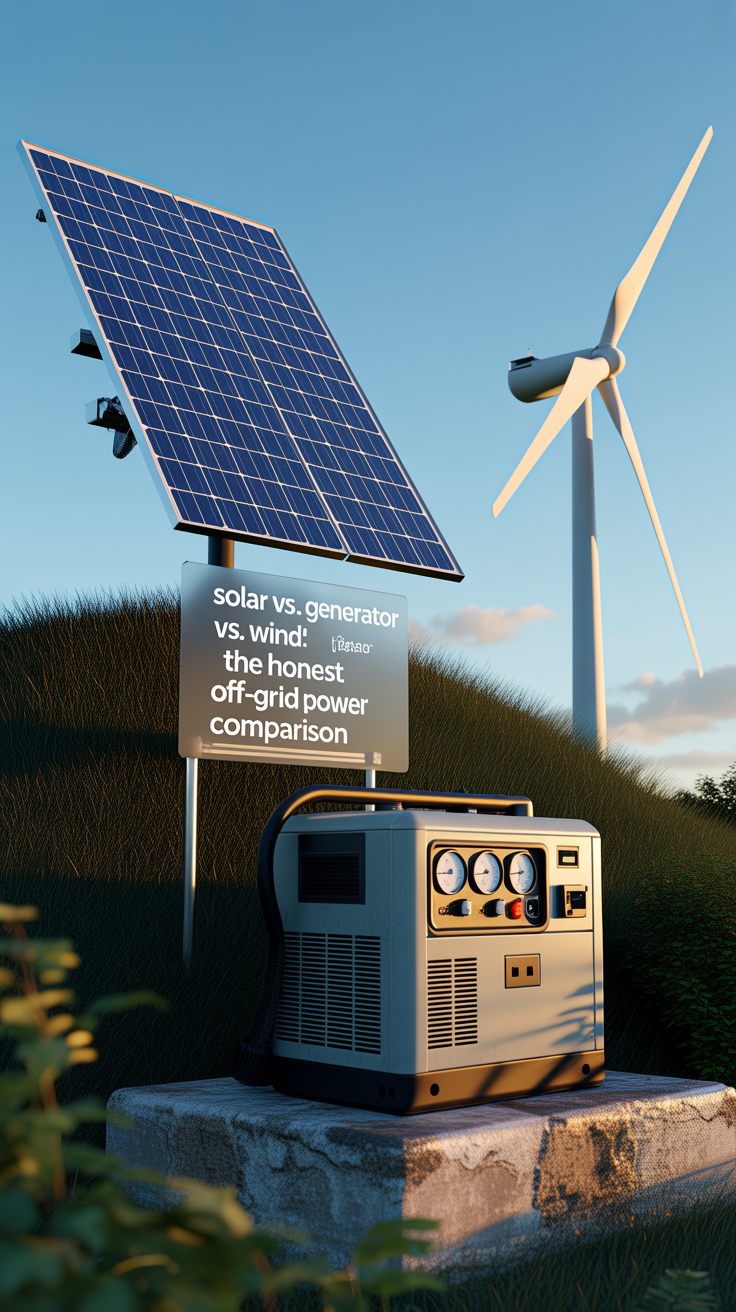
Solar vs. Generator vs. Wind: The Honest Off-Grid Power Comparison
Off-grid power shouldn’t feel like guesswork. If you’re weighing Solar vs. Generator vs. Wind: The Honest Off-Grid Power Comparison, the real challenge isn’t picking a “best” technology—it’s matching a power system to your location, loads, budget, and tolerance for maintenance. Solar can be clean and predictable, generators can be brutally reliable (with fuel), and wind can be incredible in the right site—but disappointing in the wrong one.
This guide breaks the decision down the way experienced off-grid builders do: by energy needs, seasonal performance, storage, noise, upkeep, and failure modes. You’ll also see realistic hybrid setups that outperform any single source, plus a clear checklist so you can choose confidently without overspending.
Introduction
Most off-grid mistakes happen at the planning stage: underestimating daily energy use, overestimating wind resources, or assuming a generator can “just handle it” without fuel and maintenance realities. The truth is simple: off-grid power is a system—generation plus storage plus distribution plus habits.
A practical comparison must answer:
- What produces power when you actually need it (night, winter, storms)?
- How much does it cost to install and maintain?
- How complex is it to repair when something breaks?
- What failures are annoying vs. dangerous?
If you want a shortcut, many experienced homesteaders recommend beginning with a “baseline” solar + battery system, then adding a generator for backup and (sometimes) wind if your site supports it.
💡 Recommended Solution: Energy Revolution System
Best for: building a step-by-step plan before buying equipment
Why it works:
- Helps you think in systems (loads → generation → storage)
- Reduces costly oversizing/undersizing
- Useful for hybrid setups (solar + generator, solar + wind)
Solar power fundamentals for off-grid living
Solar is the most common off-grid choice because it’s modular: you can start small and expand. It’s also quiet, has few moving parts, and produces power right where you use it.
How solar performs across seasons
Solar output depends on:
- Sun hours (varies by latitude and season)
- Panel orientation/tilt
- Shading (even partial shading can cut output)
- Temperature (panels behave differently in heat)
- Snow cover and grime
In many regions, the big challenge is winter solar: shorter days, lower sun angle, and more cloudy stretches. That doesn’t mean solar “doesn’t work” in winter—it means your system design has to be realistic. People who thrive off-grid in four-season climates often do one (or more) of the following:
- Increase panel capacity relative to summer needs
- Use energy-efficient appliances (especially refrigeration)
- Shift loads to sunny hours (laundry/tool charging midday)
- Add generator backup for extended cloud events
Storage is the real solar system
Panels are only half the story. A true off-grid solar setup usually needs batteries so you can run essential loads at night and during cloudy periods. Your battery strategy determines:
- How many days of autonomy you have
- Whether short cloudy stretches become stressful
- How often you must rely on a generator
When people say “solar failed,” they often mean “storage and load planning failed.”
Where solar shines
Solar is ideal when:
- You have decent sun exposure and minimal shading
- You want low-noise, low-maintenance power
- Your loads are steady and not extremely high
- You can shift heavy tasks to daytime
Many professionals rely on tools and plans like Energy Revolution System to streamline the planning step—because panel math is easy, but household behavior math is where budgets get blown.
Generator power for off-grid reliability
A generator is the fastest way to get dependable electricity off-grid, especially if you need high surge power for tools, pumps, or intermittent heavy loads.
Why generators remain essential in many off-grid systems
Generators are unmatched in three scenarios:
- Extended low-sun stretches (storms, winter inversions)
- High-demand bursts (workshop tools, welding, large pumps)
- Emergency recovery (battery depleted, urgent heating or medical needs)
They’re also easy to understand: fuel in → power out. That simplicity can be a lifesaver when you’re new to off-grid living.
The real costs: fuel, noise, and maintenance
The downsides are not theoretical:
- You must store fuel safely and rotate it
- Engines need routine maintenance
- Noise can be disruptive (and can attract attention)
- Long runtimes add wear and logistics pressure
A generator-centered plan can become a treadmill: if you size it to run everything, you’ll burn fuel constantly; if you size it only for backup, you must manage battery charging and priorities.
Generator as a battery-charging tool
One of the smartest uses of a generator is not running the whole house directly—but charging batteries efficiently, then shutting down. This strategy reduces noise, extends engine life, and makes your power more consistent.
💡 Recommended Solution: Ultimate OFF-GRID Generator
Best for: backup planning and resilience-minded off-grid power setups
Why it works:
- Supports a “power when you need it” mindset
- Helps you avoid being 100% weather-dependent
- Useful as part of a hybrid solar + generator strategy
As a preparedness instructor often tells students, “A backup generator isn’t about comfort—it’s about continuity.” That’s why solutions like Ultimate OFF-GRID Generator are commonly explored by people who want a fallback plan when solar production dips for days.
Wind power reality check for off-grid systems
Wind is the most misunderstood option. In the right location, it’s powerful—especially when solar is weak (like winter). In the wrong location, it becomes an expensive yard ornament.
Wind is site-specific, not brand-specific
Wind performance depends on:
- Average wind speed at turbine height (not ground level)
- Turbulence (trees, ridgelines, buildings can ruin output)
- Tower height and exposure
- Local weather patterns (night wind can be a major advantage)
What trips people up is this: the wind you feel is not the wind a turbine needs. Many locations have gusts but poor average wind energy. A small turbine in turbulent air often produces less than expected and requires more maintenance than solar.
Maintenance and mechanical wear
Unlike solar panels, turbines have moving parts: bearings, blades, yaw mechanisms, and sometimes braking systems. That means:
- More routine inspection
- More potential failure points
- More skill required to service safely (especially on a tower)
If you enjoy mechanical upkeep and have good wind exposure, wind can be a strong complement. If you want “set it and forget it,” wind is usually not it.
When wind is a smart addition
Wind makes sense when:
- You have consistent wind resources above treeline/turbulence
- Winter solar is weak but winter winds are strong
- You can install a properly tall tower
- You’re comfortable maintaining mechanical equipment
In many climates, wind works best as a solar partner, not a solar replacement.
Solar vs. generator vs. wind comparison by real-life criteria
Here’s the honest way to compare these power sources: not by hype, but by how they behave when you live with them.
Daily consistency and predictability
- Solar: predictable daily pattern; drops with clouds and winter
- Generator: predictable as long as fuel + maintenance are handled
- Wind: unpredictable unless your site has consistent averages
If you like routine and planning, solar is easiest to schedule around. If you need guaranteed output regardless of weather, a generator wins.
Cost over time
- Solar: higher upfront, lower running cost
- Generator: lower upfront (often), ongoing fuel and parts
- Wind: variable; can be costly if tower/maintenance are substantial
A key insight: long-term cost isn’t just equipment. It’s also the time cost of maintenance and the risk cost of a bad site.
Noise, visibility, and attention
- Solar: silent, low profile
- Generator: noisy, noticeable
- Wind: audible and visible; can be a concern in some communities
If discretion matters, solar typically fits best.
Failure modes and “what breaks first”
- Solar: connectors, charge controllers, inverters; usually gradual issues
- Generator: carb/fuel issues, oil neglect, starter/battery failures
- Wind: mechanical wear, blade damage, tower stress issues
Solar tends to degrade gracefully. Generator failures often trace back to fuel aging or missed maintenance. Wind failures can be more complex (and sometimes dangerous to service).
The most practical conclusion
For most off-grid households:
- Solar is the best primary generation source
- Batteries are the best stability tool
- A generator is the best insurance policy
- Wind is the best site-dependent amplifier
This is why hybrid systems dominate among people who stay off-grid long-term.
Designing a hybrid system that actually works
Hybrid doesn’t mean complicated—it means resilient. The goal is to reduce the number of days you’re forced into uncomfortable trade-offs (no refrigeration, no tools, no water pumping, etc.).
Common hybrid combinations
Solar + Generator (most common):
Solar covers daily use; generator charges batteries during poor weather or heavy work weeks.
Solar + Wind:
Solar handles daytime; wind can cover nights and winter patterns if your site supports it.
Solar + Wind + Generator (most resilient):
Weather diversity + guaranteed fallback.
Load planning: the unsexy secret of off-grid success
Before choosing equipment, list your loads:
- Refrigeration
- Well pump / water transfer
- Lighting
- Electronics / communications
- Cooking method (electric vs. propane/wood)
- Heating (avoid electric resistance off-grid if possible)
- Workshop tools
Then separate them into:
- Critical loads: refrigeration, comms, water, basic lighting
- Flexible loads: laundry, power tools, entertainment
- Seasonal loads: fans in summer, pumps/heaters in winter
Struggling with planning overload? A system-focused guide like Energy Revolution System addresses this by helping you map loads to realistic generation, so you don’t buy panels when you really needed storage—or buy a generator when efficiency would have solved the problem.
Water is a “power load” too
Off-grid power planning fails when people forget water. Pumping, filtering, and storing water can be one of your biggest energy demands, especially if you’re moving water uphill or relying on an electric pump.
💡 Recommended Solution: SmartWaterBox
Best for: off-grid water resilience that reduces dependence on constant power
Why it works:
- Supports safer water storage/management planning
- Helps lower “panic loads” during outages
- Complements solar + battery systems by reducing urgency
While solar and wind discussions focus on watts, many off-grid veterans insist water is the first utility to stabilize—because power decisions become easier when you aren’t forced to run pumps at the worst possible time.
Sizing basics without the math headache
You don’t need advanced electrical engineering to make smart decisions, but you do need to avoid the two classic errors: undersizing batteries and overestimating renewable production.
Step 1: Estimate daily energy use
Even a rough estimate helps. Track:
- Hours of refrigerator runtime
- Pump duration per day
- Lighting usage
- Device charging
- Any cooking/space heating that might be electric
If you can, use a plug-in energy meter for appliances. If not, create a conservative estimate and add margin.
Step 2: Plan around worst-week conditions
The system should survive your worst plausible stretch:
- Winter cloud week for solar-heavy setups
- A calm week for wind-heavy setups
- Fuel disruption for generator-heavy setups
This is where hybrid planning shines: you don’t need any one source to be perfect every day.
Step 3: Decide your comfort level
Some people are fine with:
- Turning off non-essentials during storms
- Running a generator every few days in winter
- Staging chores around sunny hours
Others want near-grid convenience off-grid. The more convenience you want, the more storage and generation you’ll need.
Step 4: Build for scalability
A scalable system has:
- Space to add more panels
- A battery plan you can expand
- Wiring and balance-of-system components that aren’t bottlenecks
As one preparedness-minded clinician puts it: “Health and comfort degrade fast when systems force constant stress.” That’s why many people pair their energy planning with broader household resilience resources like **Home Doctor**—not because it’s “power equipment,” but because outages tend to cascade into water, heating, food, and medical decision-making.
Off-grid power in real scenarios: cabins, homes, and emergency backup
A good comparison turns into clear recommendations when we ground it in real use cases.
Weekend cabin or hunting camp
Best fit:
- Small solar setup for lights, device charging, basic refrigeration
- Small generator for occasional heavy loads or battery recovery
Why: solar covers convenience without constant fuel logistics; generator fills gaps when you arrive after a cloudy stretch.
Full-time off-grid home
Best fit (typical):
- Solar + meaningful battery storage as the backbone
- Generator as backup and heavy-load support
- Optional wind if the site is proven windy at height
Why: you need a system that handles routine life without constant attention.
Workshop or tool-heavy homestead
Best fit:
- Solar for baseline and battery charging
- Generator for surge loads and long tool sessions
- Efficiency upgrades to reduce constant high draw
Why: tool surges can overwhelm smaller inverters; a generator is often the simplest way to handle work spikes without buying an oversized solar system.
Emergency preparedness in-grid home
Best fit:
- Solar + battery for silent essentials
- Generator as extended backup during storms or outages
For instance, households that implement a hybrid plan often report a calmer outage experience within the first major storm season—because they can keep refrigeration, communications, and some lighting stable without running a generator nonstop.
If your preparedness focus includes broader “infrastructure independence” (food, water, household continuity), resources like The Self-Sufficient Backyard and The Lost SuperFoods can complement your energy plan—because reliable power matters most when it’s supporting refrigeration strategy, cooking options, and food storage decisions.
Tools, resources, and next steps for choosing confidently
The best off-grid system is the one you can operate calmly, maintain safely, and expand over time. Before buying equipment, do these three steps:
- Inventory critical loads (water, refrigeration, communication)
- Match generation to your worst season, not your best month
- Plan for failure (backup charging, spare parts, fuel strategy)
Tools & resources (to support a resilient build)
💡 Recommended Solution: Energy Revolution System
Best for: system planning and hybrid setup design
Why it helps: clarifies loads, storage needs, and realistic generation paths💡 Recommended Solution: Ultimate OFF-GRID Generator
Best for: backup power continuity when weather or demand spikes
Why it helps: reinforces a practical “insurance policy” approach💡 Recommended Solution: SmartWaterBox
Best for: water resilience that reduces power pressure
Why it helps: stabilizes a major off-grid dependency (water access/storage)
Comparison/alternative note: While a solar-only approach is popular for its simplicity, adding a generator-focused backup strategy (and tightening up water planning) often creates a more affordable whole-house resilience path than attempting to oversize solar and batteries to handle every worst-case week.
Conclusion
Solar vs. Generator vs. Wind: The Honest Off-Grid Power Comparison comes down to this: solar is usually your most practical primary source, generators are the most reliable backup (with fuel and maintenance), and wind is a powerful but highly site-dependent multiplier. If you want the least stress and best year-round performance, build a hybrid plan that prioritizes critical loads, adequate storage, and a realistic worst-season strategy.
Start with your loads, design around the hardest week of the year, and give yourself a backup path that keeps water, food preservation, and communications steady. Off-grid power isn’t about perfection—it’s about staying comfortable and capable when conditions aren’t.
FAQ
What is the best off-grid power source between solar, generator, and wind?
For most households, solar paired with batteries is the best primary source, with a generator as backup. Wind can be excellent in proven windy locations but is less predictable and more site-sensitive.
Is solar or generator better for full-time off-grid living?
Solar is typically better for daily living because it’s quiet and low-maintenance, but a generator is still valuable as a backup during extended cloudy periods or for high-demand tool use.
Does wind power work well for off-grid homes?
Wind power works well only when you have consistent wind at turbine height and low turbulence. Without those conditions, wind output can be disappointing compared to solar.
What is the most reliable hybrid off-grid setup?
A common reliable hybrid is solar + batteries + generator backup. Adding wind can improve winter and nighttime performance if your site has strong, consistent wind.
How do I choose between solar vs. generator vs. wind without overspending?
Begin with a load inventory, design for your worst season, and build a scalable system. Many people avoid overspending by using a planning resource like Energy Revolution System before buying major components.
RANK MATH SEO BLOCK
SEO Title (≤60 chars): Solar vs Generator vs Wind: Honest Off-Grid Comparison
Meta Description (≤160 chars): Solar vs. Generator vs. Wind: The Honest Off-Grid Power Comparison to choose the right system for your location, loads, and backup needs.
URL Slug: solar-vs-generator-vs-wind-off-grid-power-comparison
Focus Keyword: Solar vs. Generator vs. Wind: The Honest Off-Grid Power Comparison
Suggested Schema Type: FAQ