
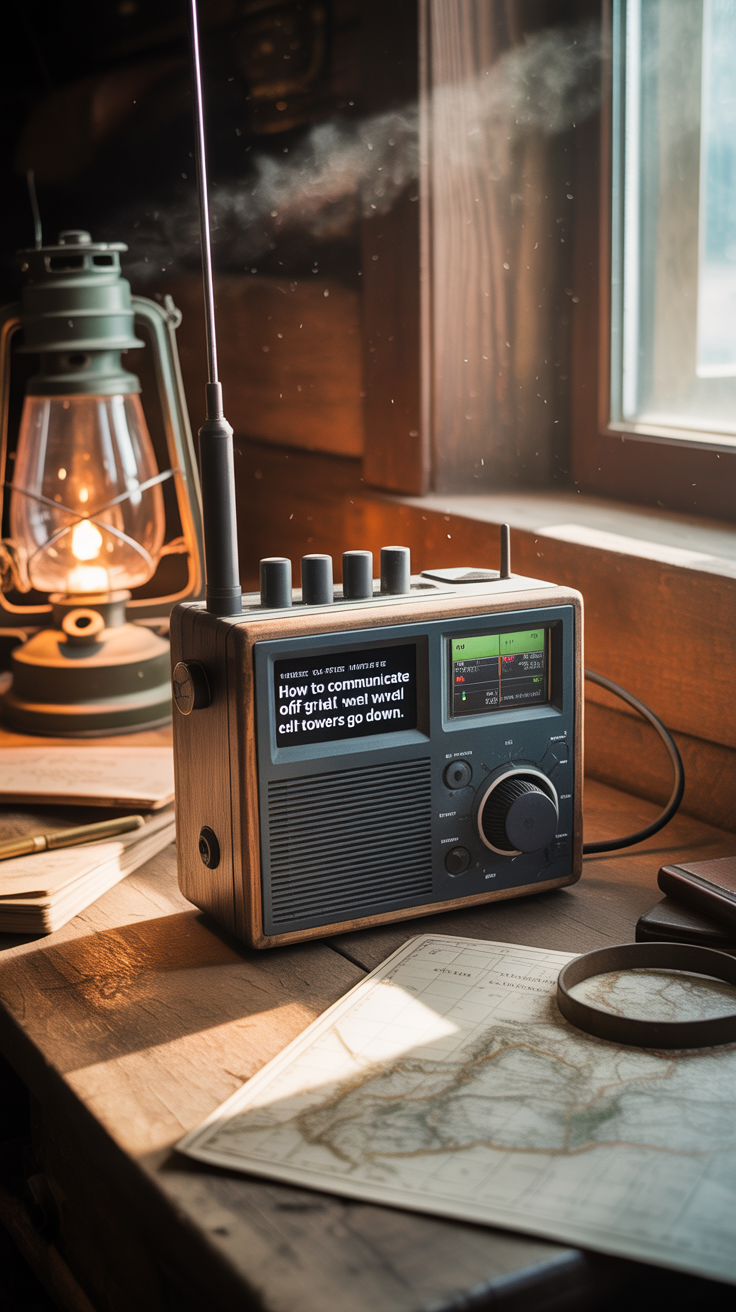
How to Communicate Off-Grid When Cell Towers Go Down
When cell towers go down, communication becomes a basic survival problem—not a convenience issue. If you’ve ever watched a storm, wildfire, cyber incident, or prolonged blackout knock out mobile service, you know the pattern: calls fail, texts stall, maps won’t load, and “I’m okay” can’t get through. Learning how to communicate off-grid when cell towers go down means building a layered plan that works with or without the internet, across short and long distances, and for both everyday disruptions and worst-case emergencies.
Off-grid communication isn’t one tool—it’s a system. The most resilient setups combine local coordination (family plans, meet-up points, paper maps, signals) with redundant devices (radios, satellite messengers, power backups) and disciplined habits (message formats, check-in windows, privacy). This guide walks you through a practical, step-by-step approach you can implement gradually, even if you’re starting from scratch.
“In most incident after-action reports, the communication failures aren’t caused by one missing gadget—they’re caused by a missing plan,” as many emergency management trainers emphasize. The goal is to build a plan that still functions when your preferred option fails.
Understanding Off-Grid Communication and Failure Points
Off-grid communication means exchanging information without relying on local cellular towers or normal consumer internet access. But “cell towers down” can mean several different realities, and your best option depends on which failure mode you’re facing.
Common reasons cell service fails
- Power loss at towers: Many towers have battery backup, but it’s limited. Extended outages can take them down.
- Backhaul failure: A tower might have power but still be cut off from the network (fiber damage, microwave relay disruption).
- Congestion: Service “works” but is unusably slow as everyone tries to call and text at once.
- Carrier throttling or outages: Software faults, cyber incidents, or core network failures can impact huge regions.
What still works when towers don’t
- Device-to-device radio (FRS/GMRS, ham radio): No towers required.
- Satellite messengers/phones: Bypass local infrastructure entirely (subscription may be required).
- Mesh messaging (limited): Some apps create phone-to-phone networks via Bluetooth/Wi‑Fi, but range is short and adoption matters.
- Physical relays: Runners, vehicle relays, written notes, and prearranged meeting points.
Your best strategy is not “choose one.” It’s layers:
- Primary: what you’ll use when things are normal (cell + messaging apps).
- Fallback: what you’ll use when towers are unstable (SMS discipline, out-of-area contact).
- Off-grid: what you’ll use when towers are down (radio/sat + analog plans).
- Worst-case: extended outages (repeaters down, fuel limited, roads blocked).
Building a Communication Plan Before You Need It
Gear helps, but a plan is what turns gear into reliability. The most effective off-grid communication plans are simple enough that everyone remembers them under stress.
Start with a contact tree and an out-of-area hub
Pick one out-of-area contact (friend or family member in another state/region). When local networks overload, long-distance routing sometimes recovers sooner, and it’s easier for separated family members to relay status through one hub.
Set rules:
- Everyone sends status to the out-of-area contact at predetermined times.
- Use the same short message format (more on that below).
- If someone can’t connect, they try again at the next check-in window instead of burning battery.
Establish meet-up points and decision triggers
Create:
- Primary meet-up point (near home)
- Secondary meet-up point (outside neighborhood)
- Tertiary point (out of town)
Define triggers like:
- If comms fail for 6 hours, go to Point A.
- If Point A is unsafe, go to Point B.
- If evacuation occurs, go to Point C.
Write these down on a wallet card for each person.
Use a structured message format
When bandwidth is scarce, clarity matters. A simple format:
WHO / WHERE / STATUS / NEEDS / NEXT
- Who: name(s)
- Where: location (intersection, landmark, GPS)
- Status: OK / injured / delayed / evacuating
- Needs: medical / water / pickup / none
- Next: next check-in time or destination
Example:
“JEN+KIDS / 3rd & Pine / OK / need ride / check-in 1900”
Power is part of communication
A dead radio is silence. Include:
- Phone power banks
- AA/AAA battery stash (for radios/flashlights)
- 12V car charger
- Solar charger (useful in prolonged outages)
If you’re building broader resilience around water, medical readiness, and home systems, it’s easier to sustain communications over days—not hours. Many people bundle comms planning with home preparedness resources like Home Doctor (practical home medical guidance) so that communication and care planning match real-world scenarios.
Short-Range Off-Grid Options for Families and Neighborhoods
Most real emergencies are local: a few blocks to a few miles. That’s good news—short-range communication is often the simplest and most affordable.
FRS radios (license-free) for immediate family coordination
FRS (Family Radio Service) handheld radios are widely available and require no license in the U.S. They’re ideal for:
- Neighborhood coordination
- Camping/hiking
- Car-to-car travel (short distances)
- Home projects across property
Practical expectations:
- “Up to 35 miles” packaging is marketing. Realistic range: 0.5–2 miles in neighborhoods, sometimes less in dense urban areas.
- Use clear, disciplined radio etiquette: short transmissions, confirm receipt, then stop talking.
GMRS radios (better range, licensed) for more capability
GMRS can use higher power and external antennas, often improving real-world performance. It’s useful if you want:
- Better neighborhood coverage
- Communication between vehicles and home base
- Optional use of GMRS repeaters (where available)
GMRS requires a license in the U.S. (no test, but you must apply and pay the FCC fee). If you’re serious about local resilience, GMRS is often the “sweet spot” between basic FRS and full ham radio.
Existing local networks: neighborhood radio check-ins
A surprisingly effective method is organizing a simple neighborhood schedule:
- One channel for local coordination
- A check-in at the top of each hour
- A designated “net control” volunteer who logs messages
This creates structure and reduces chaos. It also helps identify who needs assistance.
Communication without devices: signals and printed info
When even radios aren’t available:
- Whistle signals (3 blasts for help)
- Window/door markers (paper sign with status)
- Message board location (community bulletin at a park entrance)
Good off-grid communication includes analog backups because devices fail, get lost, or run out of power.
Long-Range Communication Without Cell Towers
If your family members could be across town, across counties, or traveling, you need long-range options that don’t rely on cellular infrastructure.
Ham radio (amateur radio) for serious capability
Ham radio is the most flexible off-grid communications method available to civilians. Benefits include:
- Local and regional voice communication
- Data modes for messages
- Ability to build stations with external antennas
- Community support through clubs and emergency nets
Trade-offs:
- Requires a license (in most countries)
- Requires time to learn and practice
- Performance depends on equipment, antenna, terrain, and bands
If you want reliable long-range capability, ham radio is often the best long-term investment—especially when paired with a home power plan.
Satellite messengers and satellite phones
Satellite devices bypass local tower infrastructure. They’re often the most straightforward way to guarantee you can send a message when everything else is down—especially during travel.
Considerations:
- Subscription costs (varies by provider)
- Sky view required (heavy canopy and narrow canyons can reduce performance)
- Message delays can occur during congestion
Satellite is not “always instant,” but it’s often the most reliable in regional outages.
CB radio for vehicle-based communications
CB is still common with truckers and off-road communities. It can be useful for:
- Vehicle convoy comms
- Highway situational awareness
- Short-to-mid range in open terrain
CB can be noisy and inconsistent, but it’s a viable layer—especially if your scenario involves travel during disruptions.
“The best long-range solution is the one you already practice with,” as radio instructors often stress. A rarely-used device can be worse than a simpler tool you’ve rehearsed.
Messaging Strategy When Networks Are Unstable
Sometimes towers aren’t fully down—they’re congested or partially working. In those cases, smart messaging habits can make the difference.
Use SMS, not app-based messaging, when bandwidth is scarce
In many incidents, SMS texts can slip through even when calls fail and data is unusable. It’s not guaranteed, but it often performs better under load.
Tactics:
- Keep your message short.
- Turn off images and attachments.
- Don’t send repetitive “are you there???” strings—each retry increases congestion.
Send status bursts with check-in windows
Plan two or three daily check-in times (e.g., 0800, 1300, 1900). Everyone attempts to send a single structured update during those windows.
Advantages:
- Saves battery
- Reduces frequency of retries
- Helps people stop worrying between check-ins
Move to out-of-area routing
If local calls fail, sometimes calls/texts to out-of-area numbers succeed. That’s why the out-of-area hub is so effective.
Protect privacy and prevent misinformation
When crises hit, rumors spread fast. Use:
- One trusted information source (local emergency management, NOAA weather radio, official notices)
- A family “code phrase” or verification detail to prevent spoofed messages
- A rule: if it’s not verified, it’s not forwarded
This matters more than many people realize. Communication without verification can create dangerous decisions.
Power, Water, and Medical Readiness as Communication Multipliers
Communication fails quickly when basic needs are unstable. You can’t coordinate if you’re constantly searching for water, fighting dehydration headaches, or dealing with preventable injuries. Off-grid communication is stronger when core preparedness is handled.
Water stability reduces urgent messaging
If your home water supply is uncertain, your communication load skyrockets (finding distribution points, coordinating pickups, troubleshooting filtration). A resilient water plan lowers panic and frees bandwidth for truly important messages.
💡 Recommended Solution: Water Freedom System
Best for: building a home-focused water readiness routine
Why it works:
- Encourages planning ahead instead of last-minute runs
- Helps organize water priorities for short outages and longer disruptions
- Supports calmer decision-making when infrastructure is unreliable
If you prefer another preparedness angle, some people use resources like SmartWaterBox as an alternative framework to think through stored water, access, and continuity—useful when communication depends on staying in place longer.
Food planning reduces mobility and risk
When you don’t have to travel constantly for basics, you reduce exposure to hazards and keep your group together—making communication easier.
A practical way to structure “stay-put” readiness is to maintain shelf-stable options and rotate them. Some preparedness-minded households use guides like The Lost SuperFoods to expand variety and reduce dependence on fragile supply chains.
Medical capability reduces urgent comms and improves outcomes
Minor injuries become major problems in long outages. If you can handle common issues at home, you reduce emergency calls that may not go through anyway.
Many people keep a clear home reference such as Home Doctor so that first aid and basic care steps are organized when stress is high. The benefit isn’t “replacing professionals”—it’s reducing preventable escalation while you wait for systems to recover.
Off-Grid Communication for Urban vs. Rural Scenarios
Your environment determines what works best. Urban areas have density and obstructions; rural areas have distance and fewer nearby helpers.
Urban and suburban priorities
- Short-range radios (FRS/GMRS) for neighborhood and family
- Prearranged meet-up points due to traffic and road closures
- Message discipline because congestion happens fast
- Situational awareness: local radio scanning (where legal), official alerts, community networks
If you’re preparing specifically for city disruptions—elevators down, transit halted, high population density—resources like URBAN Survival Code are often used as a planning guide to think through movement, safety, and coordination when infrastructure is stressed.
Rural priorities
- Long-range options (ham, satellite) due to distances
- External antennas and home base stations
- Vehicle comms for long drives
- Power generation to keep systems running for days
Power is a major factor in rural comms resilience. Many households pair radios with a robust backup power approach so devices can charge reliably.
💡 Recommended Solution: Ultimate OFF-GRID Generator
Best for: sustaining communication devices during extended outages
Why it works:
- Supports ongoing charging for radios, phones, and lights
- Helps maintain routines (scheduled check-ins) over multiple days
- Reduces the “battery panic” that breaks communication discipline
A practical comparison mindset
While satellite messaging is popular for guaranteed reach, radio networks can be more scalable for groups (family + neighbors) because one transmission can be heard by multiple people without each person needing a satellite device. In contrast, satellite can be a more direct option for communicating with someone far away when local infrastructure is compromised. Many resilient plans use both: radio locally, satellite for long-distance confirmation.
Operating Procedures That Make Off-Grid Communication Actually Work
Most people buy a device and stop there. The real reliability comes from operating procedures: who listens when, what channel, what phrasing, what happens when there’s no reply.
Create your family “comms card”
Print a small card with:
- Channels and privacy tones (if used)
- Call signs/nicknames
- Check-in windows
- Meet-up points
- Out-of-area contact
- Message format (WHO/WHERE/STATUS/NEEDS/NEXT)
Keep one in each go-bag, glove box, and wallet.
Set radio etiquette rules
- Press-to-talk, pause half a second, then speak (prevents clipped first words)
- Keep transmissions under 10 seconds
- Confirm receipt (“Copy” + key detail)
- Don’t monopolize a channel during an emergency
Practice with realistic drills
Once a month, run a 10-minute drill:
- Simulate “no cell service”
- Each person sends one message at the planned time
- Confirm you can reach the meet-up point with paper directions
You’re not trying to become a radio operator—you’re trying to make the plan automatic under stress.
Plan for information control and safety
In a serious event, you may not want to broadcast details like:
- Exact supplies
- Exact address
- Travel routes and times
Use general location references and avoid discussing sensitive details on open channels. If you need privacy, use prearranged code words or move sensitive details to more secure methods.
“The first rule of emergency comms is clarity; the second is brevity; the third is security where it matters,” as many incident communication frameworks teach.
Tools & resources list (practical, not hype)
If you’re building a broader resilience stack around communication, consider these planning-focused resources:
- URBAN Survival Code — urban-focused coordination and preparedness planning
- Home Doctor — home medical readiness to reduce emergency dependence
- Ultimate OFF-GRID Generator — power continuity to keep devices running
If you’re planning for deeper disruption scenarios and want a broader “systems” mindset, some readers explore frameworks like Dark Reset or BlackOps Elite Strategies as supplementary resources—especially when their goal is to think through decision-making, redundancy, and self-reliance beyond just communications.
Conclusion
Learning how to communicate off-grid when cell towers go down is less about owning a single “best” device and more about building a layered system: a family plan, short-range neighborhood options, long-range tools for separation, and disciplined messaging that conserves power and reduces confusion. Start with what you can do today—an out-of-area contact, written meet-up points, a message format, and a basic radio plan—then improve your resilience with practice and redundancy.
When disruption hits, the people who do best aren’t the ones with the most gear. They’re the ones who already agreed on what to do when the screen says “No Service.”
FAQ
What is the best way to communicate off-grid when cell towers go down?
The best approach is a layered plan: short-range radios for local coordination, a long-range option like ham or satellite for separation, and a written family plan with check-in windows and meet-up points.
Do text messages work when cell towers are down?
Sometimes. If towers are partially working or congested, SMS can still go through when calls and data fail. If towers are truly down or backhaul is severed, SMS may not work at all—so you need off-grid alternatives like radio or satellite.
What radios are best for family communication during a blackout?
For most families, FRS radios are the easiest starting point (no license). GMRS can provide better performance with a license and can be more effective for neighborhood-scale comms.
How can I communicate with someone far away without cell service?
The most common non-cell options are satellite messengers/phones and ham radio (depending on licensing and setup). Satellite is often simpler for direct long-distance messaging, while ham can be powerful with practice and infrastructure.
How do I keep devices charged during extended outages?
Use a layered power plan: power banks for short outages, vehicle charging when available, and longer-duration backup power for multi-day events. Sustained power makes radio schedules and check-ins realistic, not wishful thinking.
RANK MATH SEO BLOCK
SEO Title (≤60 chars): Off-Grid Communication When Cell Towers Go Down
Meta Description (≤160 chars): Learn how to communicate off-grid when cell towers go down with radios, satellite options, message plans, and power-ready strategies.
URL Slug: communicate-off-grid-when-cell-towers-go-down
Focus Keyword: How to Communicate Off-Grid When Cell Towers Go Down
Suggested Schema Type: FAQ