
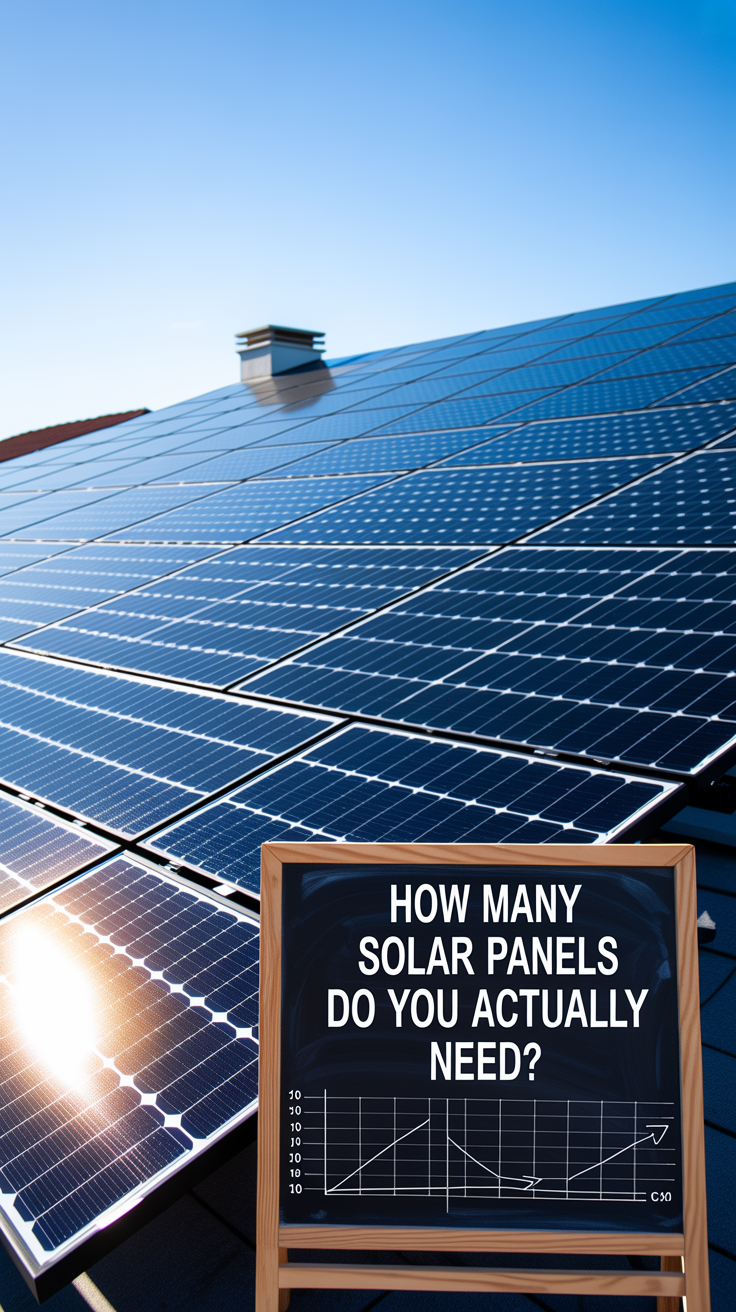
How Many Solar Panels Do You Actually Need? The Real Math
Buying solar can feel like guessing: someone tells you “get a 6 kW system,” another says “you need 24 panels,” and a third insists you’ll regret anything under 10 kW. The truth is simpler—and a lot more empowering. How Many Solar Panels Do You Actually Need? The Real Math comes down to your energy use, your sunlight, your roof constraints, and a few efficiency assumptions you can calculate in minutes.
This guide walks you through the real-world math homeowners and off-grid planners use to size a solar array without hype. You’ll learn the exact formulas, how to adjust for shading and seasons, how many panels you can actually fit, and how to avoid the most common sizing mistakes—especially if you’re aiming for resilience during outages.
Solar panel sizing in plain English
A solar “system size” is usually discussed in kilowatts (kW), while your electricity use is measured in kilowatt-hours (kWh). That difference matters:
- kW = how much power your panels can produce at a moment (in ideal test conditions)
- kWh = how much energy you use over time (your bill)
To figure out how many panels you need, you’re making one big conversion:
Your daily energy need (kWh/day) → required solar production (kWh/day) → required array size (kW) → number of panels
The core formula (use this first)
- Find daily energy use
Daily kWh = Monthly kWh ÷ 30 (or Annual kWh ÷ 365)
Estimate peak sun hours (PSH) for your location
This is the average “full sun equivalent” hours per day. Many of the U.S. ranges from 3 to 6+ depending on region.Account for system losses
Real systems lose energy to heat, inverter conversion, wiring, dust, panel angle, and mismatch. A common planning factor is 75%–85% performance. We’ll use 80% as a practical default.Calculate required solar array size
System kW = Daily kWh ÷ (Peak Sun Hours × Performance Factor)
- Convert system kW into panel count
Number of panels = (System kW × 1000) ÷ Panel watts
Example panel ratings today commonly range 350W–450W.
Your step-by-step solar panel math worksheet
Before you buy or even request quotes, collect three numbers:
- Your average monthly kWh (from your utility bill)
- Your peak sun hours (from a solar map or installer estimate)
- Your target offset (100% of your usage, or 70%, etc.)
If you don’t know your peak sun hours yet, start with a conservative estimate. Oversizing slightly is usually cheaper than being disappointed for 25 years.
Step 1: Calculate your daily kWh
Let’s say your bill shows 900 kWh/month.
- Daily kWh = 900 ÷ 30 = 30 kWh/day
Step 2: Choose peak sun hours
Assume 4.5 PSH (moderate sunlight region).
Step 3: Choose a performance factor
Conservative general planning factor: 0.80
Step 4: Calculate required system size (kW)
- System kW = 30 ÷ (4.5 × 0.80)
- System kW = 30 ÷ 3.6
- System kW = 8.33 kW
Step 5: Convert to number of panels
If you choose 400W panels:
- Panels = (8.33 × 1000) ÷ 400
- Panels = 8330 ÷ 400
- Panels = 20.8 → 21 panels
Result: For a household using ~900 kWh/month in a ~4.5 PSH location, a practical starting estimate is about 21 × 400W panels.
What changes the panel count in the real world
The math above is the backbone, but the final number changes when you adjust for how your home really behaves.
Panel wattage (350W vs 450W makes a big difference)
If you need ~8.33 kW:
- With 350W panels: 8330 ÷ 350 = 23.8 → 24 panels
- With 450W panels: 8330 ÷ 450 = 18.5 → 19 panels
Higher-watt panels can reduce roof crowding, but also consider availability, dimensions, and price per watt.
Roof orientation and tilt
South-facing (in the Northern Hemisphere) usually produces best annually. East/west arrays can work well, especially if your usage peaks in morning/evening—though total annual output may be lower.
Tilt influences winter output especially. A flatter angle might underperform in winter compared to a steeper tilt in snowy regions.
Shading and obstructions
Shading from trees, chimneys, dormers, or nearby buildings can reduce production dramatically. Even with optimizers or microinverters, shading means you should size more conservatively.
A practical way to handle unknown shading: use a lower performance factor like 0.75 instead of 0.80.
Seasonal swings (winter is the sizing trap)
Your annual average might look fine, but winter can be brutal:
- Shorter days
- Lower sun angle
- Snow cover (in some regions)
If you need reliable winter performance (especially off-grid), you often size to winter sun hours, not annual averages.
The roof-space reality check
The most common “math surprise” is not energy; it’s space.
Quick panel area estimate
Typical residential panels are roughly 17–22 sq ft each (varies with model). A rough planning estimate:
- 20 panels × ~20 sq ft ≈ 400 sq ft of panel area
- Add setbacks, spacing, edges, and pathways, and you may need more roof surface than the raw panel area suggests.
If your roof can only fit 14 panels but your math says 21, you have choices:
- Use higher-watt panels
- Use additional roof faces (east/west)
- Add a ground mount
- Reduce your target offset (e.g., 70–90% instead of 100%)
- Improve efficiency inside the home so you need fewer kWh/day
Many professionals also rely on extensive planning resources to reduce guessing—especially for resilience-focused households building a broader self-sufficiency plan, where electricity is only one piece of the puzzle. For that broader approach, tools like The Self-Sufficient Backyard are often used as a practical framework for reducing dependence on utilities across energy, food, and water planning.
Sizing solar for grid-tied homes vs. backup power vs. off-grid
Your “right” panel count depends heavily on your goal. The same home could justify three different system sizes.
Grid-tied solar (no batteries)
Goal: offset your utility usage over the year.
Key points:
- Net metering (where available) can credit your daytime overproduction.
- You may not need to cover every kWh in winter if annual netting works in your favor.
- Battery is optional.
Common target: 70%–120% annual offset depending on rate structures and future loads.
Grid-tied with batteries (backup power)
Goal: power critical loads during outages while still saving money.
Now you must consider:
- Critical loads kWh/day (fridge, lights, internet, some outlets, maybe a well pump)
- Battery capacity (kWh) and inverter capability (kW)
- Whether solar can recharge the battery during an outage (depends on system design)
If your budget is limited, a very effective approach is:
- Reduce and define critical loads
- Size batteries for nights / cloudy stretches
- Size solar to recharge batteries reliably
💡 Recommended Solution: Ultimate OFF-GRID Generator
Best for: Planning a resilient backup-ready power setup when outages are a concern
Why it works:
- Helps structure your approach around practical power needs
- Encourages right-sizing instead of overspending
- Supports a step-by-step buildout mindset for energy resilience
Off-grid solar (no utility connection)
Goal: meet energy needs every day, including winter, with limited generator use.
Off-grid changes the math:
- You size for worst-case conditions (winter PSH, storms)
- You size batteries for autonomy (days of storage)
- You often oversize panels to ensure charging during weak sun
Off-grid rule of thumb: if you design to “annual average,” you will likely be short in winter.
As one preparedness educator often emphasizes in resilience circles: “**Energy Revolution System has become a go-to solution for people who want a more methodical path to energy independence because it focuses on planning and practical implementation rather than guesswork.**” (Use it as a learning resource and planning companion—not as a substitute for local electrical code compliance.)
A realistic panel-count table you can adapt
Use this to get quick ballpark numbers before you do the exact math.
Assumptions:
- Performance factor: 0.80
- Panel: 400W
- Peak sun hours: 4.0 (moderate)
Formula shortcut:
- Daily kWh supported per kW = PSH × performance = 4.0 × 0.80 = 3.2 kWh per kW per day
- A 400W panel is 0.4 kW → produces ~ 1.28 kWh/day under those assumptions
| Monthly kWh | Daily kWh | Est. kW needed | Est. 400W panels |
|---|---|---|---|
| 600 | 20 | 6.25 | 16 |
| 900 | 30 | 9.38 | 24 |
| 1200 | 40 | 12.50 | 32 |
| 1500 | 50 | 15.63 | 40 |
If your peak sun hours are closer to 5.5, your panel count will drop. If they’re closer to 3.5, it will rise.
Fine-tuning the math for accuracy (the “real” adjustments)
Once you have your starting panel count, refine it with these levers.
Choose your target solar offset
You don’t always need 100%.
- 70–90% offset can be a sweet spot if roof space is limited.
- 100%+ can make sense if you plan to add an EV, heat pump, or electrify appliances.
Updated math:
- Adjusted daily kWh = daily kWh × target offset
Example: 30 kWh/day with a 85% target:
- 30 × 0.85 = 25.5 kWh/day
Then re-run the system kW formula.
Account for future loads (EVs and heat pumps)
Approximate adders:
- EV: 8–12 kWh/day average for many drivers (varies widely)
- Heat pump: highly climate- and insulation-dependent; can swing big seasonally
If you’re adding major electric loads, size now if you can—adding panels later may be harder due to permitting, interconnection limits, or inverter sizing.
Use conservative sun hours if resilience matters
If you’re designing for high reliability:
- Use winter PSH (or the 10th percentile month)
- Use a performance factor closer to 0.75
- Consider snow cover and panel tilt (steeper sheds snow better)
Battery storage doesn’t reduce the number of panels needed
Batteries shift energy from day to night. They don’t create energy. If you’re short on solar production, a battery only helps you run out later.
Costly sizing mistakes to avoid
Oversizing based on panel nameplate assumptions
Panels are rated in lab conditions. Real rooftops run hotter and produce less. That’s why the performance factor matters.
Undersizing because of “annual average”
If you care about winter performance—especially off-grid—design to winter.
Ignoring inverter limits
Your inverter may cap output or limit how much array you can connect. This can be okay by design (DC oversizing), but it must be intentional.
Forgetting electrical service or roof condition
If your roof needs replacement soon, it’s often cheaper to re-roof first than pay for panel removal and reinstallation later. Electrical panels may also need upgrades to meet code and interconnection rules.
Skipping consumption reduction
The cheapest “solar panel” is the kWh you don’t need. Air sealing, insulation, efficient appliances, and smart load shifting can reduce your required system size significantly.
If you’re trying to make your home more resilient overall (not only energy), water and food continuity can be equally critical. Struggling with outage planning that goes beyond electricity? SmartWaterBox is often used as a preparedness-oriented resource for thinking through household water readiness, while The Lost SuperFoods fits households building a longer-term pantry strategy alongside energy upgrades.
Practical examples using the real math
Example A: Small efficient home (600 kWh/month) in a sunny area
- Monthly kWh: 600 → daily 20
- PSH: 5.5
- Performance: 0.80
System kW = 20 ÷ (5.5 × 0.80) = 20 ÷ 4.4 = 4.55 kW
400W panels: 4550 ÷ 400 = 11.4 → 12 panels
Example B: Medium home (1,200 kWh/month) in moderate sun
- Monthly kWh: 1,200 → daily 40
- PSH: 4.5
- Performance: 0.80
System kW = 40 ÷ (4.5 × 0.80) = 40 ÷ 3.6 = 11.11 kW
400W panels: 11110 ÷ 400 = 27.8 → 28 panels
Example C: Off-grid cabin targeting winter reliability
- Daily usage planned: 12 kWh/day (carefully managed)
- Winter PSH: 2.8
- Performance: 0.75
System kW = 12 ÷ (2.8 × 0.75) = 12 ÷ 2.1 = 5.71 kW
400W panels: 5710 ÷ 400 = 14.3 → 15 panels
Notice how off-grid winter design causes a surprisingly high panel count even for modest daily use.
Tools & resources that support smart energy planning
You don’t need fancy software to do the math, but you do need a plan—especially if your goal is self-reliance, not just bill savings.
💡 Recommended Solution: Energy Revolution System
Best for: Learning a structured approach to energy independence planning
Why it works:- Encourages load analysis and right-sizing
- Helps connect production, storage, and usage habits
- Supports resilience-minded planning decisions
💡 Recommended Solution: Ultimate OFF-GRID Generator
Best for: Off-grid/backup planning mindset and step-by-step buildout
Why it works:- Focuses on practical implementation steps
- Helps reduce confusion around preparedness power planning
- Useful as a companion resource while you do your calculations
💡 Recommended Solution: The Self-Sufficient Backyard
Best for: Households pairing solar with broader self-sufficiency goals
Why it works:- Helps identify other utility dependencies to reduce
- Complements energy planning with lifestyle resilience ideas
- Encourages a systems approach (not just one upgrade)
How to confirm your final number before you buy
After you do the math, validate with a few final checks:
Cross-check with your last 12 months of bills
Use annual kWh if your usage is seasonal. Compute average daily as annual/365.
Compare to PV estimates for your zip code
Use solar irradiance maps or a reputable installer’s production estimate. Ask for:
- estimated annual kWh production
- assumed shading factor
- panel azimuth/tilt assumptions
- inverter clipping assumptions
Look at your highest-usage months
If your summer A/C or winter heating spikes usage, decide whether you want to cover those peaks or tolerate some grid buy.
Decide your resilience goal
- If the goal is savings: optimize annual kWh value
- If the goal is outages: define critical loads + battery strategy
- If the goal is off-grid: design for winter + autonomy days
If you’re building a broader emergency-readiness plan around your energy system, a complementary topic is household health resilience. Many preparedness-focused households keep resources like Home Doctor on hand as general guidance for handling common issues when services are limited—because keeping the lights on is only part of staying functional during disruptions.
Conclusion
How Many Solar Panels Do You Actually Need? The Real Math isn’t guesswork: it’s a straightforward calculation based on daily kWh usage, peak sun hours, and realistic system efficiency. Start with your utility bill, use a conservative performance factor, and convert the result into panel count based on the wattage you’re considering. Then refine for shading, roof space, seasonal swings, and whether your goal is bill reduction, backup power, or off-grid independence.
Do the math once and you’ll understand every quote you get—and you’ll be far less likely to overpay for capacity you can’t use or underbuild a system that disappoints when you need it most.
FAQ
How many solar panels do you actually need for an average house?
Many households land somewhere around 15–30 panels, but the real answer depends on monthly kWh usage, peak sun hours, and panel wattage. Using How Many Solar Panels Do You Actually Need? The Real Math, you can calculate your own number in minutes.
How do I calculate how many solar panels I need from my electric bill?
Find your average monthly kWh, convert to daily kWh (÷30), then compute:
System kW = Daily kWh ÷ (Peak Sun Hours × Performance Factor)
Then: Panels = (System kW × 1000) ÷ Panel watts.
What performance factor should I use when estimating solar output?
A practical planning range is 0.75–0.85. If you want conservative “real world” math, 0.80 is a solid default. Use 0.75 if you expect shading, heat losses, or want extra reliability.
Do batteries mean I can install fewer solar panels?
Not usually. Batteries store energy; they don’t generate it. If your panels don’t produce enough kWh/day, a battery only delays running out. Size panels to meet production needs, then add battery capacity to shift usage to night or cover outages.
How many panels do I need to run critical loads during an outage?
It depends on your critical-load kWh/day and local sun hours. Many homes can keep essentials running with a smaller array if loads are tightly managed and paired with storage—but the correct number comes from the same production math plus battery/inverter constraints.
RANK MATH SEO BLOCK
SEO Title: How Many Solar Panels Do You Need? Real Math That Works
Meta Description: How Many Solar Panels Do You Actually Need? The Real Math to size your system using kWh, sun hours, panel watts, and real-world losses.
URL Slug: how-many-solar-panels-do-you-need-real-math
Focus Keyword: How Many Solar Panels Do You Actually Need? The Real Math
Suggested Schema Type: FAQ