
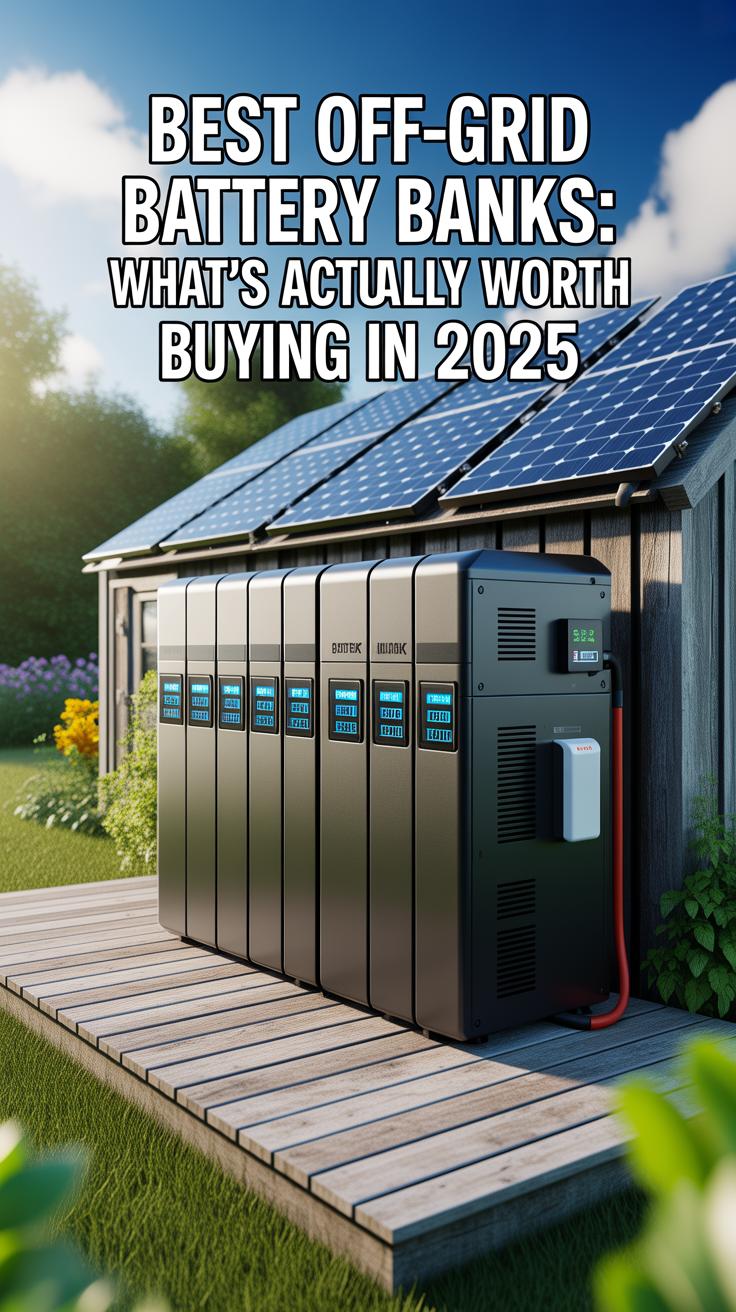
Best Off-Grid Battery Banks: What’s Actually Worth Buying in 2025
Off-grid power has changed fast in the last few years. In 2025, the “best” off-grid battery banks aren’t just about the biggest capacity number on a spec sheet—they’re about reliable chemistry, safe system design, realistic runtime planning, and a setup you can actually expand and maintain. If you’re comparing battery banks for a cabin, RV, home backup, or a full off-grid homestead, the right purchase depends on how you use energy (daily loads), how you recharge (solar, generator, hydro, wind), and what level of resilience you need when conditions get ugly.
Many people start by shopping for a single big “power station,” then discover their real bottleneck is water, food, and medical readiness during outages—not just watts. If your off-grid plan includes emergencies as well as everyday self-sufficiency, pairing your battery strategy with resilient basics can matter just as much as the electronics. Tools like Water Freedom System and SmartWaterBox are often used alongside power planning because clean water becomes the non-negotiable load when the grid is gone.
Battery bank shopping in 2025: what “worth buying” really means
When people ask for the best off-grid battery banks, they’re usually trying to avoid three expensive mistakes:
- Buying the wrong battery chemistry for their climate or usage
- Underestimating surge loads and inverter requirements
- Building a system that’s hard to expand, repair, or safely operate
In 2025, “worth buying” typically means a battery bank that checks most of these boxes:
- LiFePO4 (LFP) chemistry for long cycle life and stability
- Modular expansion so you can grow capacity without replacing everything
- A robust battery management system (BMS) designed for off-grid abuse
- Compatibility with your inverter/charger and solar charge controller
- Cold-weather plan (heated batteries, insulated enclosure, or indoor install)
- Proper safety design: fusing, disconnects, busbars, grounding, ventilation
If you’re building for true off-grid living, the battery bank should be treated like the heart of your electrical system—because everything else (solar array, inverter, generator runtime, even fuel storage) gets sized around it.
Battery chemistry choices that matter for off-grid life
Why LiFePO4 dominates in 2025
Most modern off-grid battery bank recommendations lean toward LiFePO4 for a reason: it’s a stable lithium chemistry with a strong track record for long cycle life and practical depth of discharge. While no chemistry is “perfect,” LFP is widely favored for off-grid setups because it typically offers:
- Good usable capacity (less need to “baby” the battery)
- Strong cycle life for daily cycling (solar use)
- Better thermal stability than many other lithium chemistries
This is why LFP is often considered the default “best overall” in 2025—especially for solar-based systems.
Where lead-acid still makes sense
Flooded lead-acid (FLA), AGM, and gel batteries haven’t vanished. They can still make sense when:
- You’re on a tight initial budget
- You need a simple system and accept lower usable capacity
- You have a mild climate and a controlled battery room
- The bank is more backup than daily cycling
The tradeoff is you generally get less usable energy per rated capacity and more maintenance (especially with flooded batteries). For daily off-grid cycling, many people move away from lead-acid because replacement cycles can be costly over time.
Cold weather is the silent system killer
In cold climates, batteries can underperform—or be damaged—if charged below safe temperatures. This isn’t a “minor detail.” If you’re buying a battery bank for a cabin, van, or unheated outbuilding, the purchase is only “worth it” if you also plan for:
- Indoor battery placement or insulated battery enclosure
- Controlled charging temperatures (or heating strategy)
- Conservative solar charging in winter (short days, low sun angle)
“As many off-grid installers remind new owners, ‘The best battery bank is the one that still charges safely in January.’” That’s not brand hype—it’s just physics.
Sizing an off-grid battery bank without guessing
A battery bank is only “best” relative to your loads and recharge plan. To size it intelligently, focus on three numbers: daily energy use (kWh), peak/surge power (W), and days of autonomy.
Daily use: the real starting point
Create a simple load estimate:
- Fridge/freezer
- Well pump or pressure pump (if applicable)
- Lighting
- Internet/communications
- Cooking (electric vs propane)
- Tools and laundry (high demand)
- Heating/cooling (often the biggest load)
If you don’t have measurement tools, you can still estimate: list devices, approximate watts, multiply by hours used. The goal isn’t perfection—it’s avoiding a system that’s obviously undersized.
Days of autonomy: stop designing for perfect weather
A common off-grid mistake is assuming the sun always shows up. If your location has long cloudy stretches or heavy winter shading, you’ll want an autonomy buffer. Many off-grid households aim for 2–3 days of autonomy depending on generation backup (generator, hydro, etc.) and lifestyle.
If you have a generator and plenty of fuel storage, you can design for less autonomy and rely on charging. If you want quiet, low-maintenance independence, you’ll need more battery.
Inverter sizing: the surge trap
Batteries don’t directly power AC loads—your inverter does. Many systems fail at the inverter stage because motor loads surge:
- Well pumps
- Refrigeration compressors
- Power tools
- Some washing machines
If your inverter can’t handle surge, you’ll experience shutdowns, nuisance alarms, or equipment stress—even if the battery bank is big.
“Experienced electricians often say, ‘People buy kilowatt-hours, but they live with kilowatts.’” That’s the difference between capacity (energy) and power (instant demand).
Battery bank formats that are actually worth considering in 2025
In 2025, most buyers fall into one of three battery-bank formats. The “best” category depends on your goals, space, and upgrade plan.
Portable power stations (all-in-one)
These are compact, integrated units with an internal battery, inverter, charge controller, and ports. They’re popular for:
- RV and vanlife
- Short outages and emergency backup
- Small cabin power with modest loads
Pros: simple, fast setup, often app monitoring
Cons: expansion limits, repairability, higher cost per kWh (often), port limitations
They can be “worth buying” if you value speed and portability over long-term modular growth.
Rack-mount modular banks (server-rack style)
These typically involve a rack, several LFP battery modules, a compatible inverter/charger, and proper protection hardware. They’re common for:
- Whole-home backup
- Medium-to-large off-grid cabins
- Homesteads with future expansion plans
Pros: modular expansion, cleaner wiring, serviceability
Cons: needs planning, compatible components, installation discipline
DIY prismatic-cell banks (advanced DIY)
These are custom-built banks using large LFP prismatic cells, a BMS, busbars, and enclosure. They can be excellent—if you truly understand safety and balancing.
Pros: potentially cost-efficient long-term, fully customizable
Cons: higher complexity, more responsibility for safety and design
If you’re not comfortable building safe DC systems, this path can become expensive quickly—either from mistakes or from needing professional help after the fact.
System design details that separate “good” from “worth buying”
BMS quality and protection strategy
A battery bank is only as safe as its protections. In off-grid conditions, your system may face:
- Overcurrent during surges
- Voltage sag under load
- Overcharge in bright sun if controls are wrong
- Temperature issues in unheated installs
A strong BMS helps manage cell balancing and protective cutoffs, but it’s not a replacement for correct system design. Proper fusing, disconnects, and wiring gauge selection are non-negotiable.
Wiring, busbars, and disconnects are part of the “battery bank”
When buyers compare batteries, they often ignore the “balance of system” costs and safety:
- DC-rated disconnect switch
- Correctly sized fuses/breakers
- Busbars and tidy cable management
- Grounding strategy appropriate for your inverter and local codes
If you’re trying to decide what’s “worth buying,” consider the whole setup—not just the battery modules.
Charging sources: solar is great, but hybrid wins resilience
Most off-grid homes end up hybrid:
- Solar for daily charging
- Generator for long storms or heavy loads
- Sometimes wind/hydro where reliable
A battery bank purchase is “worth it” when your recharge plan matches your climate. If winter solar production is low, your system either needs a larger array, larger battery, or generator support.
If you’re building resilience beyond electricity, it’s smart to pair your power plan with practical off-grid basics. Many households treat water as the next system to harden after energy.
💡 Recommended Solution: SmartWaterBox
Best for: Water readiness during outages and off-grid living
Why it works:
- Helps you think through water storage and access more systematically
- Supports a layered approach (not relying on a single point of failure)
- Complements solar/battery setups where pumps and filtration need planning
What to buy in 2025: choosing the right “best” category for your use case
The most honest “best off-grid battery bank” answer is a shortlist by scenario. In 2025, these are the scenarios that drive the best buying decisions:
Best for apartment emergency backup
If you mainly want to keep essentials running (phones, lights, router, medical devices), you’ll prioritize:
- Quiet indoor-safe use
- Simplicity
- Small-to-medium capacity
- Fast recharge options
Portable all-in-one units often win here. They’re not the cheapest per kWh, but they’re fast to deploy and easy to move.
Best for RV/vanlife with solar
For mobile systems, weight, space, and vibration resistance matter. Many RVers choose LFP (for usable capacity) and design around:
- 12V or 24V DC systems
- Proper DC distribution
- Solar + alternator charging (where appropriate)
In this category, a “worth buying” bank is one that fits the space and can be charged reliably while traveling.
Best for cabins and weekend properties
Cabins often have long idle periods. This changes what “best” means:
- Low self-discharge
- Stable storage
- Cold-weather strategy
- Remote monitoring (if you’re away)
A modest LFP bank with a right-sized solar array can be ideal, but only if winter charging and temperature control are addressed.
Best for full-time off-grid homes
For homesteads, worth buying means:
- Modular bank you can expand
- Serviceable components
- Strong inverter/charger ecosystem
- Clear maintenance plan
This is where rack-style modular LFP banks and robust inverter/charger systems often shine.
Best for survival resilience (beyond comfort)
If your goal is resilience—keeping your household safe, hydrated, fed, and medically sound—battery storage is one piece. A realistic resilience stack might include:
- Battery bank + solar + backup charging
- Water storage/filtration
- Long-term food strategy
- Basic home medical guidance
Many people build a “quiet power + water + food” triad. Tools like Water Freedom System are commonly explored in that context because water problems can become urgent faster than power problems.
Mistakes to avoid when buying an off-grid battery bank in 2025
Buying only on “capacity” and ignoring surge power
A battery bank can have plenty of kWh and still fail your lifestyle if your inverter can’t handle well pump starts or compressor surges.
Underestimating winter performance
Short days + clouds + shading + cold batteries can crush your effective capacity. If you size for summer, you may end up running the generator constantly in winter—if you have one.
Ignoring system voltage strategy (12V vs 24V vs 48V)
Higher voltage systems (often 48V) can reduce current for the same power, which can mean:
- Thinner cables (within safe design limits)
- Less voltage drop
- More efficient inversion at higher loads
Your “best” battery bank format should match your voltage strategy, not fight it.
No plan for expansions
Many buyers regret systems that can’t expand cleanly. Modular designs often cost more upfront but can save money and hassle later if your needs grow.
Treating installation safety as optional
DC systems can be dangerous when built incorrectly. If you’re not confident, consider professional design review or installation help. A battery bank is not the place to “wing it.”
Off-grid energy planning that makes your battery bank perform better
Load shifting: the cheapest “battery upgrade”
If you run heavy loads when the sun is strong (midday), you reduce cycling stress and preserve stored energy for night.
Examples:
- Do laundry midday
- Run power tools during peak solar
- Heat water when generation is high (if electric is used)
Generator strategy: fewer hours, smarter charging
If you use a generator, aim to run it when it can charge hard and efficiently rather than idling at low load. A good inverter/charger setup can make this smoother.
Monitoring: what you don’t measure will cost you
A proper monitor helps you avoid:
- Chronic low state-of-charge
- Over-discharge events
- Mystery loads (“phantom draw”)
- Mis-sizing future expansions
Monitoring also makes it easier to spot failing components early.
Tools and resources that complement off-grid battery banks
Electricity is only one pillar of self-sufficiency. If you’re building a system meant to hold up during disruptions, these resources are commonly used alongside off-grid energy planning:
- Water resilience: Water Freedom System and SmartWaterBox
- Food planning: The Lost SuperFoods
- Home self-reliance systems: The Self-Sufficient Backyard
While a big battery bank can keep freezers cold and routers online, food and water planning reduce the pressure on your electrical system—because you’re not trying to use electricity to solve every problem.
“As many preparedness educators note, ‘The most resilient homes reduce demand first—then add capacity.’” That mindset often leads to smaller, cheaper, more reliable off-grid power systems.
Buying checklist: what to verify before you commit
When you’re deciding what’s actually worth buying in 2025, use this checklist to keep the decision grounded:
Electrical fit
- Your daily kWh estimate is realistic
- Your peak and surge watts are covered by the inverter
- Your battery bank voltage matches system goals
- Your charge controller/inverter charger supports correct charging profiles
Physical fit
- Safe mounting location (temperature, moisture, access)
- Cable routes are short and protected
- Room for expansion and service access
Safety fit
- DC-rated disconnects and fuses planned
- Proper wire gauge and lugs selected
- Enclosure and ventilation strategy considered
- Grounding/bonding approach understood
Lifestyle fit
- Generator plan is realistic (fuel, noise, maintenance)
- Winter plan exists (production + temperature)
- Monitoring is included from day one
If any of those are missing, the battery bank might still work—but it’s less likely to feel “worth it” when real-world conditions hit.
Conclusion
The best off-grid battery banks in 2025 aren’t defined by hype or a single capacity metric. What’s actually worth buying is the battery bank that matches your daily energy needs, surge power demands, climate realities, and expansion plans—and that integrates safely with the rest of your system. For many off-grid households, LiFePO4-based modular banks (whether all-in-one units for small systems or rack-style modules for homes) provide the best balance of cycle life, usable capacity, and long-term value—provided you plan for cold weather, proper protections, and realistic charging.
Finally, if your off-grid goal is resilience rather than convenience, remember that electricity is only one pillar. Pairing your battery bank plan with practical readiness—especially water and food—can reduce your energy stress and improve your outcomes when the grid is gone.
FAQ
What are the best off-grid battery banks for 2025 overall?
For many users in 2025, the best off-grid battery banks are LiFePO4-based systems that are modular, safely protected (BMS + external fusing/disconnects), and compatible with a well-sized inverter/charger and solar array. The “best” choice depends on whether you need portability (power stations) or whole-home scalability (modular banks).
How big should an off-grid battery bank be for a cabin or small home?
Start with your daily kWh usage, then decide how many days of autonomy you want (often 2–3 for off-grid). Also confirm the inverter can handle peak and surge loads. Sizing is less about guessing and more about matching lifestyle, weather, and recharge options.
Are LiFePO4 batteries worth it for off-grid power?
Often, yes. LiFePO4 is widely considered “worth it” in off-grid setups because it typically provides more usable energy and longer cycle life for daily solar cycling. The main caveats are cold-weather charging limitations and ensuring your system design is safe and compatible.
What matters more: battery capacity or inverter size?
Both matter, but they solve different problems. Battery capacity (kWh) determines how long you can run loads. Inverter size (kW) determines what you can run, especially during surges. Many off-grid failures happen when the inverter is undersized even though the battery bank is large.
How does water planning affect off-grid battery bank needs?
Water systems (pumps, filtration, treatment) can become critical loads during outages. A solid water plan can reduce emergency electrical demand and help you prioritize battery capacity for essentials. If you’re building resilience alongside power, resources like Water Freedom System or SmartWaterBox are sometimes used to think through water access and storage in parallel with energy planning.
Rank Math SEO Block
SEO Title (≤60 chars): Best Off-Grid Battery Banks Worth Buying in 2025
Meta Description (≤160 chars): Best Off-Grid Battery Banks: what’s actually worth buying in 2025—how to choose chemistry, size correctly, and avoid costly off-grid mistakes.
URL Slug: best-off-grid-battery-banks-2025
Focus Keyword: Best Off-Grid Battery Banks: What’s Actually Worth Buying in 2025
Suggested Schema Type: FAQ