
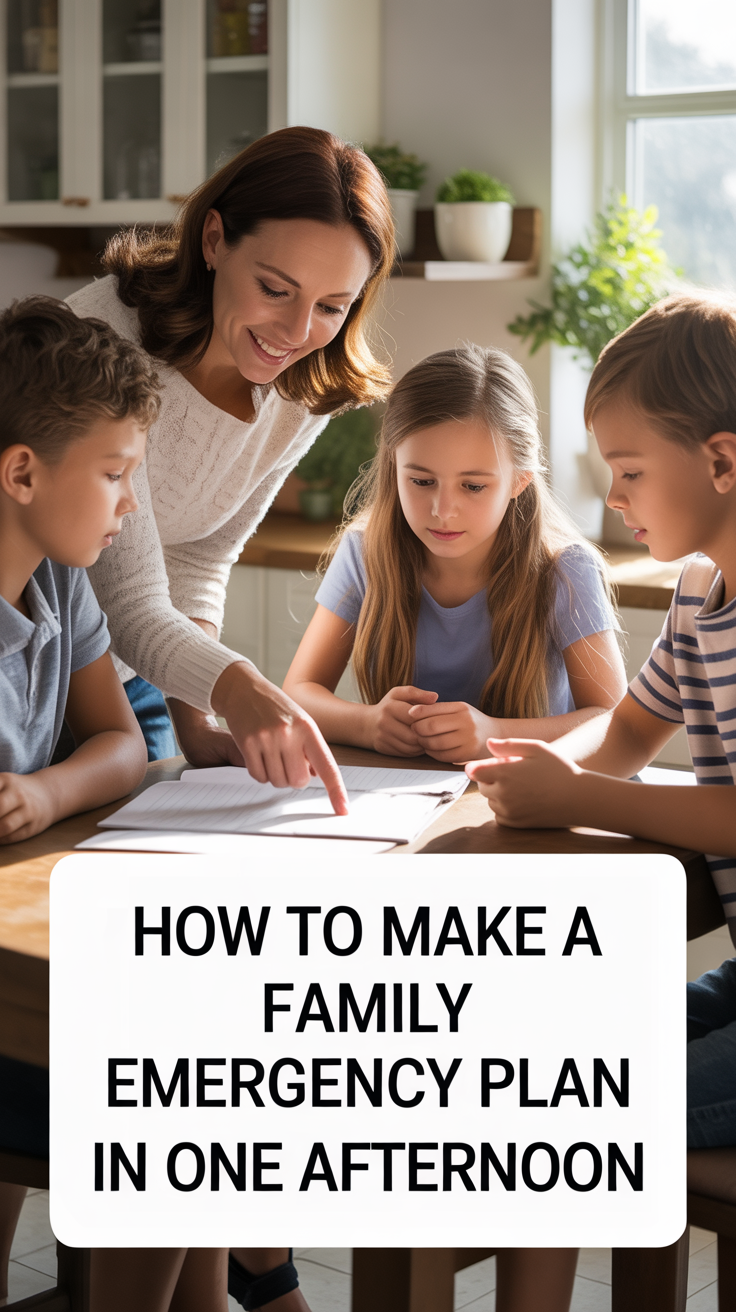
How to Make a Family Emergency Plan in One Afternoon
Making a plan for emergencies doesn’t have to be overwhelming or time-consuming. If you’ve been putting it off because it feels like a huge project, this is the simplest way to change that—today. This guide will show you how to make a family emergency plan in one afternoon, with clear steps, easy assignments, and practical checklists you can use immediately. You’ll walk away with a plan your family understands, a communication system that works when networks are overloaded, and a realistic approach to supplies (without panic-buying).
Many families assume they’ll “figure it out” if something happens. But in real events—storms, wildfires, power outages, medical emergencies, or sudden evacuations—stress narrows decision-making. A basic plan reduces confusion and helps everyone act faster and safer.
If your biggest concern is essentials like safe drinking water and backup food, many preparedness-minded households use tools like Water Freedom System or The Lost SuperFoods to streamline the “what do we actually store?” part—especially when time is short and you just want an actionable system.
Foundation and scope for a plan your family will actually follow
Before you start filling out checklists, decide what your plan is meant to cover. The most useful family emergency plans don’t try to predict everything—they focus on common scenarios and simple decisions your family can execute under stress.
Choose your “top risks” in five minutes
Pick three likely scenarios based on where you live and your family situation:
- Power outage (most common)
- Severe weather (tornado, hurricane, blizzard)
- Wildfire smoke or evacuation
- Flooding
- Home fire
- Medical emergency
- Local civil disruption or supply interruptions
Write your top three at the top of a page. This keeps your plan focused.
Define the three plan modes
Most emergencies fall into one of these modes:
- Stay Home (Shelter-in-place): safest option when roads are unsafe or conditions outside are worse than inside.
- Leave Home (Evacuate): necessary when the home becomes unsafe (fire, gas leak, flood path).
- Temporary Disruption (Day-to-day interruption): school closed, cell network unreliable, short supply shortages.
When you plan around these three modes, you avoid the trap of building a “doomsday binder” nobody reads.
Set the one-afternoon rule
To finish in one afternoon, limit yourself to:
- Two meeting points
- One out-of-area contact
- Two routes out
- A 72-hour baseline for essentials
- One-page plan per adult + a kid-friendly page
“As FEMA guidance repeatedly emphasizes, a plan works best when it’s simple enough to remember and practice—not perfect enough to admire.” Keep it short, clear, and repeatable.
Communication plan that works when phones don’t
In many emergencies, phones work poorly: batteries die, towers congest, and group texts fail. Your communication plan should assume partial failure and still function.
Create a family contact ladder
Use this structure:
- Primary out-of-area contact: someone who lives in another state/region (less likely impacted)
- Secondary out-of-area contact: backup person if the first is unavailable
- Local helper contact: nearby neighbor, friend, or relative
Every family member should know: “If I can’t reach Mom/Dad, I contact ____.”
Standardize what each message must include
Teach everyone to send messages in this order:
- Name
- Location
- Status (OK / need help / injured)
- Next action (staying / going to meeting point / heading home)
Example: “Jordan — Lincoln HS — OK — walking to Library.”
Pick two meeting places
- Near-home meeting point: something walkable (neighbor’s porch, mailbox cluster, park entrance)
- Neighborhood-out meeting point: outside your immediate area (library, community center, place of worship)
Write both addresses down. Do not rely on “everyone knows.”
Build a paper backup
Print or handwrite:
- Contacts
- Meeting points
- Medical notes (allergies, meds)
- School/work addresses
- Pet info
Put a copy in:
- Each adult’s wallet
- Each kid’s backpack
- Your car glovebox
Many professionals rely on compact references and preparedness checklists to streamline this step; resources like URBAN Survival Code can help families structure a practical, urban-friendly plan without overcomplicating it.
Evacuation and shelter strategy that reduces panic
A family emergency plan needs a clear trigger for leaving and a simple method for staying safely when leaving is a bad idea.
Decide your evacuation triggers
Choose three clear triggers that mean “we go”:
- Mandatory evacuation order
- Fire/smoke moving toward neighborhood
- Floodwater approaching roadway
- Structural damage or gas smell
- Unsafe temperatures with no power (especially with infants/elderly)
Write your triggers plainly. Ambiguity wastes time.
Map two exit routes and one destination type
You want:
- Route A: your default
- Route B: alternate if A is blocked
- Destination types: friend/family home, hotel zone, or shelter area outside the impact region
Do not pick just one destination. Your plan should say: “If we can’t go to X, we go to Y area.”
Build a “go” staging zone at home
Pick one spot near the exit door for:
- Go-bags
- Pet carrier/leash
- Copies of documents
- Small cash envelope
- Spare chargers
This single habit saves the most time.
Plan for shelter-in-place comfort and safety
Shelter-in-place isn’t just “stay home.” It means:
- Water storage/filtration plan
- Food plan that doesn’t require constant refrigeration
- Knowing how to safely heat/cool one room
- Lighting plan (flashlights, headlamps)
- Basic sanitation options
💡 Recommended Solution: SmartWaterBox
Best for: families who want a straightforward way to think about drinking water readiness
Why it works:
- Helps you structure water preparedness without guesswork
- Encourages a practical, household-friendly approach
- Supports faster decision-making when time is limited
While buying bottled water is popular, systems and structured storage approaches can be a more organized alternative—especially when you’re trying to build habits instead of doing one-off panic purchases.
Water, food, and medical readiness for 72 hours without overbuying
If you only do one “supplies” upgrade today, make it realistic and repeatable. You don’t need a garage full of gear. You need a 72-hour baseline that fits your household.
Water: your fastest readiness win
Aim for the simplest plan you’re likely to maintain:
- Drinking + basic hygiene needs
- A way to store and/or treat water
- A rotation reminder
If the idea of calculating gallons and rotation makes you freeze, it helps to use an organized framework. Struggling with water planning? Water Freedom System addresses this by giving households a clear, structured way to think about water readiness so you can act without perfect conditions.
“As many emergency management educators point out, most people don’t run out of courage first—they run out of clean water first.”
Food: build a “no-cook + easy-cook” mix
Create a 3-day menu using what your family already eats:
- No-cook: nut butter, crackers, shelf-stable protein, fruit cups
- Easy-cook: instant oats, rice packets, canned soups
- Comfort items: coffee/tea, a familiar snack for kids
A helpful approach is to make a shelf-stable meal list, then buy only what you can rotate into normal life.
Many families also use inspiration lists to stock smarter without guessing. For example, The Lost SuperFoods is often used as a practical resource for shelf-stable food ideas—especially if you’re tired of storing things nobody wants to eat.
Medical: cover routine needs first
Start with:
- 7–14 days of prescription meds when possible
- Copies of prescriptions and provider numbers
- Basic first-aid kit
- Thermometer
- Electrolytes
- N95 masks (smoke/respiratory events)
- Baby/pet supplies as applicable
Many households keep a home-reference guide for common issues. In an “one afternoon” build, Home Doctor can be a useful general educational resource to help you think through home medical readiness and decision-making.
Roles, checklists, and a kid-friendly system that sticks
Plans fail when they depend on one person remembering everything. The fix is simple: assign roles and create short checklists for specific moments.
Assign household roles
For two adults, consider:
- Planner/Communicator: contacts, updates, meeting points
- Mover/Loader: go-bags, car, pets, shutoffs
For kids:
- Shoes + jacket responsibility
- Backpack responsibility
- Buddy system (older helps younger)
Write these as “When we leave home, you do ___.”
Create two checklists: “Leave” and “Stay”
Keep to 10–15 items max.
Leave Home Checklist (example)
- Phones + battery packs
- Wallet/IDs + keys
- Go-bags
- Meds
- Water bottles
- Pet carrier/leash + pet food
- Shut off if needed (gas/water only if trained/safe)
- Lock doors
- Text out-of-area contact
Stay Home Checklist (example)
- Fill bathtub/containers (if water may fail)
- Charge devices
- Set one-room comfort plan
- Bring flashlights to central spot
- Monitor alerts
- Cook perishables first (if safe)
- Keep shoes by bed (earthquake/glass risk)
Make it kid-friendly
Kids do better with simple scripts:
- “If I can’t find you, I go to ____.”
- “If we leave, I wear shoes and grab my bag.”
- “If I’m scared, I stay with my buddy.”
Run a 3-minute practice once today:
- Everyone finds the near-home meeting point
- Everyone reads the out-of-area contact number out loud
- Everyone identifies where the go-bags live
For families who want a blueprint that emphasizes mindset and decisive action under stress, resources like BlackOps Elite Strategies are often used as general preparedness training concepts—particularly around staying calm, prioritizing, and acting quickly.
Home resilience basics: power, heat, light, and sanitation
A surprising amount of “emergency suffering” comes from simple home-systems failures: no power, no refrigeration, no lighting, and sanitation challenges. You can reduce that sharply with a few clear choices.
Power: prioritize what you must run
Make a short list:
- Phone charging
- A small fan/heater (season-dependent)
- Medical devices (if applicable)
- Basic lighting
- Refrigerator strategy (optional)
Then decide your approach:
- Short outage: battery banks + car charging
- Longer outage: generator/backup power strategy
💡 Recommended Solution: Ultimate OFF-GRID Generator
Best for: households exploring a backup power plan for longer outages
Why it works:
- Supports planning for critical power needs at home
- Can guide you toward a more resilient setup mindset
- Helps turn “we should get something” into a clear strategy
While a basic power bank is a great start, a more complete backup-power approach can be a stronger alternative when outages are frequent or extended.
Heat/cooling: pick one-room comfort
In winter:
- Choose one “warm room”
- Use safe layers, sleeping bags, blankets
- Block drafts with towels
In summer:
- Choose one “cool room”
- Use shade, airflow planning, hydration
- Reduce cooking heat
Lighting: build redundancy
Use:
- Headlamps for hands-free work
- A few lantern-style lights for rooms
- Spare batteries stored together
Sanitation: plan for short interruptions
Even brief water issues can make hygiene hard. Consider:
- Moist wipes
- Trash bags
- Hand sanitizer
- A simple toilet contingency (even a basic plan helps)
In a one-afternoon plan, you’re not building perfection—you’re preventing “day two misery.”
Tools, resources, and a simple maintenance routine
The biggest secret to emergency readiness is maintenance. A plan you update beats a plan you framed.
Tools and resources to keep planning simple
Here are a few resources some families use to speed up the “what should we do next?” decision-making—without trying to memorize everything:
- Water readiness structure: Water Freedom System
- Shelf-stable food planning ideas: The Lost SuperFoods
- Home medical readiness reference: Home Doctor
Optional: resilience beyond the first 72 hours
If you want to expand later (not today), think in layers:
- Week 1: deep pantry + better water plan
- Week 2: cooking alternatives + comfort
- Month 1: garden/preservation skills + power strategy
Some families interested in longer-term self-reliance explore backyard food systems and practical growing skills through resources like The Self-Sufficient Backyard.
The 15-minute monthly reset
Put a recurring reminder on your calendar:
- Test flashlights
- Rotate a few items into normal meals
- Check meds expiration dates
- Update contact sheet
- Review meeting points with kids
For instance, families who commit to a monthly 15-minute reset often report feeling more confident quickly—because readiness becomes a routine, not a one-time project.
“As preparedness educators often say, the best emergency plan is the one you can maintain.”
Conclusion
Learning how to make a family emergency plan in one afternoon is less about building a perfect binder and more about making a few high-impact decisions: how you’ll communicate, where you’ll meet, when you’ll leave, and how you’ll cover water, food, and medical needs for at least 72 hours. When you keep it simple, assign roles, and practice a tiny drill, your plan becomes real—and your family becomes calmer and faster when something goes wrong.
Set a timer, write the essentials, stage your go-bags, and run a short practice today. Then schedule the 15-minute monthly reset. That’s how emergency planning turns from “someday” into a lifestyle habit.
FAQ
What should be included in a family emergency plan?
A solid plan includes emergency contacts (including an out-of-area contact), two meeting locations, evacuation routes, shelter-in-place steps, medical notes (allergies/meds), pet planning, and short checklists for leaving or staying home.
How often should you update a family emergency plan?
Review it monthly in 10–15 minutes for supplies and contacts, and do a deeper update every 6–12 months—especially after moves, school changes, new jobs, or medical changes.
How do I make a family emergency plan in one afternoon if I’m busy?
Focus on the “minimum viable plan”: top three local risks, one out-of-area contact, two meeting points, two exit routes, and a 72-hour water/food/med baseline. Keep it on one page per adult and a kid-friendly version.
What’s the best way to plan emergency communication for kids?
Give kids one simple rule: if they can’t reach you, they contact a specific out-of-area person and go to a specific meeting point. Put contact cards in backpacks and practice sending a short “name-location-status” message.
How much water and food should a family store for emergencies?
At minimum, plan for 72 hours of drinking water and simple meals your family will actually eat. If you’re extending beyond that, add a little at a time and rotate supplies into everyday life to avoid waste.
Rank Math SEO Block
SEO Title (≤60 chars): Make a Family Emergency Plan in One Afternoon
Meta Description (≤160 chars): Learn how to make a family emergency plan in one afternoon with checklists, contacts, meeting points, and 72-hour supplies for home or evacuation.
URL Slug: make-family-emergency-plan-one-afternoon
Focus Keyword: How to Make a Family Emergency Plan in One Afternoon
Suggested Schema Type: HowTo / FAQ