
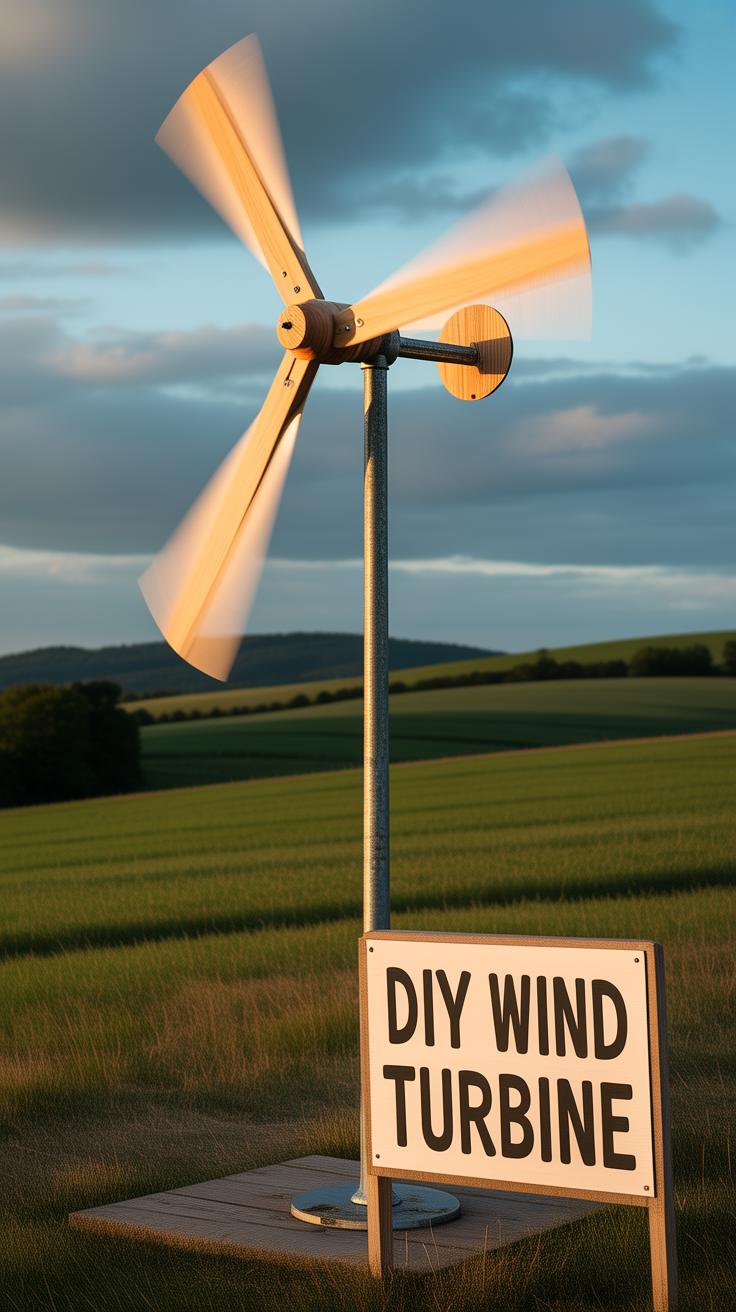
DIY Wind Turbine: Is It Really Worth Building One Yourself?
Building a home wind setup sounds like the perfect self-reliance project: free energy from the air, a weekend of hands-on work, and lower electric bills afterward. But the real-world value hinges on one thing most guides gloss over—whether your site, expectations, and budget match what small wind can realistically deliver. In this guide to DIY Wind Turbine: Is It Really Worth Building One Yourself?, you’ll get a practical, numbers-first way to decide, plus a clear look at costs, performance, maintenance, permitting, and alternatives if wind isn’t your best option.
Wind power can be incredible in the right conditions (steady wind, clear tower height, safe engineering, and appropriate electrical design). In the wrong conditions (low wind, turbulence, undersized tower, unrealistic load goals), a DIY build can turn into a loud backyard ornament. Let’s separate the myth from the math.
Understanding what a DIY wind turbine can realistically power
A DIY wind turbine’s output depends on wind speed more than anything else. That’s not a motivational line—it’s physics. Power in the wind scales roughly with the cube of wind speed, meaning a small increase in average wind can dramatically increase energy production, and a small decrease can destroy it.
Why “rated watts” can be misleading
Many small turbines advertise a “rated power” (for example, 400W, 1000W, 2000W). That rating typically assumes a high wind speed—often around 11–12 m/s (25–27 mph) depending on the manufacturer. Many residential sites rarely see that speed at turbine hub height.
What matters to you is annual energy, usually measured in kWh/year, and whether that matches your loads:
- A few LED lights, phone charging, a laptop, and a small DC fridge may be realistic for some setups.
- Running electric heat, central AC, or a full-sized well pump is usually not realistic without a serious tower, rotor diameter, and site wind resource.
The role of tower height and turbulence
Small wind is extremely sensitive to airflow quality. Trees, rooflines, and nearby buildings create turbulence that reduces output and increases wear. A turbine mounted “on the roof” often underperforms compared to a properly sited turbine on a freestanding tower.
A common rule of thumb:
- Put the rotor at least 30 feet above anything within 300 feet (often cited as “30/300 rule”).
If your property can’t support that height (or local rules prevent it), DIY wind starts looking less “worth it” and more “wish it.”
DC battery charging vs grid-tie
Most DIY builders fall into one of two camps:
- Battery-based (off-grid/hybrid): Wind charges a battery bank through a charge controller; inverter powers AC loads.
- Grid-tie: Power is inverted and fed into the grid (often requiring certified equipment and utility approval).
Battery-based systems can be more forgiving for DIY experimentation but demand careful electrical design and safety planning. Grid-tie can be efficient but usually faces more permitting and equipment constraints.
The true cost of building a wind turbine yourself
DIY wind can look cheap if you only count blades and a generator. The real cost sits in the “boring” items: tower, wiring, protection, batteries, and the hardware that keeps things safe.
Typical cost categories you should budget for
Even if you avoid exact numbers (because local pricing varies widely), you’ll want to account for:
- Rotor + alternator/generator: blades, hub, magnet rotor (if axial-flux), stator coils, bearings.
- Tower system: guyed tower or freestanding; base/foundation; anchors; gin pole; tilt-up hardware.
- Electrical equipment: rectifier (if alternator output is AC), charge controller, dump load (critical), inverter (if using AC loads), disconnects, fuses/breakers, surge protection, grounding.
- Battery bank (if off-grid): plus battery cabling, lugs, bus bars, ventilation, monitoring.
- Cabling: heavy gauge wire sized for voltage drop; conduit; strain relief; weatherproofing.
- Tools and fabrication: welding, machining, balancing tools, resin/epoxy, fasteners.
- Maintenance and replacement: bearings, blades, slip rings (if used), brake system parts.
The hidden cost: tower height done right
The tower often costs more than the turbine. It’s also the difference between “it spins” and “it produces.” If you underbuild the tower or mount low (to save cost), you can lose so much energy that the entire project becomes uneconomic.
The hidden cost: mistakes and iterations
DIY wind is a system engineering project. Many builds require redesign:
- Improper blade pitch causes poor startup or overspeed.
- Undersized wiring wastes output as heat.
- No dump load leads to battery overcharge and dangerous voltages.
- Weak tail/furling causes runaway RPM in storms.
That doesn’t mean you shouldn’t do it. It means you should value your time and learning curve as part of the cost.
Problem-solution bridge for energy resilience
If your main goal is resilience (not just saving money), you might want a broader off-grid plan that doesn’t rely solely on wind. Many people pair wind with solar, smaller loads, and backup generation.
💡 Recommended Solution: Ultimate OFF-GRID Generator
Best for: building a more complete backup-power strategy alongside DIY projects
Why it works:
- Helps you think in systems (loads, storage, redundancy) rather than gadgets
- Useful when wind conditions are seasonal or inconsistent
- Supports planning for outages and off-grid scenarios
Site assessment and wind resource basics you should not skip
If you do nothing else before building, do this: assess your wind resource honestly. Most small wind disappointments trace back to poor siting.
Step one: understand average wind speed at hub height
Wind maps are a starting point, not a verdict. Your local terrain, tree line, and microclimate matter. The most accurate approach is measuring wind at your intended hub height for as long as you can—ideally months, better a year.
If that’s not feasible, you can still do better than guessing:
- Look for nearby airport wind data (not perfect, but helpful).
- Observe vegetation “flagging,” snow drifting patterns, and local anecdotes.
- Compare your property to known windy features: ridgelines, open plains, coastal exposure, valley funnels.
Step two: identify turbulence sources
Turbulence reduces output and increases fatigue loads on blades and tower. Common culprits:
- Houses and outbuildings
- Tree canopies
- Hills and abrupt terrain changes
- Roof mounting (often a turbulence magnet)
A turbine in turbulent air can be noisier, less productive, and harder on bearings and blades.
Step three: match turbine size to your conditions
Bigger isn’t always better if your winds are moderate and your tower is short. Rotor diameter matters immensely for energy capture. Trying to compensate for low wind with a “high watt” small rotor usually fails.
Aim for a design that:
- Starts charging at realistic wind speeds
- Has sane overspeed control (furling, pitch control, braking, or electrical loading strategies)
- Uses a tower high enough to access smooth airflow
Step four: plan for seasonal variability
Many locations have windier winters and calmer summers (the reverse is also possible). If you’re building for year-round power:
- Pair wind with solar (often complementary seasonally)
- Reduce loads via efficiency (LEDs, DC appliances, insulation, smart power management)
As many off-grid energy educators emphasize, “resilience comes from redundancy: multiple generation sources and reduced demand, not one oversized device.”
If you want a structured way to think about alternatives and hybrid setups, many people explore systems-based approaches like the Energy Revolution System. Many professionals rely on tools like this to streamline planning—especially when deciding whether wind, solar, storage, or load reduction provides the best return for a specific property.
DIY wind turbine design choices that make or break performance
DIY wind turbines generally fall into two design families: horizontal-axis (HAWT) and vertical-axis (VAWT). Most high-performing small turbines are horizontal-axis for good reasons.
Horizontal-axis vs vertical-axis
Horizontal-axis (propeller style):
- Typically better efficiency in most residential conditions
- More mature design norms and community knowledge
- Requires yawing into the wind (tail vane or yaw mechanism)
Vertical-axis:
- Attractive because it’s “omnidirectional”
- Often underperforms at small scale
- Can suffer from torque ripple and lower efficiency
- Some designs look great but can be poor energy producers relative to swept area
For most DIY builders seeking real kWh, a horizontal-axis, properly towered turbine is the more proven path.
Key safety systems: furling, braking, and dump loads
Wind turbines must survive storms. Your design needs a plan for high wind.
- Furling: the turbine turns out of the wind to limit RPM.
- Mechanical braking: can help for maintenance or emergency stops.
- Electrical braking / diversion load (dump load): essential in battery-based systems to prevent runaway voltage and battery overcharge.
If you’re charging batteries, a dump load is not optional. When batteries fill and the controller stops charging, the turbine still needs a place to send power. Without it, you risk dangerously high voltages and overspeed.
Electrical topology: voltage matters
Low-voltage systems (12V) require large currents, which needs thick cable and increases losses over distance. Many small wind builders choose:
- 24V or 48V battery banks to reduce current and voltage drop
- Short cable runs where possible
- Correct wire sizing for expected currents and distance
Noise and neighbors
Even a well-built turbine makes noise:
- Aerodynamic “whoosh”
- Mechanical hum or vibration
- Tower resonance if poorly designed
Blade balance, proper bearings, and smooth airflow reduce noise. Turbulence and rooftop mounting increase it. If neighbors are close, this factor alone can decide whether DIY wind is “worth it.”
Permitting, zoning, and real-world constraints to plan for
A DIY wind build can be technically successful and still fail due to rules, inspections, or neighbor backlash. Handle this early.
Zoning and height limits
Many jurisdictions restrict:
- Maximum tower height
- Setbacks from property lines
- Noise levels
- Structural engineering requirements
Some allow small towers “by right,” others require conditional use permits. Treat this like a building project, not a hobby toy.
Utility interconnection (grid-tie)
If you intend to export power to the grid, utilities often require:
- Certified inverters
- Anti-islanding protection
- Signed interconnection agreements
- Permit inspections
DIY grid-tie wind is usually more complex than DIY solar due to variable frequency/voltage and turbine control requirements. Battery-based systems can be more DIY-friendly—but still require safe wiring and inspection compliance.
Insurance and liability
A tower is a structure. If it falls or throws debris, you may face liability. Consider:
- Wind loading and engineering
- Proper foundations and anchors
- Documented build choices
- Whether your homeowner’s policy has restrictions
Expert quote format (affiliate integration)
“As many preparedness educators note, ‘Water and power are the two pillars of household resilience—and planning beats panic every time.’” If you’re building energy independence so you can keep pumps, filtration, and communications running during outages, pairing your wind project with a practical household water resilience plan can be smart. Many people use resources like SmartWaterBox to think through storage, treatment, and continuity—especially when power sources vary.
When a DIY wind turbine is worth it (and when it isn’t)
You can absolutely justify building a wind turbine yourself—but only in the right scenario.
DIY wind is often worth it if…
- You have consistent wind at tower height (not just breezy afternoons).
- You can install a real tower high enough for smooth airflow.
- You enjoy fabrication and are comfortable with iterative engineering.
- Your goal is supplemental power (battery charging, seasonal boost), not total household electrification.
- You value resilience and learning as much as ROI.
A strong use case: an off-grid cabin with good ridge exposure, limited winter solar, and modest loads.
DIY wind is usually not worth it if…
- Your site is turbulent (trees/buildings) and you can’t get above it.
- You’re in a low-wind area and hope marketing “rated watts” will overcome it.
- You need quiet operation in a dense neighborhood.
- You want plug-and-play savings with minimal maintenance.
- You can’t do a safe tower (foundation, anchors, fall zone).
In those cases, solar or efficiency upgrades often outperform small wind.
Comparison/alternative framing
While small wind looks appealing because it can generate power at night and in winter storms, solar often wins for simplicity, predictability, and lower maintenance. If your goal is dependable household backup rather than experimenting with wind engineering, a structured off-grid approach may deliver faster results.
💡 Recommended Solution: Energy Revolution System
Best for: comparing options when deciding between DIY wind, solar, or hybrid
Why it works:
- Encourages realistic load planning and prioritization
- Helps avoid overspending on underperforming gear
- Useful for designing a balanced resilience setup
Maintenance, durability, and the long-term ownership reality
Wind turbines are exposed machines. Sun, rain, dust, ice, lightning, and vibration all matter. DIY builders who plan for maintenance enjoy their turbines longer.
Regular inspection checklist
Plan on scheduled checks—especially after storms:
- Blade condition (cracks, erosion, leading edge wear)
- Bolt torque and hub integrity
- Guy wire tension and anchor integrity
- Bearing noise/play
- Tail vane condition and furling operation
- Wire chafe points and tower cable strain relief
- Grounding connections and surge protection status
Common failure points in DIY wind
- Bearings: cheap bearings fail quickly under vibration and misalignment.
- Blades: imbalance and fatigue lead to cracks.
- Wiring: undersized cable or poor weatherproofing leads to losses and corrosion.
- Controllers/dump loads: heat management and correct sizing are essential.
- Towers: inadequate foundation, poor anchors, improper guying angles.
Lightning and grounding
A tall metal structure on a hill is a lightning invitation. Even a nearby strike can damage electronics.
A prudent grounding approach often includes:
- Ground rods at tower base (and sometimes at guy anchors)
- Bonding tower, guy wires (if appropriate), and electrical ground
- Surge protection on lines entering power equipment
- Keeping sensitive electronics protected and properly bonded
If you’re building resilience, think beyond energy alone. Health, water, food, and preparedness systems all intersect during outages.
Tools & Resources for a broader self-sufficiency plan
- The Self-Sufficient Backyard — practical planning for food, space use, and home production
- The Lost SuperFoods — focuses on shelf-stable food knowledge and storage-minded recipes
- Home Doctor — general guidance for household preparedness and health-related readiness
These aren’t “wind turbine” tools, but they complement the same goal: staying comfortable and capable when utilities are unreliable.
How to decide, step-by-step, if building one yourself makes sense
If you want a clear decision framework, use this process. It keeps you from falling in love with spinning blades before you’ve validated the real constraints.
Step 1: define your load and success criteria
Write down what you want wind to do:
- Keep batteries topped up for lights and devices
- Run a DC fridge
- Support a well pump (often challenging)
- Reduce grid usage by a specific kWh target
If you can’t define the goal, you can’t judge “worth it.”
Step 2: audit your site honestly
- Can you put a tower high enough to reach smooth airflow?
- Do you have a safe fall zone?
- Do you have strong, consistent wind for much of the year?
If you’re surrounded by tall trees and houses, wind is likely a poor bet.
Step 3: pick a plan: learning build vs dependable generation
A DIY wind turbine can be:
- A learning project (fantastic if you enjoy engineering)
- A critical power asset (requires conservative design and strong site wind)
If you need dependable power, be more conservative: robust tower, proven rotor designs, proper controllers, strong safety margins.
Step 4: run a “kill switch” test
Before spending heavily, answer:
- If the turbine produces half of what you hope, are you still happy?
- If you need to climb and maintain it every season, are you still happy?
- If permitting or neighbor concerns stop the tower, what’s your fallback?
If those answers are “no,” strongly consider solar + efficiency instead.
Step 5: build a resilience stack (not a single-point solution)
A practical path for many households is:
- Reduce loads (efficiency)
- Add solar (predictable)
- Add wind only if your site is genuinely windy and you can tower correctly
- Add water storage/treatment and food resilience
If your motivation for wind is overall preparedness, pairing your energy planning with water readiness can reduce risk. For example, when power is variable, having a plan for water access matters as much as generation—resources like Water Freedom System are often used as a starting point to think through household water independence strategies.
Conclusion
So, DIY Wind Turbine: Is It Really Worth Building One Yourself? It’s worth it when your site has strong, clean wind at tower height, you can build (or buy) a safe tower, and your expectations match what small wind can truly provide—supplemental energy, battery charging, and resilience support rather than effortless whole-home power. It’s not worth it when wind is turbulent or weak, height is restricted, or you want a low-maintenance, predictable return—because in those cases, solar and efficiency almost always deliver more dependable results.
If you approach DIY wind as a system—resource assessment, tower first, electrical safety, overspeed control, maintenance planning—the project can be both practical and deeply satisfying. If you approach it as a cheap shortcut to free electricity, it usually becomes an expensive lesson in aerodynamics.
FAQ
What is the biggest factor in whether a DIY wind turbine is worth it?
Average wind speed at the turbine’s hub height, plus airflow quality (low turbulence). Without sufficient wind and tower height, even a well-built turbine won’t generate meaningful energy.
Can a DIY wind turbine power a whole house?
Usually not by itself. Whole-house power typically requires substantial energy production, large storage, robust inverters, and a consistently windy site. DIY wind is more often used for supplemental charging and modest loads in off-grid or hybrid systems.
Are rooftop wind turbines worth building?
In most cases, no. Rooftops tend to be turbulent, which reduces output and increases noise and wear. A freestanding tower placed above turbulence is far more effective and typically safer.
What safety components should a DIY wind turbine include?
At minimum: reliable overspeed control (furling and/or braking), proper grounding and surge protection, correct wire sizing, and for battery charging systems a properly designed charge controller plus dump/diversion load.
Is a DIY wind turbine better than solar for off-grid power?
It depends on your site. Solar is generally more predictable and lower-maintenance. Wind can outperform solar in very windy areas or during seasons when solar is weak—making hybrid systems attractive where conditions support it.
RANK MATH SEO BLOCK
SEO Title (≤60 chars): DIY Wind Turbine: Is It Really Worth Building One?
Meta Description (≤160 chars): DIY Wind Turbine: Is It Really Worth Building One Yourself? Learn costs, tower needs, wind site checks, safety, and better alternatives.
URL Slug: diy-wind-turbine-worth-it
Focus Keyword: DIY Wind Turbine: Is It Really Worth Building One Yourself?
Suggested Schema Type: FAQ