
On a dark autumn night, far from city lights, you can see another galaxy with your bare eyes. It looks like a faint, fuzzy smudge. That smudge is the Andromeda galaxy, a spiral of about a trillion stars sitting 2.5 million light-years away. The light reaching your eyes left Andromeda before our species existed, so you’re looking at the galaxy as it was 2.5 million years ago.
Here’s what that distance really means, how astronomers measured it, and why Andromeda may eventually be heading our way.
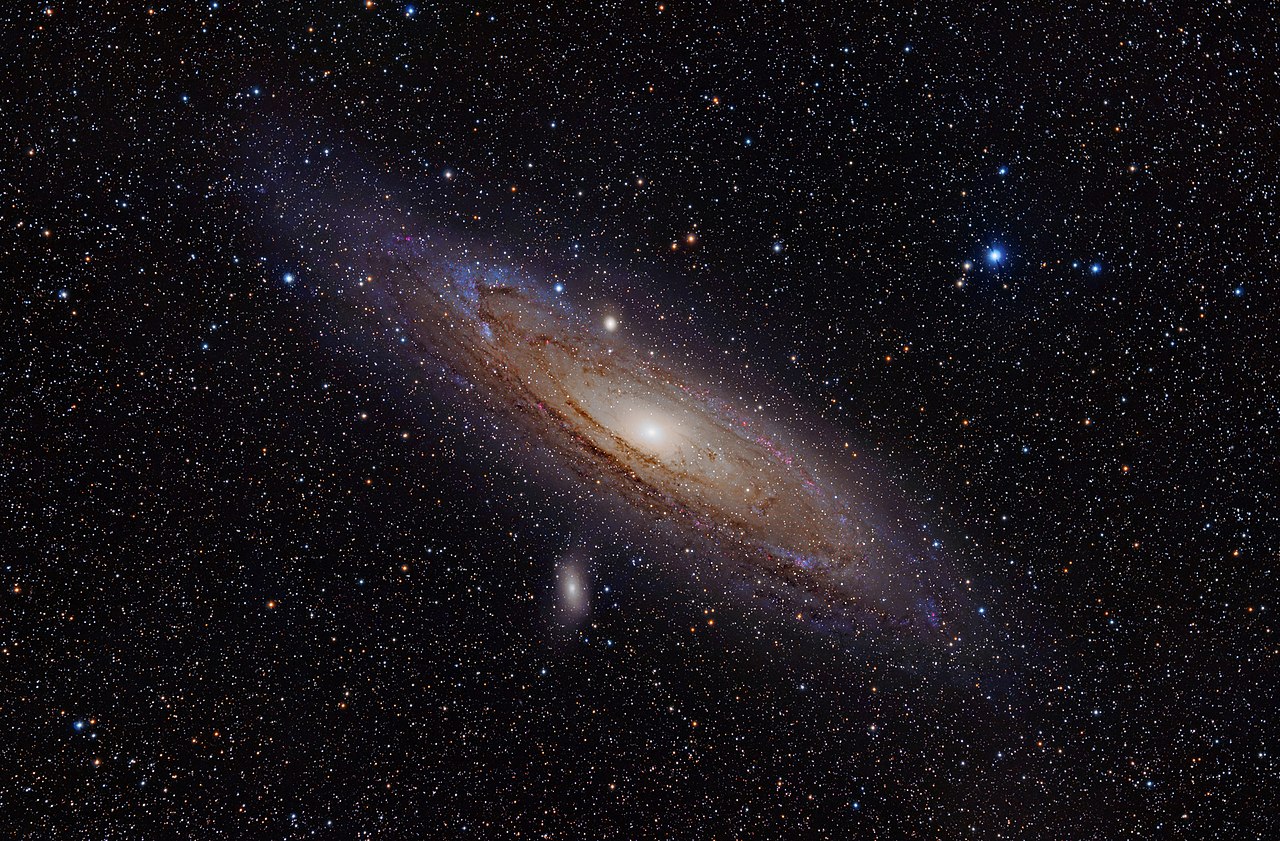
Andromeda Galaxy: Key Facts
| Distance | About 2.5 million light-years (roughly 24 quintillion km) |
|---|---|
| Diameter | About 150,000–220,000 light-years, larger than the Milky Way |
| Number of stars | Roughly 1 trillion |
| Catalog name | Messier 31 (M31) |
| Visible to the naked eye? | Yes, from dark skies; best seen in autumn in the Northern Hemisphere |
| Moving toward us at | About 110 km/s relative to the Milky Way |
How Far Is 2.5 Million Light-Years?
A light-year is the distance light travels in one year, about 9.46 trillion kilometers. Light is the fastest thing in the universe. It could circle Earth more than seven times in one second.
Even at that speed, light from Andromeda takes 2.5 million years to reach us. In kilometers, that’s around 24 quintillion (a 24 followed by 18 zeros), a number too big to picture. Some comparisons help:
- Light from the Moon reaches us in about 1.3 seconds.
- Light from the Sun takes about 8 minutes and 20 seconds.
- Light from Proxima Centauri, the nearest star, takes about 4.2 years.
- Light from Andromeda takes about 2,500,000 years.
The fastest spacecraft humans have built would still need billions of years to get there.
Looking Back in Time

Because light takes time to travel, every time you look into space you’re looking into the past. The farther away something is, the older the light.
The photons from Andromeda hitting your eye tonight set off about 2.5 million years ago. At that time, our species, Homo sapiens, did not exist yet; we appeared only around 300,000 years ago. The earliest members of our human genus were just beginning to appear in Africa.
That also means we can’t know what Andromeda looks like right now. Any changes there over the past 2.5 million years haven’t reached us yet.
How Astronomers Measured the Distance
For centuries, Andromeda was called the “Andromeda Nebula,” and many astronomers believed it was a cloud of gas inside our own galaxy. The question was settled in the 1920s.
In 1923, Edwin Hubble spotted a special kind of star in Andromeda called a Cepheid variable. Cepheids pulse in brightness, and the time each pulse takes reveals how bright the star really is. Comparing its true brightness with how dim it looks from Earth let Hubble calculate its distance. The result put Andromeda far outside the Milky Way and proved it was a separate galaxy. Our picture of the universe grew enormously overnight.
Hubble’s first estimate was too small. Modern measurements using Cepheids, eclipsing binary stars and other methods agree on about 2.5 million light-years.
Our Place in the Local Group

Andromeda and the Milky Way are the two largest members of the Local Group, a collection of more than 80 galaxies held together by gravity. The third-largest is the Triangulum galaxy (M33). The rest are small dwarf galaxies, many of them orbiting either Andromeda or the Milky Way.
On cosmic scales, 2.5 million light-years is close. Andromeda is the nearest large galaxy to us, and that’s why it’s the most distant object most people can see without a telescope.
Is Andromeda Going to Collide With the Milky Way?

Andromeda is moving toward the Milky Way at about 110 kilometers per second. For years, scientists said the two galaxies would collide and merge in about 4.5 billion years, forming one giant elliptical galaxy sometimes nicknamed “Milkomeda.”
A 2025 study using fresh data from the Hubble and Gaia space telescopes made the picture less certain. When the researchers included the pull of other Local Group galaxies, such as Triangulum and the Large Magellanic Cloud, they found only about a 50% chance of a merger in the next 10 billion years. A head-on collision within 5 billion years now looks much less likely than once thought.
Even if the galaxies do merge, stars are so far apart that almost none of them would actually hit each other. The sky from Earth would change dramatically, but the solar system would most likely survive.
How to See Andromeda Yourself
- Pick the right time. From the Northern Hemisphere, Andromeda is best seen from late summer through winter, especially in autumn.
- Find a dark sky. Get away from city lights and avoid nights with a bright Moon.
- Find Cassiopeia. Look for the W-shaped constellation Cassiopeia. Andromeda sits below it, near the Great Square of Pegasus.
- Use averted vision. Look slightly to one side of the galaxy. The edge of your vision is more sensitive to faint light.
- Try binoculars. Even basic binoculars turn the fuzzy patch into an obvious oval glow.
Keep exploring: Our own galaxy has secrets too. Read Fermi Bubbles: The 50,000 Light-Year Scars Our Galaxy Can’t Hide, or meet the star that’s leaving the Milky Way for good in S5-HVS1: The Star Our Galaxy Threw Away at 6 Million km/h.
Frequently Asked Questions
How far away is the Andromeda galaxy?
The Andromeda galaxy is about 2.5 million light-years from Earth, roughly 24 quintillion kilometers. It’s the nearest large galaxy to the Milky Way.
Can you see Andromeda without a telescope?
Yes. Under dark skies, Andromeda is visible to the naked eye as a faint, fuzzy patch. It’s the most distant object most people can see without optical help.
When will Andromeda collide with the Milky Way?
Older estimates said about 4.5 billion years. A 2025 study found only about a 50% chance that the two galaxies merge within the next 10 billion years, so a collision is no longer certain.
Is the Andromeda we see what it looks like today?
No. Its light takes about 2.5 million years to reach us, so we see Andromeda as it was 2.5 million years ago.