
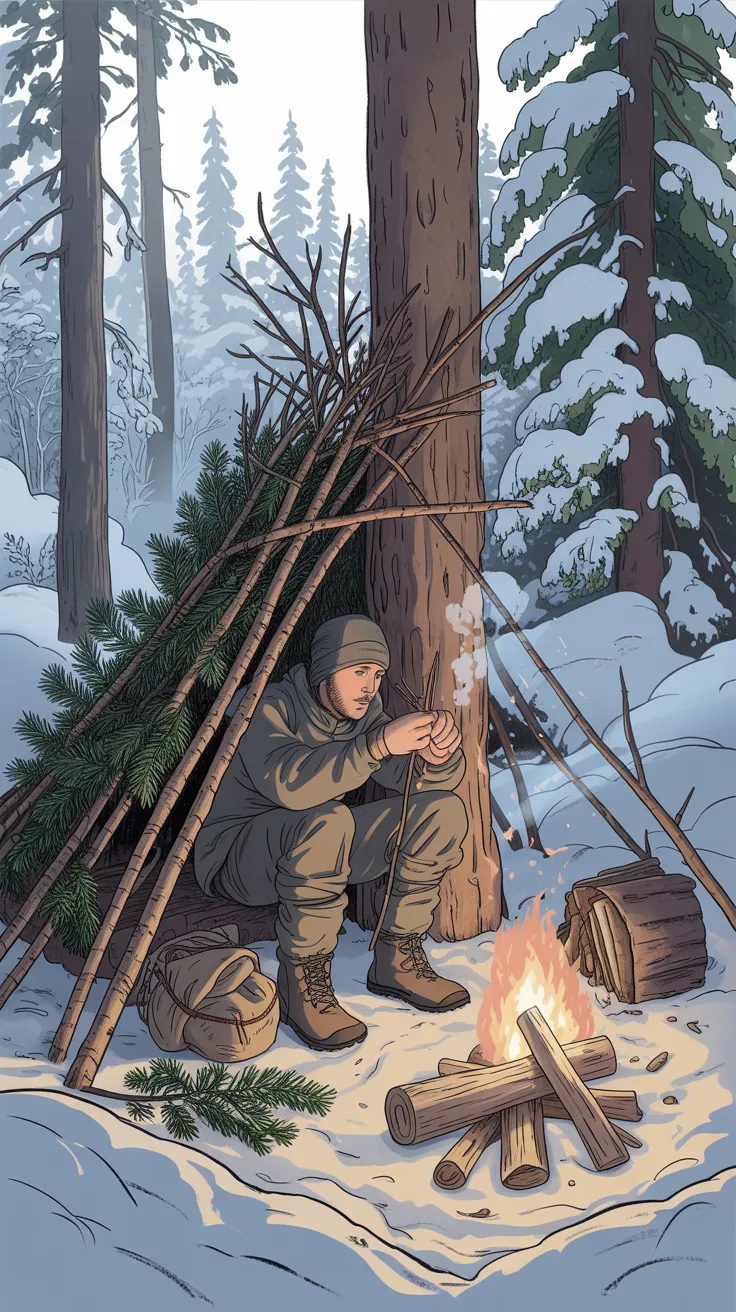
Winter changes everything. The same campsite that feels forgiving in summer becomes a high-consequence environment when temperatures drop, daylight shrinks, and wet snow turns into wind-driven ice. That’s why survival camping bushcraft outdoor shelter-making skills for winter aren’t a niche hobby—they’re foundational fieldcraft. A well-built shelter reduces heat loss, blocks wind, manages moisture, and gives you a controllable microclimate where you can rest, rewarm, and make better decisions.
In cold conditions, the shelter is often more important than the fire. Fire can fail in heavy precipitation or high winds. Fuel can be scarce. But a properly sited and constructed shelter keeps you alive even when everything else is going wrong. In this guide, you’ll learn practical winter shelter methods, how to pick the right design for your terrain, and the bushcraft techniques that make your build faster, stronger, and safer.
“In cold-weather survival, reducing exposure beats chasing comfort,” as many winter backcountry instructors emphasize. “A dependable water plan and a dependable shelter plan are the two pillars that keep small problems from turning into emergencies.”
Table of Contents
Winter shelter fundamentals that keep you alive
Before you cut a pole or pile a single armload of branches, you need to understand what actually kills heat in winter. The best winter shelter designs are built around controlling these four forces:
Conduction, convection, radiation, and evaporation
- Conduction (ground cold): Frozen ground and snow steal heat quickly. If you lie directly on them, your body becomes a heater for the earth.
- Convection (wind): Moving air strips warmth. Windproofing is often more valuable than extra roof thickness.
- Radiation (heat leaving your body): Your body radiates heat to colder surroundings, especially at night under clear skies.
- Evaporation (wet clothing, sweat): Moisture management is critical. Sweating during the build can become dangerous later.
Core principles of winter shelter-making
- Insulate from the ground first. A weak roof with great bedding can be safer than a great roof with poor insulation.
- Block wind and manage airflow. You want controlled ventilation, not drafts.
- Keep the interior small. Tiny shelters warm faster and retain heat better.
- Use what’s abundant. In deep snow, snow becomes your building material. In subalpine forests, evergreen boughs and deadfall become your toolkit.
- Build with time in mind. Choose a shelter you can finish before darkness and fatigue.
Problem-Solution Bridge: Struggling with the “basics” that make winter survivable—especially hydration and dependable field routines? Many preparedness-minded campers use resources like BlackOps Elite Strategies to structure cold-weather plans and decision-making habits, so skills don’t collapse under stress.
Site selection and hazard checks in snow country
A winter shelter can fail even if it’s well-built—if it’s built in the wrong place. In winter, site selection is a life-safety skill.
Find natural wind protection
- Look for terrain breaks: leeward sides of ridges, dense timber, rock outcrops.
- Avoid funnel zones like gullies where wind accelerates.
Avoid overhead and slope hazards
- Widowmakers: snow-loaded branches or dead limbs.
- Avalanche paths: open slopes, terrain traps, and runout zones. If you don’t know avalanche basics, avoid steep bowls and clear chutes entirely.
- Cornices: overhanging snow near ridge lines.
Think about drainage—even in winter
Snow melts from your body heat, from a fire, or from sun exposure. If you build in a low spot, you can end up in a cold slurry by morning. Choose slightly elevated ground when possible.
Build near materials and fuel
A dreamy campsite is useless if:
- Bedding material is far away,
- You must travel icy slopes to gather poles,
- Firewood is inaccessible or buried.
Route planning and time-on-task
Cold-weather shelter builds cost energy. Choose a site that allows:
- Short trips for boughs/poles,
- Safe footing,
- A clean path to water or snow collection.
Contextual Inline Mention: Many winter campers streamline their hydration plan with tools like SmartWaterBox because having a consistent water approach reduces the time and fuel spent improvising melt-and-store routines.
Essential winter shelter-making skills (tools, knots, and insulation craft)
Winter bushcraft shelter building isn’t about owning fancy gear—it’s about executing a set of repeatable skills under cold, fatigue, and limited daylight.
Cutting and processing wood safely
- Use controlled cuts. Cold hands and awkward footing increase risk.
- Make clean pole notches: they prevent collapse when snow loads the roof.
- Prefer dead standing wood for drier fuel and stronger poles.
Winter knots and lashings that matter
You don’t need a sailing manual—just reliable connections:
- Trucker’s hitch: tension ridgelines.
- Taut-line hitch: adjustable guylines.
- Bowline: fixed loop that won’t slip.
- Square lashing / diagonal lashing (basic): stabilizes tripods and frames.
In freezing weather, cord can stiffen. Make larger loops, avoid over-complicating, and check knots after the shelter settles.
Insulation and bedding technique
Your bedding is your mattress and your “floor.” In many winter scenarios, it’s the most important part of the build.
- Gather a shocking amount of insulation: evergreen boughs, dry grass, leaf litter (if available), cattail fluff, or spruce tips.
- Aim for a thick, springy layer between you and snow.
- Create a vapor/moisture strategy: avoid sweating during the build; vent your shelter slightly to reduce condensation.
Snow as a building material
Snow can be:
- Insulation (trapped air),
- Wind block (walls, berms),
- Structure (quinzhee, snow cave with proper snowpack),
but it can also create condensation and collapse risk if poorly built.
💡 Recommended Solution: Aqua Tower
Best for: building a more reliable water routine while practicing winter shelter skills
Why it works:
- Encourages consistent hydration planning when cold reduces thirst cues
- Supports a “shelter + water” priority system during winter outings
- Helps reduce reliance on improvised, time-heavy water solutions
Low-snow forest shelters: lean-to, debris hut, and modified A-frame
When snow is thin or patchy and you have timber, you can build effective shelters with branches, poles, and debris. These designs rely heavily on windproofing and insulation.
The winter lean-to (with a reflector wall option)
A lean-to is fast and effective if you:
- Face the opening away from prevailing wind,
- Build a thick rear wall,
- Add a low entrance to reduce heat loss.
For added warmth, some bushcrafters build a reflector wall opposite a fire, bouncing radiant heat into the shelter. This requires safe fire management and careful spacing.
Best use case: quick overnight, heavy wind, moderate cold, abundant wood.
The debris hut (winter version)
A debris hut is essentially a small insulated cave made of sticks and debris.
Key upgrades for winter:
- Make it smaller than you think (just enough to crawl in).
- Install a strong ridgepole and closely spaced ribs.
- Pile debris thick—then thicker.
- Add a door plug (pack, bark slab, or bough bundle) to cut drafts.
Best use case: emergency shelter when time is short and debris is abundant.
Modified A-frame with snow skirt
Build a ridgeline frame like an A-frame, cover with boughs/bark/tarp if available, then pack snow along the base as a “skirt” to block wind. This hybrid approach is common in shoulder seasons and forest snowlines.
Comparison/Alternative: While a simple tarp lean-to is popular for speed, a debris-based winter build can outperform it for warmth if you can gather enough insulation—because trapped air is your best “heater.”
Deep-snow shelters: snow trench, quinzee, and snow cave safety
When the snow is deep enough, snow shelters can provide remarkable protection from wind and cold—often holding a stable interior temperature compared to the outside. But they demand correct technique and safety checks.
Snow trench (fast, functional)
A trench is one of the quickest snow shelters:
- Dig a trench longer than your body and just wide enough to lie down.
- Insulate the bottom with boughs or spare clothing (avoid direct contact with snow).
- Roof it with poles, a tarp, skis, or sturdy boughs.
- Pile snow on top for insulation, leaving a small vent.
Strength: speed and low material needs.
Weakness: can be damp; requires bedding.
Quinzhee (snow mound shelter)
A quinzhee is built by piling snow into a mound, letting it sinter (harden), then hollowing it out.
Critical points:
- Let the mound set up before digging.
- Keep walls uniformly thick.
- Poke measuring sticks into the mound so you don’t dig too thin.
- Add a vent hole, and keep it open.
Strength: can work with many snow types.
Weakness: time and effort; collapse risk if rushed.
Snow cave (only with proper snowpack)
Snow caves require a stable drift or bank.
Safety essentials:
- Never undermine the roof.
- Build a sleeping platform higher than the entrance to trap warmer air.
- Maintain ventilation and monitor for condensation.
- Mark the exterior so it’s visible in storms.
Expert Quote Format:
“As many cold-weather survival educators note, ‘A stable shelter is meaningless if you can’t hydrate and keep routine under cold stress—systems matter as much as skills.’” For people building those systems at home, URBAN Survival Code is often used as a structured preparedness resource to help translate bushcraft theory into repeatable plans.
Heat management: microclimate design, ventilation, and safe fire use
A winter shelter’s job isn’t to feel like a cabin. It’s to tilt the energy equation in your favor: lose less heat than you produce, and recover more efficiently.
Make the interior smaller and smarter
- Reduce cubic volume: less air to heat.
- Use your pack as a draft block.
- Create a door plug from boughs or spare layers.
Ventilation is non-negotiable
Even in a snow shelter, you need airflow to reduce:
- Condensation soaking insulation,
- Frost buildup,
- Dangerous air quality issues.
A small vent hole plus a slightly leaky entrance is often enough. Check vents regularly during snow or wind.
Fire: benefits and boundaries
Fire is powerful, but it’s also a hazard.
- In enclosed shelters, avoid open flame unless you’re trained and have ventilation.
- If using a fire near a lean-to:
- Keep distance from combustibles,
- Build a reflector wall from logs or packed snow,
- Prepare extinguishing snow/water nearby.
Sleep system and body heat strategy
Your night plan is your survival plan:
- Change out of sweaty layers.
- Protect extremities: dry socks, head insulation, loosen boots.
- Eat a calorie-dense snack before sleep (if available).
- Keep water from freezing by insulating the container and storing it near you (but not risking leaks into insulation).
Problem-Solution Bridge: If you’re building an all-season safety plan that includes medical readiness (blisters, cold injury prevention, wound care basics), Home Doctor is commonly used as a general home-and-field reference-style resource—useful for decision-making when professional care is far away.
Water, calories, and energy: shelter is only half the winter equation
You can build an excellent shelter and still fail if dehydration and energy depletion catch up. Winter hides dehydration because you don’t feel as thirsty, and snow travel burns calories fast.
Hydration in freezing conditions
Key practices:
- Start hydrated before you build.
- Melt snow efficiently: use a small amount of liquid water first (if available) to prevent scorching.
- Store water in insulated containers; keep one bottle upside down (ice forms at the top first).
- Avoid eating snow directly—it cools you and can worsen dehydration perception.
💡 Recommended Solution: SmartWaterBox
Best for: maintaining a consistent water plan during winter camping and emergencies
Why it works:
- Supports organized storage and access to water when conditions are unstable
- Helps reduce guesswork around “how much is enough” for cold-weather needs
- Reinforces a systems-based approach alongside shelter and heat tactics
Calories and body heat
Your body is the furnace. Without fuel, it can’t heat your core.
- Prioritize high-fat, high-carb foods when active.
- Eat before sleep if possible.
- Avoid pushing into exhaustion—fatigue leads to bad site choices and sloppy tool use.
Contextual Inline Mention: Many preparedness-focused outdoorspeople explore resources like The Lost SuperFoods to broaden their understanding of shelf-stable food planning and resilient nutrition—important when winter conditions make resupply difficult.
Winter shelter practice plan: drills, mistakes to avoid, and a simple checklist
The fastest way to gain winter shelter confidence is to practice in controlled conditions—close to home, in fair weather first, then progressively colder.
Skill-building drills
- One-hour shelter challenge: build a functional windbreak + bedding base without rushing cuts.
- No-tarp build: practice a debris hut frame and learn how much insulation you truly need.
- Snow trench rehearsal: time your dig, test roof options, and evaluate condensation.
- Night audit: wake once and check draft points, venting, and moisture.
Common winter shelter mistakes
- Building too big: you can’t heat it.
- Skipping ground insulation: you’ll lose heat all night.
- Overworking and sweating: damp layers destroy warmth later.
- Ignoring wind direction: a perfect roof won’t stop a crosswind.
- No exit plan: storms can bury entrances; always plan a way out and mark it.
Tools & resources to support winter readiness
Use these as education and preparedness resources alongside field practice:
- BlackOps Elite Strategies – planning frameworks that support decision-making under pressure
- URBAN Survival Code – structured preparedness concepts that complement outdoor skills
- SmartWaterBox – water routine support for emergencies and cold-weather disruptions
Quick winter shelter checklist
- Site: leeward, not under dead limbs, not in a drainage low
- Design: small interior, wind-blocked entrance, clear ventilation plan
- Ground: thick insulation layer
- Weatherproofing: tight walls, snow skirt or debris thickness
- Safety: tool control, fire boundaries, visible markings, exit plan
- Sustainment: water plan + calorie plan
Comparison/Alternative: If your focus is broader resilience beyond the backcountry—like handling grid-down cold snaps—resources such as Dark Reset are sometimes used as an alternative angle on preparedness planning, especially when winter shelter concepts need to translate into home-based contingencies.
Conclusion
Mastering survival camping bushcraft outdoor shelter-making skills for winter is about stacking small advantages: picking a safe site, building a compact structure, insulating aggressively, blocking wind, and managing moisture. Whether you choose a forest lean-to with a windproofed back wall, a debris hut packed with insulation, or a snow trench that disappears into the landscape, the winning approach is the one you can reliably execute before darkness with the materials you actually have.
Practice these shelters in low-risk conditions, track what worked (and what didn’t), and refine your routine until it’s automatic. Winter rewards preparation, discipline, and simple systems—because when cold hits hard, the best shelter is the one you can build correctly, every time.
FAQ
What is the best winter shelter for emergency survival in the woods?
A debris hut or modified A-frame can be excellent in forested areas because they use abundant materials for insulation and windproofing. In deep snow, a snow trench is often faster and more realistic than a full snow cave.
How do I keep a winter bushcraft shelter warm without a fire?
Focus on wind blocking, small interior volume, and ground insulation. Most nighttime heat loss happens to the ground and through drafts. Thick bedding (evergreen boughs, dry vegetation) and a tight entrance plug often matter more than a fire.
How thick should bedding be for winter camping?
Thicker than most people expect. Aim for a deep, springy layer sufficient to prevent you from feeling cold seeping up from snow or frozen ground. If you compress it and it “bottoms out,” add more.
Are snow caves safe for beginners?
Snow caves can be safe only with the right snowpack and technique, but they carry real risks (collapse, poor ventilation). Beginners should start with snow trenches or practice with guidance in controlled conditions, always maintaining ventilation.
What should I prioritize first: shelter, water, or fire in winter?
In many winter situations, shelter and insulation come first, then water, then fire—because exposure can overwhelm you quickly. That said, conditions vary; the key is to reduce heat loss immediately while maintaining your hydration plan.