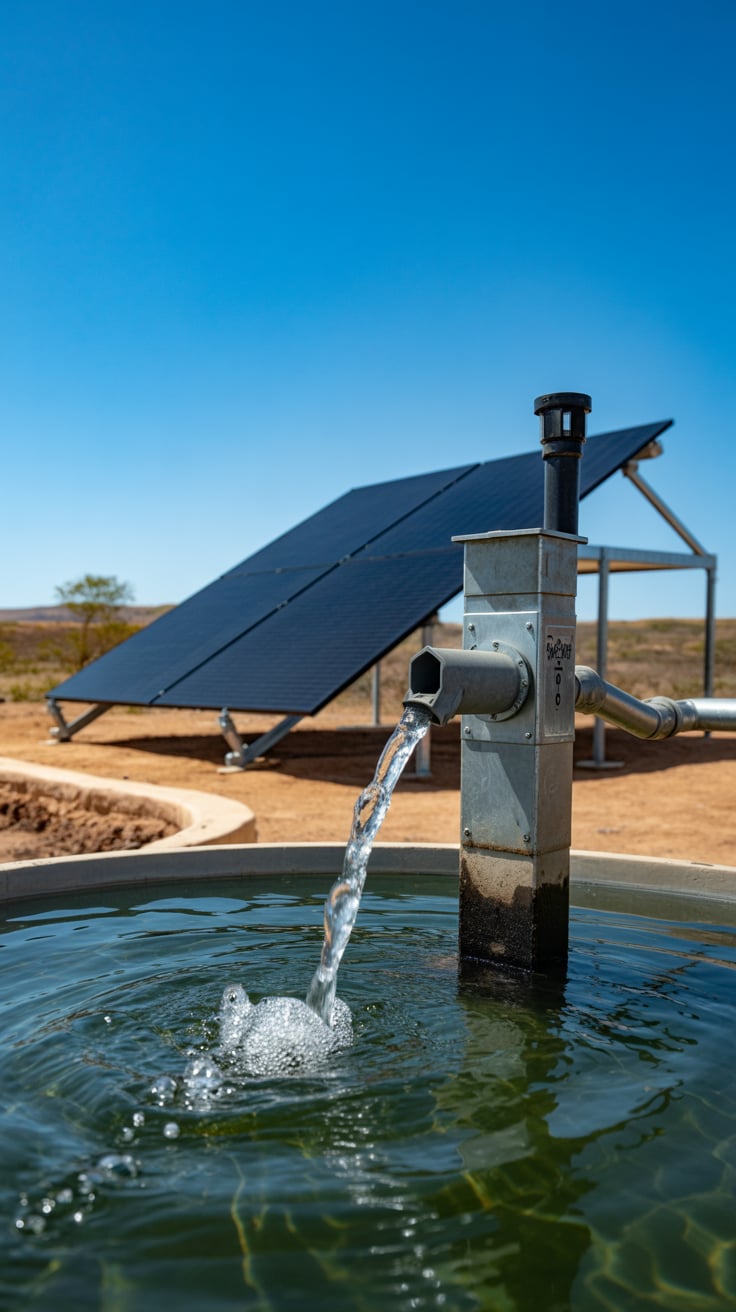
When you need running water without the grid, the goal is simple: turn sunlight into steady, on-demand pressure at your tap. This guide walks you through Water Pump Success: Solar Powered Pressurized Water Off-Grid—how to plan, size, and build a reliable system that pumps, stores, and pressurizes water for daily use. Whether you’re on a rural homestead, a cabin, or prepping for emergencies, you’ll learn the fundamentals and the pro tips that keep water flowing year-round.
For a beginner-friendly resource that complements this guide with practical, step-by-step ideas, explore Aqua Tower.
Table of Contents
Why pressurized water matters off-grid
Gravity-fed barrels and hand pumps work—but life changes when you can twist a faucet and get 40–60 psi like a regular home. That pressure makes showers comfortable, dishwashing easier, and irrigation predictable. It also ensures fixtures like water heaters, washers, and filters work correctly. Off-grid, your challenge is to build a system that:
- Draws from a source: a drilled well, spring, creek, rain collection, or hauled-in water
- Moves it efficiently using a solar-powered pump
- Stores it in a hygienic tank or cistern for buffering and nighttime use
- Delivers pressure on demand via a pressure tank and a pressure switch
- Keeps everything safe from freeze, drought, and power variability
Think of your system as three stages:
- Source and lift: submersible or surface pump moves water from the well, spring box, or cistern
- Storage and conditioning: tanks buffer supply; filters handle sediment and microbes
- Pressure and distribution: a small pressure tank and pressure control deliver steady psi to fixtures
The control strategy is the hidden hero of off-grid systems. Solar availability rises and falls with clouds and seasons; your pump must run when the sun shines, and your home must still have pressure when the sun sets. That’s why many off-grid setups separate the “lift” pump from the “pressure” pump:
- A daytime solar pump fills a ground or loft cistern
- A smaller booster pump (often solar-direct or on a small battery) pressurizes the house from the cistern through a pressure tank
This two-stage approach creates resilience. If midday sun is weak, your stored water carries you. If a pump needs service, you can switch to gravity feed temporarily. And because the high-lift pump runs when solar is strongest, it works with a smaller battery—sometimes none at all—reducing complexity and cost.
Safety and water quality matter, too. Plan for sanitary seals, screened vents, food-grade tanks, and appropriate filtration or disinfection for your source. The result is a system that feels like city water—without the grid.
Solar powered pressurized water off-grid system components
To understand Water Pump Success Solar Powered Pressurized Water Off-Grid, get familiar with the core components and how they connect:
- Solar array: Photovoltaic panels convert sun to DC power. Size the array to your daily pumping energy, seasonal sunlight, and pump voltage.
- Pump controller: Matches power from the array to the pump, improves efficiency (often via MPPT), and provides protections like dry-run or overcurrent cutoffs.
- Pump: Two common categories:
- Submersible pumps (in wells, springs, or cisterns): excellent for deep lift; DC or AC models available
- Surface pumps or jet pumps (near cisterns or shallow sources): used as booster pumps to create pressure
- Storage: A cistern or tank provides a buffer. Options include underground poly tanks, above-ground food-grade tanks, or even a loft tank for gravity backup.
- Pressure tank: A small diaphragm tank reduces short-cycling of the booster pump and maintains consistent pressure.
- Pressure switch and gauge: Automates pump start/stop based on pressure setpoints, typically in the 30–50 psi or 40–60 psi range.
- Plumbing: Food-grade pipe, check valves, unions for service, isolation valves, drain valves, and frost-proof hydrants outdoors.
- Filtration and treatment: Sediment filters, carbon filters, and, if needed for source quality, UV or chlorination.
- Controls and protection: Float switches in the cistern, check valves to prevent backflow, dry-run protection, lightning/surge protection, and sometimes a simple monitor for tank level.
Three typical architectures:
- Solar-direct to cistern + booster to house
- A daytime solar submersible pump fills a cistern whenever sun and the float switch allow.
- A booster pump pressurizes the home from the cistern through a pressure tank.
- Pros: Minimal battery; runs when the sun shines; highly reliable.
- Cons: Requires a cistern and two pumps.
- Battery-backed booster system
- A cistern feeds a booster pump powered by a small battery/inverter or DC booster.
- Pros: Nighttime pressure and steady performance.
- Cons: Adds battery complexity.
- Single deep-well pressure system
- A submersible well pump directly pressurizes the home via a pressure tank.
- Pros: Fewer components.
- Cons: Harder to align with solar variability without significant battery or generator; less buffer during cloudy periods.
Which is best? For most off-grid homesteads, solar-direct to a cistern plus a small booster pump is the sweet spot for reliability and ease of maintenance. The cistern acts like a water battery, absorbing production fluctuations so your taps feel normal.
If you prefer a compact resource that helps you visualize and plan your layout, see SmartWaterBox for practical off-grid water organization concepts.
Design rules for water pump success off-grid
Correct sizing is the difference between a system that glides and one that sputters. The process looks like this:
- Estimate daily demand
- Drinking and cooking: plan conservatively—measure in gallons per person per day
- Hygiene: showers, handwashing, laundry
- Kitchen and cleaning
- Livestock or garden irrigation (often the largest driver)
- Add a margin for seasonal peaks and guests
- Calculate Total Dynamic Head (TDH)
TDH is the total “lift” your pump must overcome:
- Static lift: vertical distance from water level to discharge point
- Friction loss: pressure drop in pipe, fittings, and filters
- Pressure requirement: the psi you want at fixtures, converted to feet (1 psi ≈ 2.31 feet of head)
TDH ≈ static lift + friction loss + (desired psi × 2.31 feet/psi)
Select a pump using its curve
Every pump has a flow-vs-head curve. Find your TDH and read the flow at that point; choose a model that delivers your target gallons per minute (GPM) at that head. If you often draw down a well and water level drops, include that drawdown in your static lift.Size the solar array and controller
- Solar-direct pumps: Size array for worst-case seasonal sun in your location. Look at pump power at your TDH and multiply by the hours of good sun (peak sun hours). Add margin for cloudy spells.
- Battery-backed systems: Ensure the battery/inverter can handle pump start surge (for AC pumps) or continuous draw (for DC pumps).
- Controllers: Use a matched controller with dry-run protection, float switch input, and thermal/overcurrent safeguards.
- Pipe and wire sizing
- Pipe: Undersized pipe creates large friction losses; upsize for long runs and higher GPM to cut energy use.
- Wire: Limit voltage drop (often <3–5%). Longer wire runs need thicker gauge. DC pumps are especially sensitive to voltage sag.
- Storage strategy
- Cistern capacity: Enough for several days of normal use is a common target; more if your well has low yield or you’re in drought-prone areas.
- Float switches: Use redundant level switches (high and low) and an overflow path.
- Plan for winter and storms
- Keep lines below frost depth where possible.
- Insulate and heat-trace exposed runs if you’re in freezing climates.
- Grounding and surge protection reduce lightning risk.
As a companion to the above, Joseph’s Well can broaden your understanding of practical water sourcing and simple off-grid well strategies, useful when your site has limited options.
Storage, pressure tanks, and plumbing layouts
A robust layout starts on paper. Sketch your source, pump, tank, filters, and fixtures with distances and elevations. Then refine for simplicity and serviceability.
Common layout blueprint:
- Source: A well with a sanitary seal, a spring box, rain catchment tied to first-flush diverters, or hauled water
- Lift pump: Submersible pump in the well or spring, or a surface pump at the spring box
- Check valve: Prevents backflow toward the pump
- Cistern: Underground or shielded above-ground tank with screened vent, access hatch, and drain
- Filtration train: Sediment filter (e.g., 20–5 micron), then carbon filter for taste/odor; place a sample port for testing
- Booster pump: Located near cistern with easy access
- Pressure tank: Placed on discharge of booster pump with a pressure gauge
- Pressure switch: Controls the booster pump based on pressure, often set at 30–50 or 40–60 psi
- Distribution manifold: Feeds house, outdoor hydrants, garden, or livestock lines
- Bypass and isolation valves: Enable maintenance without shutting down the entire system
- Drain and purge valves: Facilitate winterizing and service
Filtration and treatment:
- Sediment filtration protects pumps and fixtures.
- Carbon filtration improves taste and removes many organics.
- Disinfection depends on source quality: UV (requires clear water), ozone, or chlorination (follow local codes and manufacturer guidance). Always verify with water testing.
Pressure tank sizing:
- A small tank cushions pump cycling. Off-grid, fewer starts are better. Larger tanks reduce cycling but take space; choose a size that fits your booster pump and daily use pattern.
- Set tank pre-charge correctly (often 2 psi below the cut-in pressure). Check annually.
Gravity assist:
- A cistern located uphill from the house can provide emergency gravity flow if the booster fails.
- Even modest elevation can give usable trickle pressure for essentials.
Winterization:
- Keep pipes below frost line; use insulated, heated boxes for valves and filters where needed.
- Add drain-back loops on outdoor spigots.
- Protect vents from blowing snow and dust.
Monitoring:
- A simple sight gauge or level sensor on the cistern helps you catch leaks early.
- Consider a basic alarm or indicator for low tank level to prevent running the booster dry.
If you’re building in stages, start with a simple solar lift-to-cistern setup. Once your storage and filtration are dialed in, add the booster and pressure tank for full household pressure.
Reliability strategies for year-round water
Water Pump Success Solar Powered Pressurized Water Off-Grid depends on redundancy and protection. Design for failure modes, not just best-case days.
Freeze protection:
- Bury lines below frost depth; use sleeves when passing through foundations.
- Insulate valve boxes and add thermostatically controlled heat tape where necessary.
- Use drain-back loops and frost-proof fixtures outdoors.
- Avoid standing water in exposed sections; install slight grades so lines can drain.
Drought and low-yield wells:
- Size the cistern to buffer multi-day dry spells.
- Use pump controllers with dry-run protection and level sensors.
- Pump slower for longer midday windows to match well recovery.
- If your well is marginal, consider rain catchment or hauled water as a supplemental source.
Surge and lightning:
- Ground arrays and metal equipment per code.
- Add DC and AC surge protection devices at key points.
- Route cables cleanly; avoid sloppy splices that invite corrosion.
Filtration fouling:
- Place sediment filtration before fine filters to extend life.
- Add a bypass loop so you can service filters without losing water.
- Track pressure differential across filters; replace when clogged.
Pump longevity:
- Keep the pump within its optimal flow range.
- Avoid excessive cycling with a properly set pressure tank and sensible switch setpoints.
- Match voltage and wire gauge to reduce heat and stress.
Operational habits:
- Check cistern level visually on a routine—daily at first, then weekly once you trust the system.
- Listen for unusual pump noises; catch issues before they escalate.
- Keep spare parts: filter cartridges, key fittings, Teflon tape, pressure switch, float switch, and a couple of unions.
Resilience add-ons:
- A manual transfer valve to gravity feed if the booster is offline.
- A small generator as an emergency backup for the booster in long cloudy spells (if you use batteries/inverters, size for surge).
- A spare pump on the shelf if you’re remote, so downtime is minimal.
For a practical framework to organize components and procedures, SmartWaterBox is a helpful complement while you plan or upgrade.
Cost, ROI, and maintenance mindset
Every site is different, so treat cost as a function of your source depth, distance to the house, climate, and whether you already have solar power. Rather than chase a single “price,” focus on lifecycle value and operating costs:
- Energy independence vs. generator fuel: A solar-direct lift pump filling a cistern during sunny hours usually beats running a generator for daily pumping. If you already operate a generator, you can still reduce runtime by pumping when you have surplus solar.
- Battery savings: By using solar-direct pumping to storage and a small booster, you often avoid large battery banks. That’s less replacement cost over the years.
- Repairability: Choose pumps and controllers with available parts and clear manuals. Quick-release unions, isolation valves, and clean mounting surfaces save money every time you service the system.
- Pipe sizing and efficiency: Oversizing long pipe runs cuts friction, meaning smaller pump and array requirements. Right-sizing here is an upfront investment that reduces capital and energy costs.
- Seasonal tilt and care: Tilting panels for winter sun boosts output when you need it most. Keep modules clean to preserve pumping hours.
- Water testing: Regular testing helps set a smart filtration plan and avoids downstream damage or health risks.
Maintenance plan:
- Monthly: Visual check of array, wiring, cistern level, pressure gauge, and any leaks; purge sediment filters if your housings allow.
- Quarterly: Inspect pressure switch contacts, check tank pre-charge, confirm float and dry-run protections work.
- Semiannual: Replace filters as needed, clean panels thoroughly, test water quality.
- Annual: Review wire connections for corrosion, re-check grounding and surge protection, inspect pump performance against expected flow.
If you’re budgeting in phases, begin with the essentials: source, lift pump, cistern, and basic filtration. Then add the booster and pressure tank for pressurized distribution. This phased strategy delivers drinkable water early—and smooths out spending.
Practical build sequence and common mistakes
A step-by-step approach keeps you organized and reduces rework:
- Site evaluation and goals
- Identify water sources and their reliability (well yield, spring flow, roof area for catchment).
- Map distances and elevation changes. Note frost depth and trench paths.
- Define daily water budget, including seasonal high use.
- Preliminary design
- Choose architecture: solar-direct to cistern + booster is often best for homesteads.
- Estimate TDH and target flow to size pump and array.
- Sketch your plumbing tree with isolation valves, drain points, and filter positions.
- Component selection
- Pick a pump matched to your TDH using its curve; select a controller with dry-run and float support.
- Choose a cistern size that covers several days of use plus margin.
- Select pipe and wire sizes to keep friction and voltage drop in check.
- Decide on filtration and optional disinfection based on water quality.
- Trenching, tank placement, and rough-in
- Excavate to frost depth where needed; bed pipe in clean material.
- Set the cistern level with a stable base; install screened vent and overflow.
- Pull conduit or direct-bury wire per local code and manufacturer instructions.
- Pump and controller installation
- Install the submersible or surface pump with a check valve where required.
- Wire the controller to the array and sensors; verify correct polarity and protections.
- Use unions near the pump and filters for easy service.
- Booster, pressure tank, and controls
- Mount the booster pump on a vibration-isolated base.
- Plumb the pressure tank close to the booster outlet; set pre-charge and switch setpoints.
- Add a gauge and sampling port; install bypass loops where helpful.
- Commissioning and testing
- Flush lines thoroughly before connecting to household fixtures.
- Test float switches, dry-run protection, and pressure switch cycling.
- Verify expected flow into the cistern during sunny hours; confirm steady house pressure under typical use.
- Documentation and spares
- Label valves and switches; keep a simple system map near the mechanical area.
- Store spare filters, fittings, and a pressure switch; consider a backup booster if you’re remote.
Common mistakes to avoid:
- Underestimating TDH and friction losses: results in underperforming pumps
- Skimping on storage: leaves you dry during clouds or at night
- Forgetting freeze planning: frozen lines and cracked fittings are costly
- Ignoring voltage drop: DC pumps starve and wear prematurely
- Overcomplicating controls: keep it simple and serviceable
- Skipping isolation valves and unions: every maintenance task becomes harder
- Neglecting water testing: inappropriate filtration can foul quickly or miss contaminants
Action-oriented resources:
- For a practical overview of simple, resilient water projects that pair well with the approach above, check out Aqua Tower.
- To broaden your skill set around water sourcing and off-grid well strategies, see Joseph’s Well.
- To organize and iterate your off-grid water system with clear, modular thinking, explore SmartWaterBox.
Conclusion
Reliable running water is the cornerstone of off-grid comfort. By separating water production from water pressure, sizing the pump and array to your Total Dynamic Head and daily use, and adding a cistern buffer, you create a system that works in real weather—not just in a spreadsheet. Put these principles of Water Pump Success Solar Powered Pressurized Water Off-Grid into practice, and you’ll gain a dependable, energy-efficient water supply that feels like city water without the grid. Start with your source and storage, add a right-sized booster and pressure tank, and keep maintenance simple. The result is freedom at the tap.
FAQ
How do I start planning for Water Pump Success Solar Powered Pressurized Water Off-Grid?
Begin by estimating your daily water use, measuring your elevation differences, and identifying your source. Calculate TDH, choose a solar-direct lift to a cistern, then add a booster and pressure tank for steady household pressure.
Do I need batteries to run a solar water pump and pressure system?
Not always. Many systems pump to a cistern directly from the array during the day, then use a small booster for pressure. The booster can be DC and run from a modest battery or even solar-direct in some setups, minimizing battery dependence.
What size pressure should I target for household taps off-grid?
Most homes feel normal at 40–60 psi. Off-grid, many use a 30–50 psi or 40–60 psi pressure switch range with a properly pre-charged pressure tank to reduce pump cycling and maintain smooth flow.
How big should my cistern be for an off-grid solar water system?
A common approach is several days of normal use plus a safety margin. If your well has low yield or droughts are common, increase storage. Bigger storage decouples pumping from usage and improves reliability.
What’s the difference between a submersible pump and a booster pump in these systems?
A submersible pump lifts water from the source (well, spring, or cistern) and often fills the cistern using solar during daylight hours. A booster pump takes water from the cistern and creates steady pressure for your fixtures via a pressure tank and switch.