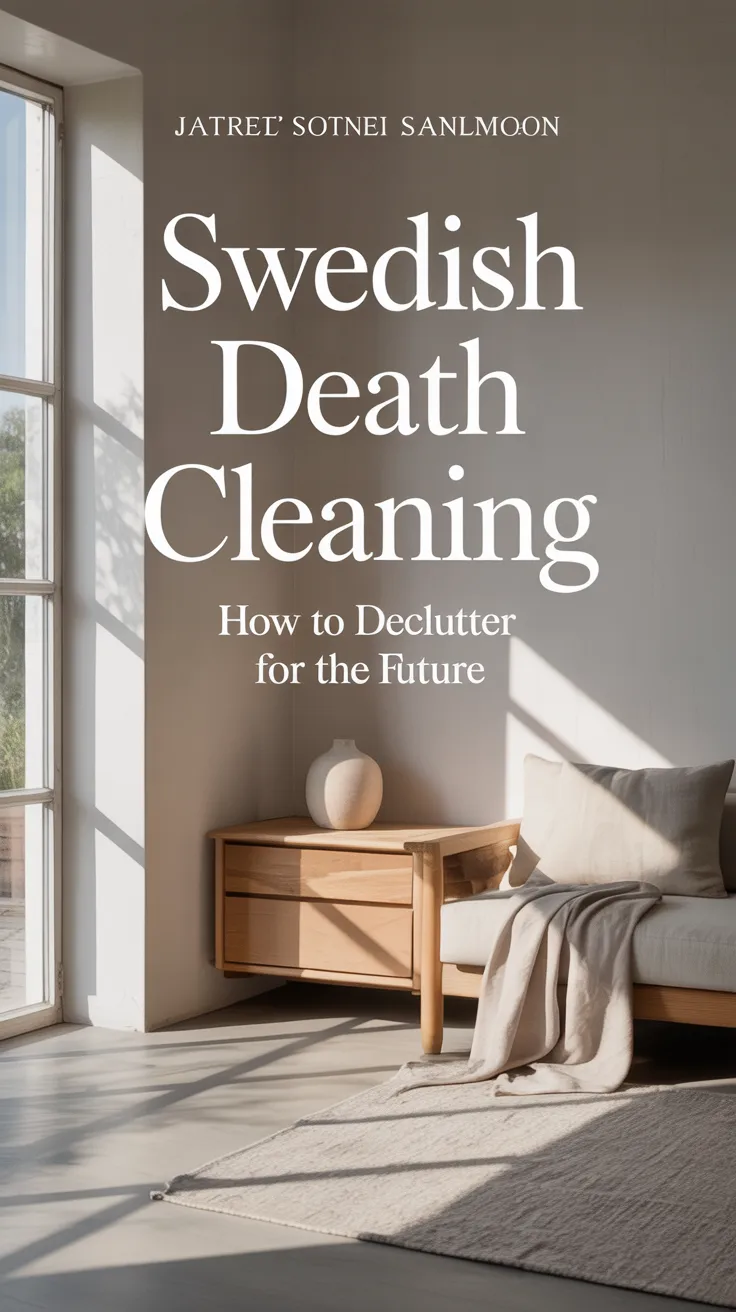
Swedish Death Cleaning: How to declutter for the future is less about being morbid and more about being kind—kind to your future self and to the people who may one day need to sort through what you leave behind. The Swedish concept döstädning encourages you to reduce clutter with intention, simplify what you own, and keep only what has real purpose, beauty, or meaning.
At its core, this method is a practical blend of minimalism, legacy planning, and everyday household organization. It’s not about getting rid of everything you love. It’s about making the things you keep easier to find, easier to use, and easier for others to understand.
Table of Contents
Understanding Swedish Death Cleaning and Why It Matters
Swedish death cleaning is often misunderstood as a one-time purge late in life. In reality, it’s a proactive and empowering way to manage your belongings at any age—especially if you’ve accumulated years (or decades) of “just in case” items.
The real purpose behind döstädning
Swedish death cleaning aims to:
- Reduce the emotional and logistical burden on family members
- Create a safer, calmer living environment
- Make daily life more functional
- Clarify what truly matters to you
Unlike quick decluttering trends, this approach emphasizes thoughtful decision-making. You’re not chasing an aesthetic; you’re creating a future-friendly household.
Who benefits most from this approach
While it’s often associated with older adults, Swedish death cleaning is useful for:
- Parents with overflowing storage and kids’ keepsakes
- Busy professionals with limited time and mental bandwidth
- Retirees downsizing or aging-in-place
- Anyone preparing for a move, renovation, or major life transition
The emotional side of decluttering
Many items aren’t hard to store—they’re hard to decide about. Swedish death cleaning acknowledges memory, grief, identity, and family dynamics.
As Swedish author Margareta Magnusson (who popularized the term) has emphasized in interviews and writing: the goal is not to erase your life, but to make the story of your life easier for others to hold.
Preparing Your Mindset and Setting Boundaries
Swedish death cleaning works best when you set expectations and boundaries upfront—especially if you’re sharing space with family.
Start with the “future you” perspective
Instead of asking, “Do I want this?” ask:
- “Will I realistically use this again?”
- “Would someone else be grateful to receive this?”
- “If I were gone, would this item confuse or burden someone?”
This shift removes guilt and replaces it with clarity.
Decide what your “enough” looks like
Create a simple definition of enough:
- Enough dishes for your household (not for a party you never host)
- Enough linens for the beds you actually use
- Enough tools for the tasks you really do
This helps you avoid re-cluttering via “replacement shopping.”
Set a timeframe that fits your life
Swedish death cleaning is not a weekend sprint. Plan in:
- 20–40 minute sessions during weekdays, or
- 2–3 hour blocks on weekends
Consistency beats intensity. A few hours per week can transform your home in a month.
Safety and preparedness as part of decluttering
One overlooked benefit of decluttering is resilience: clear pathways, organized supplies, and better access to essentials during a power outage, injury, or emergency.
Many people use structured guides to simplify preparedness planning alongside decluttering—especially when deciding what to keep for “just in case” scenarios. Many professionals rely on tools like URBAN Survival Code to streamline everyday readiness thinking so the “what if” category doesn’t become an excuse to keep everything.
Decluttering in the Right Order for Faster Progress
One reason decluttering fails is starting in the most emotional category first. Swedish death cleaning recommends beginning with low-sentiment areas and building momentum.
Begin with obvious, low-emotion categories
Start with:
- Trash and broken items
- Expired products
- Duplicate tools and kitchen gadgets
- Unused promotional items
- Worn-out linens and socks
You’ll make visible progress without decision fatigue.
Move through the home with a logical sequence
A practical order that matches Swedish death cleaning principles:
- Storage areas (attic, basement, garage)
- Clothing and shoes
- Bathroom and medicine cabinet
- Kitchen and pantry
- Paperwork and “misc” drawers
- Sentimental items (last)
This prioritizes space recovery and safety first.
Use the “keep, donate, recycle, discard” system
Set up four labeled bags or boxes. The key is speed:
- Touch each item once
- Place it in a category immediately
- Avoid creating a “later” pile unless it’s truly complex
Problem-solution bridge: overwhelmed by storage clutter?
Struggling with bulky storage and limited space? Water supplies and emergency essentials are often a big source of “clutter guilt” because they feel important—but take up room. One approach is using compact, organized systems rather than scattered bottles. SmartWaterBox is frequently used by homeowners who want a cleaner, more structured way to think about water readiness without turning the closet into chaos.
Handling Sentimental Items Without Regret
Swedish death cleaning shines most in the sentimental category—because it offers a framework for keeping meaning without keeping everything.
Separate “memory” from “item”
A powerful technique:
- Photograph items that matter but don’t need to remain physical
- Write a short note about why it mattered
- Keep a curated memory box rather than multiple bins
You preserve the story without storing the object indefinitely.
Create a “legacy pile” with intention
Ask:
- Would someone actually want this?
- Do they know it exists?
- Do they have space for it?
- Do they have any emotional connection to it?
If the answer is no, consider releasing it now rather than passing along a burden.
Use a “top 10” rule for hardest categories
For items like:
- childhood artwork
- family heirlooms
- letters and cards
- trophies and awards
Choose a limited number that best represent the memory. Quality over quantity.
Expert-quote format affiliate integration (preparedness/health angle)
“As many household safety educators note, ‘A well-organized home supports better decisions in stressful moments—because you can find what you need.’” For people who want practical guidance on home-based health readiness while reducing cluttered cabinets and drawers, resources like Home Doctor can help you think through what’s worth keeping and how to organize it around real-life scenarios—without hoarding duplicates.
Paper, Digital Clutter, and the “Hidden Mess” Problem
Physical clutter is obvious. Paper clutter and digital clutter are sneakier—and often more stressful.
Sort paperwork into simple categories
Use three folders first:
- Act now (bills, deadlines, forms)
- Keep (tax, legal, medical, insurance)
- Discard/Shred (expired, duplicates, junk mail)
Don’t overcomplicate filing at the start. The goal is to reduce volume quickly.
Identify what should be digitized
Great candidates:
- instruction manuals (often available online)
- receipts for warranties
- family photos (keep originals selectively)
- important documents (with secure backups)
Digitize only what you can store safely and access easily. Otherwise, you’ve just moved your mess to a new place.
Create an “inbox rule” to prevent re-accumulation
Pick one physical spot and one digital spot:
- A tray or folder for incoming mail
- A single folder for downloads/screenshots
Process them weekly—same day, same time. This habit keeps your future decluttering small.
Comparison/alternative angle for “survival clutter”
For people who keep piles of random “emergency” printouts, lists, and gear, a structured approach can be easier than DIY binders. While generic checklists are popular, BlackOps Elite Strategies can be an alternative for those who prefer a centralized system for planning and prioritizing—so you’re not storing scattered papers and duplicate supplies you never use.
Downsizing Decisions and Keeping What You’ll Actually Use
Swedish death cleaning often becomes urgent during downsizing: moving to a smaller home, transitioning to retirement, or simplifying after kids move out.
The “container concept” for realistic limits
Let the storage space decide:
- One bookshelf for books
- One bin for holiday decor
- One drawer for tools
- One memory box per person
If it doesn’t fit, something has to go. This reduces endless decision loops.
Keep “best-of” items, not “most-of” items
Examples:
- Keep your best pan, not five okay pans
- Keep your favorite coat, not the backups you never reach for
- Keep one reliable flashlight, not a drawer of dead batteries and broken lights
This improves daily life immediately.
Make gifting and distributing possessions easier
If you want to give things to family:
- Offer items early, not “someday”
- Attach a note explaining significance
- Avoid surprise “inheritance dumping”
This is a major Swedish death cleaning principle: reduce decision stress for others.
Product recommendation box (water organization)
💡 Recommended Solution: Aqua Tower
Best for: households that want a cleaner storage approach for water readiness
Why it works:
- Helps consolidate water planning into a more organized system
- Supports a “keep essentials, lose chaos” decluttering mindset
- Useful when downsizing storage or simplifying emergency supplies
(Keep your approach practical: whatever system you choose, aim for fewer loose items and clearer access.)
Maintaining a Decluttered Home for the Long Term
Swedish death cleaning isn’t just a declutter—it’s a lifestyle shift toward intentional ownership.
Build a “one in, one out” rhythm
For categories that expand fastest:
- clothes
- books
- kitchen gadgets
- hobby supplies
When something new comes in, something old leaves. This prevents rebound clutter.
Schedule “mini döstädning” sessions
Make it normal:
- Monthly: quick sweep of one drawer, one shelf, one folder
- Quarterly: clothing check + pantry check
- Yearly: memory box review + document refresh
A small routine keeps the home future-ready.
Make your home easier for others to navigate
A Swedish death cleaning goal is clarity. Consider:
- labeling storage bins
- creating a simple household inventory (especially for valuables)
- organizing keys, documents, and emergency contacts in one place
This is not only helpful “one day”—it’s helpful now.
Resource list style (balanced, not pushy)
If part of your clutter comes from trying to prepare for uncertain times, these resources are often used as planning frameworks so you can stop collecting random items and start focusing on what matters:
- The Lost SuperFoods — useful for thinking about shelf-stable food choices more intentionally
- Dark Reset — a planning resource some people use to simplify readiness decisions
- URBAN Survival Code — supports structured preparation so “just in case” doesn’t become clutter
The key is using a plan to prevent overbuying and duplicating supplies.
Conclusion
Swedish Death Cleaning: how to declutter for the future is ultimately about reducing friction—friction in your home, friction in your daily routines, and friction for anyone who may need to manage your belongings later. When you start with low-emotion clutter, move gradually into more meaningful categories, and adopt simple maintenance habits, you create a home that’s calmer, safer, and easier to live in now.
You don’t need perfection. You need progress, clarity, and a system that prevents clutter from quietly returning. Start small, keep what supports your real life, and let the rest go with gratitude.
FAQ
What is Swedish death cleaning and how is it different from regular decluttering?
Swedish death cleaning (döstädning) focuses on decluttering with the future in mind—so your home is easier for you to manage now and easier for loved ones to handle later. It’s more intentional and legacy-aware than a typical quick cleanout.
At what age should you start Swedish death cleaning?
You can start at any age. Many people begin in midlife when possessions accumulate, while others start during downsizing, retirement, or after a life change. The earlier you start, the easier it tends to be.
How do I do Swedish death cleaning without getting overwhelmed?
Start with low-sentimental categories (trash, duplicates, expired items), set short time blocks, and use a simple four-pile system (keep, donate, recycle, discard). Save sentimental items for later when you’ve built momentum.
What should I do with sentimental items during Swedish death cleaning?
Keep a curated selection, photograph what you don’t need to store, and consider creating one memory box per person. If you plan to pass items to family, offer them now rather than leaving large undecided piles for later.
Does Swedish death cleaning mean minimalism?
Not necessarily. It aligns with minimalist principles, but the goal isn’t owning as little as possible—it’s owning what is meaningful, useful, and manageable, while reducing future burden.