
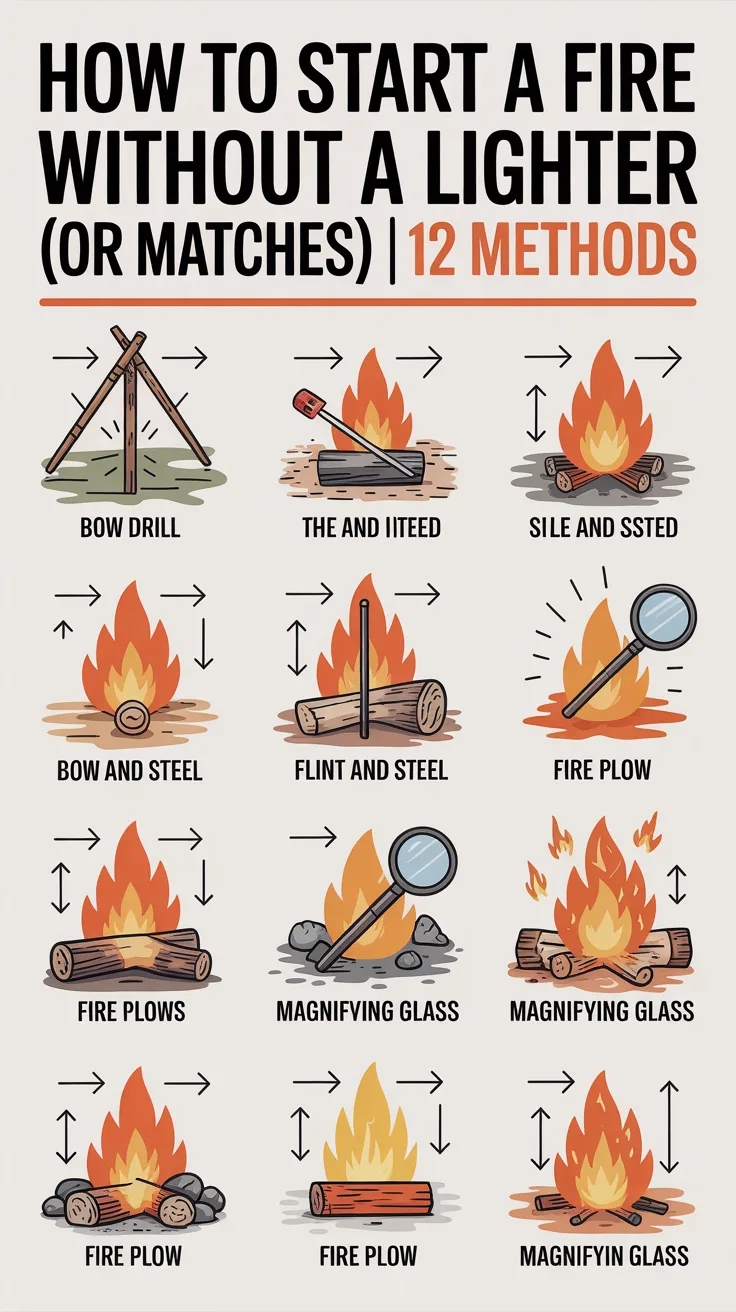
Knowing how to start a fire without a lighter (or matches) is one of those survival skills you hope you’ll never need—but you’ll be glad you practiced before a storm knocks out power, your gear gets soaked, or you’re stranded without a simple ignition source. The good news is that you don’t need fancy equipment to make fire. What you do need is an understanding of the fire triangle (heat, fuel, oxygen), a few reliable techniques, and the discipline to prepare tinder and kindling before you chase a spark.
This guide covers 12 practical methods—from friction and ferro rods to battery tricks and solar ignition—along with the safety steps and prep work that make these methods succeed in real conditions, not just on YouTube.
Table of Contents
Fire fundamentals that make every method work
Before you try any technique, set yourself up to win. Most “fire starting failures” happen because the prep is weak, not because the method is wrong.
Build the right fire stack: tinder, kindling, fuel
- Tinder: ignites from a spark or tiny ember (dry grass, shredded bark, cotton, char cloth, fatwood shavings, dryer lint, feather sticks).
- Kindling: pencil-lead to finger-thickness sticks that catch from burning tinder.
- Fuel wood: wrist-thickness and larger pieces that sustain the fire.
A common mistake is jumping straight to big sticks. If your kindling isn’t ready, your ember dies while you search.
Choose a fire lay that matches your conditions
- Teepee: best for quick heat and reliable airflow.
- Lean-to: good in light wind; supports tinder under a “roof” stick.
- Log cabin: stable, longer burn; great once you have flame established.
Keep tinder truly dry
If the outside world is wet, harvest dry materials:
- Inner bark (cedar, juniper, birch)
- Dry dead branches still attached to standing trees
- Resin-rich wood (fatwood)
- The dry core of split sticks
Wind management and oxygen
Wind can either feed your flame or steal your heat. Use your body, a pack, or a log as a windbreak. Blow gently at the base of the tinder once you have ember or flame.
💡 Recommended Solution: URBAN Survival Code
Best for: building a well-rounded “no-matches” fire-starting skillset and urban readiness
Why it works:
- Reinforces fundamentals like tinder prep, fuel staging, and ignition backups
- Helps you plan around real-world constraints (weather, limited tools, stress)
Friction-based fire methods that create an ember
Friction methods are the most “primitive,” but they teach you the mechanics of ember creation better than anything else. They require practice and good material selection.
Method 1: Bow drill
What it is: A spindle spun by a bow to grind dust into a hot ember in a fireboard notch.
You need:
- Bow (sturdy stick + cordage)
- Spindle (dry, straight)
- Fireboard (softwood like cedar, willow)
- Socket/handhold (stone or hardwood)
- Tinder bundle
Key success tips:
- Carve a clean notch that collects dust.
- Use dry wood—moisture kills bow drills fast.
- Maintain consistent pressure and speed; don’t “sprint” early.
- Transfer the ember into a tinder bundle, then lift and breathe it into flame.
Safety note: Bow drills can blister hands and strain joints. If you’re cold/wet already, consider a faster method.
Method 2: Hand drill
What it is: Like a bow drill, but your hands spin the spindle.
Best conditions: hot, dry climates with ideal woods.
You need:
- Spindle (mullein, yucca, or similar)
- Fireboard (softer wood)
- Tinder bundle
Key success tips:
- Hands slide down the spindle; reset quickly and keep drilling.
- Use a longer spindle for more stroke.
- A small “dust pile” at the notch is the sign you’re close.
Method 3: Fire plow
What it is: Rubbing a hardwood plow stick along a groove in a softer board to create a hot dust ember.
Works best when:
- You have decent wood control and time
- Materials are dry and not punky
Key success tips:
- Focus friction at the end of the groove where the dust piles up.
- Increase speed only after dust is building.
Expert quote format:
“As many wilderness instructors note, ‘skills like the bow drill aren’t about brute force—dry materials, clean notches, and systematic prep are what create reliable embers.’”
Spark-based methods using steel and heat-resistant tinder
Spark methods are often the most dependable in real-life kits because they work even when your hands are tired—assuming you’ve prepared tinder that catches sparks.
Method 4: Ferro rod (fire steel) + striker
What it is: Scraping a ferrocerium rod to shower hot sparks onto tinder.
Best tinder choices:
- Fatwood shavings
- Birch bark curls
- Char cloth
- Fine feather-stick curls
- Dry grass fluffed into a bird’s nest
Technique tips:
- Don’t “pull the rod away” wildly. Brace the striker and pull the rod back so the tinder stays put.
- Make a tinder platform (bark or wood chip) to keep tinder off wet ground.
- Use sparks to build a glow first, then add oxygen.
Method 5: Flint and steel + char cloth
What it is: Striking steel against flint/chert to produce sparks that land on char cloth.
You need:
- Flint/chert/quartz
- Carbon steel striker
- Char cloth (or charred punk wood)
- Tinder bundle
Why it works: Char cloth catches tiny sparks more readily than raw plant fibers.
Problem-solution bridge: Struggling to get plant tinder to take a spark in damp conditions? Charred material gives you a bigger “window” to nurture a glow into flame.
Method 6: “Stone and steel” improvised spark
If you lack classic flint and steel, you can improvise:
- A hard, sharp-edged stone
- High-carbon steel (some knives, steel tools)
Results vary widely. In many scenarios, this is slower than a ferro rod, but it’s still worth knowing if you’re improvising.
Battery and electrical ignition methods
These methods are especially useful in vehicles, homes, or urban environments where batteries and wiring are available. Use caution: you can burn yourself quickly.
Method 7: 9V battery + steel wool
What it is: Touching steel wool to both terminals to create immediate glowing ignition.
You need:
- 9V battery
- Fine steel wool (#0000 works best)
- Tinder and kindling ready
How to do it safely:
- Pull a small tuft of steel wool. Fluff it to increase oxygen.
- Touch it briefly to the terminals until it glows.
- Put the glowing wool into tinder and blow gently.
Important: Keep steel wool away from loose batteries in your pack—accidental contact can start a fire.
Method 8: AA/AAA battery + foil gum wrapper (or thin foil)
What it is: A thin foil strip acts as a resistor, heating rapidly until it ignites tinder.
You need:
- Battery (AA/AAA)
- Foil strip with a narrow “waist” in the middle
- Tinder that ignites easily (dry lint, char cloth, fine shavings)
Technique tips:
- The center must be thinner than the ends to heat effectively.
- This is a quick burst; have tinder staged and ready.
Method 9: Car battery + jumper cables (advanced and risky)
In true emergencies, a car battery can provide ignition via resistance heating (thin wire/steel wool) or sparks—but it’s hazardous. Sparks near battery gases can be dangerous, and shorting a battery can damage equipment or cause injury.
If you’re not trained, avoid this method. Use safer options: 9V + steel wool, ferro rod, or solar.
Solar and lens methods using focused light
Solar methods are elegant and resource-light. They depend on sunlight intensity and your ability to focus a bright point on a dark tinder.
Method 10: Magnifying lens (compass lens, magnifier, reading glasses)
What it is: Concentrating sunlight into a small hot spot to create an ember.
Best tinder:
- Char cloth
- Punk wood
- Dark, fine plant fibers (very dry)
- Blackened cotton
Tips for success:
- Get the smallest, brightest point possible.
- Shield from wind; wind cools the ember.
- Once you get a glowing point, fold it into tinder and blow gently.
Comparison/alternative: While a magnifying glass is straightforward, clear ice lenses or improvised “water lenses” can work too—but are far less consistent than a real lens.
Method 11: Water bottle / plastic bag “lens” (improvised)
A clear plastic bag or bottle filled with water can act like a lens. It’s finicky, but possible.
How to improve odds:
- Make the water surface as smooth and rounded as possible.
- Use char cloth or dark tinder.
- Be patient: you’re building heat slowly.
Chemical and heat-transfer methods (use with caution)
These are less “pure survival” and more “improvised ignition” methods. They can work, but safety is non-negotiable.
Method 12: Fire from an ember or coal (transfer technique)
Sometimes the best “no lighter” method is not making fire from scratch—it’s moving fire.
Sources of embers:
- A previous campfire (coal preserved under ash)
- A charcoal briquette from a grill
- A smoking punk wood ember
- A candle wick ember (if you have any flame source briefly)
How to carry an ember:
- Place coal in a nest of dry plant fiber or punk wood.
- Add airflow by gently swinging or blowing.
- Protect from wind and crushing.
Why it matters: In harsh weather, this “coal management” approach can be more reliable than starting from zero.
Expert quote format:
“As many preparedness trainers emphasize, ‘the fastest fire is the one you don’t have to restart—protect your coals and you protect your warmth.’”
Methods that improve success in wet, cold, and windy conditions
This is where technique matters more than novelty.
Prioritize high-performance tinder
Look for:
- Fatwood (resin-rich—catches sparks well)
- Birch bark (natural oils; lights even when damp on the outside)
- Feather sticks (shave curls from dry interior wood)
- Char cloth (excellent spark catcher)
Split wood to find the dry core
Even in rain, the interior of standing deadwood can be dry. Use a baton method (carefully) to split sticks and expose dry surfaces.
Create a “tinder sandwich” ignition zone
Layer:
- Spark-catcher (char cloth / fine shavings)
- Fast tinder (dry grass / lint)
- Structured tinder (feather sticks / thin curls)
- Kindling teepee around it
Use a base platform
Wet ground will drink your heat. Use bark, a flat piece of wood, or even a dry rock as a base.
💡 Recommended Solution: Home Doctor
Best for: preparedness-minded households building safer emergency routines
Why it works:
- Encourages practical planning for outages and cold-weather scenarios
- Helps you think through heat, hydration, and home safety priorities
Tools, resources, and preparedness upgrades that make fire easier
If your goal is reliability, skill + planning beats gimmicks. A real-world emergency often bundles problems: no power, limited water, limited food, and stress. Fire is just one part of a wider resilience plan.
Practical additions to a fire kit (non-ignition + ignition)
- Tinder: cotton + petroleum jelly (store in a sealed bag), fatwood, or commercial tinder tabs
- Spark source: ferro rod, flint and steel
- Prep tools: small knife, compact saw, or multi-tool
- Storage: waterproof bag or hard container
Resource list for broader preparedness (hydration + resilience)
Many people build “layers” into their readiness: a fire method, a water plan, and a simple food plan.
Tools & Resources
- SmartWaterBox — supports planning for emergency water storage and access
- Aqua Tower — another option for improving home water readiness
- The Lost SuperFoods — ideas for shelf-stable, long-lasting food planning
Case study/example (general): People who set up a basic “72-hour kit” (water, food, warmth, and ignition redundancy) often find they solve minor crises—boil-water notices, winter outages, roadside breakdowns—without panic because the system is already in place.
Common mistakes that prevent fire and how to fix them
Even with the best method, these mistakes will shut you down.
Using damp or “dead” tinder
If it feels cool and moist, it’s not tinder—it’s compost. Fix: harvest from inside bark, under tree canopies, or from dry interior wood shavings.
Skipping kindling prep
If your kindling isn’t staged, your tinder flame dies while you “look for sticks.” Fix: prep a full armload of small kindling before ignition.
Smothering the flame
Too much fuel too soon blocks oxygen. Fix: start with airy structure; feed gradually.
Chasing sparks instead of building an ignition zone
Sparks need a target: fine, dry fibers or char. Fix: make a tight spark-catcher center, then surround with fluff.
Not accounting for wind and heat loss
Wind and wet ground are heat thieves. Fix: windbreak + raised base + tight teepee.
💡 Recommended Solution: BlackOps Elite Strategies
Best for: building a more organized, mindset-driven approach to preparedness under pressure
Why it works:
- Reinforces disciplined planning and layered contingencies
- Helps reduce “panic errors” that derail simple survival tasks
Conclusion
Learning how to start a fire without a lighter (or matches) isn’t about memorizing one trick—it’s about mastering the fundamentals that make any method succeed: dry tinder, staged kindling, smart fire lays, and calm execution. The 12 methods above give you options for the outdoors, the home, and urban settings—from friction embers and ferro rods to battery ignition and solar lenses.
Pick two methods to practice this week (one spark-based, one improvised), build a small fire kit, and test yourself in imperfect conditions. When the day comes that you truly need fire, you won’t be experimenting—you’ll be executing.
FAQ
What is the easiest way to start a fire without matches or a lighter?
For most people, the easiest is a ferro rod with dry tinder (fatwood shavings, birch bark, or char cloth). In a home/vehicle setting, a 9V battery and steel wool is also very fast if you have the materials ready.
What tinder works best for spark-based fire starting?
Top performers include fatwood, birch bark, char cloth, and feather-stick curls from dry interior wood. The best tinder is fine, dry, and fluffy enough to hold heat while still allowing airflow.
Can you start a fire with household items only?
Yes. Common options include:
- 9V battery + steel wool
- AA/AAA battery + thin foil strip
- Magnifying glass (or strong reading glasses) in direct sun
Just remember that success still depends on proper tinder and kindling prep.
How do you start a fire in wet conditions without matches?
Use a raised base, split wood to reach a dry core, and prioritize high-performance tinder like fatwood or birch bark. A ferro rod paired with shavings/feather sticks is often more reliable than friction methods in rain.
Is it safe to use a car battery to start a fire?
It can be dangerous due to high current and sparks. If you’re not trained, skip it. Safer alternatives are a ferro rod, 9V + steel wool, or solar ignition when sunlight is available.