
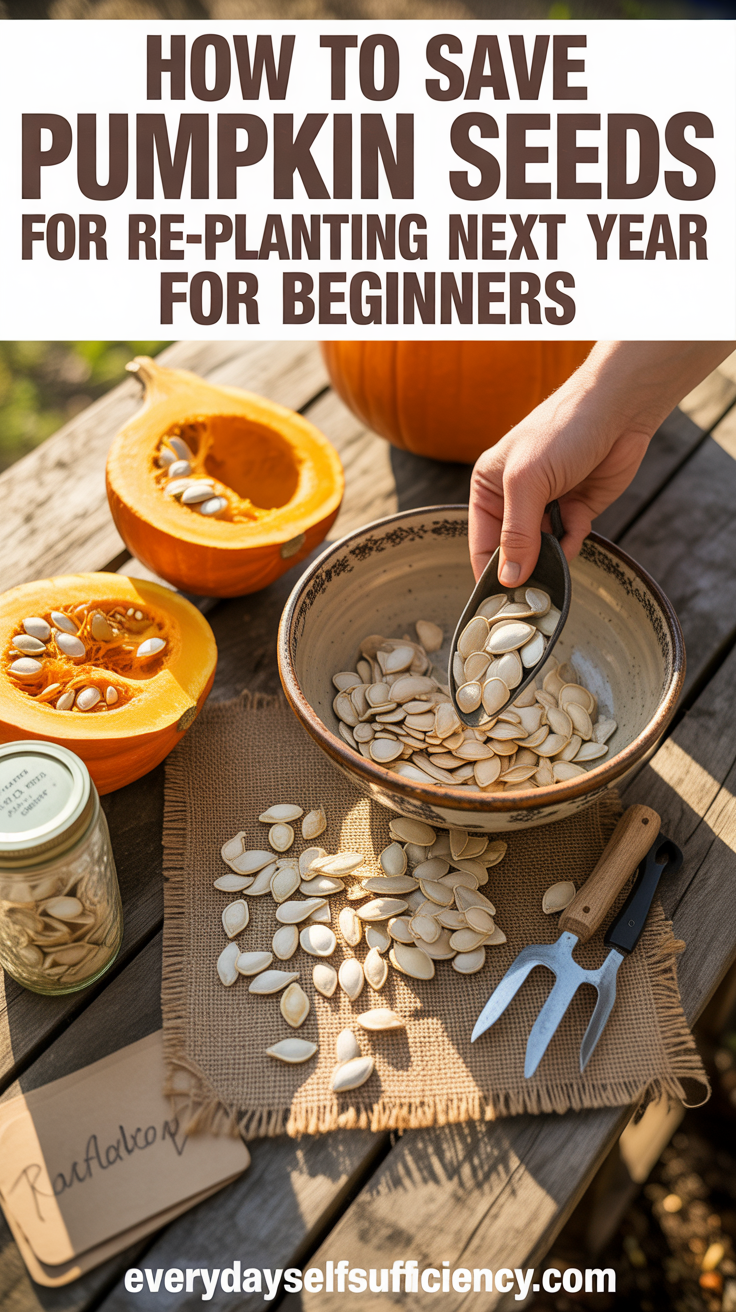
Learning how to save pumpkin seeds for re-planting next year is one of the most satisfying homestead and self-reliance skills you can master. It trims your seed bill, preserves your favorite varieties, and lets you adapt pumpkins to your unique soil and climate over time. In this step-by-step guide, you’ll learn exactly how to save pumpkin seeds for re-planting next year—from choosing the right fruit and preventing cross-pollination, to fermentation, drying, storage, and prepping your saved pumpkin seeds for planting when spring arrives.
If you’re building a resilient pantry and garden, the skills in this guide pair well with long-term food knowledge. For deeper preparedness, see The Lost SuperFoods, an approachable library of time-tested preservation methods and emergency staples that complement seed saving and gardening. Explore it here: The Lost SuperFoods
This article is written for both new and experienced gardeners. We’ll cover essential botany for pumpkins (Cucurbita), seed purity tips for urban and rural plots, and practical steps and timelines that remove guesswork. By the end, you’ll be confident in how to save pumpkin seeds for re-planting next year and how to prep pumpkin seeds for planting so you start strong each season.
Table of Contents
Choosing the Right Pumpkins and Varieties to Save
The first key to how to save pumpkin seeds for re-planting next year is selecting the right pumpkins and the right varieties. Not all pumpkins save equally. You need to know which species you’re growing and whether your seed will breed true.
- Know your species:
- Cucurbita pepo: Includes classic carving pumpkins, many pie pumpkins, zucchinis, some acorn and delicata types.
- Cucurbita moschata: Butternut and some long-neck pumpkins; excellent for hot climates and often better pest resistance.
- Cucurbita maxima: Giant pumpkins, hubbards, buttercups; outstanding flavor in many heirlooms.
- Cucurbita argyrosperma: Cushaws; less common, great heat tolerance.
Within a species, pumpkins can cross readily with other varieties of the same species if insects carry pollen between them. That matters because if you plan how to save pumpkin seeds for re-planting next year and expect the same fruit, crossing can change shape, color, and flavor. You have three primary choices to maintain purity:
- Grow only one variety per species each year.
- Maintain isolation distances (often 800 feet to half a mile for high confidence).
- Hand-pollinate and bag blossoms (covered later).
Use open-pollinated (OP) or heirloom types if you want the saved seed to be true-to-type. Avoid saving seed from F1 hybrids because the next generation often segregates into unpredictable traits. For true pie pumpkin flavor next season, this is critical when deciding how to save pumpkin seeds for re-planting next year.
Also select fruit from healthy, vigorous plants that resisted pests and diseases in your garden. Seed-saving is selective breeding on a backyard scale. Each time you choose a pumpkin whose plant thrived in your soil, you’re pushing the genetics toward resilience. This is a cornerstone of practical self-sufficiency and a subtle but powerful detail when planning how to save pumpkin seeds for re-planting next year.
Timing Your Harvest and Curing for Peak Seed Viability
Pumpkin seed maturity lags a bit behind the fruit’s initial color change. To ensure strong germination, harvest seed from fully mature pumpkins. Here’s what to look for:
- Hard, tough rind that can’t be dented with a fingernail.
- Deep, uniform color typical of the variety.
- Drying, corky stem.
- The fruit has had time to cure.
Curing boosts both flavor and seed development. Set harvested pumpkins in a warm, dry, well-ventilated spot (80–85°F/27–29°C if possible) for 10–14 days. Sun-curing on a covered porch or in a greenhouse with airflow works well. After curing, move them to a cool, dry storage area. Even two to four weeks of rest after harvest improves seed maturity. This waiting window is a frequently skipped step in how to save pumpkin seeds for re-planting next year—and it’s one of the easiest ways to raise germination rates.
Frost timing matters. A light frost might not ruin seeds, but repeated hard frosts can degrade seed viability. If a hard frost is imminent, harvest mature fruit and cure indoors. If the fruits are immature, they may not produce strong seed. In that case, it’s better to learn how to save pumpkin seeds for re-planting next year from fruits that reached full maturity earlier in the season. This is another reason to succession plant and track harvest dates.
While your pumpkins cure, prepare your tools for the extraction step: sanitized knife, cutting surface, large bowl, strainer, and clean paper towels or screens. The cleaner your workspace, the lower the mold risk later—an underrated success factor in how to save pumpkin seeds for re-planting next year.
Extracting, Cleaning, and Fermenting Pumpkin Seeds
Once your pumpkins are fully cured, you’re ready for the heart of how to save pumpkin seeds for re-planting next year: seed extraction and cleaning. The goal is to remove seeds from the fibrous pulp, separate plump, viable seeds from flat or damaged ones, and remove germination inhibitors.
Step-by-step:
- Cut the pumpkin cleanly around the stem or in half from top to bottom. Scoop the seed mass into a bowl.
- Hand separate strings and pulp. Viable seeds are generally plump and firm. Discard obviously flat seeds.
- Rinse seeds in cool water while rubbing gently to remove clinging pulp. A kitchen strainer makes it easy.
- Optional fermentation: Soak the cleaned seeds with just enough water to cover them for 24–48 hours at room temperature, stirring once or twice. Fermentation helps dissolve remaining sugars and gel-like inhibitors and can reduce some surface-borne pathogens. Do not over-ferment; when you smell a light tang and see a thin film, you’re done. Rinse thoroughly.
- Surface sanitation (optional but helpful): A mild 10% bleach solution dip for 10 minutes can reduce pathogen load; rinse seeds very well afterward. Alternatively, a 3% hydrogen peroxide rinse for 10 minutes works. If you choose sanitation, avoid extended exposure.
Many gardeners skip fermentation for pumpkins, but it can improve storability and uniformity. It’s not mandatory, but when you care about precision in how to save pumpkin seeds for re-planting next year, it’s a powerful tool. Always finish with a thorough rinse so no residues linger, then move directly to the drying stage.
Place seeds on an unglazed ceramic plate, paper towels, parchment, window screens, or mesh seed-drying screens. Avoid glossy magazine paper, plastic wrap, or anything non-breathable. Spread seeds in a single layer so they dry evenly. Label the drying tray immediately with variety, species, date, and any notes (e.g., “Plant A resisted powdery mildew”). Accurate labeling is a hallmark of good practice in how to save pumpkin seeds for re-planting next year.
Drying Seeds Safely to Lock in Viability
Proper drying is the make-or-break stage of how to save pumpkin seeds for re-planting next year. Seeds stored even slightly damp can mold, lose vigor, or die in storage. But overdrying with high heat can cook them. Find the dry, airy middle ground.
- Airflow: Use a fan on low to move air across the seeds, not directly blasting them. Flip seeds daily for even drying.
- Temperature: Keep below 95°F (35°C). Avoid ovens, dehydrators on high, or direct sun that can overheat seeds.
- Humidity: If ambient humidity is high, run a dehumidifier in the room. Drying times vary; plan for 7–14 days.
How to know they’re dry:
- The “snap test”: A fully dry pumpkin seed will snap in half cleanly rather than bend or tear.
- Weight and feel: Dry seeds feel lighter and have a papery, slightly brittle edge.
- Paper towel test: Place a few seeds in a sealed jar with a dry paper towel overnight. If the towel feels damp in the morning, continue drying.
Consider a final, gentle finish in a closed container with a desiccant (silica gel or fresh powdered milk in a tissue) for 3–5 days. Don’t let seeds directly touch desiccant. This last step is extremely helpful in humid climates and massively improves your success with how to save pumpkin seeds for re-planting next year.
After drying, do a quick viability cull: flat, discolored, or chipped seeds rarely perform well. Keep the plumpest. This careful selection builds a better line over seasons. Remember, saving seed is cumulative gardening—every season you practice how to save pumpkin seeds for re-planting next year, your seed population adapts to you.
Preventing Cross-Pollination and Keeping Varieties True
Ensuring varietal purity is a key theme in how to save pumpkin seeds for re-planting next year. If you don’t want surprises, control pollination. You have three main options:
- Isolation by distance:
- For home gardens, aim for at least 800 feet between varieties of the same species. More is better if bees are abundant.
- If you can only grow one variety per species each season, that’s the simplest route.
- Time isolation:
- Stagger plantings so that flowering times don’t overlap. This is imperfect but can work in small gardens.
- Hand-pollination and bagging:
- The evening before bloom, identify female flowers (tiny fruit at base) and male flowers (long stems). Gently close each with a clothespin or tape, or bag them with fine mesh so insects can’t enter.
- Next morning, pick a male flower, remove petals to expose the anther, and brush it onto the female stigma. Close and re-bag the female. Tag the stem with the variety and date.
- Leave the bag on the female for 24–48 hours, then remove. Mark the developing fruit. Save seeds only from these controlled fruits.
This method lets you grow multiple varieties of the same Cucurbita species in small spaces. It’s the gold standard for urban and suburban seed savers learning how to save pumpkin seeds for re-planting next year without accidental crosses.
Also pay attention to garden health. Viruses and fungal diseases can be seed-borne. Start with healthy parent plants and consider the optional sanitation dip discussed earlier. A little hygiene goes a long way in keeping your saved seed line robust.
Storing Pumpkin Seeds for Months and Years
Once seeds are fully dry, storage conditions determine longevity. The rule of thumb for how to save pumpkin seeds for re-planting next year and beyond is simple: cool, dark, and dry. The sum of temperature (°F) plus relative humidity (%) should be under 100. Lower is better.
Storage containers:
- Paper envelopes in a sealed jar with desiccant are excellent. Label clearly with variety, species, date, and any selection notes.
- Mylar bags with a small desiccant packet are great for multi-year storage.
- Glass jars (mason jars) with tight lids are reliable. Add silica gel packs.
- Avoid fluctuating temperatures and sunlight. A closet on an interior wall works well.
Refrigeration and freezing:
- The fridge can extend life, but only if seeds are thoroughly dry and sealed with desiccant to prevent condensation.
- Freezing can extend viability further, but only for very dry seeds. Bring containers to room temperature before opening to avoid moisture condensing on cold seeds.
How long do pumpkin seeds last for planting? With good drying and storage, 4–6 years of solid viability is common for Cucurbita species, with the best results in the first 2–3 years. This is a reassuring figure when considering how to save pumpkin seeds for re-planting next year and building a small seed bank.
Germination testing:
- Each winter, test a sample: 10 seeds on a damp paper towel in a bag at 75–85°F. Count sprouts at day 7 and day 14. Above 80% is great; below 60% suggests re-saving seed this season and sowing a bit heavier.
If you’re mapping your homestead systems—water, storage, seed, and pantry—bookmark your resources. You can keep all your resilience resources organized via your own site hub; for example, skim your preparedness content index here: Everyday Self-Sufficiency Sitemap. Good organization supports good execution when practicing how to save pumpkin seeds for re-planting next year.
Prepping Pumpkin Seeds for Planting Day
When spring arrives, how to prep pumpkin seeds for planting becomes the next practical step. After months of careful storing, you want a vigorous start.
- Soil temperature: Wait until the soil reaches 70–95°F (21–35°C). Pumpkins sulk in cold ground; patience pays.
- Direct sow vs. start indoors: Direct sowing in warm soil often outperforms transplants. If your season is short, start indoors 2–3 weeks before the last frost in biodegradable pots to minimize root disturbance.
- Pre-soak or prime: A 4–8 hour soak in lukewarm water can speed germination. For an extra boost, change the water once halfway through. Pat seeds dry before sowing.
- Depth and spacing: Plant 1 inch (2.5 cm) deep. For bush types, 3 feet (1 m) apart; for vining types, 5–8 feet (1.5–2.5 m) or on mounds with room to run.
- Moisture management: Keep the seed zone evenly moist, not waterlogged. A light mulch after emergence stabilizes moisture and soil temperatures.
Disease prevention at sowing:
- Rotate beds; avoid following cucurbits with cucurbits.
- Don’t overwater cold soil.
- Dust the planting hole with a biological fungicide or a light sprinkle of cinnamon to deter damping off (optional).
Label each hill with variety and sowing date. These records feed back into your seed-saving notes and support long-term improvement in how to save pumpkin seeds for re-planting next year. If you’re gardening in drought-prone regions or off-grid, integrating water resilience into your garden is a huge edge. A compact, reliable water system can turn marginal germination conditions into consistent success. Consider the self-contained Aqua Tower as a mid-content resource for gardeners who need dependable water on demand; it fits naturally into a resilient seed-to-harvest plan.
Troubleshooting: Mold, Low Germination, and “Mystery” Pumpkins
Even when you follow every step of how to save pumpkin seeds for re-planting next year, hiccups happen. Here’s how to diagnose and fix common issues:
Mold during drying or storage:
- Cause: Insufficient drying, high humidity, poor airflow, or seeds stacked too thick.
- Fix: Return seeds to drying screens with a fan; add a dehumidifier; finish with desiccant in a sealed jar. Discard any visibly moldy seeds.
Low germination:
- Cause: Immature seeds (fruit harvested too early), overheated during drying, moisture intrusion in storage, or simply aging seeds.
- Fix: Re-test after additional drying. If still low, sow heavier this year and prioritize saving fresh seed from fully mature, well-cured fruits. Tighten your drying and storage protocol next cycle.
Unexpected shapes or flavors (“mystery pumpkins”):
- Cause: Cross-pollination between different varieties of the same species.
- Fix: Implement isolation or hand-pollination and bagging next season. Save seed only from bagged fruits for the variety you want.
Weak seedlings or damping off:
- Cause: Cool soil, overwatering, or soil-borne pathogens.
- Fix: Wait for warmer soil, water less frequently, improve drainage, and consider biological seed treatments.
Seed weevils or pantry pests:
- Cause: Storage in unsealed containers.
- Fix: Freeze fully dry seed for 3–5 days in a sealed bag to kill eggs; store afterward in airtight jars with desiccant.
Remember, each problem you solve improves your process. The discipline of how to save pumpkin seeds for re-planting next year is iterative. Keep notes on harvest timing, curing days, drying duration, humidity, and storage conditions. Over 2–3 seasons, you’ll see a marked increase in vigor and uniformity.
Building a Resilient Seed System with Water and Soil Support
Seed saving doesn’t happen in a vacuum. Reliable water and living soil multiply your success. To fully capitalize on how to save pumpkin seeds for re-planting next year, strengthen the systems around your garden.
- Water resilience: Drip irrigation or soaker hoses deliver steady moisture at the root zone, reducing disease. Rainwater harvesting smooths out dry spells. If you want a smart, compact water solution that supports seedlings and mature crops, evaluate the SmartWaterBox. Reliable water at the right time translates to better fruit maturity and better seed.
- Soil health: Build compost, rotate crops, and include cover crops like rye or clover in the off-season. Healthy soil yields healthier seeds with stronger embryos and better stored reserves.
Create a yearly seed plan:
- Spring: Sow and tag rows for seed-saving candidates. Note vigor, disease resistance, and earliness.
- Midseason: Bag and hand-pollinate select blossoms for purity.
- Late season: Harvest, cure, extract, dry, test, and store.
- Winter: Run germination tests, audit storage containers, and update labels.
Centralize your records and homestead references so you don’t reinvent the wheel each season. Keep a bookmark to your resource hub: Everyday Self-Sufficiency. A tidy information workflow amplifies the gains you get from practicing how to save pumpkin seeds for re-planting next year.
Recommended Tools, Supplies, and Resources
A small toolkit streamlines how to save pumpkin seeds for re-planting next year and helps you repeat success.
Core supplies:
- Sharp, sanitized knife and sturdy cutting board
- Bowls, strainers, and a fan
- Mesh screens or parchment for drying
- Silica gel desiccant packs for finishing and storage
- Paper envelopes, glass jars, or Mylar with labels and a fine-tip marker
- Clothespins or blossom bags for hand-pollination
- Stakes and weatherproof tags to mark saved-seed fruits
Recommended resources:
- For water reliability across dry months, especially for germination and early growth, explore Aqua Tower and SmartWaterBox. Consistent, efficient watering is a quiet superpower behind high-quality seed.
- For pantry resilience that complements seed saving and seasonal eating, check out The Lost SuperFoods. Its preservation strategies sit naturally alongside a seed-saving mindset.
- For basic medical readiness around the homestead, the Home Doctor guide gives you practical, at-home care—a useful safety layer for gardeners managing tools and outdoor work.
When you build the “surroundings” of your garden—water, storage, knowledge—you massively raise the payoff from learning how to save pumpkin seeds for re-planting next year. Each tool reduces friction at a failure point: watering, drying, labeling, or health.
Real-World Calendar: A Year in Pumpkin Seed Saving
Use this simple calendar to operationalize how to save pumpkin seeds for re-planting next year:
- Late Winter:
- Review stored seeds and run germination test.
- Plan varieties and locate them on the map for isolation. Order any backup seed if needed.
- Spring:
- Prepare beds with compost; install drip or soaker lines.
- Sow when soil warms; label rows. Keep notes on emergence and vigor.
- Early Summer:
- Scout for pests; remove the weakest plants from your planned seed line to focus on the best.
- Begin blossom bagging and hand-pollination as desired.
- Mid to Late Summer:
- Tag hand-pollinated fruits. Maintain even watering and consistent feeding for seed development.
- Early Fall:
- As fruits mature, reduce watering to prevent cracking and concentrate sugars.
- Harvest mature pumpkins before hard frost. Cure 10–14 days.
- Mid to Late Fall:
- Extract, clean, optionally ferment, and dry seeds. Finish with desiccant in jars.
- Winter:
- Store jars in a cool, dark place. Update labels and log notes.
- Audit your supplies for next season.
This loop repeats and refines itself each year. The longer you practice how to save pumpkin seeds for re-planting next year, the more your pumpkins adapt to your microclimate, pests, and growing style.
Call to Action: Start Your Seed-Secure Garden Year
You now have a complete process for how to save pumpkin seeds for re-planting next year—selection, isolation, curing, extraction, fermentation, drying, storage, and planting prep. Take the first step this week: label your current pumpkins, map where you’ll dry seeds, and gather envelopes or jars.
- Build pantry resilience alongside garden resilience with The Lost SuperFoods—a natural complement to seed saving.
- For steady, efficient watering from seed to fruit, equip your beds with Aqua Tower or the compact SmartWaterBox.
- Keep a practical homestead health reference at hand with Home Doctor.
Conclusion
Mastering how to save pumpkin seeds for re-planting next year is a cornerstone homestead skill that pays you back with lower costs, truer flavors, and increasingly resilient plants. Choose mature fruits from healthy, open-pollinated varieties, prevent unwanted crosses, clean and dry seeds carefully, store them cool and dry, and prep them properly for planting. Over seasons, your saved seed becomes your signature pumpkin—adapted to your garden and kitchen.
Seed saving is more than a technique. It’s a habit that builds skill, confidence, and food security. With a small toolkit, a few good references, and a simple annual rhythm, you can keep your favorite pumpkins going for years to come.
FAQ
Can you save pumpkin seeds to plant next year?
Yes. You can absolutely save pumpkin seeds to plant next year, as long as you start with open-pollinated (non-hybrid) varieties and either grow only one variety per species or control pollination to prevent crossing. Harvest fully mature pumpkins, cure them, extract and clean the seeds, dry thoroughly, and store cool, dark, and dry. When you follow a clean process for how to save pumpkin seeds for re-planting next year, your seeds will have high viability and true-to-type characteristics.
How do I dry and save seeds for next year?
After cleaning, spread pumpkin seeds in a single layer on a breathable surface and dry with steady airflow below 95°F (35°C) for 7–14 days, flipping daily. Finish in a sealed jar with a desiccant for 3–5 days to pull residual moisture. Store in labeled envelopes inside airtight jars or Mylar with desiccant, in a cool, dark place. The core of how to save pumpkin seeds for re-planting next year is “cool, dark, dry”—and fully dry seeds are the first non-negotiable.
How long can pumpkin seeds last for planting?
With good drying and storage, pumpkin seeds commonly remain viable for 4–6 years, with best germination in the first 2–3 years. To check old lots, run a germination test each winter. If your rate has dropped, sow a bit heavier and plan to refresh your stock by practicing how to save pumpkin seeds for re-planting next year from the healthiest plants this season.
How to prep pumpkin seeds for planting?
When soil warms to at least 70°F (21°C), pre-soak seeds 4–8 hours in lukewarm water, pat dry, and sow 1 inch deep. For short seasons, start indoors 2–3 weeks before last frost in biodegradable pots to avoid transplant shock. Keep the seed zone evenly moist and warm, use mulch to stabilize conditions after emergence, and label each planting. These steps round out how to save pumpkin seeds for re-planting next year by ensuring your saved seed transitions into strong, productive plants.