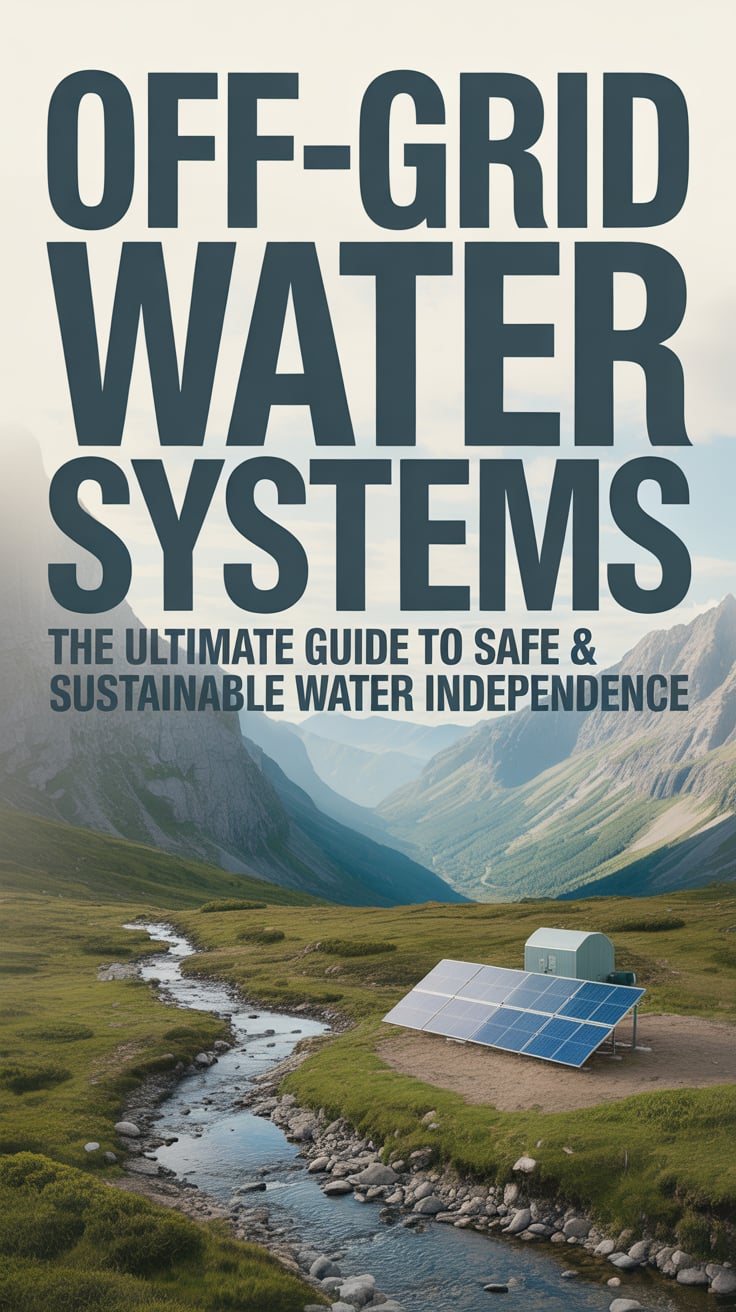
Reliable, safe water is the backbone of any self-reliant home or homestead. This guide to Off-Grid Water Systems: The Ultimate Guide to Safe & Sustainable Water Independence walks you step-by-step through assessing your needs, sourcing water, storage, purification, powering pumps, maintenance, and choosing practical gear. You’ll learn how to design a resilient, multi-barrier system that delivers potable water in all seasons.
If you’re looking for a practical, all-in-one starting point, explore SmartWaterBox for compact storage, filtration, and emergency-readiness tools that complement the strategies in this guide.
Table of Contents
Designing off-grid water systems for your site
Start by defining what “safe and sustainable” means for you. For most homesteads, the goal is a system that (1) consistently provides enough water for daily life, (2) meets potable standards for drinking and cooking, and (3) keeps working during grid outages and seasonal stress.
- Daily demand: A common planning baseline is 15–25 gallons per person per day for drinking, cooking, hygiene, and minimal laundry. Add 1–3 gallons per pet and estimate separately for gardens, livestock, and equipment cleaning.
- Peak vs. average use: Showers, laundry, and irrigation create peak loads. Storage and pressure systems should handle those surges without running pumps continuously.
- Water quality targets: Decide what must be potable (drinking, ice, cooking) versus non-potable (flushing, irrigation). You can maintain separate treatment lines to save energy and filter life.
- Risk profile: Identify potential contaminants for your area: sediment, tannins, heavy metals, nitrate, agricultural runoff, microbial pathogens, or naturally high minerals.
A baseline water test is essential if you’re using wells, springs, or surface water. Test for coliform/E. coli, nitrates/nitrites, pH, hardness, iron/manganese, and any local concerns. Retest annually or after heavy flooding, drought, or work on your system.
Map your site:
- Elevation and slope determine gravity-fed opportunities and frost depth.
- Roof area and material matter for rainwater harvesting.
- Space for tanks should allow drainage, overflow, and maintenance access.
- Safe setbacks from septic fields, barns, and chemical storage are non-negotiable.
Finally, think in layers: source → prefiltration → storage → disinfection → distribution → point-of-use polishing. Multi-barrier designs are safer and more resilient than any single device.
Sourcing reliable water off the grid
Your supply options often combine multiple sources for redundancy.
- Groundwater wells: Professionally drilled wells access aquifers below. Yields vary by geology; deeper wells may require stronger pumps and more energy. Well casings, sanitary seals, and proper setbacks protect against contamination.
- Hand-dug wells: Traditional, wide-diameter wells can be viable in shallow water tables, but require meticulous lining, secure covers, and frequent testing.
- Springs: Flowing springs can be excellent sources if protected. Capture water at the spring head with a sealed spring box, then pipe downhill to storage.
- Surface water: Creeks, ponds, and lakes are abundant but variable in quality. Plan for robust filtration, sediment control, and disinfection.
- Rainwater harvesting: Rain can be a primary or backup supply—especially where groundwater is poor. Use food-grade roof materials, first-flush diverters, leaf screens, and sealed cisterns.
Rainwater sizing basics:
- Annual yield ≈ Roof area (sq ft) × Annual rainfall (in) × 0.623 × runoff coefficient (0.75–0.95).
- Monthly yield is what drives tank size. Aim to buffer through your driest streak plus a safety margin.
- Example: 1,000 sq ft roof × 30 in/year × 0.623 × 0.9 ≈ 16,821 gallons/year. Divide seasonally to check dry-month availability.
If drilling a well is part of your plan and you want to understand DIY approaches, concepts, and low-tech access methods before talking to a pro, a resource like Joseph’s Well can help you think through groundwater basics and simple hand-pump strategies in plain language.
Permits and water rights vary by state or region. Always check local regulations for wells, spring captures, rainwater use, and surface water diversions. In some areas, rainwater for potable use requires specific materials and treatment standards; in others, rainwater is intended for non-potable uses unless approved.
Storing and distributing water safely
Storage gives you resilience against dry spells, power outages, and peak demand.
- Tank materials: Options include polyethylene (common, affordable, UV-stable), fiberglass (durable, light), concrete (robust, inert, often buried), and food-grade stainless for specialty uses. Use NSF/ANSI-61 or equivalent materials for potable systems.
- Tank placement: Above-ground tanks are easy to install and maintain; buried tanks save space and reduce freeze risk. Anchor tanks in high-wind or flood-prone areas and provide secure, screened vents.
- Sizing: A practical target for homes is 7–14 days of potable demand plus additional non-potable capacity for irrigation. If rain-fed, size to bridge your longest dry period; if well-fed, size for daily draw with a buffer for pump outages.
Distribution and pressure:
- Gravity-fed: Placing tanks uphill provides pressure without electricity. Roughly, every 2.31 feet of elevation equals 1 psi; aim for 20–50 psi at fixtures (46–115 ft of head). You can combine gravity with booster pumps for peak times.
- Pressure tanks: In pumped systems, a pressure tank reduces short-cycling and keeps water flowing during brief power blips. Size the tank so the pump runs for at least 1–2 minutes per cycle.
- Pipe selection: Use approved potable plumbing. PVC/CPVC or PEX are common; consider freeze depth and UV exposure. Insulate exposed lines and heat-trace where necessary.
- Backflow protection: Install check valves, air gaps, and backflow preventers to keep contaminants from re-entering your potable line. Separate non-potable lines clearly.
Sanitary design:
- Use screened vents and mosquito-proof inlets.
- Add first-flush diverters on rainwater to shunt the dirtiest roof runoff.
- Provide drains, sediment sumps, and accessible manways for cleaning.
- Keep light out of tanks to reduce algae growth.
Plan for overflow management: direct clean overflow to a swale or infiltration trench so you protect footings and enjoy passive irrigation rather than erosion.
Purifying and disinfecting off-grid water systems
Filtration and disinfection are distinct steps; most reliable off-grid water systems use both.
Core barriers:
- Sediment filtration: A series of 20–5–1 micron cartridges or a backwashing sediment filter protects downstream components. For high silt, consider a spin-down separator ahead of cartridges.
- Activated carbon: Improves taste and odor, adsorbs some chemicals and organics, and reduces chlorine if present. Carbon blocks offer finer filtration; granulated carbon is lower resistance and easier to maintain.
- Membrane filtration: Hollow-fiber microfilters (0.1–0.2 micron) remove bacteria and protozoa; ultrafiltration can go finer. Reverse osmosis removes salts and many contaminants but wastes some water and requires more energy.
- Disinfection: UV systems inactivate microbes when properly sized, powered, and maintained. Chemical disinfection (e.g., chlorine) provides residual protection; this is useful if water travels through storage or long distribution lines.
Point-of-use polishing:
- At kitchen taps, consider an additional 0.2–0.5 micron filter or a small RO unit for drinking and ice.
- For non-potable lines, keep at least sediment filtration to protect valves, emitters, and fixtures.
Heat-based options:
- Boiling reliably kills pathogens but cost and time make it impractical for daily large volumes.
- Solar pasteurization can work in sunny climates for small batches with temperature indicators.
If you want a compact, gravity-friendly purifier you can use daily or keep for emergencies, look into Aqua Tower. Gravity designs pair well with rainwater or as a kitchen backup when power is limited.
Design tips:
- Place UV last in the treatment train, after fine filtration, and include a UV intensity or lamp-fail indicator.
- For chlorination, target appropriate free chlorine after contact time, and use carbon to improve taste if needed.
- Use bypass and isolation valves so you can service components without shutting down the whole house.
- Maintain redundancy: a spare gravity purifier and a stash of replacement filters keep you covered if the main unit is offline.
Powering pumps and pressure the resilient way
Your energy plan should be as robust as your water plan. Water security fails quickly when pumps stop.
Pump options:
- DC solar pumps: Efficient and simple with a dedicated PV array; great for lifting from wells to a header tank during daylight. Pair with gravity-fed distribution for nighttime use.
- AC pumps: Conventional well and booster pumps run from an inverter on a solar/battery system or a generator. Size inverters for motor surge.
- Hand pumps: Valuable redundancy for shallow wells or as an add-on to deeper wells with specialized cylinders. They offer water access during full power failures.
- Hydraulic ram pumps: If you have flowing water and enough fall, rams can lift a portion uphill continuously without electricity.
Pressure strategies:
- Gravity-first: Pump to an elevated tank when the sun shines; draw down by gravity 24/7. This eliminates nighttime pumping and shrinks your battery needs.
- Pressure tanks and VFDs: A variable-frequency drive on an AC pump can maintain steady pressure efficiently. Combine with a pressure tank to avoid rapid cycling.
- Load management: Schedule irrigation and laundry for sunny hours. Use low-flow fixtures to reduce peak demand and protect your storage.
Power system notes:
- Solar array sizing: Estimate pump daily kWh and add 20–30% for losses. Dedicated arrays for water pumping can simplify design and reduce competition with household loads.
- Battery capacity: If you rely on powered pressure around the clock, ensure adequate battery autonomy (e.g., 1–2 days) or shift to gravity to reduce storage needs.
- Generator backup: Keep a small, efficient generator and treated fuel for extended bad-weather stretches. Isolate and test regularly.
Controls and protection:
- Install low-water cutoffs to protect pumps.
- Use lightning and surge protection on exterior lines.
- Add flow meters and pressure gauges to diagnose issues early.
Maintaining and monitoring off-grid water systems
Reliable water depends on routine inspection, testing, and preventive maintenance.
Testing schedule:
- Microbial: For wells, springs, and surface water, test coliform/E. coli at least annually, and after floods, droughts, or repairs. For rainwater used as potable, adopt a similar cadence.
- Chemical/minerals: Test annually or biannually for pH, hardness, iron/manganese, and site-specific risks (nitrates near agriculture, arsenic where known).
- Turbidity: Portable meters help you decide when to change filters and assess treatment performance.
Maintenance tasks:
- Filter changes: Track pressure drop across filters; replace when flow slows or manufacturer’s interval arrives.
- UV systems: Replace lamps on schedule and keep sleeves clean; a thin film can reduce UV dose.
- Tank hygiene: Inspect for sediment, biofilm, or pests. Clean on a schedule with proper disinfection and rinsing procedures.
- Lines and fixtures: Look for leaks, insulation gaps, and backflow device function. Exercise valves periodically.
Seasonal considerations:
- Freeze protection: Bury lines below frost depth, insulate exposed sections, and heat-trace vulnerable points. In extreme cold, drain nonessential lines and use tank heaters or greenhouse enclosures.
- Drought resilience: Prioritize water uses, mulching in gardens, drip irrigation, and rain capture from additional roofs or shade structures. Pre-plan hauled water connections as a last resort.
- Flood safety: Protect wellheads with raised casings, slope away from openings, and shock-chlorinate after flood exposure followed by retesting.
Documentation and spares:
- Maintain a logbook of tests, filter changes, lamp dates, and any unusual events.
- Keep a kit with spare cartridges, O-rings, UV lamps, chlorine test strips, and sanitizers.
- Label lines clearly (potable vs non-potable) and post emergency procedures where everyone can see them.
Systems built with layered barriers and routine care are safer, deliver better-tasting water, and cost less over time.
Sourcing and treatment integration for special climates
Site and climate shape design choices as much as personal preference.
Arid and semi-arid regions:
- Maximize roof capture with smooth, nonporous roofing and high-efficiency first-flush diverters.
- Oversize cisterns to bridge long dry months and prioritize low-water fixtures.
- Choose treatment with minimal water waste; membrane systems with high recovery are preferable if desalination isn’t required.
- Xeriscape and soil-building reduce irrigation demand.
Cold climates:
- Favor buried or indoor tanks and a single conditioned utility room for treatment gear.
- Use drain-back or glycol loops for solar thermal preheat if desired, and protect PV combiner boxes for pump arrays from snow load.
- Consider gravity-fed distribution to minimize powered components that can freeze.
- For hand pumps, use frost-proof designs and well caps with proper seals.
Humid and forested areas:
- Expect higher organics and tannins in surface and rainwater. Pair sediment with carbon and possibly ultrafiltration before UV.
- Keep gutters and roof areas clean and shaded tanks opaque to reduce algae.
- Manage leaf loads with larger screens and easy-to-clean prefilters.
Seismic and hurricane zones:
- Strap tanks and tall filters to structural members.
- Add flexible couplings on rigid pipe runs.
- Elevate equipment above flood lines and provide backflow protection.
Off-grid cabins and mobile setups:
- Modular, quick-disconnect systems make seasonal openings and closings easier.
- Portable gravity purifiers and collapsible bladders are useful for trips and emergencies.
- Use compact DC pumps with inline filters, powered by a small solar panel and battery.
The right combination adapts to your environment while keeping core principles—multi-barrier treatment, sanitary storage, and resilient power—front and center.
Recommended off-grid water solutions and resources
These resources pair naturally with the strategies in this guide. Choose options that match your water source, capacity needs, and power setup.
- SmartWaterBox: A compact approach to organizing water storage and filtration essentials for households and emergency kits. Useful as a starter framework and for redundancy.
- Aqua Tower: Gravity-friendly countertop purification for daily use or power outages. Pairs well with rainwater or as point-of-use polishing on any system.
- Joseph’s Well: A primer on groundwater access and DIY-minded strategies to understand wells, hand pumps, and simple extraction methods before engaging contractors.
How to use them together:
- Use Joseph’s Well to plan or validate your groundwater approach, then integrate a solar or hand pump for redundancy.
- Deploy a SmartWaterBox to organize filters, spares, and emergency storage alongside your main infrastructure.
- Keep an Aqua Tower as a daily purifier or backup polishing layer during maintenance, boil-water advisories, or grid outages.
Note: Always verify local regulations and water testing results, and match any product to your site-specific water chemistry and capacity needs.
Conclusion
Building Off-Grid Water Systems: The Ultimate Guide to Safe & Sustainable Water Independence isn’t about any single gadget—it’s about a layered design that matches your climate, source, and daily habits. When you combine reliable sourcing, right-sized storage, multi-barrier treatment, and resilient power, you create a system that delivers clean, great-tasting water year-round. Start with a baseline water test, map your site, and implement the next practical step—whether that’s adding a gravity purifier like Aqua Tower, setting up organized storage via SmartWaterBox, or exploring groundwater basics with Joseph’s Well. Layer by layer, your water independence grows.
FAQ
How much water do I need per day off-grid?
A practical planning range is 15–25 gallons per person per day for drinking, cooking, hygiene, and minimal laundry. Add separate estimates for pets, gardens, and livestock. Store at least 7–14 days of potable water capacity if possible.
Is rainwater safe to drink with off-grid water systems?
Yes, but only with proper design and treatment. Use clean roofing, first-flush diverters, sealed cisterns, sediment and carbon filtration, and a reliable disinfection step (UV or appropriate chlorination). Test periodically and maintain your system.
What’s the best filter setup for an off-grid water system?
Most systems use multiple barriers: staged sediment filters → carbon → a membrane (as needed) → disinfection (UV or chlorine). At the sink, add a point-of-use polisher for drinking and ice. Choose based on your source water test and daily volume.
Do I need a permit for a well or rainwater tanks?
Often yes. Well drilling, spring captures, and some rainwater uses are regulated. Check local water rights, building codes, and health department rules before construction. Permits ensure safe setbacks, sanitary construction, and compliant materials.
How do I winterize an off-grid water system?
Bury lines below frost depth, insulate exposed piping, and use heat trace where needed. Favor indoor or buried tanks in cold regions. Drain nonessential lines, service filters and UV before deep cold, and keep a backup purifier for emergencies.