
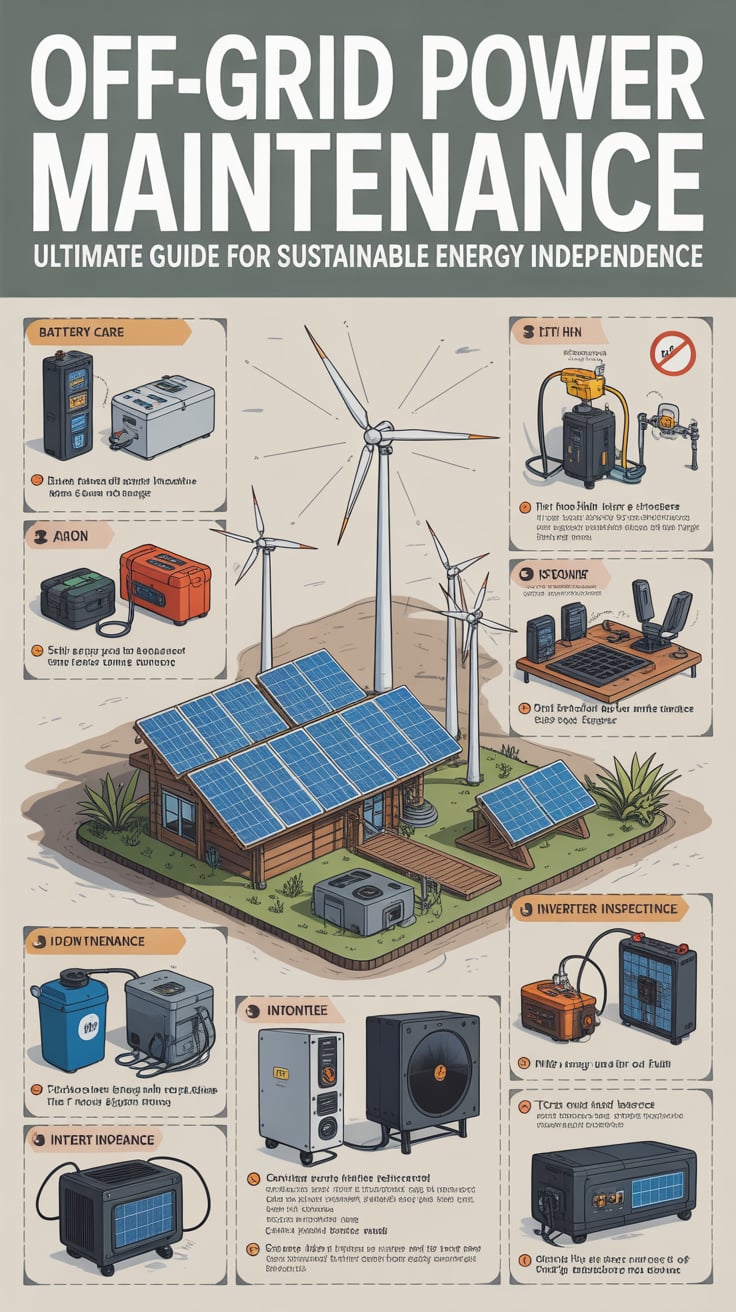
A dependable off-grid system isn’t “set and forget.” Off-grid power maintenance is the engine of true sustainable energy independence, helping you safeguard uptime, stretch component lifespans, and keep living comfortably through seasons and surprises. This guide distills pro-level practices into a practical schedule you can follow, whether your system is a compact cabin setup or a full homestead microgrid.
If you’re preparing for deeper resilience beyond routine upkeep, consider training and readiness resources like New Survival Offer: Dark Reset to tighten up your overall plan for grid-down disruptions.
Table of Contents
Off-Grid Power Maintenance Fundamentals
Solid maintenance starts with design intent and documentation. Before wrenching or cleaning, clarify three foundations: what your system includes, what success looks like for you, and what your operating environment demands.
- Define system boundaries: PV array(s), combiner boxes, charge controllers (PWM/MPPT), battery banks (flooded lead-acid, AGM, gel, LiFePO4, NMC), inverters, backup generator(s), AC/DC subpanels, transfer switch/ATS, grounding and surge protection, communications/monitoring, and critical loads (pumps, refrigeration, medical devices).
- Document nameplate specs and settings: inverter and charge-controller firmware versions, absorption/float/boost voltages, generator service intervals, wire sizes and torque values, and breaker/fuse ratings. Keep a printed binder and an off-device digital copy.
- Set maintenance goals: target uptime, acceptable depth of discharge, daily energy budget, seasonal performance benchmarks (e.g., kWh/day in winter), and maximum acceptable temperature for batteries and electronics.
Core principles that keep off-grid systems healthy:
- Safety first: de-energize before working on live circuits, use lockout/tagout on generator circuits, verify absence of voltage with a multimeter, and wear PPE (gloves, eye protection). If you’re unsure, consult a licensed electrician or solar technician.
- Cleanliness and cooling: dust chokes fans and traps heat. Keep inverters, charge controllers, and enclosures clean and ventilated. Heat is a silent killer of electronics and batteries.
- Tight and bright: loose terminations drive up resistance and heat. Check torque on lugs and busbars per manufacturer specs; look for discoloration on conductors and busbars as a heat stress indicator.
- Moisture management: condensation corrodes connectors and PCBs. Use enclosures rated for your climate, add desiccant, and ensure correct drip loops on cables.
- Grounding and surge protection: verify equipment grounds, bonding, and surge protective devices (SPDs) before storm seasons.
- Monitor and compare: use data (kWh, SOC, battery temperature, charge voltage/current, PV metrics) to catch drift early. Log weekly readings to spot trends before they become failures.
Finally, build maintainability into the layout: clear access to battery banks and breakers, labels on every conductor and device, and safe working clearance around equipment. Good organization turns maintenance from a chore into a quick routine.
Seasonal Off-Grid Power Maintenance Checklist
A seasonal rhythm keeps you ahead of weather-driven stress, dust, moisture, and load changes. Use this checklist as a starting template and adapt it to your climate and system type.
Spring
- Solar recovery: clean PV modules after pollen and winter residue; verify no new shading from tree growth. Inspect mounting hardware for corrosion and torque per spec.
- Wildlife check: look for nests under arrays or inside enclosures; add mesh guards where needed.
- Battery inspection: check case integrity, cabling, and temperature sensors. For flooded lead-acid, verify electrolyte covers plates; top up with distilled water after full charge if needed.
- Surge readiness: confirm SPDs and grounding continuity before thunderstorm season; inspect lightning protection and bonding.
- Firmware and monitoring: apply safe firmware updates and test alerts.
Summer
- Heat management: verify equipment room ventilation; clear dust from heatsinks and fans; ensure inverter/charger derating isn’t triggering under peak load.
- PV yield optimization: confirm tilt and alignment for maximum summer irradiance; note array temperatures and compare harvest to baseline.
- Battery care: keep batteries within recommended temperature (often 20–30°C/68–86°F). Check that temperature compensation on chargers is active.
- Generator exercise: run test cycles under moderate load to keep fuel, lubrication, and starting systems healthy; inspect belts, coolant, and exhaust.
- Water and critical loads: confirm that essential loads like well pumps and refrigerator freezers are not overtaxing your daily energy budget.
Fall
- Debris control: clear leaves from arrays and around generator intake/exhaust; inspect roof penetrations and cable glands for weatherproofing.
- Pre-winter tune-up: double-check torque on main DC/AC connections; test backup generator auto-start; label and test transfer switch paths.
- Battery prep: equalize flooded lead-acid if recommended by the manufacturer; verify lithium BMS parameters and cell balance status.
- Spare stock-up: replenish fuses, filters, fuel stabilizer, and desiccant packs.
Winter
- Snow and ice operations: plan safe snow-shedding; maintain a soft brush and avoid scratching glass. Adjust tilt if your racking allows.
- Cold effects: monitor lithium charge limits (many Li-ion chemistries require reduced or no charging below 0°C/32°F unless heated); ensure battery heaters or insulated enclosures are functioning.
- Generator reliability: shorter exercise intervals in extreme cold; check battery warmers, glow plugs, and cold-weather fuel blends.
- Lighting and safety: verify exterior lighting for safe maintenance access; keep pathways to equipment clear of snow and ice.
By committing to a seasonal cadence, you prevent small issues from becoming system-wide failures when conditions are harshest.
Advanced Battery Care Strategies for Off-Grid Systems
Batteries are the heart of off-grid living, and they demand nuanced, chemistry-specific care. Matching charging profiles, temperature control, and operating windows to your battery type maximizes lifespan and reliability.
Battery chemistries and key practices
- Flooded lead-acid (FLA): allow full absorption regularly; equalize periodically per manufacturer to prevent stratification; monitor specific gravity with a hydrometer for SOC accuracy; maintain proper ventilation; top up with distilled water only after a full charge.
- AGM/Gel: sealed variants reduce maintenance, but they still need correct absorption/float voltages; avoid chronic undercharge; never equalize unless the manufacturer explicitly allows a low-voltage conditioning step.
- Lithium (LiFePO4 common in off-grid): protect from charging below 0°C unless heaters are used; verify BMS parameters (cell high/low voltage cutoffs, temperature thresholds); avoid chronic 100% SOC and very deep discharge; maintain a balanced pack by occasionally allowing a full top balance if recommended.
Charging strategy
- Set charge controller profiles precisely: absorption voltage/time, float voltage, temperature compensation (lead-acid), and re-bulk thresholds. For lithium, disable float if the manufacturer advises, or set a low float.
- Depth of discharge (DoD): conservatively sizing to keep average DoD lower extends life. For lead-acid, staying near 20–50% DoD daily is kinder than 70–80%. For LiFePO4, cycling between ~20–80% SOC is a gentle operating window.
- Avoid partial state-of-charge (PSOC) abuse: long periods without full charge degrade lead-acid; schedule sunny-day full charges. Lithium tolerates PSOC better but also benefits from occasional full synchronization if the BMS needs it.
Thermal care and environment
- Keep battery temperature stable and within spec; each 10°C increase can roughly halve life in many chemistries. Use insulated boxes, ventilation in summer, and heaters in winter where needed.
- Isolate batteries from inverter heat; don’t co-locate if it pushes temps above recommended range.
- Prevent corrosion: use anti-oxidant compounds on appropriate connections; keep terminals clean and torqued; periodically inspect for creeping corrosion under heatshrink.
Storage and downtime
- Lead-acid: store fully charged and top up periodically; prevent sulfation by avoiding long idle periods at low SOC.
- Lithium: store around 40–60% SOC in a cool environment for longer shelf life; ensure the BMS prevents parasitic drain from bricking cells.
Monitoring and diagnostics
- Use battery monitors shunt-based for accurate amp-hour counting; compare coulomb count to SOC voltage charts and (for lead-acid) hydrometer readings to triangulate true capacity.
- Watch for cell imbalance in lithium packs or weak blocks in lead-acid strings; rising internal resistance and heat under load are early warning signs.
Treat your battery bank as a precision asset: the better you control charging, temperature, and DoD, the greater your return on every cycle.
Solar Array Maintenance for Maximum Yield
Your PV array is the fuel pump for your batteries. Keeping panels clean, electrically sound, and mechanically secure sustains your daily harvest.
Cleaning and surface care
- Frequency depends on dust, pollen, salt, and local wildlife. Inspect monthly; clean when you can see a film or hotspot in production data.
- Use soft water and non-abrasive tools; avoid detergents that leave residue. Clean early morning or evening to reduce thermal shock.
- For snow, use a soft-edge roof rake or brush; avoid sharp tools and heavy scraping.
Mechanical and wiring integrity
- Torque checks: confirm racking bolts and clamps per spec; thermal cycling can loosen hardware over time.
- Cable management: inspect UV-resistant ties, drip loops, and conduit integrity; replace brittle ties and add abrasion protection where cables contact edges.
- MC4 and connectors: check for signs of arcing, discoloration, or water ingress; ensure compatible brands and correct crimping; keep spare connectors and a quality crimp tool.
Electrical performance and protection
- IV-curve or comparative string testing can reveal hidden issues: mismatched strings, micro-cracks, or bypass diode failures. If you lack specialized tools, use consistent mid-day measurements of open-circuit voltage (Voc) and short-circuit current (Isc) by string with proper safety precautions.
- Combiner box health: inspect fuses/breakers, busbars, torque, and signs of heat; confirm labels are legible for quick troubleshooting.
- Surge and grounding: verify SPD indicators, bonding jumpers, and grounding electrodes. Lightning season is unforgiving; grounding integrity is your friend.
- Shading analysis: trees grow; seasonal sun paths change. Re-check shading patterns yearly, and trim vegetation to restore lost production.
Performance monitoring
- Compare current kWh/kW records to prior months and prior years, normalized for weather if possible. Sudden production dips often precede visible failures.
- Use alerting: if daily harvest falls below a set threshold for given conditions, receive a notification and investigate promptly.
A clean, well-secured array with documented baseline performance helps you spot anomalies early—long before they rob you of critical watt-hours.
Midway maintenance tip: Water independence pairs tightly with power resilience, especially for well pumps and filtration. If you’re tightening your off-grid plan, explore New Water Offer: SmartWaterBox for strategies to keep water flowing when the grid is down.
Off-Grid Power Maintenance for Generators and Inverters
Hybrid systems rely on generators and power electronics to bridge weather gaps and high-demand periods. Treat these components as mission-critical with a clear service cadence.
Generators (diesel, gasoline, propane)
- Scheduled service: follow hours-based oil and filter changes; keep air filters clean; inspect fuel lines and clamps for leaks or cracking.
- Fuel quality: rotate fuel, use stabilizers, and protect from water contamination. For diesel, address microbial growth with biocides if needed.
- Cooling and exhaust: verify coolant levels (liquid-cooled units), inspect belts and hoses, and ensure exhaust paths are clear and safely routed.
- Exercise routine: run monthly under a moderate load to keep the alternator and AVR healthy and to lubricate seals. Load banks are ideal if normal loads are insufficient.
- Electrical checks: test ATS/transfer switch, confirm neutral-ground bonding scheme is correct, and verify frequency/voltage are stable under load.
- Cold-weather prep: battery warmers, appropriate oil viscosity, and functional glow plugs or starting aids are essential.
Inverters and charge controllers
- Airflow and dust: keep intake and exhaust clear; vacuum dust; ensure fans spin freely and are unobstructed.
- Terminal torque: DC and AC connections should be torqued per spec; re-check after the first month of operation and then semi-annually.
- Firmware and configuration: update only from trusted sources; note previous versions and settings; verify that equalization and charge profiles didn’t revert.
- Derating and alarms: log any thermal derating events; they indicate cooling or oversizing needs. Address persistent overtemp warnings with ventilation improvements or capacity upgrades.
System coordination
- Auto-start integration: confirm that battery SOC thresholds properly trigger generator starts and stops; avoid short-cycling with minimum runtime settings.
- Surge handling: if motors (well pumps, compressors) cause inverter overload trips, consider soft starters or higher surge-capable inverters; maintenance includes verifying soft starter health and programming.
- Ground-fault protection: test GFCIs/RCDs; inspect insulation resistance if ground faults trip; moisture and worn cable jackets are common culprits.
Proactive upkeep of generators and inverters ensures your hybrid system delivers when solar can’t, keeping SOC healthy and lights on.
Monitoring, Diagnostics, and Troubleshooting Off-Grid Power
You can’t maintain what you don’t measure. A practical monitoring stack plus a simple diagnostic workflow turns surprises into solvable events.
Monitoring stack essentials
- Battery monitor with shunt: accurate net current and SOC tracking.
- Inverter/charger portal: remote alerts for overloads, faults, and temperature.
- Charge controller data: PV voltage/current per tracker, daily harvest, and historical logs.
- Environmental sensors: battery compartment temp, equipment room temp/humidity, irradiance proxy (optional but helpful).
- Data hygiene: back up configuration files and download monthly snapshots of performance data.
Diagnostic tools and techniques
- Multimeter and clamp meter: verify voltages and currents without opening circuits wherever possible.
- IR thermometer or thermal camera: spot hot connections and overloaded components; re-torque or replace as needed.
- Insulation resistance tester (if trained): helpful for chasing ground faults in arrays and long cable runs.
- Process of elimination: isolate subsystems—PV, battery, inverter, generator—by turning off breakers in a controlled sequence to pinpoint the issue.
Common failure patterns and quick checks
- Chronic undercharge: SOC drift, lead-acid sulfation, or lithium BMS trips. Check PV harvest vs. expected; schedule full charge cycles; confirm correct charge settings and temperature compensation.
- Sudden PV drop: shading, dirty modules, blown combiner fuses, or connector failure. Inspect strings one by one; compare Isc and Voc to baseline.
- Inverter overloads: surges from motors or too many concurrent loads. Sequence loads or add soft starters; verify inverter programming for surge capacity.
- High battery temperature: poor ventilation, failing cells, or excessive charge/discharge current. Reduce loads, improve airflow, and evaluate bank sizing.
- Generator won’t auto-start: SOC trigger mis-set, ATS wiring issue, flat starter battery, or fuel problem. Test manual start, verify start signals, and check fuel line/spark/codes.
Alert thresholds worth setting
- Low daily harvest (seasonally adjusted) triggers investigation.
- Battery temp beyond safe limits (high or low).
- Frequent generator short-cycles or unexpected runtime spikes.
- Repeated ground fault trips or RCD activations.
A disciplined monitoring routine plus a simple troubleshooting tree keeps your off-grid system predictable, efficient, and safe.
Stocking Spares, Tools, and Safety for Energy Independence
Resilience is partly logistics. When a $2 fuse stands between you and heat on a winter night, preparedness pays for itself.
Critical spares
- Electrical protection: DC fuses and breakers for PV strings, battery circuits, and inverter inputs; spare AC breakers and GFCIs.
- Connectors and wiring: MC4 connectors, appropriate crimp lugs, heatshrink, UV-rated cable ties, and lengths of PV wire and battery cable sized for your system.
- Power electronics odds and ends: spare fans and filters for inverters/chargers (if serviceable), replacement relays for ATS (if supported), spare SPD modules if your design allows hot-swap.
- Generator essentials: oil, fuel, filters (oil, air, fuel), belts, spark plugs (gasoline), glow plugs (diesel if applicable).
- Battery specifics: vent caps for flooded lead-acid, distilled water, hydrometer; for lithium, spare temperature probes and communication cables.
Tools that pay for themselves
- Quality torque wrench and torque screwdriver for precise terminations.
- Ratcheting crimper matched to your lug sizes; cable cutters for large-gauge conductors.
- Multimeter and clamp meter; label maker; headlamp; insulated tools for DC work.
- IR thermometer or compact thermal camera for hot-spot detection.
- Ladder safety gear, fall protection where appropriate, and a non-metallic cleaning kit for modules.
Safety and organization
- PPE: safety glasses, insulated gloves, hearing protection (generators), respirator mask for dusty environments.
- Fire safety: class ABC fire extinguisher near equipment; for battery rooms, consider ratings appropriate to electrical fires.
- Clear labeling: every breaker, string, and conductor labeled at both ends. A laminated one-line diagram posted at the equipment wall.
- Documentation: printed manual pages for urgent procedures—generator manual start, inverter fault codes, battery emergency disconnects—plus contact info for professionals.
- Fuel and water storage: safe, ventilated storage with spill containment; rotate and treat fuels seasonally.
When you can replace, rewire, or reprogram on the spot, small disruptions never become crises, and your path to long-term sustainable energy independence stays smooth.
Preparedness and Training for Grid-Down Events
Sound operations plus practical training is a powerful combo. Build skills that bridge the gap between maintenance and crisis response.
- Practice drills: simulate a PV string outage, an inverter overload, or a generator no-start; time your diagnosis and document the fix.
- Load triage: know exactly which loads to shed first, which to cycle, and which must stay powered. Post a priority list near the subpanel.
- Communication plan: if your system supports remote alerts, ensure they reach you even when internet is unstable—use cellular fallbacks if available.
For structured preparedness beyond electrical systems, consider:
- New Survival Offer: URBAN Survival Code for practical urban grid-down strategies that complement off-grid planning.
- Home Doctor for medical self-reliance when help is far or delayed.
Recommended resources for off-grid resilience
These curated resources pair well with the maintenance playbook above:
- New Survival Offer: Dark Reset — Preparedness training to harden your overall resilience plan.
- New Water Offer: SmartWaterBox — Strategies and tools for water autonomy that integrate with off-grid power.
- Joseph’s Well — Resource for enhancing reliable water access, a critical companion to power maintenance.
- The Lost SuperFoods — Food resilience to match your energy independence.
- Home Doctor — Practical medical guidance for remote or emergency situations.
Conclusion
Off-grid power maintenance is the ongoing discipline that transforms a good design into true sustainable energy independence. With a seasonal checklist, careful battery stewardship, clean and well-secured PV arrays, reliable generator and inverter routines, vigilant monitoring, and a stocked toolkit, you’ll prevent downtime, reduce costs, and extend component life. Build your maintenance rhythm, keep excellent records, and keep learning—the payoff is a resilient, comfortable, and confident off-grid life that keeps working when the grid doesn’t.
FAQ
How often should I perform off-grid power maintenance?
A quick visual check weekly, targeted monthly inspections, and thorough seasonal maintenance work well for most systems. Generators follow hours-based service intervals, and batteries deserve monthly attention to SOC, connections, and temperatures.
What’s the best cleaning method for solar panels?
Use soft water and a non-abrasive brush or squeegee during cool hours. Avoid harsh detergents and high-pressure jets. Clean when you see visible film or notice production dropping relative to weather norms.
How can I extend battery life in an off-grid system?
Match charge profiles to chemistry, keep temperatures within spec, avoid chronic deep discharge, and for lead-acid prevent long periods at partial state-of-charge. For lithium, keep a moderate SOC window and ensure BMS parameters are correct.
Do I need a generator for off-grid power maintenance success?
Not always, but in many climates a generator adds essential resilience for long cloudy spells or peak loads. If you go generator-free, oversize PV and battery capacity and plan for load shedding during extended low-sun periods.
What’s a safe approach to troubleshooting off-grid power issues?
Start with safety: de-energize where possible and use PPE. Isolate subsystems step-by-step, verify readings with a multimeter and clamp meter, and compare to your documented baselines. If you’re unsure, consult a qualified professional.