
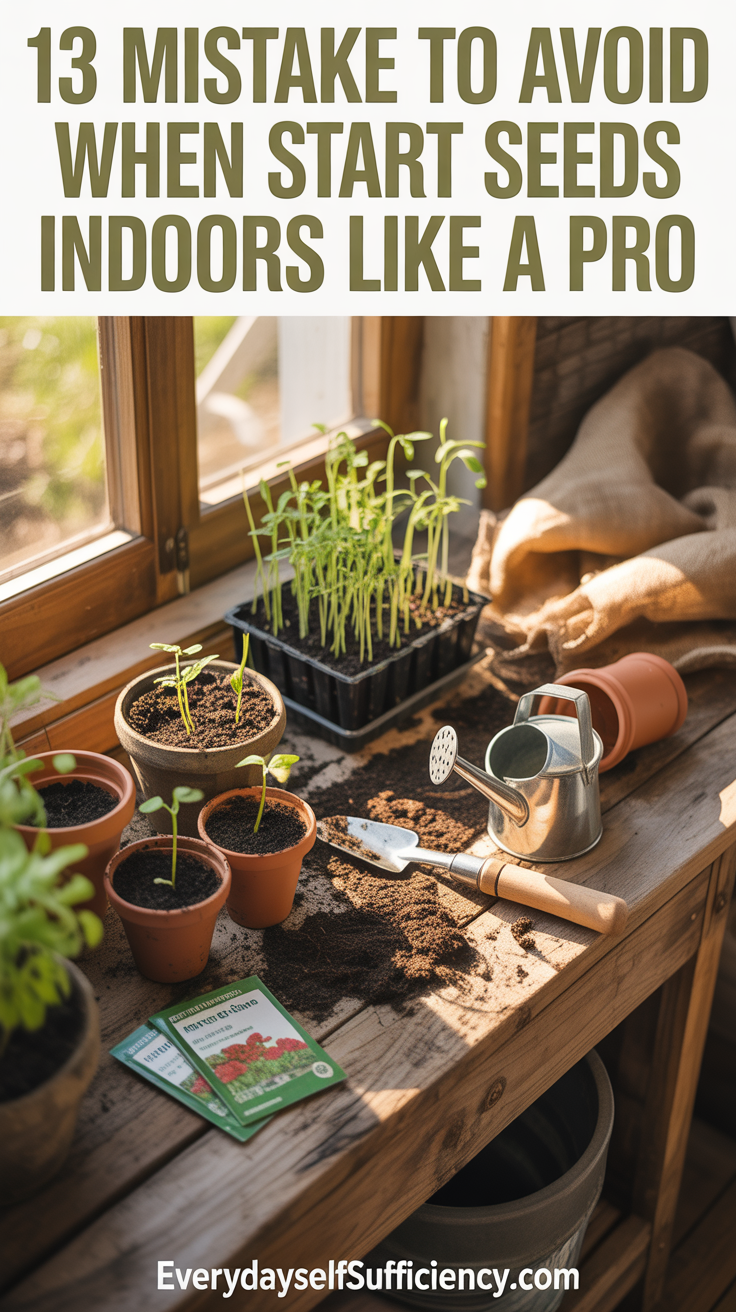
Starting seeds inside is the single most cost-effective way to grow more food, extend your season, and build real self-sufficiency. Yet even experienced gardeners run into the same 13 Mistake to avoid when Start Seeds Indoors every spring: damping-off, leggy seedlings, poor germination, and transplants that never quite recover. This guide breaks down those pitfalls, shows you exactly how to fix them, and helps you set up an indoor seed-starting system that’s simple, repeatable, and resilient.
If you’re building a food-secure home and want steadier germination and healthier seedlings with less daily fuss, a reliable, low-maintenance watering approach helps a ton. Consider automating water delivery for seedlings with a wicking or reservoir method. For example, the compact system inside SmartWaterBox makes consistent moisture far easier—especially if your schedule is tight or you tend to overwater.
You’ll also find a few strategic tools and resources throughout—always optional, always contextual—so you can pick what actually serves your homestead plan. For more DIY resilience content, bookmark the site’s hub at Everyday Self-Sufficiency.
Table of Contents
Mistake #1 — Using Garden Soil or a Non-Sterile Medium
One of the most overlooked 13 Mistake to avoid when Start Seeds Indoors is grabbing soil from the yard or using a dense all-purpose potting mix for sowing. Garden soil brings along pathogens, fungus gnat eggs, and weed seeds. Heavy mixes hold too much water, suffocate young roots, and encourage damping-off, the fungal disease that cuts seedlings at the soil line.
What to use instead:
- A sterile, soilless seed-starting mix. Look for blends based on peat or coco coir with fine perlite or vermiculite for aeration and water retention.
- Mix should feel light and fluffy, not compacted.
- If you blend your own (coco or peat + perlite/vermiculite), pre-moisten until it holds shape when squeezed but does not drip.
How to prepare trays:
- Fill cell trays or shallow flats loosely; don’t pack tightly.
- Tap the tray once to settle the mix; level the surface.
- Pre-wet the mix with a fine mist or bottom-water to evenly hydrate before sowing.
Diagnose damping-off early:
- Seedlings suddenly topple; stems look pinched and water-soaked.
- A white, cottony fungal growth may be visible on the surface.
Prevention checklist:
- Sterile medium and clean containers.
- Adequate airflow (small fan on low).
- Avoid overwatering; keep surface just moist.
- Bottom-water to reduce splashing pathogens onto stems.
- Remove humidity domes after germination to reduce excess moisture.
Bonus tip for indoor seed starting success:
- Bake your DIY mix at 180°F (82°C) for 30 minutes to pasteurize if unsure about sterility. Let cool fully, then moisten.
Remember, of the 13 Mistake to avoid when Start Seeds Indoors, using the wrong medium is the one that silently causes multiple downstream problems—fungus gnats, damping-off, poor root development, and irregular moisture. Solve this once, and your success rate jumps.
Mistake #2 — Inconsistent Moisture (Overwatering and Underwatering)
Overwatering suffocates roots, leaches oxygen from the medium, and fosters fungal diseases. Underwatering desiccates the seed or fragile radicle at the worst time, stalling germination. This is another core 13 Mistake to avoid when Start Seeds Indoors, and it’s 100% fixable.
Targets to aim for:
- Germination: Evenly moist like a wrung-out sponge; never soggy.
- Post-germination: Allow the top 0.25–0.5 inch (6–12 mm) to dry slightly between waterings to discourage fungi.
Practical techniques:
- Bottom-watering: Place trays in a shallow reservoir and let cells wick moisture for 10–20 minutes, then drain off excess.
- Capillary matting: Set trays on a wicking mat that feeds water steadily from a reservoir. This reduces human error and keeps moisture stable.
- Misting: Use a fine spray morning and evening during germination, then transition to bottom watering.
Moisture troubleshooting:
- Symptoms of overwatering: algae on soil surface, musty smell, slow growth, damping-off.
- Symptoms of underwatering: dry, crusty surface; seeds fail to swell; weak, pale seedlings.
If you want steadier moisture without babysitting, look at simple reservoir-based methods that reduce daily hands-on watering. A compact, self-regulating approach like SmartWaterBox is especially helpful when you’re starting dozens of cells or juggling busy workdays.
Water quality matters too:
- Use room-temperature water.
- If your tap is very hard, consider filtering or diluting with rainwater to avoid salt buildup.
- Aim for water pH around 6.0–6.5 for most vegetables.
Of all the 13 Mistake to avoid when Start Seeds Indoors, inconsistent moisture is the fastest way to sabotage germination. Dial this in, and you’ll see faster, more uniform sprouting.
Mistake #3 — Not Enough Light (Leggy, Weak Seedlings)
Weak, stretched, “leggy” seedlings are almost always a lighting issue. Even a south-facing window in late winter rarely provides the 12–16 hours of high-intensity light seedlings require. This is one of the most common 13 Mistake to avoid when Start Seeds Indoors.
Lighting must-knows:
- Duration: 14–16 hours of light daily is ideal; use a timer.
- Intensity: Seedlings want bright, close light. Keep LED shop lights or T5 fixtures 2–4 inches (5–10 cm) above the canopy and adjust as they grow.
- Spectrum: Full-spectrum LEDs are efficient and run cool. Prioritize PPFD (photosynthetic photon flux density) over marketing terms; most modern LED shop lights are sufficient for seedling stages.
Signs of poor lighting:
- Tall, spindly stems leaning toward the light.
- Pale leaves; wide internodal spacing.
- Slow development and poor root systems.
Pro setup checklist:
- Use a simple wire rack with two LED shop lights per shelf.
- Timer set to 15–16 hours on, 8–9 hours off.
- White or reflective backing to bounce light evenly.
- Keep a small fan circulating air to strengthen stems.
Temperature, light, and water are intertwined:
- If temps are too high but light is weak, legginess accelerates.
- If you bump light intensity, watch moisture; plants may transpire more.
Troubleshooting legginess:
- Lower the light to 2–3 inches above the tallest seedlings.
- Gently brush tops of seedlings daily or use a fan on low to mimic wind.
- Consider up-potting leggy tomatoes deeper to bury stems and stimulate adventitious roots.
This single correction eliminates a major 13 Mistake to avoid when Start Seeds Indoors and produces stocky, dark-green seedlings that transplant like champs.
Mistake #4 — Wrong Temperature and Heat; Mistake #5 — Incorrect Sowing Depth
Germination is driven by temperature. Too cold and seeds stall; too warm and you favor pathogens. Inconsistent heat is an easy-to-overlook 13 Mistake to avoid when Start Seeds Indoors.
Temperature tips:
- Bottom heat: Use a seedling heat mat for heat-loving crops (tomatoes, peppers, eggplants). Target 75–85°F (24–29°C) for germination.
- Cool-season crops (lettuce, brassicas) prefer 60–70°F (16–21°C). Too much heat may reduce germination.
- Once germination begins, remove the heat mat to prevent leggy growth from accelerated metabolism.
Sowing depth 101 (Mistake #5):
- General rule: Sow seeds at a depth 2–3 times their diameter.
- Tiny seeds (lettuce, basil): Surface-sow and lightly press for contact; they often need light to germinate.
- Medium seeds (tomatoes, brassicas): 1/4 inch (6 mm).
- Larger seeds (squash, melon): Typically better direct-sown outdoors; if starting, plant 1 inch (2.5 cm) deep in larger cells or pots.
Practical workflow:
- Pre-warm your moistened trays on a heat mat for a few hours before sowing warm-loving crops.
- Label each cell/tray with the date and crop for tracking.
- Use a humidity dome only until you see the first sprouts; then crack it and remove within 24–48 hours to reduce fungus.
Quick fixes for two crucial 13 Mistake to avoid when Start Seeds Indoors:
- If germination is patchy, confirm the seed’s preferred temperature range and adjust with or without a heat mat.
- If seedlings emerge and stall, double-check sowing depth; too deep limits oxygen and pushes the seedling to exhaustion before reaching light.
Dialing in heat and depth gives you uniform, speedy germination and reduces disease pressure.
Mistake #6 — Poor Airflow; Mistake #7 — Starting the Wrong Crops Indoors
Many growers focus on water and light but skip airflow. Stagnant, humid air is a breeding ground for damping-off and mold, making it a consistent 13 Mistake to avoid when Start Seeds Indoors.
Airflow essentials:
- Small oscillating fan on low near the seedling shelf; never blast directly at trays.
- Keep seedlings moving slightly, like a gentle breeze. This thickens stems and reduces fungal issues.
- Space trays so leaves aren’t constantly touching and trapping moisture.
Dealing with humidity:
- Humidity domes are great pre-germination but must be removed as soon as you see green.
- If your room’s RH stays above 70%, increase ventilation or run a small dehumidifier.
Starting the wrong crops inside (Mistake #7):
- Best started indoors: Tomatoes, peppers, eggplants, brassicas (broccoli, cabbage), onions, leeks, herbs, and many flowers.
- Often direct-sowed outdoors: Root crops (carrots, beets, radishes), peas, beans, corn, and large-seeded cucurbits (squash, melons) — unless your season or pest pressure demands exceptions.
- Why it matters: Transplanting root-disturbance-sensitive crops can stunt or fork roots, reducing yield.
Pro tip:
- When you must start larger seeds indoors (squash/melons), use individual 3–4 inch pots and transplant very carefully at first true leaf stage to limit root shock.
To navigate more homestead skills beyond seedlings, keep the site’s resource map handy at the sitemap. Avoiding these airflow and crop-selection pitfalls takes two major 13 Mistake to avoid when Start Seeds Indoors off your list.
Mistake #8 — Starting Too Early or Too Late; Mistake #9 — Skipping Labels and Tracking
Timing is everything. Starting too early leads to rootbound plants languishing under lights; too late and you miss your window for a strong transplant. This timing mismatch is a persistent 13 Mistake to avoid when Start Seeds Indoors.
Timing framework:
- Find your local average last frost date.
- Count backward the recommended weeks for each crop (e.g., tomatoes 6–8 weeks; peppers 8–10 weeks; brassicas 4–6 weeks).
- Build a simple spreadsheet or planner with sow, pot-up, and transplant targets.
Avoiding “too early”:
- If seedlings outgrow cells before weather cooperates, they get leggy, nutrient-starved, and rootbound.
- Plan a pot-up date into 3–4 inch pots for slow-to-transplant crops like peppers.
Avoiding “too late”:
- Late sowings can’t catch up on heat-loving crops; fruiting window shrinks.
- Use succession sowing for greens and herbs to ensure continuity.
Label and track everything (Mistake #9):
- Use UV-resistant tags or painter’s tape on tray edges; write crop, variety, and sow date with a paint pen or pencil (ink fades).
- Maintain a simple log: germination date, pot-up date, first true leaves, fertilizer start date, and any notes.
- Tracking reveals your local patterns and prevents repeating the same 13 Mistake to avoid when Start Seeds Indoors next season.
Seed saving and resilience:
- Note which varieties thrived in your exact conditions; they’re candidates for future seed saving and a more resilient pantry plan. For longer-term food security inspiration, the historical storage strategies in The Lost SuperFoods can spark practical ideas for what to grow and preserve.
Your calendar and labels are simple tools that eliminate two time-costly 13 Mistake to avoid when Start Seeds Indoors.
Mistake #10 — Feeding Too Soon or Too Strong; Mistake #11 — Ignoring pH and Water Quality
Fertilizer timing and strength can make or break seedlings. Overfeeding burns young roots; underfeeding yields pale, stalled growth. This is a nuance-packed 13 Mistake to avoid when Start Seeds Indoors that’s easy to master.
Feeding timeline:
- Seedlings feed from their seed reserves until cotyledons are fully expanded.
- Start gentle feeding when the first set of true leaves appears.
- Use a balanced, water-soluble fertilizer at 1/4 to 1/2 strength weekly; observe color and vigor.
Signs of nutrient issues:
- Pale yellowing = possible nitrogen deficiency; increase slightly.
- Burned leaf tips/margins = too strong; flush cells with plain water and back off concentration.
- Purpling leaves (phosphorus stress) can be due to cold roots; warm the environment before adding more P.
pH and water quality (Mistake #11):
- Most seedlings prefer a slightly acidic medium (pH 6.0–6.5). Extremely hard or alkaline water can lock out nutrients.
- If you suspect issues, test water pH and EC (electrical conductivity). Consider mixing in captured rainwater.
- Allow chlorinated tap water to sit 24 hours before use to dissipate chlorine.
Resilient water sourcing:
- If you’re building redundancy around water for plants and home use, the gravity-fed ideas in Joseph’s Well can inspire off-grid reliability.
- For compact, on-hand water supply that pairs well with indoor racks, the modular reservoir ideas inside SmartWaterBox help maintain consistent moisture while you fine-tune feeding.
With mindful feeding and pH control, you eliminate two more 13 Mistake to avoid when Start Seeds Indoors and set your transplants up for quick garden takeoff.
Recommended Tools and Resources for Rock-Solid Indoor Seed Starting
This section compiles optional tools that directly solve the 13 Mistake to avoid when Start Seeds Indoors. Choose what aligns with your budget and goals; none are required to succeed, but each reduces friction.
Core equipment:
- LED shop lights or full-spectrum grow lights with a timer.
- Seedling heat mat with thermostat for warm crops.
- Wire shelving rack; reflective backing to boost light use.
- Fan for gentle airflow; small dehumidifier if your space runs damp.
- Sterile seed-starting mix; cell trays, 1020 trays, humidity domes.
- Labels and a simple spreadsheet or notebook for tracking.
Watering and resilience helpers:
- Wicking or reservoir system to maintain consistent moisture: SmartWaterBox.
- Backup water know-how for off-grid or low-maintenance setups: Aqua Tower and Joseph’s Well.
Knowledge and planning:
- Pantry-first growing ideas and preservation strategies to inform what seedlings you start: The Lost SuperFoods.
- Household health contingency while you build a self-reliant garden life: Home Doctor.
How these help you avoid the 13 Mistake to avoid when Start Seeds Indoors:
- Moisture stability eliminates damping-off and uneven germination.
- Adequate light and airflow produce stocky, disease-resistant seedlings.
- Timers and thermostats remove guesswork on light and temperature.
- Logs and labels prevent timing, variety, and fertilizing errors.
- Water resilience keeps your seedling routine stable if life intervenes.
If you’re just starting out, prioritize lights, a timer, a fan, and a sterile mix. Then add a simple reservoir system to stabilize moisture. This layered approach systematically removes the most common 13 Mistake to avoid when Start Seeds Indoors without overspending.
Mistake #12 — Skipping Hardening Off; Mistake #13 — Rough Transplanting
You’ve nurtured perfect seedlings indoors—now don’t lose them at the finish line. Skipping hardening off and rushing transplants are classic 13 Mistake to avoid when Start Seeds Indoors.
Hardening off (Mistake #12):
- Purpose: Gradually acclimate seedlings to sun, wind, and outdoor temperature swings.
- Schedule: 7–10 days.
- Day 1–2: Shade outdoors, 1–2 hours, no midday sun, protected from wind.
- Day 3–5: Increase to 3–5 hours; introduce mild morning sun.
- Day 6–7: 6–8 hours; mid-morning to early afternoon sun if temps are mild.
- Day 8–10: Full day; consider an overnight if frost isn’t a risk.
Transplanting technique (Mistake #13):
- Water seedlings 1–2 hours before transplanting.
- Choose a calm, overcast day or late afternoon.
- Handle by leaves, not stems. Avoid tearing roots; for cells, push from the bottom.
- Plant at correct depth: tomatoes can be planted deeper; most others at the same depth as in the cell.
- Backfill, firm gently, and water-in with a mild starter solution.
- Provide temporary shade cloth if the sun is strong the first 2–3 days.
Troubleshooting transplant shock:
- Wilting soon after transplant? Provide shade, water lightly (don’t drown), and wait 24–48 hours.
- Yellowing after a week? Offer a half-strength balanced feed.
Final pre-transplant checklist that clears your last two 13 Mistake to avoid when Start Seeds Indoors:
- Seedlings have at least 2–3 sets of true leaves and sturdy stems.
- Roots are developed but not tightly rootbound.
- Outdoor soil is workable and warms to crop-appropriate temps.
- Frost risk has passed for tender crops (or you have protection ready).
For a last-minute safety net against surprise weather or schedule hiccups, keeping water and shade tools ready matters. If you want to reduce the “what-ifs” around moisture and plant stress, revisit the simplicity of SmartWaterBox to keep new transplants evenly hydrated through those first critical days.
Conclusion: Your Repeatable System for Avoiding the 13 Mistake to avoid when Start Seeds Indoors
Indoor seed starting is a skill stack, not a mystery. When you put sterile medium, steady moisture, strong light, correct temperatures, good airflow, precise timing, gentle feeding, and careful hardening/transplanting into one routine, you’ve eliminated every one of the 13 Mistake to avoid when Start Seeds Indoors.
Your next steps:
- Pick two changes you’ll implement immediately—often it’s light height/timers and moisture control.
- Create a simple sowing calendar from your last frost date.
- Keep one logbook; label every tray.
For homestead-wide resilience, bookmark the main hub at Everyday Self-Sufficiency and keep the sitemap handy for related guides. If water stability is your bottleneck, set up a small reservoir or wicking system now so your next sowing round is almost automatic. A compact option like SmartWaterBox pairs perfectly with standard 1020 trays and cuts daily guesswork.
- Build your seed-starting shelf this weekend: lights + timer + fan + sterile mix.
- Decide on your moisture strategy, whether manual bottom-watering or a simple reservoir/wicking approach.
- Start your first tray this week. The learning compounds fast—by your second or third round, you’ll be running a smooth, repeatable system that avoids the 13 Mistake to avoid when Start Seeds Indoors and feeds your family all season.
FAQ
What seeds should I not start indoors?
Generally, direct-sow root crops and fast, cool-tolerant species that dislike transplant disturbance. Top candidates for direct seeding: carrots, parsnips, radishes, turnips, and often beets (though beets can be transplanted with care). Peas, beans, corn, and many cucurbits (squash, melons, cucumbers) also prefer direct sowing because their large seeds and fragile roots resent handling. If your season is very short or pests are intense, you can start cucurbits indoors in 3–4 inch pots and transplant carefully at the first true leaf stage, minimizing root disturbance. Most herbs, brassicas, tomatoes, peppers, onions, and leeks are ideal for indoor starts.
What are the 5 factors affecting seed germination?
Temperature: Each crop has an optimal germination range (cool crops 60–70°F, warm crops 75–85°F).
Moisture: Even, consistent moisture without waterlogging is essential for enzyme activation and radicle emergence.
Oxygen/Aeration: Dense, soggy media suffocate seeds; a light, airy mix supports respiration and root growth.
Light/Dark cues: Some seeds (lettuce, many herbs) prefer light to germinate; others want darkness. Check packet specifics.
Seed viability and age: Older seeds have reduced vigor; test with a simple paper towel germination trial before sowing at scale.
What to know about starting seeds indoors?
Start with a sterile, soilless seed-starting mix and clean trays; maintain consistent warmth and moisture for germination. Provide 14–16 hours of bright, close light to prevent legginess, and a small fan for airflow to deter damping-off. Label every sowing and track dates so you can pot-up, feed at first true leaves, and transplant on schedule. Use heat mats for warm crops, remove humidity domes after emergence, and harden off seedlings over 7–10 days before transplanting. Avoid the 13 Mistake to avoid when Start Seeds Indoors by focusing on eight pillars: sterile medium, moisture stability, strong light, correct temps, airflow, timing, gentle feeding with correct pH, and careful hardening/transplanting.
Is it better to germinate seeds in water or paper towel?
Both water and paper towel methods can speed germination checks, but they add handling steps that can damage delicate radicles during transfer. For most home growers, sowing directly into a sterile, pre-moistened seed-starting mix is simpler and safer. If you do a paper towel test, keep seeds barely moist, warm, and well-ventilated; transplant as soon as the radicle emerges, handling by the seed coat, not the root. A direct-sow approach with bottom heat for warm crops and consistent moisture (e.g., with a reservoir or wicking setup like SmartWaterBox) offers nearly the same speed with less risk of transplant injury.
By mastering these fundamentals and avoiding the 13 Mistake to avoid when Start Seeds Indoors, you’ll produce vigorous transplants, hit your planting windows, and turn indoor seed starting into a dependable pillar of your self-sufficient home.