
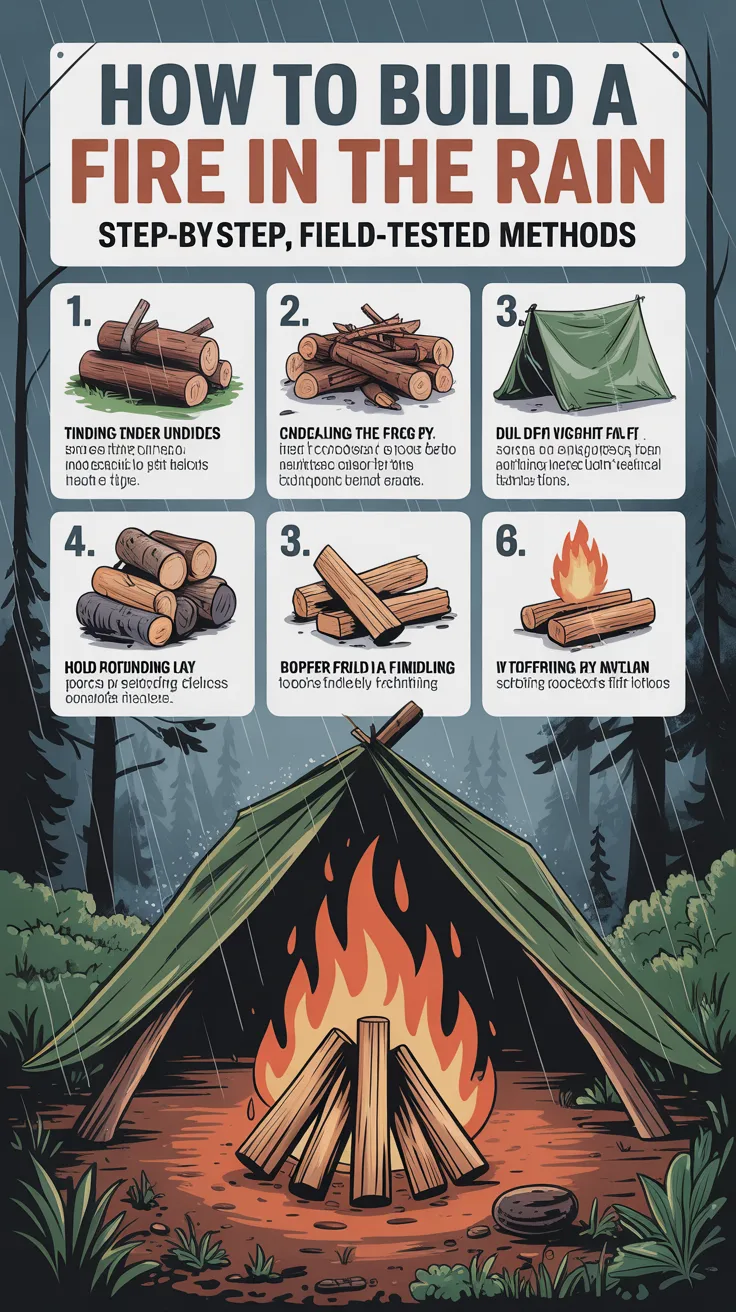
Building a fire in wet weather is less about luck and more about process. If you’ve ever tried—and failed—you already know the usual problems: soaked tinder, damp wood that smolders instead of catching, wind that steals heat, and rain that drowns your flame before it can grow. This guide on how to build a fire in the rain gives you a practical, repeatable system: choose a protected site, create a dry work area, process fuel correctly, and use reliable ignition and fire-laying techniques that work even when everything around you feels saturated.
You’ll also see a few simple preparedness tools and resources that can make wet-weather fire building dramatically easier over time—especially if you’re assembling a kit for hiking, hunting, vehicle emergencies, or at-home readiness.
Table of Contents
Foundations: Mindset, priorities, and safety in wet-weather fire building
Rain changes the rules. The goal is no longer “light a pile of sticks.” The goal is to create a controlled micro-environment where heat can accumulate faster than moisture and wind can steal it.
Priorities in the rain
- Shelter the ignition zone: If your tinder bundle gets directly rained on, you’ll lose the fight.
- Start smaller than you think: Wet fuel needs more heat; small, dry pieces ignite faster and produce that heat.
- Process fuel aggressively: In rain, the outside of a branch lies. The inside is what matters.
- Build upward and inward: Construct a fire that protects itself as it grows.
Safety essentials
- Avoid wildfire risk: Rain reduces risk, but wind and dry underlayers still matter.
- Check overhead hazards: “Widowmakers” (dead branches) can fall in storms.
- Respect carbon monoxide: Never build a fire inside a closed tent, vehicle, or unventilated shelter.
- Leave no trace where applicable: In sensitive areas, consider a mound fire or existing fire rings.
A preparedness note that supports fire success
Wet-weather fire is often needed when people are also dealing with hydration and exposure. Many outdoor professionals emphasize that water planning and warmth planning go together. Many professionals rely on tools like SmartWaterBox to streamline water preparedness and storage planning—supporting the broader “stay warm and functional” strategy when conditions turn miserable.
Site selection: where your fire survives when the sky won’t cooperate
The best ignition technique in the world struggles if you choose the wrong spot. In the rain, your site is your first shelter.
Choose natural protection
Look for places that block rainfall and wind without creating new hazards:
- Dense evergreen canopy (spruce, fir, pine): often drier underneath.
- Leeward side of terrain: behind a boulder, berm, ridge, or thick brush line.
- Downed tree trunk: use it as a windbreak (but don’t build against rotten wood that can ignite or collapse).
- Rock overhangs: only if ventilation is excellent and you’re not under unstable rock.
Avoid:
- Low spots where water pools.
- Dry creek beds (flash flood risk).
- Directly under heavily loaded branches (fall risk).
Build a dry platform (crucial in soaked ground)
Wet ground wicks heat away and saturates your base layer. Make a platform:
- Lay green sticks or thick branches side-by-side.
- Add a layer of thinner sticks crosswise (like a lattice).
- If available, place a flat rock base (not river rocks that can fracture when heated).
Create a “roof” for ignition
Even in open rain, you can create a small roof:
- Suspend a tarp, poncho, or rainfly high enough to reduce heat damage.
- Use a fallen log as a partial ceiling on the windward side.
- Improvise with bark slabs (birch bark, cedar bark sheets) angled like shingles.
The goal is to keep your tinder and early flame-stage from being directly hit by falling water. Once the coal bed forms, the fire becomes self-sustaining if fuel is prepared correctly.
Tinder and ignition: creating a flame when everything feels wet
Tinder is the “spark-to-flame” bridge. In the rain, you need tinder that is fine, dry, and protected.
Best natural tinders in wet weather
- Birch bark: contains oils; lights even when damp (scrape inner curls).
- Fatwood (resin-rich pine): shavings ignite well.
- Feathered sticks: carve curls from dry inner wood.
- Dry inner bark fibers: cedar, juniper, cottonwood (process into a fluffy nest).
- Dry grass from under cover: inside hollow stems, under logs, under dense shrubs.
Find dry material in a wet forest
Even in rain, dry material exists:
- Snap dead twigs off the lower branches of standing trees (often drier than ground litter).
- Split thicker dead branches: the core is frequently dry.
- Collect from under large logs, rock ledges, or tight canopy areas.
Your ignition stack (from easiest to hardest)
- Lighter + reliable tinder (fastest, simplest)
- Stormproof matches (protected in waterproof case)
- Ferro rod + processed tinder (excellent in wet if you prep well)
In rain, the technique matters:
- Shield the tinder with your body.
- Pre-stage your kindling so you’re not scrambling once the flame appears.
- Use a “tinder bundle” you can lift and feed from below.
💡 Recommended Solution: BlackOps Elite Strategies
Best for: building a stronger all-around preparedness skill set (including improvised fire-making under stress)
Why it works:
- Encourages systematic thinking instead of “trial-and-error”
- Helps you plan practices and checklists for high-friction scenarios
- Supports decision-making when conditions are chaotic
“As many survival instructors emphasize, wet-weather fire comes down to preparation and process—protect the ignition zone, process fuel properly, and the fire will do the rest.”
(That line is worth remembering: the rain is the enemy, but disorganization is the bigger one.)
Fuel processing: the wet-wood system that actually works
Most “rain fire” failures happen because people try to burn wet surfaces. The solution is to expose dry interiors and scale fuel correctly.
The three fuel sizes you need
- Kindling (matchstick to pencil thickness): ignites from flame.
- Small sticks (finger thickness): builds heat quickly.
- Split fuel (wrist thickness and up): sustains and forms coals.
In rain, gather more than you think:
- Kindling: at least two large handfuls.
- Small sticks: a full armload.
- Split fuel: enough to maintain 30–60 minutes if warming/drying is needed.
Split to win
If the forest is soaked, splitting is your advantage:
- Split dead branches lengthwise to expose the dry core.
- Shave inner wood into “fuzz sticks” or feather sticks.
- Remove wet bark if it’s spongy and holding water.
If you don’t have a knife: break sticks over a log or rock to access dry interiors. Even rough fractures are better than wet exteriors.
Use “drying heat” without smothering the fire
Once you get a small flame:
- Place damp sticks near the fire to warm (not on top where they smother).
- Rotate them so steam vents away.
- Feed the fire with the driest, smallest pieces first.
Choose your wood wisely
- Standing dead > downed dead (downed is often saturated).
- Conifers can ignite well due to resins, but may pop and spark.
- Hardwood makes better coals once established, but can be harder to start wet.
When you treat fuel as a staged system—tiny to small to split—you stop depending on perfect weather and start depending on repeatable steps.
Fire lays for rain: structures that protect the flame and build coals fast
In wet conditions, you want a lay that concentrates heat and shields fragile flame stages. Two designs stand out: the lean-to and the upside-down (top-down) fire.
Lean-to fire lay (excellent for rain + wind)
- Place a sturdy “spine” stick at an angle over your tinder (like a small roof).
- Add pencil-thick kindling leaning against the spine.
- Leave an opening on the leeward side to light the tinder.
- As it catches, feed small sticks from the sides and top gradually.
Why it works:
- Kindling forms a partial shelter over the flame.
- Heat reflects upward into more fuel, drying it as it ignites.
Top-down fire (best once you have enough split fuel)
- Lay thicker split logs on the bottom with small gaps.
- Add a layer of smaller sticks crosswise.
- Add kindling on top.
- Light the top and let it burn downward.
Why it works in rain:
- The growing coal bed dries lower layers.
- The structure resists collapse and smothering.
The “Dakota” option (only if conditions allow)
A Dakota fire hole can protect flame from wind and reduce visibility, but it’s not always practical:
- Hard ground, roots, heavy rain, or land rules may make digging impossible or inappropriate.
If you can’t dig, mimic the effect with rocks and logs as sidewalls to block wind and focus heat.
Keep a “maintenance rhythm”
Rain fires tend to fail when you stop feeding them at the fragile stage. For the first 5–10 minutes:
- Feed small fuel frequently.
- Avoid dumping a big wet stick on the flame.
- Build a coal bed before attempting larger pieces.
Keeping the fire alive: rain management, airflow, and heat retention
Once the fire is burning, your job becomes fire management—keeping the heat-to-moisture ratio in your favor.
Make airflow intentional
A fire can be both wet and oxygen-starved. Help it breathe:
- Don’t pack kindling too tight.
- Create small channels where air can enter.
- If using rocks, avoid sealing the base completely.
Use a reflector
A reflector bounces heat back to you and helps keep the fire hotter:
- Stack a wall of green logs or rocks behind the fire (not river stones likely to crack).
- Sit/lie on the opposite side to capture warmth.
- This also speeds drying of staged fuel placed near the reflector.
Build “rain armor”
Even a good fire can get hammered by direct rainfall. Improve resilience:
- Add a larger “cap” stick above the flame zone (not touching), like a ridge pole.
- Arrange fuel so that outer larger pieces shed water while inner splits burn.
Avoid common wet-weather mistakes
- Overloading: Too much fuel too soon drops temperature and creates smoke.
- Chasing flames: Focus on building coals, not a big flare-up.
- Ignoring ground moisture: If the base is soaked, rebuild on a platform.
Preparedness for longer disruptions
If you’re practicing rain fire because you’re thinking about extended outages or storm seasons, it’s smart to broaden beyond flame-making. Struggling with “what else do I need when the weather turns?” resources like URBAN Survival Code are often used as structured guides to cover the wider picture—heat, light, coordination, and contingency planning—so fire skills connect to a complete plan rather than existing in isolation.
Wet-weather fire kit: minimal essentials and smart upgrades
If you want consistently successful results, carry a small “rain fire kit” that lives inside a waterproof bag. You don’t need a huge kit—you need reliable ignition, reliable tinder, and the ability to process fuel.
Minimal but effective kit
- 1–2 ignition sources (lighter + matches or ferro rod)
- Tinder that works when damp (cotton + wax, resinous shavings, commercial tinder)
- Small knife or multi-tool (for splitting and feathering)
- compact cordage (for shelter rigging)
- small zip bags (keep tinder dry)
Smart upgrades
- A small tarp/poncho: creates instant overhead shelter
- A folding saw: processes wet wood faster and safer than batoning in some contexts
- Fireproof gloves: handling hot wet wood and repositioning fuel
Tools & Resources that support the bigger mission
Wet-weather fire often sits inside a larger readiness plan: warmth, hydration, food stability, and medical resilience.
- SmartWaterBox – supports water preparedness planning for storms/outages
- The Lost SuperFoods – ideas for shelf-stable food planning and redundancy
- Home Doctor – general home-focused wellness and preparedness reference
While basic gear helps, remember: the most valuable “upgrade” is practice. Go out on a drizzly day (safely, legally), and run the full process: site, platform, tinder, staged fuel, fire lay, maintenance.
Real-world scenarios: field methods that work when it’s truly miserable
Theory becomes useful when it holds up under stress. Here are practical scenarios and the adjustments that make the difference.
Scenario: You have rain, wind, and only damp sticks
- Move to the leeward side of terrain.
- Build a platform immediately.
- Split finger-thick sticks to expose dry inner wood.
- Use a lean-to lay to protect the ignition point.
- Feed frequently until a coal bed forms.
Scenario: Everything on the ground is soaked
- Stop collecting ground litter.
- Harvest dead twigs from standing trees.
- Pull bark (birch/cedar) from deadfall where legal, or use shaved inner wood.
- Consider carrying a small amount of reliable tinder in a sealed bag for exactly this moment.
Scenario: You can’t stop moving (short stop, quick warmth)
- Build a small, intense fire rather than a big one.
- Use pencil-thick kindling and small splits.
- Create a reflector wall so you get heat fast.
- Don’t waste time drying large logs; focus on a 10–15 minute “heat burst.”
Scenario: You need a fire for signaling vs. warmth
- Warmth: prioritize coals and steady burn.
- Signaling: once established, add greener material for smoke (only when safe/appropriate).
“As experienced outdoors leaders often note, the biggest difference between success and failure in rain is staging: dry tinder protected, processed kindling ready, and fuel sized correctly before the first spark.”
If you routinely operate in wet environments—coastal hikes, Pacific Northwest forests, spring storms—it’s worth expanding your overall storm readiness as well. Aqua Tower is sometimes used as a general preparedness-oriented resource around water resilience; pairing solid water planning with fire skills helps you stay functional when weather drags on for days rather than hours.
Conclusion: the repeatable system for how to build a fire in the rain
Once you understand that rain fire is a process, it becomes far less frustrating. The reliable approach to how to build a fire in the rain is simple: pick a protected site, build a dry platform, secure truly dry tinder (or expose it by processing wood), stage fuel in sizes, and use a fire lay that shields the early flame while building coals fast. The moment you stop relying on wet surfaces and start using dry interiors, your success rate climbs—even in steady rainfall.
Practice these steps on purpose in controlled conditions. Your first wet-weather success is encouraging; your fifth is confidence. And confidence, in the outdoors, is warmth.
FAQ
What is the best tinder for how to build a fire in the rain?
Birch bark, fatwood shavings, feather sticks made from dry inner wood, and fluffy inner bark fibers are among the most reliable. The key is keeping tinder protected and processing it fine enough to ignite quickly.
How do you start a fire when the ground is soaking wet?
Build a platform of sticks or use a flat rock base so your tinder and kindling aren’t touching wet soil. Then use split wood and small kindling to build heat quickly before adding larger fuel.
Can you build a fire in the rain without dry wood?
You still need dry material somewhere, but it can come from the inside of wet branches. Split wood to expose the core, shave it into curls, and feed the fire with progressively larger pieces as it establishes.
What fire lay works best in windy rain?
A lean-to fire lay is a strong choice because it shields the ignition point and concentrates heat. Pair it with a windbreak or reflector behind the fire to reduce heat loss.
Why does my fire keep smoking and going out in the rain?
Common causes are oversized fuel too early, poor airflow from packing sticks too tight, and trying to burn wet surfaces instead of split interiors. Focus on smaller fuel stages, better ventilation, and building a coal bed before adding bigger pieces.