
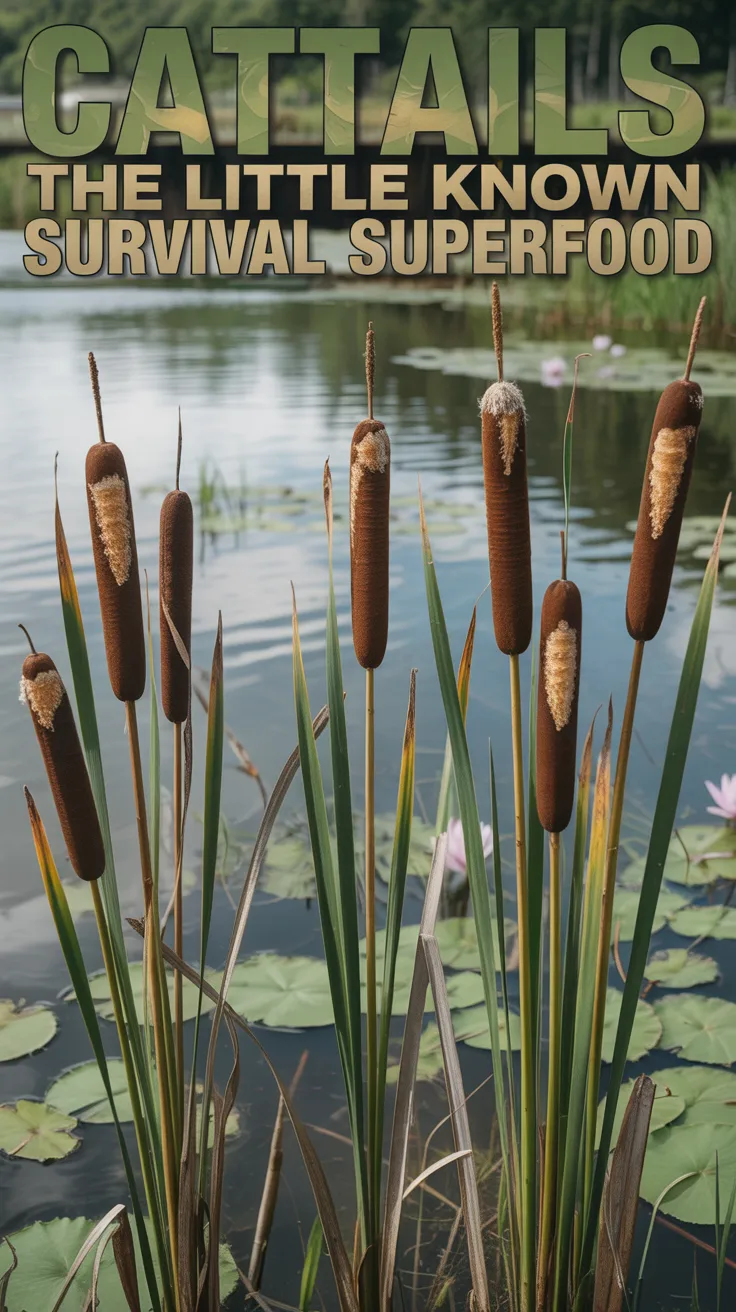
Cattails are one of the most overlooked wild resources in North America, yet they show up wherever there’s shallow water and sunlight—pond edges, marshes, ditches, and lake margins. For anyone interested in preparedness, foraging, or self-reliance, cattails – the little known survival superood deserve a permanent place on your mental map. Nearly every season offers something useful: starchy rhizomes, tender shoots, pollen, and even fluffy seed heads for tinder or insulation.
Food is only one part of the story. Cattails also help you think like a survivalist: identify reliable habitats, harvest sustainably, process what you find safely, and pair wild calories with clean water and practical medical know-how. That combination—edible plants + water security + basic health skills—is what turns “foraging” into true resilience. (If you’re building a fuller plan, many preparedness-minded people also use tools like The Lost SuperFoods to organize forgotten calorie sources and preservation ideas alongside wild foods.)
Table of Contents
Understanding Cattails as a Survival Staple
Cattails (genus Typha) are often called “the supermarket of the swamp,” but that phrase can be misleading if it implies you can just grab and eat. The truth is better: cattails are dependable, widespread, and versatile—and when you learn the plant’s structure and seasonal cycles, you can harvest meaningful nutrition with simple tools.
Why cattails matter in survival nutrition
In survival contexts, we care about three things:
- Calories (especially carbohydrates and fats)
- Micronutrients (to prevent fatigue and deficiency)
- Reliability (a resource you can find again)
Cattails score highest on reliability. They grow in thick stands, reproduce aggressively through rhizomes, and often appear in human-altered waterways: drainage ditches, retention ponds, and canals. That increases your odds of encountering them in both rural and suburban environments.
Nutritionally, cattails are best thought of as a starch source rather than a leafy green. The rhizomes (underground stems) contain usable carbohydrates, while young shoots offer tender fiber and mild flavor. Pollen provides a seasonal nutrient booster that can be mixed into meals.
Cattail habitat clues
Finding cattails is mostly about finding the right water:
- Shallow water or saturated soil
- Full sun or partial sun
- Low to moderate flow (marsh edges, pond margins, slow creeks)
They often form a dense wall at the waterline. In survival terms, dense growth means two things: more harvest potential and more hidden hazards (mud, deep pockets, sudden drop-offs).
A realistic survival expectation
A key survival lesson: cattails provide food, but processing takes time. Rhizomes need cleaning and starch extraction; shoots need careful selection; and any wetland harvest raises water-safety questions. If you treat cattails as a “grab-and-go snack,” you’ll be disappointed. If you treat them as a repeatable, seasonal staple you can plan around, they become extremely valuable.
Expert Quote Format
“As many field instructors note, ‘Water-adjacent foods are only as good as your ability to make the water safe.’ That’s why solutions like SmartWaterBox are often discussed as part of a complete preparedness setup—because reliable hydration and safer water handling make wild food strategies far more practical.”
Identifying Cattails with Confidence
Correct identification is non-negotiable. Wetlands host edible plants—and also dangerous lookalikes. Cattails are generally distinctive, but you must look for a combination of traits, not one feature.
Key identification features
- Tall, upright, blade-like leaves (flat and strap-shaped)
- Round, unbranched stalk rising from the base
- Brown “hot dog” seed head (often two parts: male above, female below)
- Grows in dense colonies from rhizomes
In late summer and fall, the iconic seed head is the giveaway. In spring, when plants are young, you may not see it—so pay attention to the leaf shape and the colony growth pattern.
Seasonal ID tips
- Early spring: Look for emerging green spears in saturated soil; older dead stalks may still stand nearby.
- Late spring to early summer: Male flower spikes appear above the developing female head; pollen phase is brief.
- Late summer: Mature brown heads are prominent.
- Fall into winter: Seed heads can burst into fluff; leaves die back, but stalk bases remain.
Common confusion and safer rules
Some wetland plants can cause illness or aren’t worth the risk. Without turning this into a botany textbook, use these safety rules:
- Don’t eat any wetland plant unless you can ID it in multiple ways.
- Avoid harvesting in areas exposed to runoff, pesticides, industrial drainage, or sewage.
- When in doubt, skip it—there will be another stand elsewhere.
Simple field checklist
Before you harvest:
- Confirm you’re seeing a Typha colony (dense stand, strap leaves, characteristic head or remnants).
- Check the water source and surrounding land use.
- Decide what you’re taking: shoots, pollen, or rhizomes.
- Plan your exit path—mud and steep banks can trap you.
If you’re foraging in suburban zones, cattails may be abundant—but those same locations often have questionable water quality. Treat urban cattails as educational unless you’re confident the site is clean.
Harvesting Cattails Sustainably and Safely
Survival isn’t just “take what you can.” Overharvesting a stand can damage future yields and the ecosystem. Also, wetlands are physically risky: deep mud, sharp debris, and cold-water exposure can injure you quickly. A sustainable, safety-first approach keeps you alive now and preserves the resource for later.
Best practices for sustainable harvest
- Take a little from many spots instead of stripping one patch.
- Leave enough rhizomes for regeneration.
- Avoid trampling: cattail stands can hide holes and destroy habitat when crushed.
A practical rule: harvest no more than 10–20% of what you see in an area, especially if you plan to return.
Tools that make cattails easier
You can harvest with bare hands, but basic tools help:
- A sturdy knife for trimming shoots and peeling layers
- A digging stick or small spade for rhizomes
- A bag or mesh sack for carrying muddy roots
- Gloves (wetland debris can slice skin)
If you’re building a broader urban resilience kit, many professionals rely on structured guides like URBAN Survival Code to streamline what to carry and how to prioritize essentials when your environment is more concrete than wilderness.
Water and contamination realities
Cattails grow where water collects—exactly where contaminants collect, too. Even if the plant is edible, the environment may not be.
Avoid harvesting near:
- Roadside ditches with heavy traffic runoff
- Golf courses and sprayed lawns
- Industrial sites and drainage outflows
- Agricultural runoff zones (fertilizers, manure)
When you do harvest, rinse thoroughly and cook when appropriate. In survival settings, “clean enough” is a moving target, but foodborne illness can be a bigger threat than hunger.
Problem-Solution Bridge
Struggling with the uncertainty of water safety when foraging near wetlands? Aqua Tower is often discussed for preparedness because it focuses on improving access to usable water—an essential backbone for any wild-food plan where washing, boiling, and hydration are constant needs.
Eating Cattails: What Parts Are Edible and When
Cattails are valuable because they offer multiple edible parts across the year. Knowing what to harvest in each season turns a swamp plant into a practical food strategy.
Spring: tender shoots and “cossack asparagus”
In early spring, cattails produce tender inner shoots at the base. Foragers sometimes call these “cossack asparagus.” Harvest by pulling or cutting near the base, then peeling away outer layers until you reach the pale, tender core.
- Flavor: mild, cucumber-like, slightly sweet
- Use: eaten raw (if safe), lightly cooked, or added to soups
- Best tip: younger is better—older shoots get fibrous
Early summer: pollen as a nutrient booster
Cattail pollen is bright yellow and collected from the male flower spike (the upper portion). The window is short; once it’s gone, it’s gone.
How to collect:
- Shake the pollen into a bag or container
- Keep it dry and use soon, or dry it further for storage
Use cases:
- Mix into flour for pancakes or flatbreads
- Stir into porridge as a thickener
- Add to soups for color and nutrients
Pollen isn’t a huge calorie source, but it’s a high-value add-on that improves the quality of simple meals.
Fall and winter: rhizomes for starch
Rhizomes are the real survival engine. They’re muddy, stringy, and time-consuming—yet they can provide meaningful carbohydrates when other sources are scarce.
Harvest:
- Dig along the base of the plant
- Pull out thick, jointed rhizomes
- Rinse repeatedly
Eating:
- Roast and peel (labor-intensive and fibrous)
- Better: extract starch by pounding and washing in water, letting starch settle, then using the sediment as flour
This starch can thicken stews or form simple cakes when cooked on a hot rock or pan.
A realistic calorie note
Rhizomes can help, but you must balance effort vs. return. In a true survival scenario, cattails shine when you can:
- Harvest efficiently (good stand, decent tools)
- Process near a water source (safe water access)
- Combine with other foods (fish, acorns, stored grains)
That’s why experienced preparedness plans don’t rely on any single plant—even a “superfood.” They build a system.
Comparison/Alternative
While many people focus on garden crops and canned goods, wild staples and old preservation methods can provide a more resilient alternative when supply chains fail. Resources like The Lost SuperFoods are often used alongside foraging knowledge to round out the “what do I eat next week?” problem with shelf-stable options and forgotten techniques.
Processing Cattails for Maximum Value
Processing is the difference between “edible” and “useful.” Cattails especially demand this mindset because the most calorie-dense part—the rhizome—needs work before it becomes good food.
Cleaning and prep workflow
A simple field-to-kitchen workflow:
- Rinse rhizomes aggressively to remove mud and grit.
- Trim away rotten sections.
- Separate thick rhizomes from thin, stringy parts.
- Choose your method: roast/peel or starch extraction.
For shoots, peel down to the tender core and rinse. For pollen, keep it dry and avoid contamination.
Starch extraction method (practical survival approach)
This method is often the best return for effort:
- Chop rhizomes into manageable pieces
- Pound or crush in a container
- Add water and knead the fibers to release starch
- Strain out fibers (cloth works)
- Let the liquid settle; starch drops to the bottom
- Pour off water and keep the starch paste
- Cook into cakes, thicken soups, or dry for later use
It’s messy, but it produces a versatile ingredient. Even a small amount of starch can make thin soups feel like meals.
Cooking ideas without a full kitchen
- Flatbread cakes: cattail starch + water + pinch of salt (if you have it), cooked on a hot stone or pan
- Thickened stew: add starch slurry near the end
- Quick sauté shoots: shoots + fat if available (oil, bacon grease)
If you have other wild foods—fish, small game, or greens—cattail starch can tie them together into a more complete dish.
Health and digestion considerations
Some people find cattail fibers tough. Cooking helps. If you’re in a situation where medical care is limited, you want to avoid self-inflicted digestive problems.
Expert Quote Format
“As many emergency-preparedness educators emphasize, ‘The best survival food is the one your body can digest consistently.’ That’s one reason guides like Home Doctor are often kept in preparedness libraries—because knowing how to handle common health issues matters as much as knowing what to eat.”
Cattails Beyond Food: Fire, Shelter, and Practical Uses
Calling cattails a survival superfood barely covers their full value. In a field situation, multi-use plants are force multipliers—saving time, gear, and energy.
Fire-starting and tinder
The mature seed head fluff is highly flammable when dry. It can:
- Catch a spark quickly
- Extend a small ember
- Help ignite damp kindling when combined with better tinder
Caution: it burns fast. Think of it as a spark-catcher, not a long-lasting fuel.
Insulation and bedding
Cattail fluff can be used as:
- Emergency insulation in clothing (messy, but warm)
- Bedding fill to lift you off cold ground
- Stuffing for improvised pillows or mittens
It’s not as effective as modern insulation, but in a pinch it can reduce heat loss.
Cordage and weaving
Leaves can be dried and used for:
- Simple cordage (twisted fibers)
- Weaving mats, crude baskets, and thatching
- Lashing lightweight structures
Processing leaves takes practice: harvest mature leaves, dry them, then re-wet slightly to improve flexibility before weaving.
Signaling and navigation
A less-discussed advantage: cattails are a habitat indicator. Where cattails thrive, you often have:
- Consistent water presence (not always clean, but present)
- Wildlife activity (birds, fish, amphibians)
- Potential travel obstacles (mud, thick stands)
In survival planning, plants are clues. Cattails can help you read the landscape—where water collects, where the ground is unstable, and where you might locate other resources.
Building a Practical Preparedness Plan Around Cattails
Cattails become most valuable when integrated into a broader plan. A smart approach treats them as one component in a layered strategy: knowledge, water, calories, and security.
The “food-water-time” triangle
Foraging works when:
- You can find food
- You can make water safe
- You can spend time processing without creating bigger risks
Cattails score high on findability, medium on processing time, and variable on water safety. That’s why water planning is the linchpin.
Many preparedness-minded people use tools like SmartWaterBox to simplify water readiness at home, while others look into broader collection strategies such as Aqua Tower to strengthen long-term resilience. The point isn’t a gadget—it’s a system where cleaning, cooking, and hydration are actually doable.
Layering knowledge: beyond one plant
Cattails are easiest when you also know:
- Other wetland edibles in your region (and which to avoid)
- How to preserve what you harvest (drying, starch storage, simple cooking)
- How to rotate between wild foods and stored foods
This is where a “forgotten foods” framework can be helpful. While you can learn everything piecemeal, resources like The Lost SuperFoods can serve as a structured reference for backup calories and preservation concepts that pair well with seasonal foraging.
Urban and grid-down considerations
If outages or disruption are part of your concern set, think about:
- Access routes to wetlands or drainage canals
- Local rules (some areas restrict harvesting)
- Personal safety (visibility, wildlife, exposure, other people)
Case Study/Example (generalized)
For instance, families who treat foraging as a weekend skill-building habit—mapping cleanish harvest spots, practicing starch extraction once or twice a season, and improving water readiness—tend to report more confidence and less panic during short-term disruptions. The results aren’t “magic”; they come from repetition.
Tools & Resources (balanced list)
If you’re building a cohesive plan around wild foods like cattails, consider keeping a few resources that cover the biggest failure points:
💡 Recommended Solution: SmartWaterBox
Best for: Water readiness at home during disruptions
Why it works:- Supports a more organized approach to water access
- Helps reduce uncertainty around daily use needs
- Pairs well with cooking and sanitation planning
💡 Recommended Solution: The Lost SuperFoods
Best for: Expanding calorie options beyond modern grocery habits
Why it works:- Encourages redundancy in food planning
- Helps you think in seasons and preservation cycles
- Complements foraging with shelf-stable strategies
💡 Recommended Solution: Home Doctor
Best for: Basic health knowledge when help is delayed
Why it works:- Reinforces prevention-first thinking
- Supports smarter decisions around food, water, and hygiene
- Helps you plan for common issues without improvising blindly
Conclusion
Cattails are more than a wetland plant with a funny brown “hot dog” on top. In practical terms, cattails – the little known survival superood represent a repeatable, teachable survival lesson: reliable resources are everywhere, but usefulness depends on identification, safe harvesting, and smart processing. When you learn when to gather shoots, how to collect pollen, and how to extract rhizome starch, you unlock real calories and culinary flexibility—especially when other options are scarce.
Just remember the core principle: cattails thrive near water, and water is both a gift and a hazard. Pair your cattail knowledge with water readiness, basic medical awareness, and a broader food strategy, and you’ll have something much better than a foraging trick—you’ll have resilience.
FAQ
Are cattails safe to eat in survival situations?
Cattails are widely considered edible, but safety depends on correct identification and clean harvest locations. Avoid polluted waterways and always wash thoroughly; cooking and proper processing reduce risk.
What part of cattails is the most nutritious?
The rhizomes offer the most survival value because they contain usable starch (calories). Young shoots provide tender edible material, and pollen can boost meals seasonally, but rhizomes are the main “fuel.”
When is the best time to harvest cattail rhizomes?
Late fall through winter is often ideal because energy is stored in the rhizomes. Harvest is easier when water levels are lower and the stand is easier to navigate, but conditions vary by region.
How do you make flour from cattails?
You don’t “grind” cattail rhizomes like wheat; you typically extract starch. Crush the rhizomes in water, strain fibers out, let the starch settle, then cook or dry the starch for later use.
What are the biggest risks when foraging cattails?
The biggest risks are misidentification, contaminated water sources, physical hazards (mud, sharp debris, cold exposure), and digestive upset from poorly processed fibers. A conservative, safety-first approach is best.