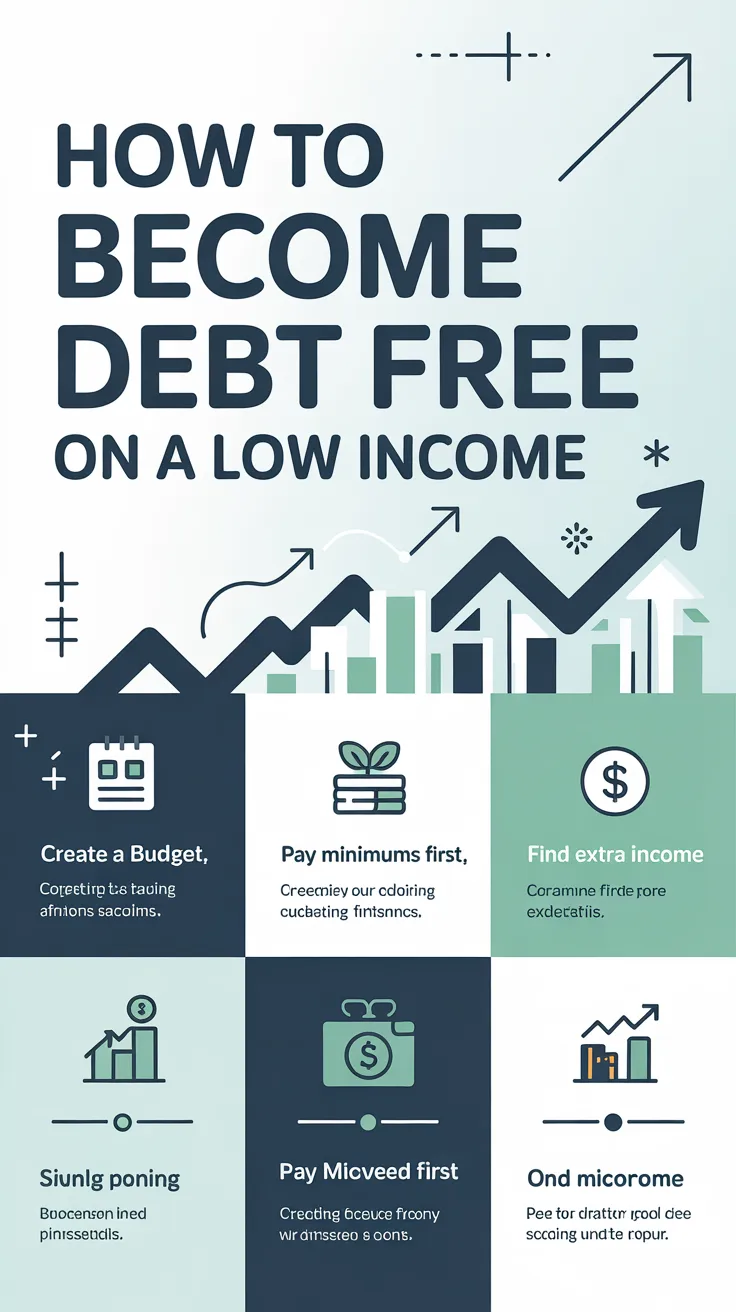
Learning how to become debt free on a low income isn’t about finding a magic budget template or living on rice and regret. It’s about building a system that makes progress predictable—even if your paycheck is inconsistent, your cost of living is high, or you’re supporting other people. The truth is: you don’t need perfect finances to start. You need a clear snapshot of your debt, a plan that fits your reality, and a few smart rules that stop new debt from replacing the old.
This guide walks you through a step-by-step approach that works on tight margins: stabilizing cash flow, choosing the right payoff method, negotiating bills, increasing income in realistic ways, and staying debt-free long-term.
Table of Contents
Building a realistic debt-free roadmap on limited income
Before you can move fast, you need to move clearly. Debt overwhelm often comes from fuzzy numbers: not knowing exact balances, interest rates, due dates, and minimum payments.
Create a “debt inventory” in 20 minutes
Open a note or spreadsheet and list:
- Creditor name
- Balance
- APR (interest rate)
- Minimum payment
- Due date
- Status (current / behind / in collections)
Add up your total minimum payments. That number is your baseline “debt overhead.”
Calculate your true monthly survival cost
On low income, the biggest mistake is planning from wishful spending rather than real spending. List only the essentials:
- Rent/mortgage
- Utilities
- Groceries
- Transportation
- Insurance
- Minimum debt payments
- Medication/health needs
- Childcare
This creates your “keep-the-lights-on” number. Anything above that—no matter how small—becomes your debt payoff fuel.
Build a plan that assumes imperfect months
If your income fluctuates, don’t budget with a single number. Use:
- Low month income (your worst normal month)
- Average month income
- Good month income
Your plan should still work in the low month. In average and good months, you accelerate.
“As many nonprofit credit counselors emphasize, the best repayment plans are the ones you can follow in your tightest month—not your best month.”
Stopping the bleeding before you pay aggressively
If you’re trying to pay off debt while still relying on credit cards for groceries, you’re swimming uphill. The first job isn’t aggressiveness—it’s stability.
Set up a tiny “anti-relapse” buffer
Even $300–$500 in a starter emergency fund reduces new debt dramatically. Build this before you throw every spare dollar at balances. Why? Because the next tire, copay, or school fee will otherwise go right back on credit.
Starter buffer ideas (choose 2–3, temporary):
- Pause extra principal payments for one month
- Sell a few unused items
- Take 1–2 extra shifts this month only
- Cut one “silent drain” subscription
Freeze new debt at the source
Use friction. Remove your card from:
- Amazon/Walmart saved payments
- Food delivery apps
- In-app purchases
- Auto-renew subscriptions
If needed, put the physical card in a sealed envelope or lockbox. You’re not “punishing yourself.” You’re protecting future you.
Replace convenience spending with a default plan
A low-income debt-free journey often fails in the “decision fatigue zone”—the 6pm “what’s for dinner?” moment.
Create a fallback list:
- 5 cheap meals you can cook fast
- 3 no-cook meals
- 2 emergency freezer meals
This prevents the $28 impulse delivery that quietly kills your momentum.
Choosing the right payoff method for low-income households
Two classic payoff strategies dominate for a reason: they work. The key is picking the one you’ll stick with.
Debt snowball method (best for motivation)
Pay minimums on all debts, then throw every extra dollar at the smallest balance first. When it’s gone, roll that payment into the next smallest.
Best if:
- You feel discouraged easily
- You have many debts
- You need quick wins
Debt avalanche method (best for saving interest)
Pay minimums on all debts, then throw every extra dollar at the highest APR first.
Best if:
- Your interest rates are crushing you
- You can stay motivated without quick wins
- You want the mathematically fastest path
Hybrid method (often best on low income)
Start with snowball to clear 1–2 small balances fast, then switch to avalanche to save interest once your budget has breathing room.
Make progress even with “small extra” payments
If you only have $25 extra per month, you’re not doomed. The hidden win is that each paid-off account reduces your minimum payment load—turning $25 into $40, then $90, then $170.
That’s how debt freedom compounds.
Cutting monthly expenses without cutting your quality of life
You don’t need extreme deprivation. You need high-impact adjustments—the ones that free up cash every single month.
Negotiate your “big three” bills first
- Housing: If moving isn’t realistic, negotiate by:
- Asking for a lease renewal freeze
- Offering autopay for a discount
- Taking on a small maintenance task for a credit (depends on landlord)
- Transportation:
- Shop insurance every 6–12 months
- Raise deductibles only if you have the starter buffer
- Use gas station loyalty + route planning
- Groceries:
- Build meals around 2–3 “anchor foods” per week
- Use store brands for staples
- Reduce waste with a “use-first” bin
Cancel subscriptions the smart way
Most people cancel entertainment but keep the expensive hidden ones:
- App subscriptions
- Cloud storage upgrades
- “Free trial” renewals
- Bank account fees
Do a 10-minute audit: open your bank app and scan the last 30 days. Anything recurring gets questioned.
Lower utilities without a lifestyle collapse
- Ask your utility company about budget billing
- Apply for hardship programs if eligible
- Swap to LED bulbs gradually
- Wash laundry cold and air-dry some loads
“Personal finance is less about heroic willpower and more about removing recurring friction.”
Increasing income realistically when time and energy are limited
Low income makes debt payoff slow—unless you create targeted income boosts that don’t burn you out.
Use the “$200 gap” strategy
Instead of trying to double your income, aim to increase net monthly income by $200–$500. That amount can dramatically change payoff speed.
Ways to find the gap:
- One weekend gig twice per month
- Selling 10–15 items per month
- Offering one service locally (cleaning, babysitting, pet sitting)
- Seasonal work (retail, warehouse, events)
Focus on high-return skills (not endless side hustles)
Your best long-term move is often a skill with quick market value:
- Basic bookkeeping
- Medical billing/coding intro
- Customer support for remote companies
- Freelance writing or editing
- Trades helper work leading to apprenticeship
Protect your health and resilience
Debt payoff collapses when you’re exhausted and sick. Treat sleep and basic nutrition like financial tools, not luxuries.
Problem-Solution Bridge: Struggling to keep a low-cost pantry while staying healthy and full? Some people use resources like The Lost SuperFoods to get ideas for shelf-stable foods and simple storage habits—useful when you’re trying to cut grocery runs and avoid expensive convenience meals.
Handling collections, late payments, and “already behind” situations
If you’re behind, the priority changes. The goal becomes stability and damage control—then payoff.
Triage your bills in the right order
Pay in this order:
- Housing (rent/mortgage)
- Utilities (keep lights/water on)
- Transportation (so you can work)
- Food/medicine
- Minimum debt payments
If you can’t pay everything, keep life stable first.
Talk to creditors early (script-friendly approach)
Call and ask:
- Can my interest rate be reduced?
- Can I get a hardship plan?
- Can you waive late fees?
- Can you move my due date?
Keep notes: date, representative, and what was offered.
Be careful with debt settlement promises
Some companies promise quick fixes but can create extra fees and credit damage. If considering settlement, do research carefully and get terms in writing.
Collections strategy basics (general guidance)
- Don’t ignore notices
- Ask for validation of the debt
- Negotiate only if you know what you can pay
- Get agreements in writing before paying
“As consumer protection experts often note, documentation wins disputes—keep records of every call, letter, and payment.”
Staying debt-free after the payoff and building a safety-first life
Debt freedom isn’t the finish line. It’s the start of financial stability—especially when income is tight.
Replace debt payments with a “freedom stack”
Once a debt is gone, redirect that payment to:
- Emergency fund (aim for 1 month, then 3 months)
- Sinking funds (car repairs, birthdays, school costs)
- Retirement or long-term savings (even small auto deposits)
This prevents the “paid off, then fell back” cycle.
Build a system for emergencies that doesn’t use credit
Create categories:
- Car: $25–$75/month
- Medical: $25/month
- Home: $25/month
- Travel/holidays: small monthly amount
Even micro-funds reduce panic spending.
Prepare for disruptions (the overlooked debt trigger)
Job loss, outages, and price spikes can push low-income households into debt fast.
Resource List: Tools & preparedness resources that can reduce emergency spending
- SmartWaterBox — helpful if you want a practical plan for water readiness so you’re not overspending last-minute during disruptions.
- Aqua Tower — another option people look into for building more resilient water habits at home.
- URBAN Survival Code — a general preparedness resource that can help you think through “what if” scenarios without panic buying.
Expert quote format (framed as common professional guidance)
“As many emergency-preparedness educators note, ‘**SmartWaterBox** has become a go-to resource for people who want a clearer, calmer approach to water readiness—because planning ahead is usually cheaper than scrambling later.’”
The point isn’t to turn your home into a bunker. It’s to prevent the kind of surprise expense that ends up on a credit card at 29% APR.
Product recommendation box (light, practical)
💡 Recommended Solution: Home Doctor
Best for: reducing expensive “urgent” decisions by learning basic home/health preparedness habits
Why it works:
- Encourages simple, proactive routines that can prevent panic spending
- Helps you think through common household problems before they become costly
- Supports a more self-reliant approach while you rebuild savings
Conclusion
If you’ve been wondering how to become debt free on a low income, the real answer is: you do it with systems, not perfection. You stabilize your essentials, stop new borrowing, build a small buffer, pick a payoff strategy you’ll actually follow, negotiate what you can, and increase income in targeted ways. Progress might feel slow at first—especially when your “extra” money is small—but consistency creates momentum. Every balance you eliminate frees up future cash flow, making the next payoff easier than the last.
Debt freedom on low income is absolutely possible—and once you’re there, the skills you built to get out will keep you out.
FAQ
How to become debt free on a low income if I can only pay the minimums?
Start by building a tiny buffer ($300–$500) and then free up even $25–$50/month through one expense cut or small income boost. Use a snowball or hybrid method so you get early wins that reduce your total minimum payments over time.
Should I save money or pay off debt first on a low income?
Do both, in order: build a starter emergency fund first (to prevent new debt), then pay down high-interest debt while growing savings gradually. Without a buffer, emergencies often send you back to credit cards.
What is the best debt payoff method for low income?
A hybrid approach often works best: snowball first to clear 1–2 small balances quickly, then avalanche to attack the highest interest rates. The best method is the one you can stick with in your tightest month.
Can I negotiate credit card interest rates or payment plans?
Yes. Call and request a lower APR, waived fees, or a hardship plan. Be polite, specific, and ready to explain what payment you can consistently make. Always document who you spoke with and what was offered.
How do I stay debt-free after I pay everything off?
Redirect your old debt payments into an emergency fund and sinking funds immediately. Automate small savings categories (car, medical, home) so surprises don’t push you back into borrowing.