
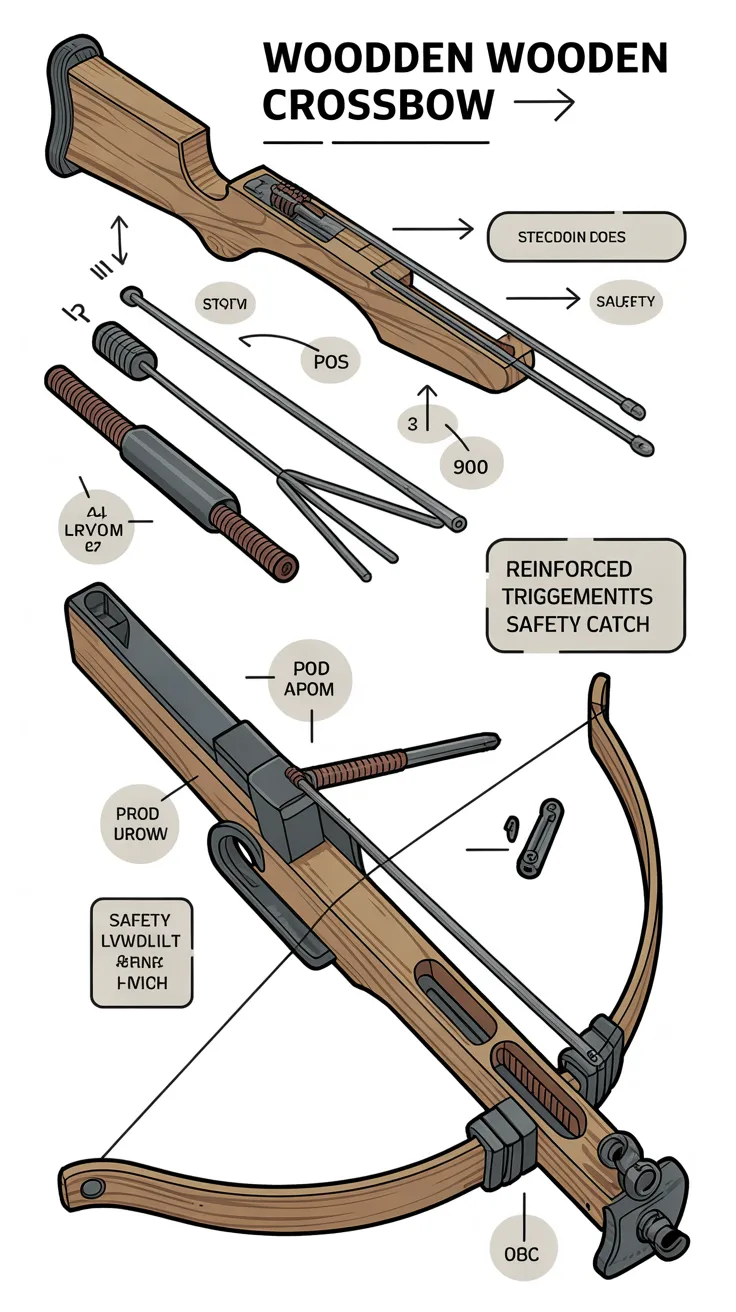
Building a strong crossbow is as much about smart design choices as it is about workmanship. If you’re learning how to build a strong crossbow, the goal isn’t just raw power—it’s a safe, repeatable platform with dependable limb alignment, a solid stock, a consistent trigger, and hardware that won’t loosen under vibration. Done right, a DIY crossbow can become a rugged tool for training, target shooting, and preparedness-focused skill building—without relying on fragile materials or guesswork.
A strong crossbow build also benefits from a broader “systems” mindset: water, food, medical readiness, and personal security planning matter just as much as the tool itself. In the field, many people pair gear projects with practical resources like SmartWaterBox for water preparedness that complements any self-reliant skill set.
Table of Contents
Core Principles of a Strong Crossbow Design
Strength in a crossbow isn’t a single feature—it’s the sum of several structural and mechanical decisions working together. Before you cut, drill, or bolt anything, it helps to understand what “strong” really means in crossbow terms.
Strength vs. power vs. durability
- Power is the energy imparted to the bolt (often correlated with draw weight, limb efficiency, and power stroke length).
- Strength is the crossbow’s ability to handle that energy without flexing unpredictably, loosening, or failing.
- Durability is long-term resistance to wear: string abrasion, trigger sear rounding, rail grooving, and limb bolt fatigue.
A smart build aims for all three, not just high draw weight.
The load path concept
A strong crossbow manages forces cleanly:
- Limbs push and flex at the front.
- The prod mount transfers load into the stock/riser.
- The rail resists bending and guides the bolt.
- The trigger box holds full draw tension safely until release.
If any one of those areas is weak—especially the limb mount or trigger—everything else becomes risky.
Alignment is “hidden strength”
Even if you overbuild the stock, poor alignment will make the bow feel inconsistent and stress parts unevenly:
- Limb tips must be symmetrical.
- String must track the center of the rail.
- The bolt must sit flat with consistent nock engagement.
Strength includes repeatability and predictability.
Planning the Build for Safety and Performance
A strong crossbow starts on paper (or at least in a sketch). Planning is where you decide the type of limbs, your draw geometry, and the materials you trust.
Choose a crossbow architecture
Most DIY builds fall into these categories:
- Recurve crossbow: Simpler limb system, fewer moving parts, often easier to maintain.
- Compound crossbow: Higher complexity (cams, cables), greater tuning demand, harder to DIY safely.
If your aim is a durable, reliable first build, recurve-style is usually the most approachable path.
Decide your “strength targets”
Rather than chasing extreme draw weight, define practical strength goals:
- A stock that doesn’t flex under cocking
- A limb mount that doesn’t shift or crush
- A trigger that retains full tension without slipping
- Hardware that stays tight after repeated shots
Build around available, dependable limbs
The limb set (prod) is not a casual DIY component. Many homebuilders use:
- Repurposed archery limbs (with careful mounting)
- Dedicated crossbow prods
- High-quality fiberglass prods from reputable suppliers
Avoid experimenting with unknown composites or improvised laminated stacks unless you have the engineering background and tooling to validate them.
Tooling and workspace basics
A strong crossbow requires precise drilling and straight reference lines. Helpful tools include:
- Drill press (or stable drill guide)
- Calipers or accurate ruler
- Square and straightedge
- Clamps, files, sandpaper
- Epoxy suited for structural bonding (if used)
- Threadlocker for fasteners (where appropriate)
Also consider safety gear: eye protection, gloves when handling string/limbs, and a safe test area with a backstop.
Materials and Components That Improve Structural Strength
A tough crossbow can be built from wood, metal, or hybrid assemblies. The best choice depends on your tools and the environment you’ll use it in.
Stock and rail material options
- Hardwood stock (maple, oak, ash): Good stiffness and shock resistance when properly sealed.
- Laminated hardwood: Often stronger and more stable than a single board (less warping).
- Aluminum rail: Great for straightness and wear resistance, but requires careful mounting.
Many builders use a hardwood stock with a reinforced “rail cap” or metal wear strip to reduce bolt-track erosion.
Reinforcing the rail
The rail takes friction and impact:
- Add a wear plate or reinforced rail surface.
- Consider a low-friction strip (applied carefully) to reduce abrasion.
- Ensure the bolt channel is consistent so fletching doesn’t clip or drag.
Limb mount and riser reinforcement
This is one of the most failure-prone zones if underbuilt.
- Use thick steel or aluminum plates for clamping.
- Spread load with wider washers/plates rather than point pressure.
- Avoid crushing wood fibers—use inserts or bedding techniques if needed.
String, serving, and fasteners
Small items matter:
- Use a string suited to the limb type and draw weight.
- Maintain serving where the bolt contacts the string.
- Use quality fasteners and check threads for proper engagement.
As a general guideline, strength comes from good interfaces: clean mating surfaces, stable fasteners, and load spreading.
Building the Stock and Rail for Reduced Flex and Better Consistency
A stock that flexes during cocking or firing creates accuracy problems and can cause long-term fatigue at the limb mount. Here’s how to build the “backbone” correctly.
Layout: align first, cut second
Start by marking:
- True centerline down the stock
- Rail height and bolt path
- Trigger box location (based on your power stroke)
- Prod mount location and bolt holes
If the centerline is wrong, everything that follows is compromised. Measure twice, cut once—then measure again.
Rail construction tips
- Keep the rail straight and flat.
- Create a consistent bolt channel: not too tight (drag), not too loose (wobble).
- Ensure the bolt sits at the same height relative to the string each time.
If you’re using wood for the rail, seal it thoroughly to prevent swelling. If you’re using metal, deburr all edges to avoid cutting string serving or damaging bolt shafts.
Reduce flex at high-stress areas
Areas to reinforce:
- Around the prod mount (front)
- Around the trigger box (mid)
- The grip and butt (for handling stability)
Reinforcement ideas include:
- Laminating an extra block at the front
- Adding a metal strap along the underside of the rail
- Using bedding epoxy to improve contact surfaces (if you have experience with it)
Practical durability details
- Round over sharp corners where hands or strings pass.
- Seal all wood (especially end grain) with a durable finish.
- Add a simple, non-slip foregrip area for safe handling.
A “strong” crossbow build isn’t just about surviving a shot—it’s about staying tight and consistent after many shots.
Trigger Mechanism and Retention System for a Strong Crossbow
The trigger is not the place to improvise. It is the safety-critical system that must hold full draw tension reliably and release cleanly.
Understand what the trigger must do
A crossbow trigger system must:
- Retain the string at full draw
- Resist creep or slip under vibration
- Release predictably without gouging the string
- Provide a margin of safety against accidental release
Many DIY builders adapt proven trigger designs, but all designs should be approached with caution and tested carefully.
Key elements that increase strength and safety
- Proper sear geometry: reduces slip risk when under load.
- Hard, wear-resistant contact surfaces: prevents rounding that can cause accidental release.
- Secure trigger box mounting: movement under load leads to inconsistent engagement.
Anti-dry-fire and basic safety concepts
Some crossbows include mechanisms to prevent firing without a bolt. Whether or not you add such features, adopt procedures that reduce risk:
- Never test-fire without a properly seated bolt (unless you have a safe, purpose-built test method).
- Always point into a safe backstop during function checks.
- Keep hands and fingers below the rail and away from the string path.
Expert quote-style note on preparedness layering
“As many preparedness instructors note, ‘Skill is only as useful as the support systems behind it’—and that’s why resources like URBAN Survival Code are often used alongside practical build projects to round out planning, decision-making, and personal readiness.”
That principle applies directly here: a strong crossbow is part of a broader safety and readiness plan, not a standalone solution.
Limb Mounting, Tuning, and Reliability Under Repeated Use
A strong crossbow can still fail if the limb mount shifts or if tuning is neglected. Reliability is built through careful fitment, alignment, and controlled testing.
Limb mounting basics
Your limb/prod mount must:
- Keep the prod square to the rail
- Prevent twisting under load
- Distribute compression forces into the stock/riser
- Resist loosening from repeated vibration
Practical mounting options vary by design, but the universal rules are: flat contact, even clamping, lock fasteners, no wobble.
Aligning the string to the rail
Check:
- String sits centered over the bolt channel
- Limb tips are even and symmetrical
- String tracks the same path at rest and drawn
If you see the string drifting left/right, stop and correct alignment before shooting.
Tuning for consistency
Even a simple recurve crossbow benefits from tuning:
- Verify brace height (consistent baseline)
- Check serving condition where the bolt contacts string
- Ensure bolt retention (simple spring clip or retention method) doesn’t deform bolts or cause drag
Reliability testing (cautious approach)
Start low and slow:
- Function check without full draw (safe controlled checks)
- Low-load draw checks to confirm trigger engagement
- Incremental testing while watching for:
- loosening fasteners
- rail wear
- string fraying
- cracks at the limb mount
Stop immediately if you see abnormal noises, limb twist, shifting hardware, or inconsistent trigger behavior.
Problem-solution bridge: field basics beyond the tool
Struggling with planning the “after” part—water, food stability, and what happens if routines break down? Tools like The Lost SuperFoods are often used as a practical resource for building a more resilient pantry strategy that complements hands-on skills.
Bolts, Sighting, and Practical Accuracy for Real-World Use
A strong crossbow that’s inaccurate or inconsistent can be frustrating and potentially unsafe. Accuracy comes from bolt compatibility, a stable rail, and repeatable shooting fundamentals.
Bolt (arrow) selection and compatibility
Use bolts that match your crossbow’s dimensional needs:
- Correct length for your rail
- Proper nock type for secure string engagement
- Appropriate stiffness (spine) for your expected energy
Avoid mixing random bolts and nocks without confirming they seat properly and clear the rail/retention system.
Consistent bolt seating
Accuracy comes from repeatability:
- Bolt should sit flat in the channel
- Nock should index consistently
- Fletching should clear the rail and any retention hardware
If bolts lift, tilt, or wobble, fix the rail channel or retention method before changing other variables.
Sighting options
Depending on your intended use:
- Simple iron sights for ruggedness
- Red-dot optics for quick acquisition
- Scope for longer-range precision (if appropriate and safely used)
Mounting must be secure and aligned to the rail. Loose mounts mimic “mystery tuning problems.”
Practical shooting fundamentals
- Maintain a stable grip and consistent cheek weld
- Keep hands safely away from the string path
- Use a consistent cocking method (uneven cocking causes horizontal spread)
- Track groups, not single shots
A strong crossbow build shines when it does the same thing every time.
Tools, Resources, and Preparedness Add-Ons That Fit a DIY Builder Mindset
If you’re building a strong crossbow for self-reliance or long-term skills, it’s smart to pair the project with broader practical resources that address the realities around the tool—hydration, food, medical readiness, and general survival planning.
Tools & Resources list (balanced options)
Many people keep resources like these on hand for preparedness planning:
💡 Recommended Solution: SmartWaterBox
Best for: water preparedness planning alongside outdoor skills
Why it works:- Supports a structured approach to water readiness
- Useful as part of a broader self-reliance setup
💡 Recommended Solution: Water Freedom System
Best for: learning options for water resilience in the home
Why it works:- Helps frame water storage and access planning
- Complements practical, hands-on preparedness projects
💡 Recommended Solution: Home Doctor
Best for: home-focused medical readiness reference
Why it works:- Encourages proactive planning for common situations
- Helpful as a general reference mindset for preparedness
Comparison/alternative framing (without overclaiming)
While some people focus only on equipment projects, resources like Home Doctor can be a useful alternative for strengthening the “human” side of readiness—what you do when supplies are limited or care is delayed. Pairing skills with planning tends to produce better outcomes than relying on gear alone.
Case-study style example (general, non-specific)
For instance, builders who treat DIY projects as part of a larger preparedness plan often report smoother decision-making during stressful events—because checklists, routines, and backups are already thought through.
Conclusion
Learning how to build a strong crossbow comes down to a few non-negotiables: a straight rail, a reinforced limb mount, safe and reliable string retention, proper alignment, and cautious testing. Strength isn’t only higher draw weight; it’s structural integrity, repeatable performance, and the discipline to avoid shortcuts—especially around the trigger and limb interfaces.
If you approach your build with a “systems” mindset—pairing craftsmanship with water, food, and medical readiness—you’ll end up with something far more valuable than a single tool: a dependable skill set supported by practical planning.
FAQ
What makes a crossbow strong beyond draw weight?
A strong crossbow is defined by structural integrity: a stiff stock/rail, a secure limb mount that doesn’t shift, reliable trigger retention, quality fasteners, and good alignment. High draw weight without reinforcement and tuning can decrease durability and safety.
How to build a strong crossbow that stays accurate over time?
Focus on repeatability: keep the rail straight and wear-resistant, ensure the string tracks the centerline, use consistent bolt seating, and prevent hardware from loosening. Regularly inspect serving, rail wear, and limb mount tightness.
What materials are best for a strong DIY crossbow stock?
Many builders use hardwoods like oak, ash, or maple, often laminated for stability. Hybrid approaches—hardwood stock plus a metal wear strip on the rail—can improve durability if installed carefully.
How important is the trigger system when building a strong crossbow?
It’s critical. The trigger must safely hold full draw tension without slipping and release cleanly. Improvised or poorly fitted triggers can be dangerous; use proven designs and cautious step-by-step testing.
Can preparedness resources help alongside learning how to build a strong crossbow?
Yes. A crossbow is only one part of readiness. Water, food planning, and medical preparedness matter in real scenarios. Resources like URBAN Survival Code or water-planning tools can complement skill-building without replacing safe training and responsible use.