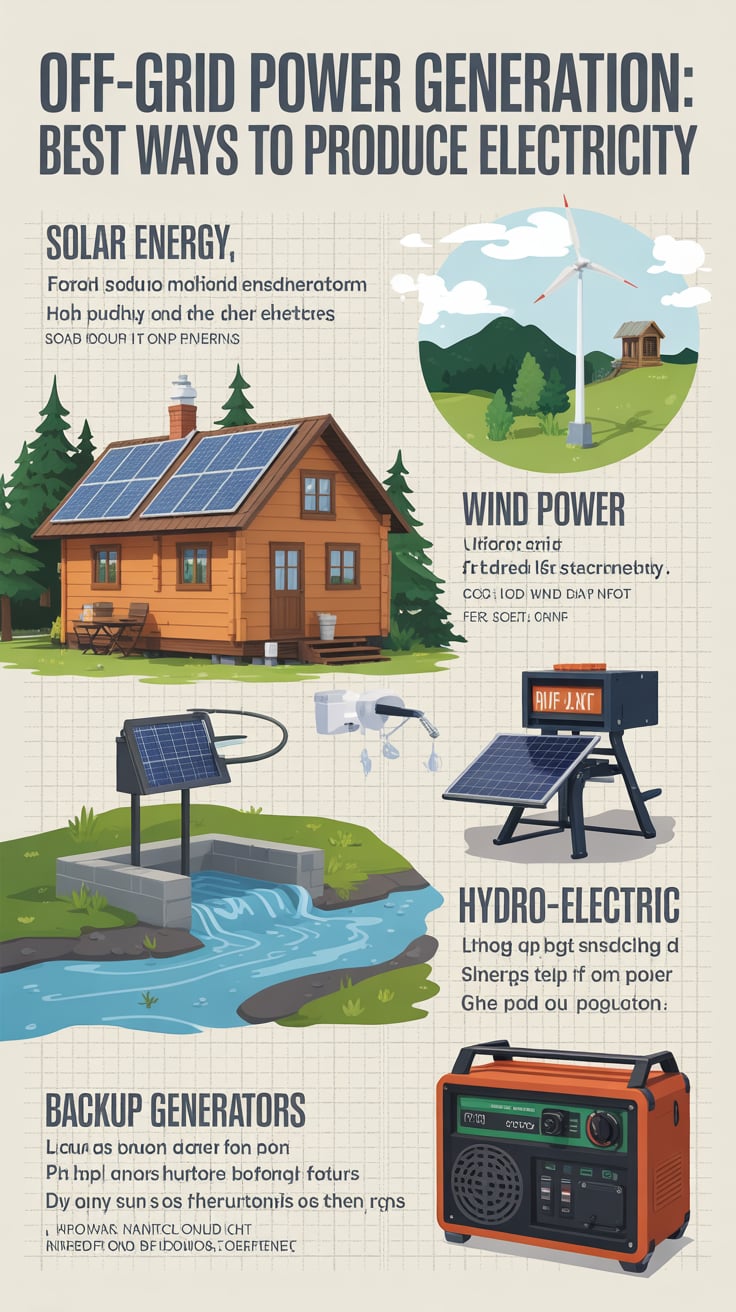
Reliable power is the backbone of self-reliance. Whether you’re homesteading, planning a cabin retreat, preparing for grid disruptions, or simply cutting your utility bill to zero, off-grid power generation is about more than panels and batteries—it’s a system that matches your lifestyle, location, and budget. In this guide, you’ll learn the best ways to produce electricity off-grid, how to right-size equipment, the trade-offs of solar, wind, micro-hydro, and generators, and the practical steps to make it all work year-round.
If you want a ready-made action plan for living through prolonged grid-down events while you set up your system, the field-proven guide New Survival Offer: Dark Reset is a practical companion you can study this week.
Table of Contents
Start with a realistic energy plan for off-grid living
Most off-grid projects fail on paper before they fail in the field. The reason: loads are underestimated and expectations are too optimistic. Begin with an energy plan that translates your lifestyle into numbers.
Audit your loads
- List every appliance and device you’ll run: fridge, freezer, lights, well pump, fans, routers, laptops, tools, medical devices, etc.
- Write down watts (W) for each, hours of use per day, and surge demands (e.g., compressors and pumps).
- Convert to daily energy: watts × hours = watt-hours (Wh). Divide by 1,000 for kilowatt-hours (kWh).
- A modest off-grid cabin often targets 3–8 kWh/day. A full-time family home might need 10–25 kWh/day with efficiency upgrades.
Reduce before you produce
- Refrigeration: choose high-efficiency units and keep gaskets tight; chest freezers are often more efficient than uprights.
- Lighting: switch to LEDs and install task lighting; use motion sensors in rarely used areas.
- Water: low-flow fixtures reduce hot water energy; gravity-fed options can reduce pump run time.
- Heating and cooking: consider propane, wood, or efficient heat pumps where feasible.
- Phantom loads: eliminate wall-warts and standbys with switched power strips or DC alternatives.
- Insulation and air sealing: the cheapest “gen-set” is better building envelope performance.
Define peak vs. base loads
- Peak load: the largest instantaneous draw your inverter must supply (e.g., well pump + fridge start-up + microwave).
- Base load: the 24/7 background consumption like routers, security, and standby electronics.
- Aim to schedule heavy loads for sunny and windy hours when generation is active.
Design for your climate
- Sun hours vary by season; wind can be highly site-specific; streams may run strong in spring but slow by late summer.
- A resilient plan staggers resources: solar for long summer days, wind for storms, hydro for steady baseline where water is available, and generators for backup.
Prioritize safety and code compliance
- Grounding and bonding reduce shock and fire hazards.
- Proper wire sizing avoids voltage drop and heat.
- Use listed equipment and consult local codes and professionals for installation, especially for battery banks, transfer switches, and generator interlocks.
A well-defined energy plan is your blueprint—helping you pick the right mix of generation, storage, and backup that fits your daily reality.
Solar power that actually meets your loads
Solar photovoltaic (PV) is the cornerstone of many off-grid systems: predictable, scalable, and low-maintenance. It’s not a magic carpet, though—performance depends on array size, sun hours, orientation, and how efficiently you use energy.
Size the array with realistic math
- Start with daily energy needs in kWh. Add system losses (inverter, wiring, temperature, dust) of 20–30%.
- Divide by average sun hours. For example: 8 kWh/day ÷ 4 peak sun hours ÷ 0.75 (for losses) ≈ 2.7 kW of PV.
- Oversize if winter sun is limited or if you want more generator-free autonomy.
Choose the right mounting and orientation
- Fixed roof mounts are common; ground mounts ease cleaning and help with cooling, often improving efficiency.
- Tilt angles near your latitude perform well yearly; steeper tilts favor winter.
- Avoid shading from trees, chimneys, or nearby structures—partial shading can drastically cut output.
Use quality balance-of-system components
- Charge controllers: MPPT controllers harvest more energy than PWM, especially in cold or variable conditions.
- Inverters: Pure sine wave inverters play nice with sensitive electronics and motors; size for both continuous and surge.
- Wiring and protection: Correct gauge wire minimizes voltage drop; include DC disconnects, fusing, and lightning/surge protection as appropriate.
- Racking and anchors: Ensure wind/snow load ratings and corrosion resistance for your climate.
Plan for seasonal realities
- Snow shedding may require steeper panels; keep a soft brush handy.
- Dust and pollen reduce output; periodic cleaning matters.
- Summer can overheat panels; ventilation and ground mounts can help maintain efficiency.
Daily operations and maintenance
- Monitor kWh production and battery state-of-charge (SoC) with a reliable shunt-based monitor or integrated app.
- Shift heavy loads (laundry, power tools) to midday when sun is strongest, reducing battery cycling.
- Keep spares: MC4 connectors, fuses, and a spare charge controller if your system is mission-critical.
Solar is the most straightforward path for many off-grid setups. Yet most thriving systems pair PV with storage and at least one other generation method to ride out cloudy weeks and seasonal dips.
Small wind that works in the real world
Wind promises power when the sun is sleeping—but only if your site has reliable wind at the right height. Poorly sited wind turbines produce disappointment and noise; well-sited turbines can nicely complement solar.
Assess your wind resource honestly
- Look beyond “it’s breezy.” What matters is average wind speed at hub height.
- Use local wind maps, anemometer data, or a temporary mast to log wind over weeks or months.
- As a rule, average speeds under ~10–12 mph (4.5–5.5 m/s) are usually marginal for small wind.
Height is everything
- Wind speed increases with elevation and clears turbulence.
- A good rule: place the turbine at least 30 feet above any obstacle within 300 feet.
- Taller towers typically mean exponentially better output—don’t skimp on height.
Turbine selection and tower types
- Horizontal-axis turbines (the classic propeller style) dominate small wind due to better power curves.
- Vertical-axis turbines are simpler to mount but generally less efficient for the same swept area.
- Guyed lattice or tilt-up tubular towers are practical and serviceable for small systems.
Power electronics and integration
- Use matched controllers and diversion loads; wind can’t just “turn off” when batteries are full.
- Hybrid controllers let wind and solar charge the same battery bank with coordinated regulation.
- Brake switches and mechanical shutdowns add safety in storms and maintenance.
Maintenance matters
- Expect periodic bearing, blade, and electrical inspections; tighten bolts and inspect guy wires.
- Ice and salt environments accelerate wear; plan spares and safe tower lowering for service.
- Noise: modern small turbines can be quiet when balanced and sited well, but verify local rules and neighbor impact.
When the wind resource is strong and properly tapped—with the right height, tower, and controls—small wind can meaningfully increase winter and night production, reducing generator runtime.
Micro-hydro for 24/7 baseline power
Micro-hydro is the unsung hero of off-grid power generation. If you have a suitable stream, a small turbine can provide continuous power—day and night, rain or shine—often with less hardware than equivalent solar and battery capacity.
Understand head and flow
- Head: the vertical drop (in feet or meters) between water intake and turbine. More head means more potential energy.
- Flow: the volume of water passing per unit time (e.g., gallons per minute or liters per second).
- Power rough estimate: Watts ≈ 9.8 × head (m) × flow (L/s) × efficiency (0.3–0.7 typical). In imperial units, use a comparable conversion.
Choose the right turbine type
- Pelton and Turgo wheels excel at high head, low flow sites.
- Crossflow turbines work well at moderate head and flow.
- Propeller or Francis-style turbines fit low head, high flow locations.
- Permanent magnet alternators paired with rectifiers are common; ensure waterproofing and proper enclosures.
Penstock, intake, and tailrace
- Minimize friction loss with adequate pipe size and smooth runs.
- Design an intake that excludes debris and air; add screens and settle basins as needed.
- A stable foundation and flood-safe housing protect the turbine and electronics.
Electrical integration
- Regulate output with charge controllers designed for hydro; diversion loads protect batteries when they’re full.
- Many micro-hydro setups can power base loads continuously, reducing battery cycling and required capacity.
- Use adequate surge protection and grounding, especially in lightning-prone areas.
Environmental and legal considerations
- Check local permitting for water rights, fish passage, and environmental impact.
- Seasonal flow changes can reduce output; plan for minimum viable flow during late summer or drought.
If water self-reliance is part of your plan, strengthening your potable supply complements hydro power. Practical resources like New Water Offer: SmartWaterBox and Survival Water Box can help you think through independent water setups while you design your off-grid system.
Batteries, inverters, and system integration
Storage and conversion are where off-grid systems either shine or struggle. The battery bank, charge controls, inverter, and wiring topology must work as a cohesive unit sized to your loads and climate.
Choose a battery chemistry that fits your use
- Flooded lead-acid (FLA): low upfront cost, proven, but require maintenance and ventilation; best at shallow cycling.
- Sealed AGM/Gel: maintenance-reduced but can be sensitive to overcharge; good for intermittent use.
- Lithium iron phosphate (LiFePO4): higher upfront cost, long cycle life, deep discharge capability, lightweight, and efficient; needs a proper Battery Management System (BMS) and low-temperature charging protection.
- Sizing: Aim for at least 1–3 days of autonomy; consider winter when solar output is lowest.
Inverters and system voltage
- Choose 12V for very small systems, 24V for medium, 48V for larger to reduce current and cable size.
- Size inverter continuous rating to exceed typical peak use; verify surge capacity for motor starts (often 2–6× running watts).
- Pure sine wave inverters protect electronics and reduce hum and heat.
Charge controllers and coupling
- MPPT controllers maximize PV harvest; ensure input voltage and current fall within controller specs.
- DC-coupled systems feed batteries directly from PV/wind/hydro controllers; AC-coupled systems use grid-tie inverters tied to an off-grid inverter—flexible for retrofits and expansion.
- Diversion loads are essential for wind/hydro to safely bleed excess energy.
Protection, wiring, and monitoring
- Use appropriately rated DC breakers/fuses, busbars, and disconnects; size conductors for both current and acceptable voltage drop (e.g., <3% on critical runs).
- Grounding and bonding reduce fault and lightning risks.
- Monitor battery SoC with a shunt-based meter; many inverters and BMSes integrate Bluetooth/app monitoring.
System layout and maintenance
- Group batteries in a thermally stable area; avoid freezing or excessive heat.
- Keep cable lengths short and equalized across parallel strings; minimize the number of parallel strings where possible.
- Maintain logs: daily kWh generation/consumption, battery SoC, and maintenance tasks. Early detection prevents expensive failures.
With the right storage and conversion backbone, your solar, wind, and hydro can work together seamlessly—and your generator becomes a true backup instead of a daily habit.
Generators and biofuels as strategic backups
Even superb off-grid systems benefit from a generator, especially in winter or during extended storms. The trick is to size and use generators strategically to protect your batteries and minimize fuel costs.
Fuel choices and trade-offs
- Gasoline: easy to source, but short storage life without stabilizers; smaller engines are common and portable.
- Diesel: efficient under steady loads and long-lived; heavier and louder; fuel stores better than gasoline with care.
- Propane: clean-burning and stores indefinitely in cylinders; slightly less energy per unit than diesel; great for standby units.
- Biofuels: some diesel gensets accept properly processed biodiesel; ensure manufacturer guidance and cold-weather strategies.
Inverter generators vs. conventional
- Inverter generators provide clean sine-wave power and throttle down with light loads, saving fuel.
- Conventional units excel at heavy continuous loads but can be less fuel-efficient at partial load.
- Match generator output to battery charger size (e.g., 2–3 kW genset with a 60–100A charger on a 24/48V bank).
Smart usage reduces costs and noise
- Run the generator to bulk-charge batteries from low SoC to around 80–90%, when charging is most efficient; let solar/wind finish the absorb stage.
- Batch heavy tasks (laundry, power tools) during generator runtime to leverage direct AC power.
- Maintain adequate ventilation, exhaust safety clearances, and CO detectors.
Transfer switches and safety
- Never backfeed a panel; use an interlock or transfer switch for any whole-house circuits.
- Isolate generator power from any grid connection to protect line workers and equipment.
- Bonding and grounding must follow code and generator/inverter manufacturer guidance.
Maintenance and spares
- Keep oil, filters, spark plugs, and a spare pull cord; follow the recommended service intervals.
- Test monthly under load; fuel-cycle stored gasoline and treat with stabilizers.
- Store fuel safely with approved containers; rotate stocks and track dates.
Generators buy you time and autonomy. Used strategically with a well-designed battery and renewable setup, they become quiet, occasional helpers rather than noisy daily drivers.
Emerging and low-tech options that boost resilience
Beyond the big three (solar, wind, hydro), a handful of alternative and low-tech options can enhance resilience—especially for niche loads or when you want redundancy without complexity.
Human-powered and mechanical energy
- Pedal generators for charging small battery banks or emergency communications gear.
- Hand-crank devices for radios and lights; good for emergencies but not primary power.
- Mechanical water pumping (windmills, treadle pumps) offloads electrical demand from your system.
Biogas and biomass
- Small-scale anaerobic digesters produce methane-rich gas from organic waste; use for cooking or heating, sparing electrical loads.
- Efficient wood stoves and rocket stoves minimize fuel needs and can pair with thermoelectric generators for trickle charging.
- Wood gasification can run modified gensets in some contexts; requires knowledge, safety, and consistent fuel processing.
Thermal to electric
- Thermoelectric modules harvest small amounts of electricity from heat sources (stoves) to run fans or charge devices.
- Stirling engines can convert heat to mechanical power; niche and requires tinkering but compelling for DIYers.
Direct DC appliances
- DC fridges/freezers and pumps can improve overall efficiency by skipping inverter losses.
- USB-C PD and 12V distribution for electronics reduce conversion steps.
Load shifting and seasonal strategies
- Use solar ovens or dehydrators in summer to offload cooking energy.
- Run dehumidification or water pumping during mid-day production peaks.
- In winter, prioritize high-efficiency lighting and minimize electric heat—use biomass or propane for thermal needs.
Think of these as layers in your resilience stack. They won’t replace PV or a battery bank, but they can shave loads, create redundancy, and keep essentials running during edge cases.
Preparedness resources, tools, and step-by-step next actions
A solid off-grid system is part engineering, part habit, and part preparedness mindset. This section ties your plan together and points you to practical resources you can use immediately.
Your 30/60/90-day roadmap
- Next 30 days
- Complete a load audit and set a daily kWh target.
- Tackle low-cost efficiency wins: LEDs, smart strips, sealing drafts.
- Order a battery monitor and temporary watt-hour meters for key appliances.
- Next 60 days
- Install or expand PV with an MPPT controller sized for your future array.
- Choose a battery chemistry and start with a bank that gives you at least one day of autonomy; add a generator interlock and charger.
- If wind or hydro are viable, begin site assessment and permitting.
- Next 90 days
- Integrate a second generation source (wind or hydro) if viable or improve PV capacity and tilt.
- Build spares kits: fuses, connectors, spare controller, oil/filters.
- Practice weekly “grid-off” drills; log kWh, SoC, and runtime to fine-tune.
- Next 30 days
Recommended off-grid resources and guides
- New Survival Offer: Dark Reset — a step-by-step survival framework for grid-down scenarios that pairs well with building your energy plan.
- New Survival Offer: URBAN Survival Code — practical strategies for apartment and city dwellers who need off-grid resilience in tight spaces.
- New Water Offer: SmartWaterBox — helpful concepts for setting up independent water, an essential twin to power.
- Survival Water Box — insights for well-based water independence to pair with off-grid power for pumps.
- The Lost SuperFoods — food resilience ideas that reduce electric cooking and refrigeration burden.
- Home Doctor — medical self-reliance reference, invaluable if power outages limit access to care.
Budgeting and phasing your build
- Start with the energy plan and efficiency; these are low-cost and high-return.
- Phase 1: PV + MPPT + modest battery + inverter; add generator with charger and a safe transfer setup.
- Phase 2: Expand PV or add wind/hydro depending on site; increase battery autonomy.
- Phase 3: Optimize with DC appliances, monitoring, spares, and seasonal tilt or trackers if budget allows.
- Keep 10–15% contingency in the budget for wiring, racking, and protection hardware you didn’t anticipate.
Skills and habits that pay off
- Learn basic DC safety, crimping, and torque specs; keep a tidy, labeled system.
- Log performance; small tweaks in schedules and appliance choices can save hundreds of kWh over a year.
- Practice outage scenarios while monitoring SoC; you’ll quickly discover the best times to run heavy loads and when to let the sun do the work.
Preparedness is the multiplier that turns hardware into real resilience. Use the resources above to build both your system and the confidence to run it.
Conclusion
The best off-grid power generation strategy blends honest load planning with diversified production and smart storage. Solar provides predictable, scalable energy; wind and hydro add round-the-clock or storm-driven power; batteries and inverters knit everything together; and a well-chosen generator fills the gaps. Start with a realistic energy audit, reduce what you can, and then invest in generation and storage sized to your climate and goals. With a phased plan and a few resilience-minded resources, off-grid power generation becomes not just possible, but comfortable and sustainable for the long haul.
Frequently asked questions
u003cpu003eWhat is the cheapest way to produce electricity off-grid?u003c/pu003e
The cheapest kWh is the one you don’t need. Start with efficiency: insulation, LEDs, and efficient appliances. For generation, fixed-mount solar PV with an MPPT controller and a modest battery bank tends to offer the best cost per kWh. Add a small inverter generator for occasional backup rather than oversizing batteries for rare cloudy stretches.
u003cpu003eHow many solar panels do I need to run a house off-grid?u003c/pu003e
It depends on your daily kWh and sun hours. As a ballpark: a household targeting 10 kWh/day in an area with 4 peak sun hours might need a 3–4 kW array after accounting for losses and some seasonal margin. Do a load audit, factor in winter sun, and size panels alongside a battery bank and inverter that meet both energy and peak power needs.
u003cpu003eIs wind or solar better for off-grid power generation?u003c/pu003e
Most sites benefit from solar as the foundation because it’s predictable and low-maintenance. Wind can be excellent if you have consistent wind speeds (often 10–12+ mph averages) and room for a tall tower. Hybrid solar-wind shines in places with winter winds and summer sun, reducing generator runtime and battery cycling.
u003cpu003eHow big should my battery bank be for off-grid living?u003c/pu003e
Size for at least 1–3 days of autonomy based on your daily kWh use and local weather patterns. Lithium iron phosphate (LiFePO4) offers deep discharge and long cycle life but costs more upfront. Lead-acid is cheaper but prefers shallow cycles and regular maintenance. Protect batteries from extreme temperatures and monitor state-of-charge.
u003cpu003eDo I need permits for off-grid systems?u003c/pu003e
Often yes, especially for structural mounts, electrical work, and any water or hydro installations. Local codes may govern wiring, grounding, setbacks, tower heights for wind, and water rights for hydro. Working with professionals familiar with local regulations can save time and ensure safety.
u003cpu003eWhat’s the best way to power a well pump off-grid?u003c/pu003e
Size your inverter for the pump’s surge current, consider soft-start controllers, and schedule pumping during peak solar hours. A dedicated circuit, pressure tank sizing, and possibly direct DC options can reduce surges on your system. Pairing power with robust water resilience resources like New Water Offer: u003ca href=u0022https://fc3d20hfj5km1ofgjdtlu9cs4r.hop.clickbank.netu0022u003eSmartWaterBoxu003c/au003e and u003ca href=u0022https://405688dfeamhtkaftoolkg6r3r.hop.clickbank.netu0022u003eJoseph’s Wellu003c/au003e helps ensure reliability.