
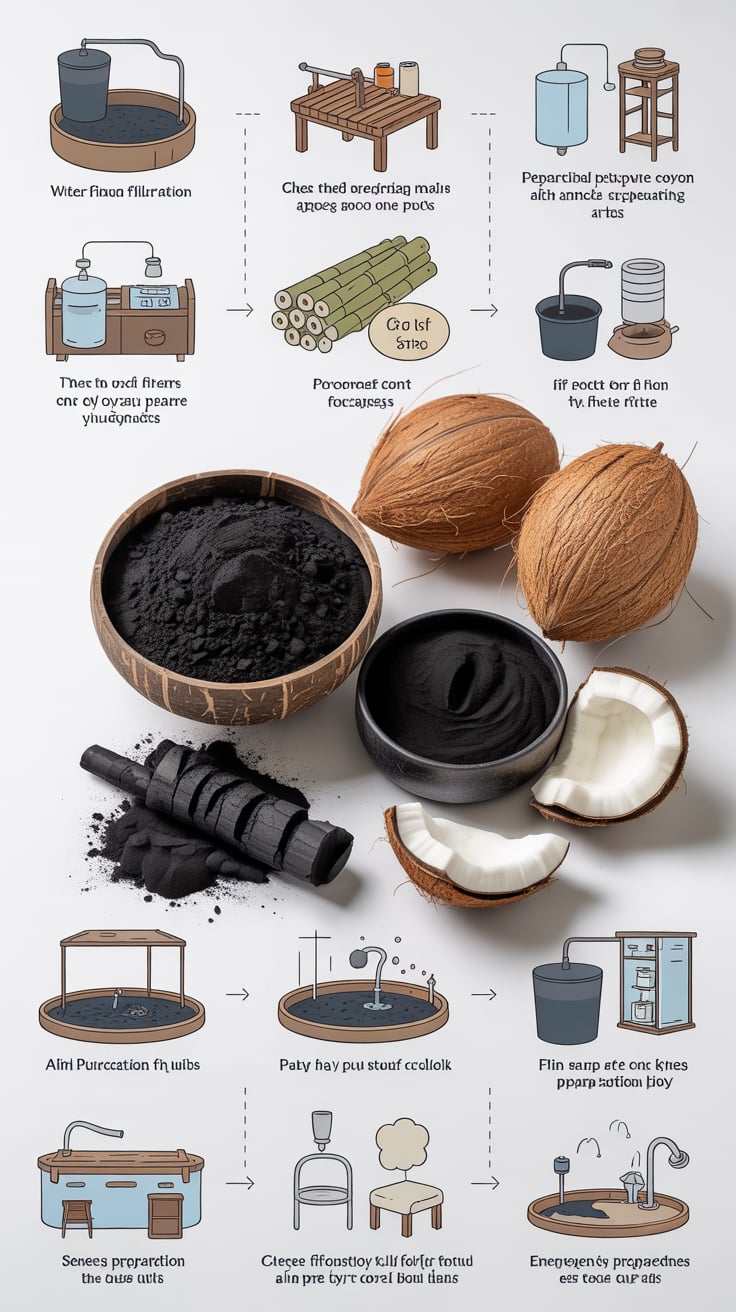
DIY Activated Charcoal is one of those rare projects that blends homesteading, preparedness, and practical everyday utility. When made and used correctly, it can help improve water taste, reduce odors, and serve as a useful component in basic filtration tasks. It’s also a staple in survival kits because it’s light, versatile, and can be made from common natural materials. This guide covers what activated charcoal is, how to make it at home as safely as possible, how to use it effectively, and how to store and test it so you know it’s doing real work—not just turning things black.
If you want a ready-made home backup for cleaner-tasting water while you learn the craft, check out the compact SmartWaterBox.
Table of Contents
What activated charcoal is and how it works
Activated charcoal (also called activated carbon) is a form of carbon processed to have a massive network of pores and a huge internal surface area. Those pores create sites where molecules—especially many organic compounds—can adhere. That process is called adsorption (not absorption): contaminants stick to the carbon’s surface rather than being soaked up like a sponge.
Key concepts:
- Micropores and mesopores: The most effective activated carbons have a distribution of pore sizes to trap a range of molecules. Micropores capture small molecules; mesopores help with larger ones and improve flow.
- Surface chemistry: Different activation methods create different functional groups on the carbon surface, which can improve affinity for certain contaminants.
- Not a silver bullet: Activated charcoal is excellent for improving taste and odor, reducing many organics, and helping remove chlorine and some byproducts. It is not a universal purifier—metals like lead or pathogens like viruses and bacteria require other treatment steps (ion exchange, reverse osmosis, chemical disinfection, UV, or boiling).
Activated charcoal vs. regular charcoal vs. biochar:
- Regular charcoal is carbonized wood (or another biomass) without special processing. It has lower porosity and limited adsorption capability.
- Biochar is similar to charcoal but optimized for soil use. It can improve soil structure and hold nutrients, but it is not the same as high-performing activated carbon for filtration.
- Activated charcoal undergoes additional activation—either chemical or physical (steam/CO₂)—to massively increase porosity and surface area.
The performance of DIY Activated Charcoal depends heavily on your process, from the feedstock you choose to how you activate, rinse, and size the particles. Expect big improvements over plain charcoal, but don’t assume it will match lab-grade carbon. That’s okay—knowing its strengths and limits lets you use it wisely.
Safety and sourcing basics for DIY projects
Before you start, safety first. Working with heat, steam, and chemicals demands a plan and proper protection.
- Ventilation: Carbonizing wood or other biomass produces smoke and volatile compounds. Work outdoors or under excellent ventilation. Never do the burn indoors.
- Protective gear: Wear heat-resistant gloves, eye protection, long sleeves, and a proper dust mask or respirator when handling carbon dust. Carbon dust is messy and can irritate lungs.
- Appropriate feedstock: Use clean, untreated hardwoods (oak, maple, hickory, beech). Skip pressure-treated lumber, painted wood, plywood, or any wood with glue, varnish, or chemical treatments.
- Food-grade considerations: If you plan to use your activated charcoal for anything related to water or food, aim for the cleanest materials and avoid any questionable chemicals. When in doubt, use benign activators like citric acid (lemon juice) and rinse thoroughly.
- Heat safety: Charcoal stays hot inside for a long time. Quench carefully and never assume embers are out just because smoke has stopped.
- Medical disclaimer: Do not self-administer activated charcoal for poisoning unless specifically instructed by a medical professional or poison control. It can interfere with medications, isn’t effective for some poisons (acids, alkalis, alcohols, heavy metals), and must be used correctly to avoid aspiration or other complications.
- Filter limitations: DIY filters with activated charcoal improve taste, odor, and many organic contaminants, but they do not guarantee microbiological safety. Boil, chemically disinfect, or use a certified purifier for pathogen control.
Responsibly sourced materials and careful handling make your results safer and more effective—and your cleanup much easier.
Tools, materials, and prep workspace
A successful DIY Activated Charcoal project starts with a simple kit and a clean workflow.
Suggested tools:
- Heat source: Fire pit, grill, rocket stove, or outdoor burner
- Charcoal retort or lidded metal container: A steel pot, paint can, or ammo can with a small vent hole works for small batches
- Stainless or enamel pot for activation and rinsing (avoid aluminum with acidic solutions)
- Strainers or fine mesh (nylon or stainless)
- Mortar and pestle or a sturdy grinder for sizing the carbon
- pH test strips (optional but helpful for rinsing to neutral)
- Clean buckets, stirring spoon, and a scale or measuring cups
- N95 dust mask or respirator and safety glasses
Materials:
- Clean, dry hardwood chunks or sticks
- Activator: Citric acid solution (food-safe; lemon juice or powdered citric acid) or calcium chloride solution (commonly sold for pickling or dehumidifiers; handle carefully and rinse thoroughly)
- Clean water for rinsing (copious)
- Coffee filters or fine cloth for final rinses
- For filter builds: clean gravel, washed sand, and filter housings/bottles
Workspace setup:
- Choose a safe outdoor area with minimal wind, away from structures.
- Designate a clean “post-activation” area to prevent cross-contamination of finished carbon with ash or soot.
- Keep a metal tray and a bucket of water or sand ready for fire control.
- Stage your rinse and drying area so once the carbon is activated you can immediately move into thorough rinsing and drying.
Attention to cleanliness matters. Activated carbon’s pores can be clogged or contaminated easily. The more carefully you manage materials and rinsing, the better your results.
Make DIY activated charcoal: step-by-step method
Physical steam activation at 800–900°C is the gold standard—but it’s not practical for most backyards. For homestead-scale projects, a careful carbonization plus a mild chemical activation offers a workable path. Here’s a structured, safety-minded approach.
Step 1: Carbonize the wood
- Cut hardwood into small pieces (thumb-sized or smaller) for even heating.
- Place wood inside your metal retort (a lidded pot or can with a small vent hole).
- Set the retort over your heat source. You want to drive off moisture and volatiles without letting the contents blaze. Think “bake” rather than “burn.”
- As gases vent, you’ll see smoke; maintain heat until the smoke thins. For small batches, this often takes 1–2 hours.
- When vapors subside, remove retort carefully and allow it to cool with the lid on. Don’t open while hot—exposure to oxygen can ignite the carbon.
Result: You now have plain charcoal with decent carbonization.
Step 2: Grind to increase surface area
- Once fully cool, break up the charcoal into small granules. Aim for 0.5–2 mm for general filtration. Powder is useful for certain tasks but can cause high resistance in filters.
- Wear a mask—carbon dust is ultrafine.
Step 3: Choose an activation route
- Citric acid activation (gentler, food-safe): Make a 25% citric acid solution (by weight) or use strong lemon juice. Submerge the charcoal, bring just to a simmer, and maintain for 30–45 minutes. Stir occasionally.
- Calcium chloride activation (effective but requires careful rinsing): Make a 25% CaCl₂ solution. Submerge the charcoal and gently heat for 30–45 minutes. Stir periodically.
Notes: - Both methods help open pores and remove tarry residues. They are not identical to industrial activation but are a practical compromise.
- Avoid strong corrosive or toxic chemicals at home. If you can’t rinse to neutral or don’t have pH strips, choose citric acid.
Step 4: Rinse thoroughly
- Decant the activation solution safely. Rinse the carbon with copious clean water, stirring and draining repeatedly until the rinse water runs clear.
- Check pH with strips. Aim for neutral (~7). If using calcium chloride, extra rinses are often needed.
- For water-related uses, end with a final rinse using your cleanest water.
Step 5: Dry completely
- Spread the carbon in a thin layer on a clean tray. Air-dry in a dust-free area or bake at low heat (90–110°C / 195–230°F) until fully dry.
- Store in an airtight, labeled jar or mylar bag with a desiccant.
Optional improvement cycle:
- Repeat a short soak in fresh citric acid solution and re-rinse to further clean and open pores.
- Sieve to separate sizes for different uses (finer for air/odor pouches, coarser for water filters).
Remember: DIY methods won’t recreate lab-grade surface area, but consistent technique delivers real, measurable improvements over plain charcoal.
Build simple water filters using activated charcoal
Water safety is layered. Activated charcoal improves taste and reduces many organics and chlorine, but you still must address pathogens and particulates appropriately. Here are practical builds.
Bottle gravity filter (field-expedient)
- Materials: A clean plastic bottle, knife, coffee filter or cloth, fine sand, DIY activated charcoal granules, small gravel.
- Build from bottom to top: coffee filter/cloth (to keep fines in), a 2–3 cm layer of fine charcoal, 2–3 cm of washed sand, a thin layer of small gravel to prevent mixing.
- Invert the bottle and pour water through slowly into a clean container.
- Pre-filter very dirty water through cloth first to prevent clogging.
- Replace or rinse charcoal regularly; don’t expect bio-pathogen removal—boil after filtering or disinfect chemically.
Bucket or canister filter
- A food-safe bucket with a spigot makes a good gravity system. Stack layers inside a mesh or fabric sock: fine charcoal, sand, and a top layer of gravel to diffuse flow.
- Aim for a slow flow rate. Contact time matters: slower flow = better adsorption.
- Replace the charcoal periodically. If taste or odor returns, or if flow slows dramatically even after rinsing, it’s time to refresh.
Series filtration concept
- Sediment first: cloth or coffee filter, then sand, then activated charcoal.
- Disinfection last: boil, UV, or chemical treatment as needed.
- Taste polish: a small bed of fresh DIY Activated Charcoal after chemical treatment can improve flavor by reducing residual chlorine.
Pro tip: Keep at least one turnkey option at home so you’re never stuck while you experiment. A gravity-fed home system is a smart companion to DIY projects; see the Water Freedom System for a ready-made approach. If you want to deepen your off-grid water know-how—from sourcing to storage—Survival Water Box offers practical, preparedness-minded insights.
Maintenance guidelines
- Never assume indefinite life. Activated carbon saturates.
- Keep a log: date installed, water volume processed, and sensory changes (smell/taste).
- If using chlorinated tap water, a modest charcoal bed often maintains great taste for weeks; raw surface water will exhaust carbon faster.
- Always disinfect source water if microbiological contamination is possible.
Practical uses at home and in survival kits
DIY Activated Charcoal is more than just water filtration. Here’s how to deploy it strategically.
Odor control
- Fridge and freezer: Place a small jar or breathable pouch of granules to absorb food odors. Replace monthly or as needed.
- Shoes and gym bags: Fill small cotton pouches and tuck them in overnight. Dry and “sun-refresh” periodically.
- Pet areas and litter boxes: A ventilated container near the source can noticeably reduce smell.
Air and VOC reduction
- While a DIY sachet can reduce smells, it’s not a substitute for a HEPA filter or certified carbon air purifier. That said, small carbon packs near paint or chemical cabinets can reduce lingering fumes.
Spill cleanup
- Minor oil drips in the garage or cooking oil spills: Sprinkle carbon, let it adsorb, then sweep up. Dispose of responsibly.
Soil and home-garden support
- Biochar vs. activated charcoal: For soil, biochar (charcoal quenched and “charged” with compost or nutrients) is better than activated carbon. If you only have activated charcoal, you can still “charge” it in compost tea before mixing into soil to avoid nutrient lock-up. Use sparingly and test with a small patch first.
Personal care caution
- Face masks and scrubs: Fine carbon can be blended with gentle clays for occasional masks. Patch test first; charcoal is messy and can be drying.
- Teeth whitening: Use caution; abrasive powders can harm enamel. Follow professional dental guidance.
- Ingestion: Again—do not ingest without medical advice. It can reduce the effectiveness of medications and is inappropriate for many substances.
Survival kits
- Pack a small bag of granules in a sealed pouch, along with a couple of coffee filters and a bandana. This combination lets you create an improvised multi-layer filter on the fly.
- Include redundancy: a chemical disinfectant, metal container for boiling, and a trustworthy portable purifier if possible.
Testing quality, storage, and replacement
Measuring performance at home is about practical indicators rather than lab-grade metrics. Here’s how to gauge and maintain quality.
Simple at-home checks
- Rinse clarity: After activation and multiple rinses, the water should run nearly clear. Persistent murkiness suggests more rinsing or finer screening is needed.
- pH test: Finished carbon for water use should rinse to near-neutral pH. If using calcium chloride, test and continue rinsing until pH ~7.
- Chlorine reduction: If you have chlorinated tap water, use an inexpensive pool chlorine test. Pass water through your carbon and compare free chlorine before/after. Noticeable reduction indicates functional adsorption.
- Taste and odor: It’s subjective but meaningful. If treated water tastes cleaner and smells less “chemical,” your carbon is helping.
Understanding saturation
- Adsorption sites fill over time. Once saturated, carbon can even release previously adsorbed compounds (desorption) in some conditions.
- Replace the carbon routinely. How often? It depends on water quality and volume. For household experiments, start with replacing small filter beds every 2–4 weeks, then adjust based on results.
Reactivation reality
- Baking carbon at home can dry and drive off some volatiles, but true regeneration requires controlled high heat and steam—difficult without specialized gear.
- For water use, assume carbon is mostly single-cycle. It’s better to produce fresh batches than rely on incomplete “reactivation.”
Storage
- Keep finished carbon dry, airtight, and away from strong odors (it will adsorb them).
- Use sealed glass jars or mylar with desiccants.
- Label jars with the date and activation method used.
Disposal
- Spent carbon used for odor control or oil spills can often go in regular trash. If it has adsorbed hazardous materials, handle according to local waste guidelines.
- For garden use, avoid adding spent carbon that may contain undesirable chemicals.
Documentation and iteration
- Keep notes on feedstock, temperatures (if you can estimate), activation time, rinses, and test outcomes. Consistency plus slight tweaks lead to better performance with each batch.
Get prepared: next steps and trusted resources
If you’re building self-reliance around water, medical readiness, and urban contingencies, a few curated resources can accelerate your learning curve.
- Expand your water resilience: Pair your DIY skills with a reliable, done-for-you home backup like SmartWaterBox so you’re covered while you iterate on your own carbon.
- Off-grid water know-how: Survival Water Box focuses on practical strategies for finding, moving, and safeguarding water when systems fail.
- Medical readiness at home: Home Doctor helps you build confidence and protocols for common emergencies—ideal alongside a well-built first aid kit.
- Urban contingency planning: If you commute or live in a city, URBAN Survival Code provides tactics and checklists tailored to dense environments.
Select the resources that match your goals. The aim is layered resilience: DIY capability plus dependable backups.
Recommended products and learning aids
- Water Freedom System: A gravity-fed option for cleaner-tasting water at home without electricity—a strong companion to your DIY carbon projects.
- SmartWaterBox: Compact, practical filtration for everyday readiness and short-term disruptions.
- Survival Water Box: Guidance on sourcing and securing water off-grid to complement your filtration setups.
- Home Doctor: A practical reference to handle common health issues when access to care is delayed.
- The Lost SuperFoods: Food resilience ideas that pair well with water preparedness and basic filtration know-how.
These recommendations are meant to support, not replace, your hands-on learning. Keep experimenting and document what works for you.
Conclusion
DIY Activated Charcoal gives you a powerful, adaptable tool for water taste improvement, odor reduction, and everyday problem-solving. While homemade carbon won’t match the exact porosity of industrial grades, a careful process—clean feedstock, gentle chemical activation, thorough rinsing, proper sizing, and smart deployment in layered filtration—delivers meaningful results. Remember the limits: treat pathogens with proven methods, don’t self-medicate poisoning, and refresh carbon routinely.
Pair your growing skills with a reliable backup such as SmartWaterBox or Water Freedom System, and you’ll have both DIY and turnkey options at the ready. With practice, notes, and a rinse-first mindset, your DIY Activated Charcoal will become a dependable piece of your home and survival toolkit.
FAQ
u003cpu003eWhat’s the difference between charcoal, biochar, and activated charcoal?u003cbru003eu003c/pu003e
u003cpu003eCharcoal is carbonized biomass. Biochar is charcoal intended for soil, often “charged” with nutrients. Activated charcoal undergoes an additional activation step to create a huge internal surface area, making it much better at adsorbing many contaminants in water and air.u003c/pu003e
u003cpu003eIs DIY Activated Charcoal safe to ingest?u003cbru003eu003c/pu003e
u003cpu003eDo not ingest DIY Activated Charcoal unless a medical professional or poison control specifically instructs you to. It can interfere with medications and is not effective for many substances. For suspected poisoning, seek immediate professional help.u003c/pu003e
u003cpu003eHow long does homemade activated charcoal last in a water filter?u003cbru003eu003c/pu003e
u003cpu003eIt depends on water quality and volume. In general, expect weeks rather than months for small, simple beds. Keep notes, monitor taste/odor, and replace carbon when performance drops. Remember to disinfect water if microbiological contamination is possible.u003c/pu003e
u003cpu003eCan I reactivate spent carbon in my oven?u003cbru003eu003c/pu003e
u003cpu003eOven heating can dry carbon and drive off some volatiles, but true regeneration requires high heat and steam in controlled conditions. For water filtration, it’s best to replace with fresh carbon rather than rely on home “reactivation.”u003c/pu003e
u003cpu003eWhich activator is better: citric acid or calcium chloride?u003cbru003eu003c/pu003e
u003cpu003eCitric acid is gentler and food-safe, making it ideal for home projects where thorough rinsing is critical. Calcium chloride can be effective but requires more careful rinsing and pH checks. Either way, rinse to neutral and verify with simple tests.u003c/pu003e
u003cpu003eDoes activated charcoal remove heavy metals or pathogens?u003cbru003eu003c/pu003e
u003cpu003eDIY activated carbon is not reliable for heavy metals or pathogens. It’s effective for improving taste and odor and reducing many organics and chlorine. Pair it with proven disinfection (boiling, chemical, UV) and appropriate filtration for particulates and metals.u003c/pu003e
u003cpu003eWhat particle size should I use for filters?u003cbru003eu003c/pu003e
u003cpu003eGranules around 0.5–2 mm balance surface area and flow. Too fine and the filter clogs; too coarse and contact time drops. Sieve to get consistent sizing for predictable results.u003c/pu003e