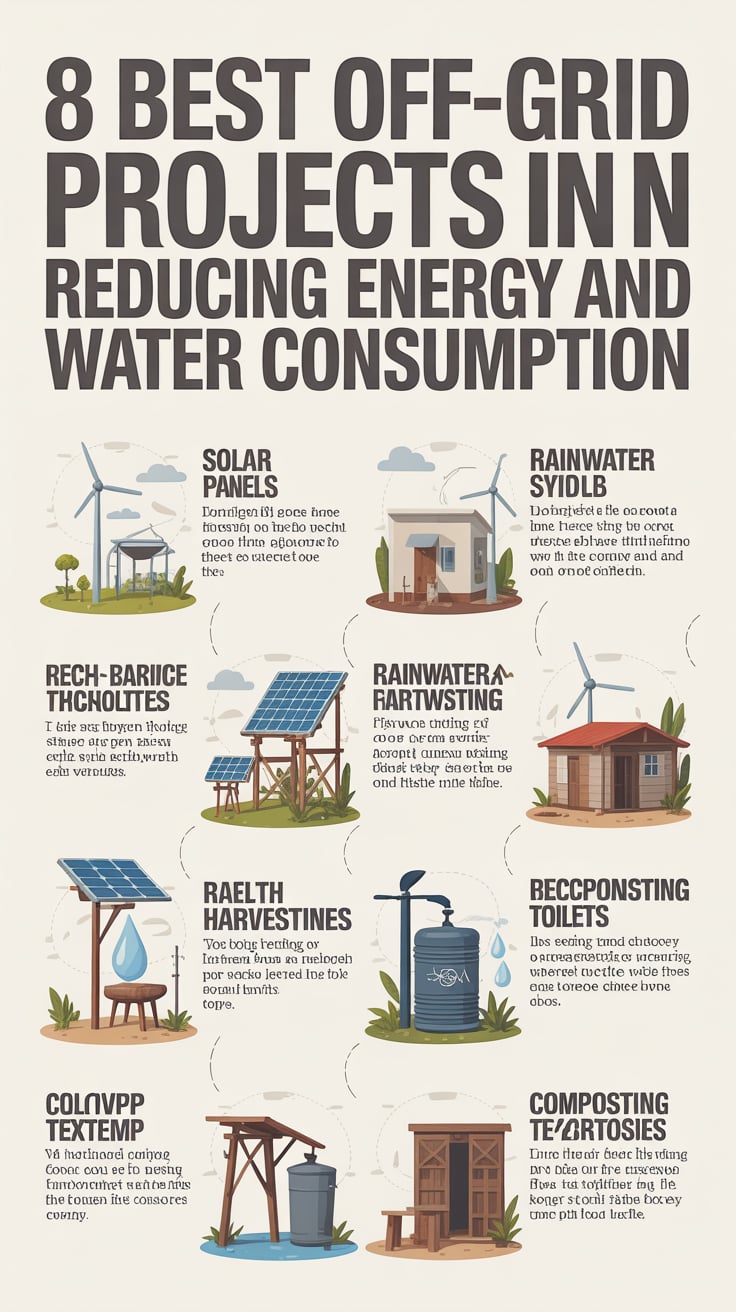
Adopting off-grid systems is one of the smartest ways to protect your household from rising utility costs and climate uncertainty. This guide covers the 8 best off-grid projects in reducing energy and water consumption, from rain capture and greywater reuse to solar heat and superinsulation. Whether you’re in a rural homestead or a suburban lot, these projects can cut dependence on the grid and stretch every watt and gallon.
For households prioritizing water independence, a portable purification and storage setup pairs perfectly with rain capture. Explore the versatile SmartWaterBox for an easy way to store, filter, and dispense harvested water.
Rainwater harvesting: one of the 8 best off-grid projects in reducing energy and water consumption
Rainwater harvesting turns your roof into a reliable source of clean water and reduces the energy your utility spends on pumping and treatment. It’s also the gateway project that makes other water-saving systems (like gravity-fed irrigation) easier.
Key components:
- Catchment: Roof surfaces (metal is ideal) feed into gutters and downspouts.
- Filtration at the top: Leaf guards and screens prevent debris entry.
- First-flush diverter: Redirects the dirtiest initial runoff.
- Storage: Food-grade barrels or IBC totes; better yet, a large cistern.
- Treatment: Sediment filtration and disinfection for potable use.
Step-by-step overview:
- Optimize gutters and downspouts to direct flow into a screened inlet. 2) Install a first-flush diverter to keep roof dust and pollen out of the tank. 3) Place storage on a sturdy, raised platform so you can gravity-feed. 4) Add overflow away from foundations, ideally into a swale or rain garden. 5) Integrate a simple sediment filter, then a carbon filter; use UV, boiling, or chemical disinfection if drinking.
Energy savings tips:
- Use elevation to create water pressure (0.43 psi per foot of height). A tower or raised platform can eliminate or minimize pump use.
- Choose a dark, opaque tank to reduce algae growth and maintenance.
Helpful add-ons:
- A compact, all-in-one filtration and dispensing solution makes harvested rain more practical for daily use. The SmartWaterBox is well-suited here.
- For projects that require tower elevation and steady pressure, see the modular Water Freedom System concept for high, stable storage.
With these elements in place, your rain system becomes a low-energy backbone for household and garden needs throughout the year.
Greywater reuse system for irrigation and toilet flushing
Greywater (from sinks, showers, and laundry—not kitchen sinks in some jurisdictions) can be safely reused to irrigate trees and landscape plants and, in some setups, to flush toilets. It reduces fresh water use and the energy utilities expend on treatment and pumping.
Best-practice design:
- Keep it simple and gravity-fed whenever possible. Laundry-to-landscape systems using a three-way valve are a great start.
- Filter hair and lint with a mesh screen; place a small mulch basin or sand/gravel pre-filter before distribution.
- Use branched-drain lines to distribute evenly to multiple trees or beds, preventing pooling.
- Choose plant-friendly soaps (low sodium, no bleach or antimicrobial additives).
- Keep greywater below the surface to reduce odors and human contact.
Toilet flushing option:
- A dedicated tank fed by greywater with a secondary filter can supply non-potable flushing. Include a backflow prevention device and a municipal bypass valve.
Energy and water win:
- Reusing shower/laundry water cuts outdoor irrigation demand by hundreds of gallons per month.
- Gravity design means zero ongoing power use. If you must pump uphill, choose a small, high-efficiency DC pump paired with a small solar panel.
Safety and compliance:
- Follow local codes; many regions allow simple, no-permit greywater systems if you meet setback and subsurface standards.
- Keep greywater off edible leaves and root crops; focus on trees, vines, ornamentals, and mulched beds.
A well-designed greywater system can reduce landscape watering dramatically—often enough to keep fruit trees thriving through dry seasons with minimal added water.
Superinsulation and air sealing for deep energy cuts
Before adding generation, reduce demand. Upgrading your building envelope (insulation + air sealing) often delivers the largest, fastest energy savings with immediate comfort improvements.
Targets and techniques:
- Air sealing: Use a blower-door test (or a DIY incense-stick draft hunt) to find leaks around attic hatches, top plates, rim joists, outlets, and window/door frames. Seal with caulk, foam, gaskets, and weatherstripping.
- Attic insulation: Increase to R-49+ in cold climates; focus on even coverage and baffle vents to maintain airflow at eaves.
- Wall insulation: Dense-pack cellulose or add continuous exterior insulation during re-siding to eliminate thermal bridging.
- Floors and basements: Insulate rim joists; add rigid foam or spray foam to reduce moisture and heat loss.
- Windows and doors: Add low-e storm windows, insulated curtains, and door sweeps. Full replacements pay off during scheduled upgrades.
Passive strategies:
- Shading: Awnings, pergolas, and deciduous trees block summer heat while allowing winter sun.
- Ventilation: Use stack effect with high/low vents and night-flush cooling where climates allow.
- Thermal mass: Inside masonry or water barrels stabilize indoor temperature swings.
Why it matters off-grid:
- Smaller heating/cooling loads mean fewer solar panels, smaller batteries, and less generator runtime.
- A tight, well-insulated envelope pairs beautifully with passive solar gain and natural ventilation to maintain comfort using almost no energy.
Return on effort:
- Air sealing typically offers the best dollar-for-dollar savings.
- Combine a weekend of sealing with a few attic batts and storm window kits, and you may cut heating/cooling energy by 20–40%—a foundational step for every off-grid home.
Solar PV with battery and DC-first efficiency
Once you’ve slashed loads, solar photovoltaics with storage lets you run essentials without grid exposure. The secret to making a smaller, more affordable system is DC-first efficiency and load management.
Core principles:
- Prioritize efficient DC appliances when possible: DC well pumps, DC fridge/freezers, and DC fans avoid inverter losses.
- Right-size your battery for critical loads (lighting, communications, refrigeration, pump). Add a generator input for rare cloudy stretches rather than oversizing.
- Use a high-efficiency MPPT charge controller and a right-sized pure sine inverter for mixed AC loads.
Load shaping:
- Run heavy loads (washing machine, power tools) in daylight when panels are producing directly.
- Stagger big draws to avoid battery-sag and inverter peaks.
- Use timers and smart relays to automate daytime scheduling.
Everyday efficiency stack:
- LED lighting throughout, with task lighting in work zones.
- Induction cooktop used at midday with solar surplus.
- Laptop computing vs. desktop; e-ink readers for long-form reading.
- Ceiling fans before AC; targeted mini-splits where necessary.
Water connection:
- A small DC pressure pump paired with rain storage or a well can deliver household water with minimal energy draw. Position storage high to let gravity handle most pressure needs and reserve the pump for top-ups.
With careful load management and DC-biased choices, your PV system will be smaller, cheaper, and more reliable—an essential pillar of off-grid resilience.
Solar water heating and ultra-low-flow fixtures
Water heating can be the second-largest energy load after space conditioning. Off-grid households can cut that demand drastically with solar thermal and efficient fixtures.
Solar thermal options:
- Batch (integral) collectors: A dark tank in an insulated box preheats water. Simple, low-cost, and effective in sunny climates.
- Flat-plate or evacuated-tube collectors: Circulate fluid through a roof-mounted collector into a well-insulated storage tank. Freeze protection and pressure relief are critical design elements.
Distribution efficiency:
- Shorten hot-water runs where possible; insulate hot lines and the storage tank.
- Use recirculation only with demand-triggered pumps; avoid continuous loops that waste heat.
Fixture-level savings:
- Ultra-low-flow showerheads (1.25–1.75 gpm) with good spray patterns maintain comfort while cutting both water and energy.
- Aerated faucets (0.5–1.0 gpm) and foot or lever taps limit unnecessary flow.
- Thermostatic mixing valves prevent scalding and allow higher tank storage temperatures for better solar capture without comfort issues.
Off-grid synergy:
- Preheating with solar thermal means your PV or backup heater does far less work, especially in summer.
- In mild climates, solar thermal can handle most domestic hot water needs with minimal backup.
Pair this with a compact safety and filtration setup so harvested water stays clean for bathing and hygiene. For a modular, portable approach that integrates storage and treatment, see the SmartWaterBox.
Composting toilet and urine diversion: one of the 8 best off-grid projects in reducing energy and water consumption
Flushing toilets are among the largest indoor water uses. Composting toilets and urine-diverting systems nearly eliminate that demand while closing nutrient loops for soil building.
Core concepts:
- Dry composting toilets use bulking agents (sawdust, shredded leaves) to cover deposits, manage moisture, and control odor. Proper venting keeps air fresh.
- Urine diversion separates nitrogen-rich urine, reducing smell and accelerating composting. In some designs, diluted urine (10:1 water-to-urine) becomes a valuable fertilizer for non-root edible crops and fruit trees, following local regulations and best practices.
System styles:
- Self-contained units: All-in-one systems above the floor for tiny homes, cabins, or retrofits.
- Central systems: A toilet pedestal feeds a larger remote bin or drum, ideal for families and long-term capacity.
- Humanure composting: Batch systems outside in twin bins allow one bin to rest and fully compost while the other is in use.
Design tips:
- Ensure continuous, passive venting with a vertical stack. A small, efficient DC fan is optional for extra odor control.
- Maintain a carbon-to-nitrogen balance with bulking material after each use.
- Respect curing times and safety guidelines if compost is used; many households dedicate finished compost to trees and ornamentals.
Water and energy benefits:
- Saves thousands of gallons per person annually.
- Reduces stress on septic systems and eliminates the energy required to pump and treat sewage at the municipal level.
This project is transformative: it slashes water use, simplifies plumbing, and builds resilience—making it a standout among the 8 best off-grid projects in reducing energy and water consumption.
Gravity-fed irrigation with drip lines, swales, and mulching
Outdoor watering is often the biggest variable in a home’s total water budget. A gravity-fed system paired with soil-water strategies can keep gardens lush with minimal input.
Design stack:
- Elevated storage: Place tanks or a tower above garden grade to generate head pressure for distribution. Consider a stable, modular approach like the Water Freedom System concept to simplify elevation and pressure.
- Drip irrigation: Use pressure-compensating emitters and mainlines with shutoff valves for each bed. Drip delivers water directly to roots, minimizing evaporation.
- Mulch and soil: Two to four inches of organic mulch reduce evaporation and suppress weeds. Add compost and biochar to increase water-holding capacity.
- Swales and contouring: Shallow, level ditches on contour slow and sink runoff, rehydrating the landscape and cutting irrigation needs.
- Zoning: Group plants by water demand and irrigate the highest-need zones first.
Operation:
- Water early morning or evening.
- Install simple mechanical or solar timers for consistent, short pulses rather than long, infrequent soaks.
- Include a sand or disk filter at the tank outlet to prevent emitter clogging, especially when using rainwater.
Outcome:
- Expect 30–60% irrigation savings vs. overhead sprinklers.
- Gravity-only delivery means zero operating energy, and systems can run during power outages without interruption.
Efficient cooking and heat management with solar and biomass
Cooking can be a major daily energy draw if handled inefficiently. Shift to low-energy cooking methods and free solar heat to cut both electricity and fuel use.
Low-energy methods:
- Solar cookers: Box or parabolic designs cook and bake using direct sunlight—perfect for grains, beans, stews, and bread on clear days.
- Rocket stoves: Efficient combustion chambers focus heat on the pot with small-diameter sticks and scrap wood, reducing fuel and smoke dramatically.
- Thermal retention: After bringing food to boil, move pots into insulated “haybox” cookers to finish with stored heat.
- Pressure cooking: Cuts cooking time and water use for beans, stews, and tough cuts.
Kitchen tactics:
- Batch cook during sunny midday when PV power is abundant; reheat with minimal energy.
- Use lids and appropriately sized pans; pre-soak legumes for faster cooking.
- Shift high-heat tasks outdoors in summer to keep indoor cooling loads down.
Food independence synergy:
- Build a pantry around shelf-stable staples and traditional foods, which reduce reliance on energy-heavy freezing and refrigeration. For inspiration and techniques to store hearty, resilient foods, explore The Lost SuperFoods.
With a solar-first mindset and high-efficiency burners, you’ll slash daily energy use while staying flexible when the grid is strained.
Backup water sourcing with hand pumps and well strategies
Even with rain capture and storage, many homesteads benefit from a supplemental, low-energy water source. A shallow well with a manual pump or well bucket offers resilience when power is out or during extended droughts.
Approach:
- Site assessment: Understand local geology, water table depth, and any permitting requirements.
- Shallow hand pumps: For accessible water tables, a manual pump provides household or garden water without electricity.
- Well buckets: A simple, narrow container lowered by rope can retrieve water from deeper wells in a pinch.
- Hybrid approach: Use a small, efficient DC pump for daily pressure needs and keep a manual backup for emergencies.
Integration with other systems:
- Plumb well output into your storage tanks, using the elevated head for gravity-fed distribution.
- Maintain separation between potable and irrigation lines, with proper check valves and labeling.
Why it matters:
- Reduces dependence on delivered water or the grid.
- Ensures you can fill tanks and meet basic needs during outages.
If you want a practical primer on low-tech well options and hand-pump strategies, consider the step-by-step guidance in Survival Water Box, a resource focused on off-grid water independence.
Off-grid starter toolkit to accelerate your setup
Putting these systems together is easier when you combine a few versatile tools and guides. These resources complement the 8 best off-grid projects in reducing energy and water consumption and help you move from planning to action:
- SmartWaterBox: Portable storage and filtration that pairs perfectly with rain capture and emergency use.
- Water Freedom System: A modular approach to elevated storage for gravity-fed water pressure.
- Survival Water Box: Guidance on low-tech wells and manual pumping to secure a no-electricity backup supply.
- The Lost SuperFoods: Techniques to stock and store resilient foods that minimize reliance on energy-intensive refrigeration.
Choose one water and one energy project to complete this month, then add a new system each quarter. Compounding gains across capture, reuse, insulation, and low-energy cooking quickly adds up to major reductions in both utility dependence and monthly bills.
Conclusion
A resilient home doesn’t emerge from a single gadget; it’s the product of layered systems that reduce waste and make the most of local resources. The 8 best off-grid projects in reducing energy and water consumption—rain capture, greywater reuse, superinsulation, solar PV, solar water heat, composting toilets, gravity-fed irrigation, and efficient cooking—work together to transform how your home uses resources. Start with the easiest wins (air sealing and rain barrels), then level up to solar thermal and greywater. With each step, you’ll feel the freedom of a home that runs lean, clean, and ready for anything.
FAQ
u003cpu003eWhat is the most cost-effective off-grid project to start with?u003cbru003eu003c/pu003e
u003cpu003eAir sealing and basic insulation typically offer the fastest payback, with major comfort gains. For water, begin with rain barrels and a first-flush diverter—it’s inexpensive and sets up future gravity-fed uses.u003c/pu003e
u003cpu003eHow do the 8 best off-grid projects in reducing energy and water consumption work in small spaces?u003cbru003eu003c/pu003e
u003cpu003eEven on a small lot, you can install rain barrels, a laundry-to-landscape greywater line, window shading, LED lighting, and a compact solar cooker. Superinsulation upgrades and efficient fixtures fit any dwelling size.u003c/pu003e
u003cpu003eCan I drink rainwater safely after harvesting?u003cbru003eu003c/pu003e
u003cpu003eYes—if it’s properly filtered and disinfected. Use sediment and carbon filters, then apply UV, boiling, or chemical disinfection. A portable solution like the u003ca href=u0022https://fc3d20hfj5km1ofgjdtlu9cs4r.hop.clickbank.netu0022u003eSmartWaterBoxu003c/au003e simplifies treatment and dispensing.u003c/pu003e
u003cpu003eDo composting toilets smell or attract pests?u003cbru003eu003c/pu003e
u003cpu003eWell-designed systems with adequate venting and regular use of carbon bulking agents are odor-free. Keep bins sealed, maintain proper moisture, and follow best practices to avoid pests.u003c/pu003e
u003cpu003eHow much solar do I need for off-grid living?u003cbru003eu003c/pu003e
u003cpu003eFirst, reduce loads with superinsulation, efficient appliances, and solar thermal. Then size PV for critical loads with some buffer, and run heavy tasks in daylight. This approach keeps your array and battery bank smaller and more affordable.u003c/pu003e