
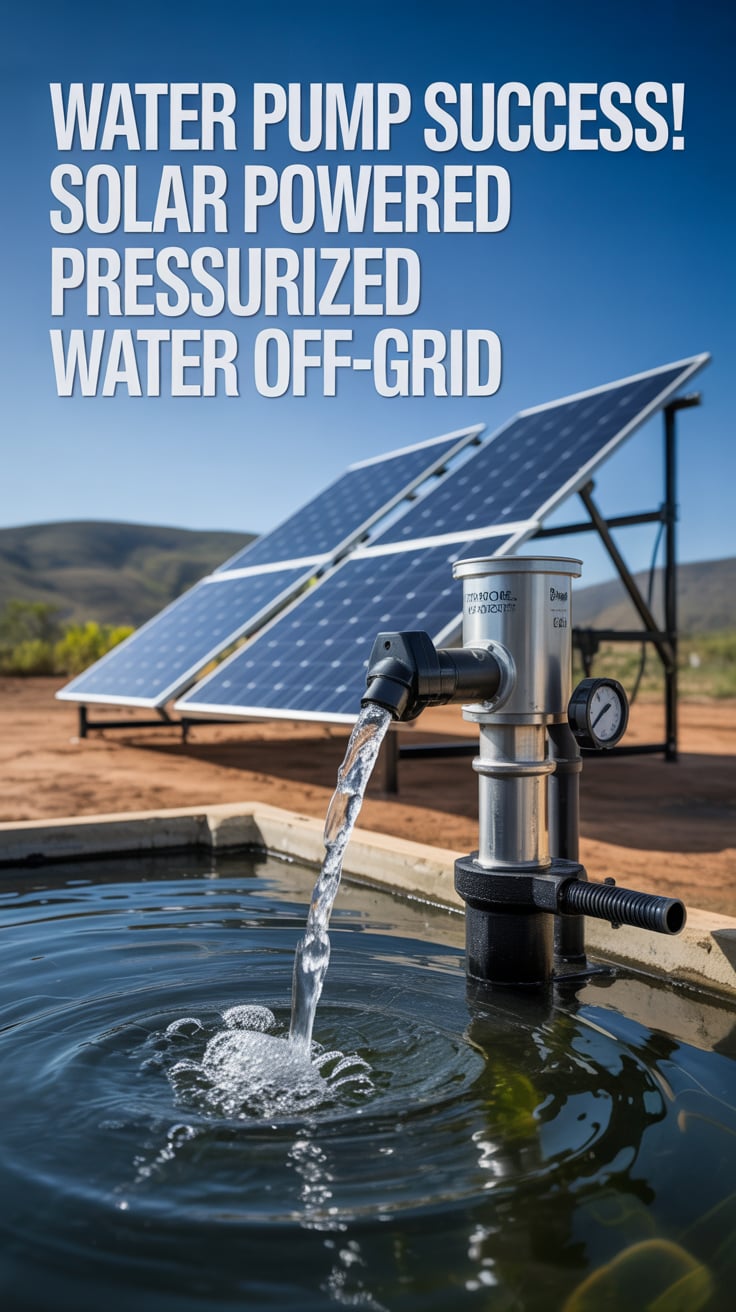
Your home, cabin, tiny house, or homestead can have clean, on-demand, pressurized water without the grid. This complete guide shows you how to achieve Water Pump Success! Solar Powered Pressurized Water Off-Grid—so taps flow, showers run hot, toilets flush, and gardens thrive using only sunlight. We’ll cover design foundations, exact sizing steps, components, plumbing, build sequences, maintenance, and smart upgrades that keep water reliable year-round.
If you’re just starting out or upgrading a DIY system, you’ll find a clear path from idea to running water. And if you want a ready-to-use solution for rain capture and filtration alongside your pump system, explore the compact, resilient Water Freedom System.
Table of Contents
Design Foundations for Water Pump Success! Solar Powered Pressurized Water Off-Grid
Off-grid water systems do two jobs: move water from a source and deliver it at pressure. A solar-pressurized setup combines photovoltaic power with a pump, storage, and pressure management so your faucets behave like grid-tied municipal water—only cleaner and more resilient.
Key concepts to understand first:
- Source and lift: Your source might be a well, spring, stream, pond, tank, or rain catchment. The height difference from source to destination and pipe friction determines “total dynamic head” (TDH). Pump selection depends on TDH plus desired flow.
- Pressure vs. flow: Household comfort needs roughly 30–60 PSI at the tap and around 2–5 GPM for individual fixtures. You’ll design for peak draw (e.g., two fixtures at once) while keeping pressure steady.
- Storage strategy: Storing water in a cistern or tank decouples pumping from demand. A pump can run in daylight to fill a tank; a booster pump and pressure tank then provide on-demand pressure, even at night or during cloudy spells.
- Power strategy: You can run a DC pump directly from solar (direct-drive), use a battery-coupled DC pump, or run an AC pump via an inverter. Each has trade-offs for efficiency, complexity, and 24/7 availability.
Typical architectures:
- Deep well + submersible DC pump + ground cistern + booster pump + pressure tank
- Shallow well/surface source + intake screen + surface DC/AC pump + pressure tank
- Rain catchment + roof-to-tank + prefiltration + booster pump + UV/filters + pressure tank
Core components you’ll likely use:
- Pump: submersible for deep sources; surface pump for shallow/suction applications.
- PV array: solar panels sized to meet pump and booster power needs.
- Pump controller/charge controller: optimizes solar input and protects the pump.
- Electrical: wiring, breakers/fuses, disconnects, and possibly a battery bank and inverter.
- Storage: cistern or large poly tank with float/level controls.
- Pressure hardware: pressure tank, pressure switch, gauge, check valves, expansion relief.
- Filtration: sediment prefilter, activated carbon, possibly UV or other treatment depending on source.
Design for safety and sanity:
- Include unions and isolation valves for serviceability.
- Use NSF-rated components for potable water lines.
- Add a pressure relief valve and low-pressure cutoff to protect equipment.
- Plan for freeze protection in cold climates with buried lines, insulation, or drainback provisions.
The result: a system that quietly fills storage when the sun shines and delivers strong, consistent water pressure on demand.
Sizing Guide for Water Pump Success! Solar Powered Pressurized Water Off-Grid
Sizing is where you ensure your system “feels” like a real home water supply. Take it step-by-step.
- Estimate daily and peak demand
- Daily volume: Tally fixtures and typical use. A conservative off-grid home might use 30–60 gallons per person per day (ppd). Two people at 40 ppd = 80 gallons/day. Add garden/animals as needed.
- Peak flow: Count simultaneous uses. Shower (
1.5–2.5 GPM), faucet (1–1.5 GPM), toilet refill (1–2 GPM), washer (2–3 GPM while filling intermittently). A modest home might require 3–5 GPM peak at 40–60 PSI.
- Calculate total dynamic head (TDH)
- Static lift/head: Vertical distance the pump must lift water (well water level or source elevation to tank/house).
- Pressure head: Convert desired PSI to feet (PSI × 2.31 = feet of head). For 50 PSI, add ~115 feet.
- Friction loss: Depends on pipe length, diameter, fittings, and flow rate; use a friction loss chart or calculator. Larger diameter reduces loss and saves energy.
- Sum these to get TDH. Example: 60 feet static + 115 feet for 50 PSI + 15 feet friction ≈ 190 feet TDH.
- Choose the pump to match TDH and flow
- Use pump curves from the manufacturer to find a model that delivers your target GPM at your TDH. Submersible DC pumps excel for deep wells; efficient surface pumps work for shallow sources or boosting from tanks.
- Consider a two-pump approach: one pump to move water to storage and a booster to pressurize the house. This increases efficiency and reliability.
- Decide on power architecture
- Direct-drive solar to a tank: Ultra-reliable with minimal electronics; water is pumped during sun hours to a cistern. Then a small booster pressurizes on-demand (battery optional if you want water at night without the main array).
- Battery-coupled: A battery bank provides 24/7 power; useful when you want pressurized water anytime without big storage, but it adds cost and complexity.
- AC vs. DC: DC pumps can be efficient and simple; AC pumps are widely available and can use well-known pressure switch controls via an inverter.
- Size the PV array
- Pump energy: Estimate daily watt-hours. Example: If your pump uses 400 W and runs 2 hours/day to fill a tank, that’s 800 Wh/day. Add a buffer for cloudy days and system losses.
- Array rule-of-thumb: For small systems, 1–2 standard panels (350–450 W each) can often run efficient DC pumps in good sun. Larger lifts or higher flows require more panels.
- Battery sizing (if used): For night operation of a booster pump drawing 300 W for 30 minutes/day, that’s ~150 Wh. A modest LiFePO4 battery could handle it easily; include 20–30% reserve capacity.
- Select storage capacity
- Minimum one day of water demand is common. Two to three days increases resilience. For 80 gallons/day, a 200–300 gallon tank is a comfortable cushion.
- Add a tank level indicator and float switch for automatic fill stop.
- Choose pressure hardware
- A 20–40 or 30–50 PSI pressure switch paired with a pressure tank (e.g., 2–5 gallons drawdown for small systems, larger for smoother cycling) keeps flow steady and reduces pump short-cycling.
- Consider constant-pressure controllers if using a compatible pump and budget allows.
With these numbers, you’ll have a confident shopping list and a system that meets your comfort and reliability goals.
Pressure, Storage, and Flow Optimization
Delivering steady, household-quality pressure is the key to a satisfying off-grid water experience. Your options depend on whether you pressurize directly from the source or via storage.
Pressurizing from storage
- Architecture: Source pump fills a cistern; a booster pump plus pressure tank supplies the house.
- Benefits: Easy to maintain stable pressure; pump against lower head (from tank level); pump covers short bursts and shuts off after filling tank volume consumed.
- Considerations: Place the tank as close and as level with the booster as possible; install a foot valve at the tank outlet if drawing from top; use a screened tank vent.
Direct well pressurization
- Architecture: A submersible pump in the well feeds the house through a pressure tank.
- Benefits: Fewer components; strong pressure if pump matches TDH.
- Considerations: Requires enough power availability when you open a tap; battery or inverter reliability becomes more important.
Pressure tank and switch tuning
- Pressure switch ranges: Common cut-in/cut-out settings are 20/40 PSI, 30/50 PSI, and 40/60 PSI. Match to your fixtures and pipe quality.
- Tank precharge: Set the air precharge to 2 PSI below the cut-in pressure (e.g., for 30/50, set precharge to 28 PSI) with water pressure at zero.
- Pump cycling: Larger tanks reduce short-cycling; match tank size to pump flow and household habits.
Pipe diameter and friction
- Use 3/4-inch lines for main runs to reduce friction loss, especially over long distances. Step down to 1/2-inch for fixture branches.
- Use sweeping elbows and minimize fittings. HDPE or PEX with barbed/sleeved connections are durable and freeze-tolerant options.
Gravity assist and elevation
- If your storage is uphill of the home, gravity can provide baseline pressure (0.433 PSI per foot of elevation). A tank 120 feet above the house gives ~52 PSI without a booster.
- Many sites don’t have that elevation; a booster pump is the practical solution for most properties.
Quality and taste
- Sediment prefilters (5–20 micron) protect pumps and fixtures. Carbon filtration improves taste and removes odors. Use a UV stage if microbial risk exists.
- Maintain accessible bypass loops around filters so you can keep water flowing during maintenance.
The sweet spot is a system that runs a booster pump for short, efficient bursts and uses hydraulic smoothing (pressure tanks, well-sized pipes, storage) to make water feel instant and powerful.
Piping, Filtration, and Freeze Protection
A well-laid water line and thoughtful filtration ensure longevity and safe drinking water, while freeze protection prevents mid-winter headaches.
Plumbing layout best practices
- Put service unions and ball valves before and after major components: pump, filters, tank, and UV. This makes replacement and maintenance easy.
- Install check valves to prevent backflow. Submersible pumps usually include a built-in check; you may add a second near the pressure tank for stability.
- Add pressure gauges before and after filters to track clogging; a 10–15 PSI drop indicates it’s time to replace cartridges.
Pipe materials for off-grid durability
- HDPE (poly) with compression fittings is tough for buried main lines. Use NSF-certified pipe for potable water.
- PEX is flexible and freeze-tolerant inside structures; it simplifies routing and manifolds.
- PVC is common for cold water but more brittle in freezing temps; protect and avoid direct sunlight if exposed.
Filtration sequences
- Clear, non-silty wells: Sediment prefilter → Carbon filter → Optional UV
- Rainwater: Gutter screens → First-flush diverter → Sediment prefilter → Carbon block → UV or other disinfection
- Surface water: Intake screen → Sediment → Carbon → UV; consider additional treatment as needed based on water tests
Sanitation and testing
- Shock chlorinate new wells or tanks per guidelines to sanitize lines and fixtures.
- Test water for bacteria, nitrates, and minerals. Adjust filtration/treatment accordingly.
Freeze and heat strategies
- Bury lines below frost depth with a bed of sand and warning tape above.
- Insulate exposed pipes; in extreme climates, consider heat trace with thermostatic control and low-energy power plans.
- Add drain-down valves at low points; design for easy winterization by purging lines and isolating vulnerable sections.
- For solar electronics, keep controllers and batteries in insulated enclosures with ventilation.
Rain capture integration
- Roof area × rainfall = potential harvest. A 1,000-square-foot roof in a 20-inch rainfall area yields over 12,000 gallons/year.
- A compact rain-to-drink solution can complement your pumping system. If you want a modular approach to capture and filtration, the SmartWaterBox offers a streamlined way to add resilience without reinventing the wheel.
Build with serviceability in mind: Label valves, leave space to swap filters, and provide a dry, clean equipment niche to extend lifespan.
Build Blueprint: Water Pump Success! Solar Powered Pressurized Water Off-Grid
Use this step-by-step sequence to assemble a proven, reliable system. Adjust details for your source and site.
- Site assessment and layout
- Map the shortest, most direct route for buried lines from well/source to storage and from storage to the house.
- Choose a location for the equipment wall or board: pressure tank, booster, filters, gauges, and controls should be consolidated for easy access.
- Plan the PV array placement with maximum sun exposure and secure mounting.
- Select and stage your components
- Submersible or surface pump sized to your TDH and flow
- Booster pump (if using storage) plus pressure tank and pressure switch
- Storage tank with overflow and screened vent; install a level gauge or float switch
- Sediment and carbon filters, plus UV if needed
- PV modules, charge controller or dedicated pump controller, wiring, fuses/breakers, and disconnects
- Piping, fittings, unions, valves, check/foot valves, and gauges
- Electrical build
- Mount PV modules on a secure rack with proper tilt and orientation.
- Run PV wiring to the controller using UV-rated cable; size conductors to minimize voltage drop.
- Install appropriately sized DC breakers or fuses; label all circuits.
- For battery systems, mount the battery in a ventilated, insulated spot; connect to controller and inverter if using an AC pump.
- If direct-driving a DC pump, use the pump controller recommended for your model to optimize starting and protect against low/high voltage.
- Pump and storage installation
- For wells: Install the submersible pump at the correct depth with safety rope, torque arrestor, and wire guards. Ensure a robust well cap and sanitary seal.
- For surface sources: Use an intake screen/foot valve and keep inlets off the bottom to avoid sediment.
- Plumb the pump discharge to the storage tank with a check valve and isolation valve. Include a tank float or level sensor to stop fill.
- From storage to the utility area, run a supply line to the booster pump inlet with a sediment screen or prefilter.
- Pressure and filtration assembly
- Mount the booster pump solidly; align with a pressure tank via a tee. Install a pressure gauge and relief valve.
- Install a pressure switch at the tank tee and wire it to control the booster.
- Add filtration stages on the outlet side before distribution. Use a bypass loop so you can isolate the filter bank without shutting down the house.
- Set tank precharge to 2 PSI below your switch cut-in.
- Commissioning and tuning
- Flush lines thoroughly before connecting to filters. Run water until clear and free of air.
- Set pressure switch (e.g., 30/50 PSI) and test cycling. Check for leaks at all unions and fittings.
- Measure flow rates at fixtures. Adjust pressure and verify pump duty cycle is reasonable (not short-cycling).
- Confirm automatic tank fill starts and stops properly with the level control. Inspect overflow path.
- Performance verification and fallback modes
- Simulate a cloudy day by reducing PV input and ensure you can still draw from storage comfortably.
- If using batteries, test a night-draw scenario. Confirm low-voltage protections work.
- Label a manual bypass route for filtration and keep a gravity-draw plan (spigot at tank) in case of pump failure.
Looking for a deep-dive blueprint on well-based systems and field-proven techniques? Practical guides like Survival Water Box can complement your build with site-tested options and clever DIY solutions you might not think of upfront.
Maintenance, Troubleshooting, and Safety
A few minutes of seasonal maintenance prevents most failures and protects water quality.
Routine maintenance checklist
- Monthly: Check pressure gauge at the tank; verify cut-in/out pressures. Inspect for leaks, unusual noises, or vibration.
- Every 3 months: Inspect filter differential pressure; replace cartridges if clogged or at manufacturer’s interval. Confirm tank precharge at least twice per year.
- Seasonal: Drain and flush sediment from storage tanks if design allows. Inspect roof catchment for debris. Check PV wiring, tighten lugs, and clean panels as needed.
- Annually: Test water quality for bacteria and nitrates, especially after heavy rains or source changes. Inspect check valves and foot valves for proper hold.
Common troubleshooting
- Short-cycling booster: Pressure tank too small, waterlogged, or precharge off. Adjust precharge and consider a larger tank.
- Weak pressure at fixtures: Clogged filters, excessive friction from undersized pipe, or failing pump. Isolate with valves and test each segment.
- Air in lines: Suction leaks on the booster inlet or low water level at source. Reseat fittings and inspect intake.
- Pump won’t start: Check power, breakers, controller status, and pressure switch contacts. On well pumps, verify well water level and pump safeties.
- Low flow from well: Throttling or pump size mismatch. Revisit TDH and pump curve; consider staged pumping via storage.
Safety essentials
- Electrical safety: Use proper fusing, grounding, and disconnects. Keep electronics dry and accessible.
- Sanitary practices: Use NSF-rated components for drinking water lines; keep storage tanks sealed and vents screened.
- Pressure relief: Install a relief valve near the pressure tank; verify operation during commissioning.
- Winterization: In freezing climates, put the system in a mode where lines can drain or remain heated/insulated.
Resilience mindset
- Keep spare filter cartridges, a spare pressure switch, and essential fittings on hand.
- Know your gravity fallback: an emergency spigot at your storage tank or a manual pump option can keep you supplied during repairs.
- If you want broader household resilience planning and blackout strategies to complement your water system, a practical guide like Dark Reset can help you think through power, communications, and contingency setups.
Real-World Setups and Smart Upgrades
Three proven configurations show how to tailor your system to your property and lifestyle:
Deep-well homestead with daytime pumping
- Components: DC submersible well pump → 500–1,000 gallon cistern → DC or AC booster → 30/50 PSI tank → whole-house filtration.
- Power: 2–4 PV modules for the well pump (daytime fill), separate small PV/battery for booster (night showers).
- Why it works: Decouples the heavy-lift well pump from instant demand. Boosters run briefly, keeping battery size small.
Rain-first tiny house with minimal draw
- Components: Roof catchment with first-flush diverter → 200–300 gallon tank → compact booster → dual-stage filter + UV → pressure tank.
- Power: 1–2 PV modules and a small battery keep the booster available anytime.
- Why it works: Low daily volume, high-quality filtration, and simple plumbing deliver city-like taps in a tiny package.
Ranch layout with gravity assist
- Components: Spring or well to hilltop tank → gravity-fed line to house and troughs → optional booster for higher-pressure fixtures → filter manifold at the house.
- Power: Modest solar for the source pump; booster runs only when sub-60 PSI pressure is noticeable.
- Why it works: Elevation does the heavy lifting; pumps just top off storage.
Upgrades that raise performance and reliability
- Constant pressure controllers: Offer steady PSI with compatible pumps; less cycling at the cost of more electronics.
- Remote monitoring: Tank level sensors, pressure transducers, and smart relays let you check status from a phone, preventing surprises.
- Distributed manifolds: A home-run PEX manifold system gives every fixture a dedicated supply, balancing flows and simplifying service.
- Enhanced filtration: Add iron/manganese treatment, softening, or cartridge upgrades if your water tests call for it.
- Quick-drain freeze loops: Strategically placed drain valves and air-admittance points let you winterize fast.
If you prefer to add a modular water resilience layer instead of sourcing everything à la carte, the compact SmartWaterBox can slot into your plan as a capture/filtration backbone while your pumps handle pressure. For rain-to-tap or emergency backup, you can also integrate the Water Freedom System to round out your off-grid water strategy.
Recommended Off-Grid Water and Resilience Tools
- Water Freedom System: A compact capture/filtration solution that complements solar pumping for everyday and emergency use.
- SmartWaterBox: A modular way to integrate water storage and treatment with your solar-pressurized system.
- Survival Water Box: Practical insights and build tactics for well-based off-grid water setups and DIY optimizations.
- Dark Reset: Broader resilience planning to keep your off-grid home functional when the grid is down.
Choose tools that fit your design; the best “kit” is the one matched to your source, head, and daily use.
Conclusion: Your Path to Reliable Off-Grid Pressure
If a city-like water experience is your goal, you can achieve it with Water Pump Success! Solar Powered Pressurized Water Off-Grid by combining the right pump strategy with storage, pressure control, and thoughtful plumbing. Size your system with real numbers, design for serviceability, and add filtration that matches your water quality. When the sun powers your water and your taps run like normal, it changes the way you live—simpler, independent, and resilient.
For a plug-in companion to your pumping system, explore the Water Freedom System or the modular SmartWaterBox, and tap the practical insights in Survival Water Box as you build.
Frequently Asked Questions
How much solar do I need to run a pressurized water system?
It depends on your pump wattage and daily runtime. An efficient DC pump moving water to storage might run on 350–900 W of solar in good sun. A small battery-backed booster (200–500 W) covers short, pressurized draws. Size for your head, flow, and local sun hours, then add 20–30% margin.
Can a solar-powered pump deliver enough pressure for showers and laundry?
Yes. With a properly sized pump and a pressure tank set around 30/50 or 40/60 PSI, you’ll get household-quality pressure. A storage-plus-booster approach provides consistent flow even at night or during cloudy weather.
Is a battery required for Water Pump Success! Solar Powered Pressurized Water Off-Grid?
Not strictly. A direct-drive pump can fill a cistern in daylight, and a small booster can run off a modest battery for on-demand pressure. Batteries add convenience but can be minimized with good storage design.
What’s the best pipe for off-grid water lines?
Use HDPE for buried mains (tough and freeze-resistant) and PEX for indoor runs (flexible and durable). Keep pipe diameters generous (3/4-inch for mains) to reduce friction loss and improve pressure.
How do I protect my system from freezing?
Bury lines below frost depth, insulate exposed sections, and consider heat trace where needed. Include drain-down valves for winterization. Keep pumps and controls in a protected, insulated space.
What filtration do I need for a well versus rainwater?
For clear wells, a sediment prefilter plus carbon block is often enough; add UV if bacteria are a concern. For rainwater, use gutter screens and a first-flush diverter before sediment, carbon, and UV. Test your water and tailor filtration to the results.
Can I run everything without an inverter?
Yes, many systems use DC pumps with dedicated controllers. If you prefer common AC pumps, an inverter is fine—just ensure you size it for pump startup surges and overall efficiency.