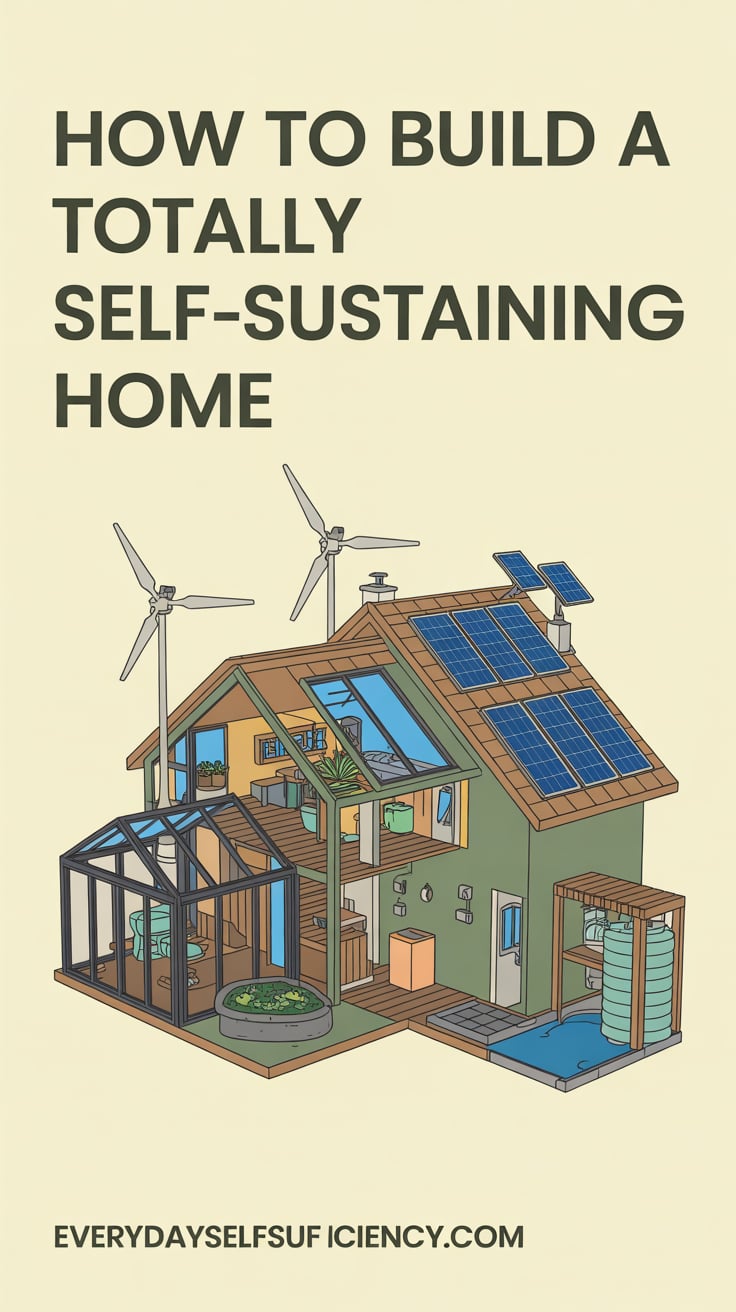
Self-reliance doesn’t happen by accident—it’s designed, built, and maintained. This guide shows exactly how to build a totally self-sustaining home that provides its own power, water, food, and sanitation while staying resilient through disruptions. Whether you’re planning a rural homestead or retrofitting a suburban house, you’ll find practical frameworks, design principles, and actionable steps to get from idea to reality.
For water preparedness from day one, a compact, modular resource like Water Freedom System can help you set up a dedicated capture-and-filtration solution without overhauling your entire plumbing. It’s a helpful starting point as you map the rest of your system.
Blueprints for How to Build a Totally Self-Sustaining Home
A self-sustaining home is an integrated ecosystem. The core aim is to meet essential needs—energy, water, food, sanitation, health, and security—on-site, with minimal outside inputs. That doesn’t mean going primitive; it means designing smarter.
Key planning steps:
- Define mission and scope: full off-grid vs. grid-tied resilience. Full off-grid requires bigger storage and redundancies; grid-tied with islanding capability can be more cost-effective while retaining autonomy during outages.
- Analyze your site: solar access, wind exposure, precipitation patterns, soil type, slope, and microclimates. A site analysis informs everything from panel placement to water storage and garden design.
- Start with the building envelope: superinsulation, high-performance windows, air sealing, and passive solar design cut energy demand before you size systems. An efficient shell is “generation you don’t have to buy.”
- Design for maintainability: choose systems you can inspect, clean, service, and repair with basic tools and replacement parts.
- Map your critical loads: fridge, well pump, internet router, medical devices, ventilation. Prioritize these in your energy system design.
- Plan layering and redundancy: two independent ways to meet life-safety needs (power, heat, water purification). Redundancy is resilience.
- Think in zones: inside (energy, health), near house (kitchen garden, rain tanks), outer zone (orchard, compost, woodlot). This permaculture concept keeps daily-use systems close and low-friction.
Budget and phasing:
- Phase 1 (quick wins): efficiency upgrades, LED lighting, low-flow fixtures, tote water storage, portable filtration, countertop induction, basic solar backup.
- Phase 2 (core systems): PV array + batteries, rainwater harvesting, greywater, kitchen garden, composting.
- Phase 3 (enhancements): greenhouse, orchard, microhydro or wind (if viable), expanded storage, whole-house water treatment.
- Phase 4 (community and skills): neighbors, bartering, shared tools, local food co-ops.
Pro tip: Document everything. A simple “house manual” with system diagrams, part numbers, and maintenance schedules prevents minor issues from becoming major.
Internal resource to plan your system: [How to size an off-grid solar system](INTERNAL LINK PLACEHOLDER).
Energy Systems for How to Build a Totally Self-Sustaining Home
Energy independence begins with reducing demand and meeting the remaining load from local renewable sources.
Right-size your load:
- Audit usage: measure daily kWh with a smart meter plug or energy monitor.
- Cut base load: swap to heat pump water heaters, induction cooktops, and high-SEER heat pumps; fix phantom loads with advanced power strips.
- Supercharge the envelope: attic and wall insulation, air sealing, ERV/HRV for fresh air without heat loss.
Power generation options:
- Solar PV: Most practical for residential sites. A common starting point is 5–10 kW grid-tied with hybrid inverter and battery for backup. Orient for maximum sun (true south in the Northern Hemisphere) with minimal shading.
- Wind: Only if you have consistent average wind speeds (>5 m/s at hub height) and local approval. Use a tower high enough to clear turbulence.
- Microhydro: Excellent if you have year-round flow and drop (head). Delivers steady power day and night, reducing battery needs.
Storage and conversion:
- Hybrid inverters with islanding keep critical circuits powered when the grid is down.
- Lithium-iron phosphate (LFP) batteries are popular for safety and cycle life.
- Generator backup ensures resilience in long storms; size for essential loads and pair with a transfer switch.
Electrical architecture:
- Critical loads subpanel: fridge, well pump, networking, lighting, key outlets.
- DC-coupled vs. AC-coupled storage: both work; DC-coupled is often more efficient for new installs, AC-coupled is flexible for retrofits.
- Grounding, surge protection, and code compliance are non-negotiable.
Design for seasons:
- Winter: lower solar production and higher heating loads demand larger storage or supplemental heat (wood, pellet, or high-efficiency heat pump).
- Summer: plan for cooling and dehumidification with ceiling fans, shading, and reflective roofs.
Authority resource: U.S. Department of Energy’s Energy Saver provides best practices for home energy systems (energy.gov/energysaver).
Internal planning help: [How to size an off-grid solar system](INTERNAL LINK PLACEHOLDER).
Water Security in How to Build a Totally Self-Sustaining Home
Water autonomy requires three layers: reliable source, safe storage, and guaranteed purification.
Harvesting and sourcing:
- Rainwater: Use a metal or high-quality composite roof. Install gutters with leaf screens, a first-flush diverter, and a pre-filter before the tank.
- Cisterns: Above-ground poly tanks are easy to service; buried concrete or polypropylene tanks save space and moderate temperature. Size tanks based on dry-season length and daily demand (drinking, hygiene, irrigation).
- Wells and springs: If you have a well, pair it with a solar-compatible pump and cistern for storage; consider a manual or hand-pump backup.
- Surface water: Treat as nonpotable unless rigorously filtered and disinfected.
Distribution and treatment:
- Pumping: Use efficient pumps with pressure tanks. A small DC pump with a solar direct line can maintain basic supply during outages.
- Filtration train: sediment (5–20 micron) → activated carbon → disinfection (UV or chlorination). Point-of-use filters add redundancy at the kitchen sink.
- Greywater reuse: Route laundry and shower water to subsurface irrigation (where allowed). Keep soaps biodegradable and systems lint-protected.
Contamination safeguards:
- Protect tanks from light and pests; include screened vents and overflow.
- Separate potable and nonpotable lines clearly to avoid cross-connection.
- Maintain a minimum of two independent purification methods for drinking water.
For practical, modular water solutions, SmartWaterBox offers a compact approach to storage and purification that fits small spaces, while Survival Water Box provides guidance for establishing reliable off-grid water access. Combined with a capture system like Water Freedom System, you build redundancy across capture, storage, and treatment without a full plumbing overhaul.
Authority resource: EPA guidance on water reuse and stormwater best practices (epa.gov/water-reuse) and CDC info on household water treatment (cdc.gov/healthywater).
Internal deep dive: [How to design a rainwater harvesting system](INTERNAL LINK PLACEHOLDER).
Resilient Food Production and Preservation at Home
Food security comes from a layered approach: fast-yield annuals, long-term perennials, and preservation that carries you through lean seasons.
Grow what you eat:
- Start with a kitchen garden near the door: greens, herbs, tomatoes, peppers, beans. Raised beds and drip irrigation simplify management.
- Add perennials: berries, asparagus, rhubarb, and fruit trees. Perennials increase calories per hour of labor over time.
- Extend seasons: low tunnels, cold frames, or a small greenhouse for shoulder months. Choose varieties that thrive in your climate.
Design with permaculture zones:
- Zone 0–1: kitchen herbs, salad greens, compost tumbler, rain barrels.
- Zone 2: main vegetable beds, chickens, tool shed.
- Zone 3–4: orchard, larger compost, woodlot, wildlife buffer.
Protein and nutrient density:
- Small livestock like chickens provide eggs, pest control, and manure. Rabbits or quail are compact options in many locales.
- Aquaponics and vertical towers offer production where space is limited.
Preservation methods:
- Canning (pressure and water-bath), dehydration, freeze-drying (if available), fermentation, and root cellaring. Diversify methods to diversify resilience.
- A basement nook can become a root cellar with ventilation, cool temps, and humidity control.
If you’re building your pantry skills, The Lost SuperFoods offers practical, historically inspired preservation ideas to diversify shelf-stable meals without specialized equipment.
Authority resource: USDA’s Complete Guide to Home Canning (nchfp.uga.edu/publications/publications_usda.html) is the gold standard for safe canning procedures.
Internal how-to: [How to build a root cellar](INTERNAL LINK PLACEHOLDER).
Sanitation, Waste, and Household Health Systems
Sanitation and health are essential pillars of a self-sustaining home. Well-designed waste systems protect water quality, improve soil, and reduce disease risk.
Toilets and wastewater:
- Composting toilets: Separate solids and liquids for odor control and faster composting. Follow local codes; some jurisdictions allow NSF-certified units and designated composting areas.
- Blackwater and septic: If you have a septic system, maintain it—pumped at recommended intervals, no grease or harsh chemicals.
- Greywater: Divert laundry and shower water to mulch basins or subsurface lines for trees and shrubs (where legal). Filter lint and avoid sodium-heavy detergents.
Solid waste loops:
- Compost kitchen scraps and yard waste; balance greens (nitrogen) and browns (carbon) for proper temperature and pathogen reduction.
- Black soldier fly larvae bins or worm composting can accelerate waste reduction and produce soil amendments.
Hygiene and ventilation:
- Keep an ERV/HRV balanced for fresh, filtered air without energy penalty.
- Maintain humidity 40–60% to limit mold and viral transmission.
Medical self-reliance:
- Build a two-tier medical kit: daily-use supplies and a deeper reserve for disruptions. Include meds rotation, wound care, OTCs, and reference material.
- A practical, common-sense reference like Home Doctor can help households handle minor issues and prepare for care delays.
Internal guide: [How to choose a composting toilet](INTERNAL LINK PLACEHOLDER).
Security, Communication, and Community Resilience
A self-sustaining home is as strong as its weakest link. Security isn’t about fear—it’s about continuity of your essential systems.
Physical security:
- Layered approach: good lighting, trimmed shrubs, visible cameras, strong doors/locks, and laminated windows or film.
- Storage security: lock battery rooms, fuel stores, and tool sheds; label hazards clearly.
Cyber and controls:
- Secure your inverter and battery systems behind a robust network. Change default passwords and update firmware.
- Keep backups of system configs and a manual “run book” for critical procedures.
Communication:
- Redundant comms: mobile, landline/VoIP with UPS, GMRS/FRS radios, and a handheld ham radio if licensed.
- Plan contact trees with neighbors; run periodic check-ins during storms or outages.
Emergency planning:
- Keep a written emergency plan: evacuation routes, rally points, and a 72-hour “grab and go” kit tailored to your home systems.
- Practice partial blackouts to test your setup and identify gaps.
Urban and suburban resilience:
- Even in apartments, you can store water, deploy a compact power station, grow microgreens, and improve safety. For city-specific tactics, resources like URBAN-focused guides can offer step-by-step frameworks without major renovations. If you want a deeper dive into urban contingencies and planning, URBAN Survival Code provides adaptable strategies for smaller spaces.
Authority resource: FEMA’s Ready program covers emergency plans and supplies (ready.gov).
Budgets, Permits, and Phased Implementation Roadmap
A great plan respects both your wallet and local rules. Build your self-sufficient home in sensible phases, stacking value from day one.
Budgeting and ROI:
- Prioritize high-impact upgrades: air sealing, insulation, and heat pump retrofits often deliver quick utility savings.
- Solar ROI improves with incentives and self-consumption. Batteries rarely “pay back” in utility savings alone but add invaluable resilience.
- Water systems save most where rates are high and irrigation demand is significant.
Financing and incentives:
- Check local, state, and national incentives for renewables, storage, heat pumps, and weatherization. Tax credits can cover a significant share of costs.
- Consider energy-efficient mortgages or green loans that factor utility savings into underwriting.
Permits and legal:
- Coordinate with local building officials early. Provide clear drawings for PV, batteries, structural mounts, and plumbing changes.
- Verify greywater and composting toilet legality; some places require specific models or site plans.
- Understand HOA rules and aesthetic restrictions; solutions like ground arrays or screened tanks can satisfy design guidelines.
Phasing the build:
- Month 1–3: efficiency, LED, weatherization, tote water storage, portable filtration, small garden.
- Month 4–9: PV + hybrid inverter + batteries, rainwater tanks + filtration, greywater lines, expanded beds, composting.
- Month 10–18: greenhouse, orchard, second water source (well or surface), tool upgrades, security layers.
- Ongoing: drills, maintenance, skills, community ties, pantry rotation.
Resilience accounting:
- Create a “continuity bill of materials” with spare filters, pump seals, fuses, hoses, UV bulbs, and a parts kit for your inverter/battery brand.
- Track performance and maintenance in a simple spreadsheet or binder.
Internal resource: [How to design a rainwater harvesting system](INTERNAL LINK PLACEHOLDER) and [How to size an off-grid solar system](INTERNAL LINK PLACEHOLDER) can anchor your planning.
Recommended tools and guides for a self-sustaining home
Curated resources that align with the systems discussed above. Choose only what fits your plan and local rules.
- Water capture and filtration: Water Freedom System — a compact way to stand up a dedicated water solution as you build out larger infrastructure.
- Portable storage and purification: SmartWaterBox — helpful for modular storage, filtration, and redundancy.
- Off-grid water access: Survival Water Box — guidance to secure reliable, off-grid water sources.
- Pantry and preservation playbook: The Lost SuperFoods — diversify shelf-stable meals and preservation methods.
- Household medical reference: Home Doctor — practical guidance for handling common issues and care delays.
- City-specific resilience: URBAN Survival Code — strategies tailored to apartments and townhomes.
Choose conservatively; fewer, well-used tools beat crowded shelves.
Conclusion: Putting the pieces together
You now have a blueprint for how to build a totally self-sustaining home: trim demand first, then layer resilient power, water, food, sanitation, health, and security. Begin with quick wins that reduce consumption and add redundancy. Next, phase in core systems—solar with storage, water harvesting and treatment, gardens and preservation—then expand with greenhouses, orchards, and secondary sources. Keep a maintenance mindset, document your systems, and cultivate community ties that multiply your resilience.
Self-reliance is not a one-time project; it’s a lifestyle of continuous improvement. Start small this month, add one capability per quarter, and within a year you’ll feel the shift from dependence to genuine autonomy.
For simple wins on day one, consider a modular water solution like Water Freedom System, plus a pantry plan with The Lost SuperFoods, and a reliable home medical reference via Home Doctor. Build only what you’ll use, and let your results guide the next step.
Frequently asked questions
What does “self-sustaining home” mean?
A self-sustaining home provides essential needs—power, water, food, sanitation, and basic healthcare—on-site with minimal outside inputs, using efficient design and renewable systems.How to build a totally self-sustaining home in the suburbs?
Focus on efficiency, rooftop solar with batteries, rain barrels or a cistern, greywater for landscaping (where legal), raised beds, and a small greenhouse. Many suburban homes can cover most essentials without major structural changes.How big should my solar and battery system be?
Right-size to your critical loads and local climate. Audit usage, cut demand first, then design a PV array and battery bank to cover essentials for your target outage duration. See [How to size an off-grid solar system](INTERNAL LINK PLACEHOLDER).What’s the best water filtration setup for home use?
Use a “train” approach: sediment → carbon → disinfection (UV or chlorine). Add point-of-use filters at the kitchen sink for redundancy. Store at least two weeks of potable water and rotate regularly.How can I make my food supply resilient year-round?
Combine quick-yield annuals, productive perennials, and preservation methods (canning, dehydrating, fermenting, root cellaring). A resource like The Lost SuperFoods can help diversify shelf-stable options.Are composting toilets legal everywhere?
No. Laws vary widely. Many places permit certified units with specific installation guides. Check local codes and, if needed, plan for a hybrid approach with septic or blackwater systems.Do I need a generator if I have solar and batteries?
A generator adds resilience in long storms or winter low-sun periods. Consider a small, efficient unit sized to your critical loads, and test it under real conditions.What’s the first step if I’m renting?
Focus on portable and reversible upgrades: plug-in solar generators, water storage and filtration, indoor growing racks, and a well-organized pantry. An urban-focused resource like URBAN Survival Code can help you tailor strategies to smaller spaces.