
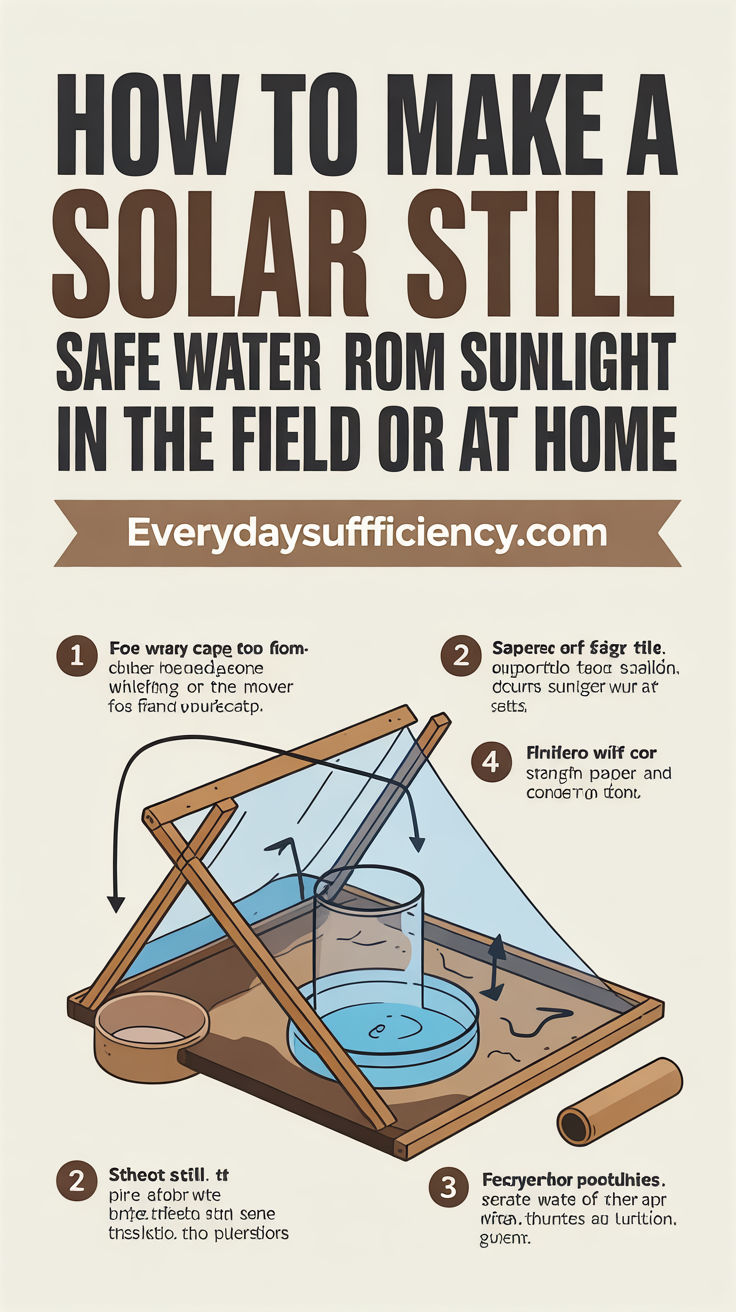
Clean water is non-negotiable in emergencies and off-grid adventures. If you’re stranded, near brackish water, or need to turn contaminated water or damp soil into drinkable water without fuel or electricity, learning how to make a solar still can be a lifesaver. A solar still uses the sun’s energy to evaporate water and then condense it into a container—effectively distilling it and leaving most contaminants behind.
If you’re preparing at home and want an easy, plug-and-play backup system for safe, great-tasting water, consider pairing this skill with a compact, off-grid solution like SmartWaterBox for everyday resilience.
[How to Find Water in the Wild](INTERNAL LINK PLACEHOLDER) • [Emergency Water Storage Guide](INTERNAL LINK PLACEHOLDER) • [Solar Water Disinfection (SODIS)](INTERNAL LINK PLACEHOLDER) • [DIY Rainwater Harvesting](INTERNAL LINK PLACEHOLDER)
How a Solar Still Works and When It’s Worth Using
A solar still is a simple distillation system that leverages the greenhouse effect. Sunlight heats a sealed, transparent cover over a moist source (soil, plant material, saltwater, or contaminated water). Water evaporates, rises, and condenses on the cooler surface of the cover. Gravity guides the droplets down into a collection container. The result is distilled water: it’s free from salts and many heavy contaminants because they don’t evaporate with the water.
Why and when to use one:
- Emergency hydration: When you can’t boil, filter, or chemically treat water, a solar still can be built with basic scavenged materials.
- Desalination: It’s one of the simplest ways to turn saltwater into fresh water along coastlines.
- Chemical reduction: Distillation can reduce many contaminants, including salts and metals. However, it may not remove certain volatile chemicals that evaporate at temperatures close to or below water’s boiling point.
- Off-grid skill-building: Homesteaders, preppers, and campers can practice this technique as part of a layered water plan.
Limitations to know:
- Yield is limited: A single still typically produces modest amounts per day under good sun. It’s a supplement, not a high-output solution.
- Time-dependent: Performance hinges on strong sunlight and ambient temperature differences between day and night.
- Not a silver bullet: Some contaminants (like certain volatile organic compounds) can travel with the vapor. Location choice matters.
Use case scenarios:
- Coastal survival to desalinate seawater.
- Arid regions with damp soil or morning dew.
- Post-storm or boil advisory situations where fuel is scarce.
- Fieldcraft and training as part of a comprehensive water strategy.
For ongoing preparedness, practical reference materials such as The Lost SuperFoods can expand your self-reliance toolkit beyond water.
Materials, Tools, and Site Selection
You can build a solar still from hardware-store materials or scavenged items. The exact build will vary, but the principles stay the same.
Common materials:
- Transparent cover: Clear plastic sheet (2–3 mil or thicker), a clear oven bag, or clear food-grade wrap. The clearer and sturdier, the better.
- Container to collect water: Cup, bottle, or a clean can.
- Condensation surface: The underside of your clear plastic acts as the condenser.
- Tubing (optional): A small length of food-grade tubing can create a drinking straw so you don’t have to disassemble the still to drink.
- Rock or weight: To create a low point in the cover for condensation to drip.
- Shovel or digging tool: For ground/pit stills.
- Tape, cordage, or soil: For sealing edges and preventing heat loss.
- Source water or moisture: Seawater, brackish water, contaminated water, damp soil, fresh green vegetation, or a water-filled container inside the still.
Choosing the right site:
- Full sun exposure: Pick an area with unobstructed sunlight for 6–10 hours.
- Warm, dark substrate: Dark soil warms quickly and improves evaporation.
- Microclimate: Light wind can help cool the plastic cover and enhance condensation, but avoid high winds that could tear your cover.
- Avoid hazards: Don’t dig in areas with roots, sharp rocks, or contaminants that could puncture the plastic. Keep away from waste sites or chemical spills.
Safety considerations:
- Avoid collecting water that condenses near adhesives, non-food plastics with strong odors, or painted surfaces, which could off-gas.
- If you suspect volatile chemical contamination (e.g., gasoline), choose a different site, use vegetation-only stills, or move to a safer water source.
Pro tip:
- Pre-warm your input water to ambient temperature or darker containers to improve evaporation inside the still.
- For a more robust home setup, a dedicated system like SmartWaterBox can provide convenience while you practice DIY methods.
Step-by-Step: Ground Solar Still for Soil Moisture or Brackish Sources
A ground (pit) solar still is the classic field method. It concentrates sun energy to evaporate moisture from soil, plant material, or even a container of contaminated water placed inside the pit.
- Mark and dig the pit
- Size: Aim for a conical or bowl-shaped pit about 2–3 feet (60–90 cm) across and 1–2 feet (30–60 cm) deep.
- Smooth the base and remove sharp objects that could puncture the cover.
- If the ground is very dry, add a container of dirty or salty water inside the pit as the moisture source.
- Place the collection cup or bottle
- Set a clean cup or bottle in the center of the pit. Stable is critical—place a flat stone base if needed.
- Optional: Insert a clean straw or tubing into the cup and lead it to the edge of the pit for drinking without dismantling.
- Add moisture sources
- You can use damp soil, soaked cloth, or green plant matter (avoid toxic plants).
- Optionally, place a separate container with saltwater or contaminated water in the pit to evaporate from—just make sure it doesn’t spill into the collection cup.
- Seal with clear plastic
- Lay the clear plastic sheeting over the pit with at least 6–12 inches (15–30 cm) of overlap beyond the pit edge.
- Use soil, rocks, or sand to seal all edges. The seal is vital to trapping heat and vapor.
- Create a drip point
- Place a small, smooth stone above the collection cup on the plastic to form a low point.
- Adjust until the drip line hits the center of the cup. You should see condensation form and drip after the system heats up.
- Monitor and optimize
- Check for leaks: Warm air escaping drastically reduces output.
- Keep the plastic clean: Dust or debris reduces sunlight transmission.
- Replenish moisture: Add more input water or vegetation as needed.
What you can expect:
- Output varies widely with sun, temperature, and available moisture. Strong sun and a good seal make the biggest difference.
- Consider building two or more stills to meet minimum needs during hot, sunny days.
Fieldcraft tip:
- If you’re on the move daily, a quick variation is a shallower pit with a smaller cover that sets up and breaks down fast—ideal for short stops.
Step-by-Step: Container/Bucket Solar Still and Transpiration Variations
When digging isn’t practical or you’re on hard-packed ground, a container-based still lets you distill water using a bucket, a clear lid, and a collection cup. It’s portable, fast to set, and great for desalinating seawater.
Container or bucket still:
- Materials: A clean bucket (metal or dark plastic helps absorb heat), a smaller cup or jar to collect, a clear lid or heavy-duty plastic wrap, and a small stone for a drip point.
- Setup:
- Pour your source water (saltwater, brackish, or contaminated) into the bucket, staying below the height of the collection cup’s rim.
- Place the empty collection cup in the center. Weight the base if it floats—use a small stone inside the cup for stability if needed.
- Cover the bucket tightly with a clear lid or plastic. Seal edges with a bungee, tape, or cord.
- Place a small stone on the cover directly over the cup to create a drip point.
- Set the bucket in full sun.
- Advantages: No digging; easy to relocate; good for patios, rooftops, and beaches; ideal for desalination.
- Tips: Prewarm brackish water in the sun before filling the bucket to jump-start evaporation.
Transpiration bag (vegetation still):
- Materials: A large, clear plastic bag and cordage.
- How it works: Tie the bag over a leafy branch in direct sun, with a small rock in a corner to form a low point for water to collect. The leaves transpire water, which condenses inside the bag.
- Use clean, non-toxic plants. Avoid sap-heavy, resinous, or potentially poisonous species.
- This method is fast to deploy, lightweight, and can produce useful sips during the day.
Solar still inside a window or car:
- In very hot climates, placing a container still inside a closed vehicle under the windshield can increase temperature and speed evaporation. Ensure safety and avoid melting or warping plastics.
Preparedness note:
- Skills stack well with knowledge. For food and off-grid know-how beyond water, consider a reference like The Lost SuperFoods to round out your resilience plan.
- For austere medical guidance when you’re far from help, Home Doctor can be a practical addition to your emergency library.
Maximizing Output: Layouts, Reflectors, and Smart Tweaks
Because daily yield is limited, small upgrades can significantly improve performance. Here’s how to get more distilled water from the same sun.
Increase energy input:
- Use dark basins: Dark-colored buckets or pans absorb heat better than reflective ones.
- Pre-warm source water: Leave source water in a dark container in the sun before adding it to the still.
- Add reflectors: Aluminum foil, a reflective windshield screen, or a Mylar emergency blanket angled toward the still can bounce extra sunlight onto the evaporation surface.
Improve condensation:
- Orientation: Face the still to catch the longest arc of sunlight through the day.
- Airflow: Gentle ambient airflow cools the cover enough to promote condensation. Avoid high winds that break the seal or cool the system excessively.
- Double-surface condensation: Slightly tilt the cover so condensed water flows predictably to your drip point.
Optimize the seal:
- Edge management: Heap soil or sand on edges of a ground still; use tape or cord for container stills.
- Reduce headspace: The less air volume inside, the faster saturation occurs and condensation begins.
- Keep the cover clean: Dirt reduces solar transmission and heat input.
Scale up with arrays:
- Build multiple small stills: Two or more ground pits can outperform one large pit, and they’re easier to seal and maintain.
- Stagger setups: Start one still in the morning and another at midday to even out production.
Input strategies:
- Feed steadily: Rather than flooding the still with a large volume of cold water, add smaller amounts that match evaporation rates.
- Use warm, shallow pans: In a bucket still, put source water in a shallow black pan inside the bucket to increase surface area.
Understand your environment:
- Hot, arid, sunny days with cool nights tend to produce more condensation.
- Coastal breezes can cool your cover and improve drip rates if the seal holds.
Alternative: hybrid approach
- Combine solar distillation with other methods. For example, use SODIS for microbiological safety on clear water and reserve solar distillation for desalination or chemical reduction. In a home setup, keep an easy backup like SmartWaterBox to cover days when sun or time are limited.
Safety, Water Quality, and Storage
Understanding what a solar still can and cannot do is central to safe hydration.
What distillation addresses:
- Salts and heavy particulates: Left behind as water evaporates.
- Many heavy metals: Do not evaporate and remain in the source container.
- Microbes: Most pathogens are left behind since they don’t evaporate. Distillation is considered a high-barrier method for many biological contaminants.
What distillation may not address:
- Volatile chemicals: Some solvents and volatile organic compounds can evaporate at or below water’s boiling point and may carry over. Avoid building stills near fuel spills, industrial runoff, or areas with chemical odors.
- Taste and minerals: Distilled water lacks minerals and can taste “flat.” It’s fine for short-term hydration and emergency use, but some prefer to remineralize for everyday taste.
Handling and storage:
- Use clean, food-grade containers for the collected water.
- Avoid touching the inside of the collection cup and the underside of the cover with dirty hands to prevent recontamination.
- Store distilled water in sanitized bottles out of direct sunlight. Label and date containers in a home preparedness setup.
Practical safety steps:
- When in doubt, reroute: If the source environment suggests chemical contamination, relocate your still or use a different water source.
- Combine methods: Where possible, use multiple barriers—settling and filtering prior to distillation, or activated carbon after distillation—to address a broader range of contaminants.
- Know your limits: In austere medical events, staying hydrated is crucial. Reference material like Home Doctor can help you manage dehydration risks and field care while you work on water solutions.
Authoritative guidance worth reading:
- CDC: Making Water Safe in an Emergency
- WHO: Technical notes on drinking-water safety in emergencies
- USGS: Distillation and desalination basics
Troubleshooting, Maintenance, and Scaling Your Setup
Most low output and failed builds come down to heat loss, poor seals, and misaligned drip points. Work through these quickly to restore performance.
Common problems and fixes:
- Low or no condensation: Improve the seal, reduce the air volume under the cover, or add reflectors to increase heat input. Ensure there’s sufficient moisture—add more source water or vegetation.
- Drips miss the cup: Reposition the weight on the plastic so the lowest point is directly above the cup. Test with a few drops of water on the cover and watch the path.
- Plastic sags or tears: Use thicker sheeting and remove sharp rocks. Build smaller pits if wind is strong. Reinforce edges with a second layer if available.
- Contamination concerns: Keep the collection cup isolated from source water and plant material. If any spills into the cup, discard and restart.
- Cloudy or dirty plastic: Wipe gently to restore clarity. Replace if degraded.
Maintenance for multi-day use:
- Empty the collection cup at dusk and reset the still. Night cooling often boosts condensation—having an empty cup prevents overflow.
- Refresh vegetation daily and top up source water as needed.
- Rotate covers: If you have multiple plastic sheets, switch them to avoid wear.
Scaling strategies for households and homesteads:
- Multi-still arrays: Build several small, efficient stills rather than one large one. Arrays handle wind better and are easier to move or repair.
- Hybrid water plan: Combine rain catchment, stored water, and point-of-use filtration for everyday resilience. Use solar distillation as a backup for desalination or special cases.
- Reference and training: Regular practice ensures you can build a functional still fast when needed.
Recommended gear and resources (prep-friendly):
- For everyday backup filtration and storage convenience, check SmartWaterBox.
- If you’re in dry country and want additional ideas for accessing water or building off-grid solutions, explore Survival Water Box.
- For compact off-grid water strategies and preparedness frameworks, see Water Freedom System.
- Broaden your self-reliance knowledge with The Lost SuperFoods and keep medical readiness sharp with Home Doctor.
Action step and CTA:
- Build a practice still at home this week. Time how long it takes to set up, seal, and collect your first ounces. Then, round out your water plan with a home-ready system like SmartWaterBox so you’re covered on cloudy days and during time-critical emergencies.
Conclusion: Building Confidence with Sun-Powered Water
Knowing how to make a solar still gives you a low-tech, fuel-free way to produce safer water in tough circumstances—especially for desalination or when boiling and filtration aren’t options. It’s not a high-yield method, but with a good seal, strong sun, and the right setup, a still can meaningfully supplement your hydration while buying time for better solutions. Practice now, refine your technique, and combine this skill with a layered water plan so you’re never caught off guard.
Frequently Asked Questions
How much water can a solar still produce in a day?
Output varies widely with sun intensity, temperature, humidity, and how well you sealed the system. Expect modest amounts per still on a sunny day. For practical needs, build multiple stills or pair this method with other water strategies.
Can a solar still remove salt from seawater?
Yes. Distillation separates water from dissolved salts, so a solar still is a simple way to desalinate seawater. Ensure the collection cup is isolated from the saltwater reservoir and that drips fall cleanly into it.
Does a solar still remove bacteria and viruses?
Distillation leaves most microbes behind because they don’t evaporate with water. However, always consider the possibility of volatile chemicals and recontamination. Use clean containers and combine methods when possible for extra safety.
What if I only have plants and plastic—no shovel?
Use a transpiration bag method. Tie a clear plastic bag around a leafy branch in direct sun, add a small rock to create a low point, and collect the condensed moisture. Repeat with multiple bags to increase yield.
Is distilled water safe to drink long-term?
Distilled water lacks minerals and can taste flat. It’s safe for short-term and emergency use. For everyday drinking, many people prefer mineralized water. In preparedness planning, consider stored water and point-of-use filtration for routine consumption.
What’s the best way to boost output without fancy gear?
Improve the seal, minimize air space under the cover, orient for maximum sun, use dark containers to absorb heat, and add a simple reflector like a foil windshield screen. Building two or three smaller stills often beats one large one.