
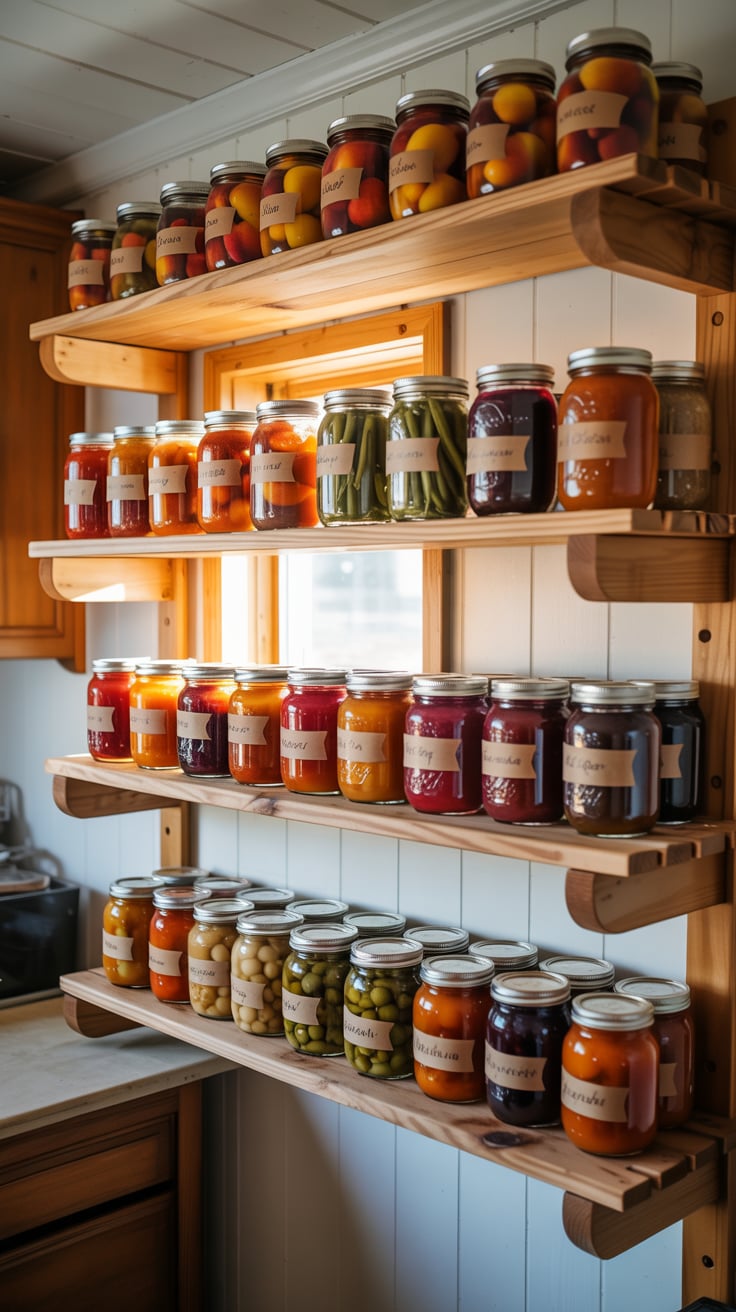
Building DIY canning storage shelves is one of the most satisfying, budget-friendly upgrades you can make for your pantry, basement, or garage. Done right, these shelves keep jars safe, maximize small spaces, and make food rotation painless—so you actually use what you preserve. Whether you’re a new canner or expanding a homestead pantry, this easy home project will help you store more, waste less, and find what you need at a glance. For deeper pantry-prep ideas and shelf-stable meal inspiration, see The Lost SuperFoods.
Why build DIY shelves that hold real-world pantry loads
Store-bought utility shelves can be fine for paper towels and light bins, but glass jars full of soups, meats, and sauces deserve more than flimsy particleboard or wobbly uprights. DIY canning storage shelves let you control the depth, spacing, and strength so you can:
- Fit jars, #10 cans, and buckets without wasted inches
- Make shelves shallow enough to prevent jars from “hiding” behind each other
- Anchor to studs or masonry safely, reducing tip risk and earthquake vulnerability
- Design for rotation so older jars are used first
Weight matters. A single 4-foot shelf with two rows of quarts can hold 30–40 jars. Assuming roughly 2–3 lb per filled quart (varies by contents and glass), that’s 60–120 lb on one shelf. Multiply by multiple levels and you’ll see why real wood, good fasteners, and solid anchoring make a difference.
Common shelf problems this build solves:
- Sagging: Thin particleboard bows when loaded. We’ll use 3/4-inch plywood or solid boards with strong front edges and short spans.
- Tip-over risk: Freestanding racks can fail if someone bumps them or in minor seismic activity. We’ll anchor to wall studs or concrete.
- Lost jars: Deep shelves waste stock and make rotation hard. We’ll build shelves at 10–12 inches deep so everything is visible.
- Poor spacing: Shelves too tall or too short waste vertical space or squeeze jars. We’ll plan clearances for pints, quarts, and half-gallons.
Cost control without compromises:
- Stick to standard lumber sizes like 2×4 uprights and 3/4-inch plywood shelves.
- Keep spans to 32–36 inches between supports to reduce sag.
- Use simple joinery: screw-through supports, cleats, or pocket screws. No custom hardware required.
Finally, safety equals savings. Adjusting the design for your jars, room layout, and floors prevents cracked glass and broken seals—protecting months of preservation work. See the National Center for Home Food Preservation’s guidance for safe storage conditions at the National Center for Home Food Preservation.
[How to plan a pantry you’ll actually use](INTERNAL LINK PLACEHOLDER)
Planning your pantry space, measurements, and layout
Before cutting wood, map the space. A careful plan eliminates 90% of pantry frustrations. Bring a tape measure, pencil, and a notepad or notes app.
Key measurements to capture:
- Ceiling height: Shelves are usually 72–84 inches tall to keep top rows reachable. If ceilings are lower or sloped, adapt.
- Wall width: Decide how many bays you can fit. A “bay” is one vertical section with its own shelves and supports.
- Depth constraints: Doors, water heaters, ducts, or outlets near the wall can set maximum shelf depth.
- Walkways: Leave a minimum 30 inches of aisle space. Tight spaces invite accidents and make rotation annoying.
- Floor type: Concrete? Wood? Slightly out of level? Note any slope—helpful for leveling.
Locate studs or masonry:
- Studs: Use a stud finder and mark stud centers. Typical spacing: 16 inches on center.
- Masonry: If you’re anchoring to concrete or block, you’ll use masonry anchors or Tapcon-style screws.
Inventory jars and containers:
- Pints: allow roughly 6.5–7 inches of vertical clearance
- Quarts: allow roughly 8–8.5 inches
- Half-gallons or tall jars: allow roughly 10–11 inches
- #10 cans: allow roughly 7.5–8 inches
- 5-gallon buckets: often need 16–18 inches of vertical clearance and 12–14 inches of depth
A practical shelf layout:
- Depth: 10–12 inches for jar shelves, 14–16 inches for big cans and bins
- Spacing: 7 inches tall for pints; 9 inches for quarts; 11 inches for tall jars
- Number of levels: 5–7 shelves is typical for an 80-inch unit (allowing for base and top clearance)
Seismic and safety considerations:
- In earthquake zones, lower the top-heavy risk by keeping heaviest jars on bottom shelves.
- Add front lips to shelves to reduce roll-off risk.
- Anchor the unit at multiple points across studs or into masonry.
Climate matters:
- Aim for cool, dark, and dry. Avoid heat sources and direct sunlight.
- Allow modest airflow to reduce condensation and rust on lids. The pantry storage basics at Ready.gov are a good refresher for temperature and humidity targets.
[How to set up blackout-safe pantry lighting](INTERNAL LINK PLACEHOLDER)
Materials and tools that balance strength, cost, and speed
One strength of DIY canning storage shelves is the simple materials list. You can build a robust unit with common lumber and basic tools.
Core materials:
- Uprights and horizontal supports: 2×4 construction lumber
- Shelves: 3/4-inch plywood (cabinet-grade or sanded construction) or 1×10 / 1×12 boards
- Cleats or ledgers: 1×2 or ripped strips of plywood for underside support
- Back bracing: 1/4-inch plywood or diagonal 2×2 bracing (optional but helpful)
- Fasteners: 2.5–3-inch wood screws for framing; 1.25–1.5-inch screws for shelf-to-cleat
- Anchors: 3-inch screws into wall studs or masonry anchors into concrete/block
- Anti-tip straps or L-brackets for extra security
- Wood glue (optional for cleats and edging)
Optional upgrades:
- Edge band or a 1×2 front rail to stiffen shelves and provide a jar “lip”
- Rubber or cork strips on shelves to reduce vibration and sliding
- Finish: water-based polyurethane or paint for sealed, cleanable surfaces
Tools:
- Circular saw or miter saw for cuts
- Drill/driver with countersink bit
- Stud finder, level, square, and measuring tape
- Sanding block or orbital sander
- Clamps (optional but helpful)
- Safety gear: glasses, ear protection, dust mask
Why these choices work:
- 2×4 frames provide high load capacity with simple joinery.
- 3/4-inch plywood resists sag over moderate spans; a 1×2 front rail increases stiffness significantly.
- Cleats distribute load across the side supports, taking pressure off screws.
Water storage fits the same mindset: sturdy, well-supported, and easy to access. If you’re expanding your shelter-in-place setup, consider modular water storage that tucks under lower shelves or in adjacent space. A compact solution like SmartWaterBox can help you organize potable water without sacrificing pantry real estate.
[Pantry-safe finishes and sealers](INTERNAL LINK PLACEHOLDER)
Cut list and modular shelf dimensions for jars and buckets
Use this adaptable cut list as a starting point for one 72-inch-tall, 36-inch-wide, 12-inch-deep shelving bay designed for canning jars. Adjust lengths for your room and jar mix.
Assumptions:
- Overall unit: 72 inches tall; 36 inches wide; 12 inches deep
- Shelves: 3/4-inch plywood at 11.25 inches actual depth (often sold as 12 inches nominal)
- Vertical 2×4 uprights: two in front, two in back
- Support rails (2×4) set at each shelf height, front and back
- Shelf spacing: a mix for pints and quarts
Suggested cut list (per 36-inch bay):
- Uprights: four 2×4 at 72 inches
- Top and bottom rails: four 2×4 at 33 inches (inside width between uprights minus thickness)
- Intermediate shelf rails: eight 2×4 at 33 inches (two per shelf level)
- Shelves: four to six plywood panels at 36 inches wide × 11.25 inches deep
- Front rails or lips (optional): six 1×2 at 36 inches
- Cleats (optional alternative to 2×4 rails): twelve 1×2 at 33 inches
Spacing mix example:
- Shelf A & B (pints): 7-inch clear space
- Shelf C & D (quarts): 9-inch clear space
- Shelf E (tall jars/#10 cans): 11-inch clear space
How to set heights:
- Start 3 inches above the floor for airflow and mop access (or raise more if on a damp slab).
- Add shelf thickness and rail thickness when measuring clear space.
- Mark all shelf heights on uprights before assembly—saves mistakes.
Depth considerations:
- 10–12 inches deep prevents double-stacking jars that get forgotten.
- For bins or buckets, keep a separate bay at 14–16 inches deep.
Alternative cut list for narrow spaces:
- Use 30-inch width with more bays. Narrow shelves reduce sag and fit around obstacles.
- Go taller (80–84 inches) if you have headroom; mix in one deep shelf for bulk storage.
Front lips and safety:
- A 1×2 front lip not only stiffens the shelf but also creates a 3/4-inch rise that helps prevent roll-off.
- If you want FIFO can rotation, leave one shelf without a lip and add sloped dividers or rails that allow cans to feed forward.
Remember: lumber dimensions can vary. Measure twice, dry-fit, then cut. For food safety storage conditions and shelf life, consult extension resources like Penn State Extension – Home Food Preservation.
Step-by-step build guide for rock-solid shelving
This build uses a simple ladder frame on each side with front and back rails holding each shelf level. It prioritizes strength and repeatable measurements.
- Prep and mark
- Cut all pieces to size and lightly sand edges.
- On each 2×4 upright, mark the top of each shelf rail location using your planned clearances. Transfer marks across all four uprights so shelves align.
- Assemble side frames
- Lay two uprights flat. Position the top and bottom rails between them, flush with ends. Pre-drill and screw through uprights into rails.
- Add intermediate shelf rails at your marks. Repeat for the second side frame.
- Stand up frames and connect
- Stand both side frames and connect them with the front and back rails at the top and bottom. Check square with a framing square or by measuring diagonals. Adjust before tightening fully.
- Add intermediate connecting rails
- Install remaining front and back rails at each shelf level, matching the heights marked on the side frames. Screw from the outside through the uprights into the rail ends.
- Anchor to the wall
- Slide the unit to the wall. Shim to plumb if the floor is uneven.
- Anchor the top rail or dedicated 2×4 ledger into studs with 3-inch screws at two or more points. For masonry, drill pilot holes and use appropriate anchors.
- Install shelves
- Drop plywood shelves onto the rail pairs. Optionally add a line of glue on rails first, then pre-drill and screw downward through the shelf into the rails.
- Add 1×2 front lips. Glue and pin-nail or screw from below.
- Back bracing (optional)
- For extra rigidity, nail 1/4-inch plywood across the back or add a diagonal 2×2 brace.
- Finish and protect
- Seal with water-based polyurethane or paint to make cleanup easier and reduce moisture absorption. Avoid heavy solvent odors in closed pantries.
- Load test
- Before loading glass, place a few heavy jugs or weights across each shelf and watch for movement or creaks. Tighten any connections.
Pro tips:
- Keep spans to 32–36 inches for 3/4-inch shelves. If you go wider, add a center support.
- Pre-drill to prevent splitting near ends of 2×4s.
- Label each shelf layer (Pints/Quarts) while building—it keeps your plan honest when you start loading jars.
For general emergency pantry targets (water, calories per person, rotation cadence), see Ready.gov – Food and Water.
Anchoring, safety, and load testing for full jars
Anchoring is non-negotiable for a canning pantry. Even if you don’t live in an earthquake zone, shelves can tip when bumped or unevenly loaded. Plan to anchor the unit at least at two points—ideally one near the top and one mid-height.
Anchoring to studs:
- Use a stud finder to mark centers, then pre-drill through a ledger board or the top shelf rail.
- Drive 3-inch wood screws into each stud you can reach. Two or more anchors per bay are recommended.
Anchoring to masonry:
- Mark holes, then drill with a masonry bit. Use sleeve anchors or concrete screws rated for shelf loads.
- Wipe dust from holes before inserting anchors so they grip.
Anti-tip strategies:
- Add metal L-brackets from the top rail to studs.
- Use two anti-tip straps at opposite ends as redundancy.
- Keep heaviest jars on the lowest shelves to lower the center of gravity.
Vibration and roll-off prevention:
- Add a 1×2 or 1×3 lip to front edges.
- Use thin rubber shelf liners or cork at the front third of shelves to dampen vibration.
- Keep jars at least 1/2 inch from the shelf front edge.
Load testing routine:
- Start with 25% of expected load and wait 15 minutes.
- Increase to 50%, then 75%, watching for sag. A straightedge or level across the front makes sag visible.
- Tighten connections and re-check anchors if you notice movement.
- If sag appears on longer shelves, add a center support or double the front rail.
Moisture and temperature:
- Avoid damp walls. Add a 1/2-inch spacer behind the frame if needed to encourage airflow.
- Keep pantry temps cool and consistent; avoid positioning near furnace rooms or sunlit windows. The National Center for Home Food Preservation offers guidance on ideal storage conditions to protect food quality.
Periodic checks:
- Inspect shelves quarterly for fastener loosening, rust on lids, and any musty odors.
- Wipe spills promptly; sugar syrups can glue jars in place or attract pests.
If you’re designing an all-hazards pantry, consider pairing your shelves with compact water storage like SmartWaterBox. It keeps potable water accessible without monopolizing shelf space.
Smart organization, labeling, and rotation that saves food
A beautiful build is half the win; the rest is organization. The goal is fast retrieval and automatic rotation so older jars move forward and get used first.
Shelf mapping:
- Assign each shelf a category: proteins, tomatoes, broths, fruits, pickles, sauces.
- Keep pints and quarts separate if possible—height differences complicate stacking.
FIFO (first in, first out):
- Load from the back, retrieve from the front. If your shelf depth allows, create simple dividers to guide rows forward.
- Alternatively, use two rows deep: set the back row slightly elevated with a thin board so you can see lids.
Labeling system:
- Lid labels: write “Item – Month/Year” with a paint marker or dissolvable labels.
- Shelf labels: add stick-on label holders at the lip for category names and date ranges.
- Color coding: use a colored dot for each year, making it obvious what to use first.
Inventory tracking:
- Keep a small whiteboard or clipboard on the end of the unit to note opens, adds, and empties.
- Update a digital sheet weekly. A simple “Have/Target/Use by” sheet keeps overcanning in check. See this guide: [How to track pantry inventory without overbuying](INTERNAL LINK PLACEHOLDER).
Ergonomics and safety:
- Heavy jars low, light jars higher.
- Leave one deep shelf for bulky dry goods (flour, rice, beans) in sealed containers.
- Avoid stacking jars more than two high unless in crates designed for stacking.
Lighting and access:
- Add battery puck lights under upper shelves for visibility.
- Keep a dedicated step stool nearby for top shelves.
Sanitation:
- Wipe shelves quarterly with mild soap and water.
- Store rings off jars to spot compromised seals faster.
- Keep a small bin for chips or rusted lids to replace during the next canning day.
For long-term menu planning and shelf-stable meal ideas, a resource like The Lost SuperFoods can help you design practical rotation menus around what you actually store.
Quick preparedness boosts that complement your shelves
Well-built shelves are a foundation for resilience, but a few targeted upgrades can multiply the payoff.
- Water redundancy: Keep at least several days of potable water per person. If space is tight or you prefer modular setups, a compact system like SmartWaterBox slots neatly around your pantry.
- Practical skills: Urban or suburban? Situational awareness and everyday preparedness matter as much as supplies. A concise primer like URBAN Survival Code can help you build routines that protect your pantry and your home in uncertain times.
- Menu planning: Turn shelf-stable foods into real meals so nothing lingers. Browse ideas in The Lost SuperFoods to convert stored ingredients into quick family staples.
For government and extension guidance on shelf life and environmental ranges, cross-check with Ready.gov and Penn State Extension – Home Food Preservation.
Recommended resources and upgrades
Curated picks that fit this project and topic:
- Shelf-stable meal ideas and food history you can actually cook from: The Lost SuperFoods
- Space-efficient home water storage for shelter-in-place plans: SmartWaterBox
- Everyday urban preparedness routines and security mindset: URBAN Survival Code
Authority references worth bookmarking:
- National Center for Home Food Preservation: National Center for Home Food Preservation
- FEMA’s official food and water basics: Ready.gov – Food
- University extension canning and storage advice: Penn State Extension – Home Food Preservation
[How to build a rolling can rack for FIFO rotation](INTERNAL LINK PLACEHOLDER)
Conclusion
DIY canning storage shelves—an easy home project that pays off for years—turn chaotic stacks into a safe, organized pantry you’ll actually use. By planning shelf depth and spacing for your exact jar mix, building with sturdy 2×4 frames and 3/4-inch shelves, anchoring securely, and labeling for FIFO rotation, you’ll protect your canning work and speed up everyday cooking. Round out your pantry with compact water storage like SmartWaterBox and explore menu ideas from The Lost SuperFoods so every jar you store becomes a meal you love. Build once, stock smart, and let your shelves quietly do the work.
FAQ
Q1: What depth is best for DIY canning storage shelves?
A: For most canning jars, 10–12 inches deep is ideal. It prevents items from getting lost behind each other and keeps weight near the wall for stability. Use 14–16 inches only for bulky bins or #10 cans in a dedicated bay.
Q2: How much weight should each shelf support?
A: Plan conservatively. A 36-inch shelf holding two rows of quarts can see 60–120 lb. Use 3/4-inch plywood or solid boards, keep spans to 32–36 inches, add a front 1×2 rail for stiffness, and anchor the unit to wall studs or masonry.
Q3: What’s the right spacing between shelves for pints and quarts?
A: Provide about 7 inches of clear height for pints, 9 inches for quarts, and 11 inches for tall jars or half-gallons. Measure your specific jars—brands vary slightly—and include shelf thickness when marking.
Q4: How do I anchor shelves safely in a basement or garage?
A: Locate studs and drive 3-inch screws through a top rail or ledger. For concrete or block, use masonry anchors. Add anti-tip straps or L-brackets, and place heavier items on lower shelves to lower the center of gravity.
Q5: What wood should I use, and do I need to seal it?
A: 2×4 framing with 3/4-inch plywood shelves is durable and budget-friendly. Sealing with water-based polyurethane or paint makes cleaning easier and helps limit moisture absorption—use low-odor finishes in tight spaces.
Q6: How can I set up FIFO rotation on flat shelves?
A: Label lids with “Item – Month/Year,” load from the back and pull from the front, and use simple dividers. For cans, sloped rails or a DIY rolling can rack can create true FIFO. See: [How to build a rolling can rack for FIFO rotation](INTERNAL LINK PLACEHOLDER).
Q7: Are DIY canning storage shelves safe in earthquake-prone areas?
A: Yes, with proper anchoring, front lips to prevent roll-off, tight fasteners, and weight kept low. Consider more frequent anchors to studs and rubber shelf strips to reduce vibration.
Q8: Can I combine food and water storage in the same area?
A: Yes. Keep water on the lowest shelves or on the floor in modular containers to minimize load on the structure and for easy access. A compact solution like SmartWaterBox can make this simpler.