
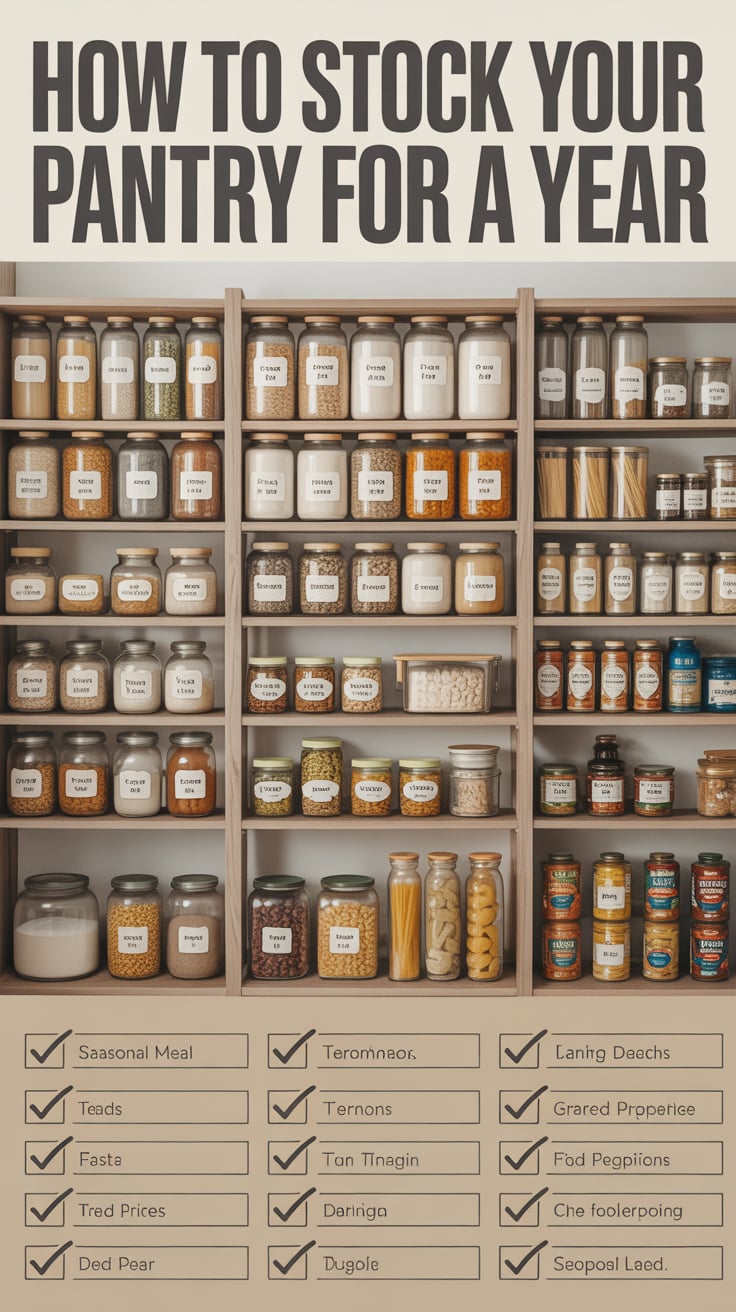
Stocking a year-long pantry isn’t about hoarding; it’s about building a calm, dependable food and water buffer that supports your daily life and protects you from disruptions. If you’ve wondered how to stock your pantry for a year without stress or waste, this guide walks you through goals, budgeting, smart storage, rotation, and a practical 12‑month roadmap you can start today. As you plan, aim for a pantry you’ll actually cook from—not a museum of cans.
If you want a head start on long-lasting recipes and preservation methods, the resource guide The Lost SuperFoods provides timeless techniques you can integrate into your year-long pantry planning.
What it really takes to stock your pantry for a year
A one-year pantry balances calories, nutrients, water, space, and budget. It should support everyday meals, with backups for emergency scenarios, special diets, and comfort.
- Calorie baseline: Many households plan around 2,000–2,400 calories per adult per day, adjusting for activity, age, and health. Children often need less; athletes and pregnant people typically need more. A good starting point: estimate 700,000–875,000 calories per adult per year and scale to your household.
- Macronutrients: For long-term energy and satiety, aim for a mix of complex carbohydrates (grains), protein (legumes, canned meats, nut butters), and fats (oils, ghee, seeds).
- Dietary needs: If anyone is gluten-free, vegetarian, low-sodium, or has allergies, plan substitutes now and label shelves by person or diet type.
- Cooking method: Assume you’ll prefer normal cooking most of the time. For outages, keep no-cook or low-fuel options like ready-to-eat canned items, dehydrated foods, and instant grains.
- Space and climate: Cool, dark, dry storage extends shelf life. If space is tight, prioritize calorically dense staples and vertical shelving.
- Waste prevention: You’re building a working pantry, not an emergency-only stash. Stock what you already eat, then expand into pantry-friendly swaps you’ll use regularly.
Helpful references for safe storage and shelf life include the USDA FoodKeeper guidance and Ready.gov preparedness resources.
- External resources:
Building a realistic budget and shopping plan
A year-long pantry is easier when you spread purchases over months and leverage sales cycles. Treat it like a project with milestones, not a single shopping trip.
- Set a monthly pantry line item: Pick a manageable amount—say, 5–10% of your grocery budget—to dedicate to long-term staples.
- Batch by category: Each month, focus on 1–2 categories (e.g., grains in Month 1, proteins in Month 2) so you can buy in bulk and optimize savings.
- Buy what you cook: Anchor your list in your actual meal rotation. Gradually shift a few fresh-heavy meals toward pantry-first versions (e.g., shelf-stable soups, grain bowls with canned fish).
- Track unit costs: Build a simple price book to compare real per-ounce or per-pound costs across stores. This pays off with staples like rice, beans, canned tomatoes, and oils.
- Mix premium and basic: Use store brands for basics, then layer in a few premium items that increase variety (spices, sauces, condiments).
- Schedule use of perishables: While this guide focuses on shelf-stable goods, your weekly shopping can still feature fresh produce and meat. Use your pantry for backbone calories, then top off with fresh when possible.
- Coupon, clearance, and case discounts: Watch for case-lot sales and buy-1-get-1 deals on canned fish, tomatoes, and legumes, which are foundational.
- Build a running inventory: Keep a one-page list of target quantities per category and mark progress as you fill in. This keeps purchases purposeful.
Internal resources you might build or consult:
- [How to build a 30-day emergency meal plan](INTERNAL LINK PLACEHOLDER)
- [Pantry budgeting template for families](INTERNAL LINK PLACEHOLDER)
Core shelf-stable foods that anchor a one-year pantry
Think in categories you can mix and match into full meals. Quantities below are general starting points per adult; adjust for your household, diet, and how much you’ll cook from the pantry versus fresh sources.
- Grains and starches
- Rice (white rice stores longer than brown): 50–100 lb
- Oats, pasta, quinoa, cornmeal, instant potatoes
- Tortillas and flatbreads (shelf-stable varieties), crackers for no-cook options
- Legumes and plant proteins
- Dry beans (pinto, black, chickpeas, lentils): 50–100 lb
- Canned beans for quick meals
- Textured vegetable protein (TVP), tofu in shelf-stable packaging, nut butters
- Animal proteins
- Canned tuna, salmon, sardines
- Canned chicken, beef, or ham
- Jerky and shelf-stable sausages for variety
- Fats and oils
- Neutral oil (canola, avocado, or high-oleic): 1–3 gallons total, bought in smaller bottles to rotate
- Olive oil, ghee, coconut oil for cooking and calories
- Seeds and nuts in airtight containers for short- to mid-term storage
- Dairy and dairy alternatives
- Powdered milk or shelf-stable milk alternatives
- Shelf-stable cheese products, evaporated and condensed milk for baking
- Vegetables and fruits
- Canned tomatoes (diced, paste, crushed), mixed veg, carrots, greens
- Fruit in juice or water, applesauce, dried fruits
- Freeze-dried options to preserve texture and nutrients
- Baking and breakfast essentials
- Flour (all-purpose + whole wheat), yeast, baking powder/soda, sugar, salt
- Pancake mix, oats, granola
- Flavor and comfort
- Spices, bouillon, soy sauce, hot sauce, vinegar
- Coffee, tea, cocoa, jams, pickles
- Shelf-stable desserts and morale boosters
Tips for quantity planning:
- Start with a 4-week menu you already love, then multiply the shelf-stable components to cover a year.
- Use higher-calorie staples (oils, rice, beans) to hit energy targets efficiently.
- Store flour for the near term and whole grains (wheat berries, oats) for longer shelf life; mill as needed if you have a grinder.
For longevity and diverse recipes that make pantry eating enjoyable over months, the heritage recipes and preservation methods in The Lost SuperFoods can help you turn staples into satisfying meals.
Water storage, purification, and rotation for year-long resilience
Food is only part of the equation. For a true year-long cushion, plan for water storage and treatment. Ready.gov suggests at least 1 gallon of water per person per day for drinking and sanitation, with more in hot climates, for pregnant or breastfeeding individuals, and for heavy activity.
- Baseline targets: For two adults, 60 gallons covers one month at 1 gallon/person/day. Few households store a full year of water due to space; combine stored water with purification capability and rotating supplies.
- Storage options:
- Commercially sealed water jugs are convenient but rotate them yearly.
- Food-grade containers (3–7 gallon jugs, stackable cubes) balance portability and capacity.
- Larger barrels (30–55 gallon) are space-efficient; use appropriate pumps and stabilizers as needed.
- Keep some small bottles for grab-and-go and power outages.
- Purification and treatment:
- Maintain a gravity-fed filtration system for daily use or emergencies. A household-scale system like Water Freedom System can turn questionable water into safe drinking water without electricity.
- For compact storage and backup, a modular container-filtration combo such as SmartWaterBox helps you store, dispense, and rotate water efficiently.
- Keep water treatment drops or tablets for disinfection, and boil water when possible in emergencies.
- Rotation plan:
- Label containers with fill dates and rotate every 6–12 months depending on container and conditions.
- Use stored water for cooking once a month, then refill—this ensures freshness and keeps the system in use.
Read more guidance from Ready.gov and the CDC on safe water storage and emergency disinfection.
Storage systems, containers, and shelf life management
Good storage can double or triple the useful life of many staples. Focus on temperature, light, oxygen, and pests.
- Temperature and humidity
- Aim for cool, stable temps (ideally 50–70°F). Avoid garages and attics that swing hot and cold.
- Dry is critical: high humidity degrades packaging and invites mold.
- Containers and packaging
- Use food-grade buckets with gasketed lids for bulk grains and beans. For longest life, store in mylar bags with appropriate oxygen absorbers inside the buckets.
- Keep oils in smaller, opaque bottles to reduce oxidation.
- Transfer flour, sugar, oats, and pasta to airtight containers to deter pests.
- Elevate items off concrete floors and leave airflow behind shelves.
- Organization
- Divide shelves by category (grains, proteins, veggies, fruits, fats, baking, snacks, hydration).
- Keep open duplicates up front and backups behind; label shelves with target quantities so you can see at a glance what needs restocking.
- Shelf life references
- Most canned goods store well past the “best by” date if unopened, undamaged, and stored cool and dry. Always check for bulging, rust, leaks, or off smells before use. See USDA guidance on date labels and quality versus safety.
- Pest prevention
- Inspect bulk goods on arrival; consider freezing grains/beans for 72 hours to kill pantry moth eggs before long-term storage.
- Use bay leaves or diatomaceous earth (food grade) around shelf edges as a deterrent.
If you’re comparing container options or a rack system, see: [Best pantry containers and mylar setup](INTERNAL LINK PLACEHOLDER). For food dating guidance, consult the USDA FoodKeeper App.
Rotation, inventory, and meal planning to keep food moving
A one-year pantry only works if you eat from it. Rotation protects your investment, and meal planning turns “storage” into dinner.
- FIFO as a habit
- First In, First Out: place new items behind older ones and decant into working containers.
- Date everything—top and front—with a bold marker.
- Inventory that stays simple
- Maintain a one-page master list with target quantities and actual counts per category.
- Once a month, do a 10-minute scan and update. This guides your next grocery run.
- Use an app or a shared note so the whole household participates.
- Meal planning that favors pantry-first
- Build 10–15 “pantry wins” you can cook fast: pasta puttanesca, bean chili, tuna and chickpea salad, coconut dal, tomato soup with grilled cheese, rice bowls with canned salmon and veg.
- Practice “cook one, store one”: every time you open the last can in a row, add it to your list.
- Batch-cook sauces (e.g., marinara from canned tomatoes) and pressure-can or freeze to extend variety.
- Prevent fatigue
- Rotate cuisines weekly: Mediterranean, Mexican, Indian, Southeast Asian, American classics.
- Keep flavor matrices handy: tomato + olive + capers; coconut + curry + lentils; soy + ginger + chili + sesame.
- Heritage preservation ideas
- Consider shelf-stable recipes like pemmican-style bars, rendered fats, and lacto-fermented vegetables to extend variety and nutrition. For more, the guide The Lost SuperFoods offers practical approaches to time-tested foods that store well.
For weekly implementation, see: [Pantry-meal template and 7-day rotation](INTERNAL LINK PLACEHOLDER).
A practical 12-month stocking roadmap
Use this month-by-month approach to reach a one-year pantry without overwhelming your budget or space. Adjust the order based on local sales cycles and your household’s tastes.
- Month 1: Grain foundation
- Buy 25–50 lb of rice or oats, plus pasta. Add airtight containers and labels.
- Begin your price book and inventory sheet.
- Month 2: Beans and legumes
- Add 25–50 lb of dry beans and a case of canned beans. Include lentils for quick-cooking versatility.
- Test one new legume recipe per week to lock in habits.
- Month 3: Tomatoes and vegetables
- Stock diced, crushed, paste, and whole tomatoes; mixed veg, corn, green beans.
- Practice a weekly pasta or chili night using these cans.
- Month 4: Proteins you’ll actually eat
- Add canned tuna, salmon, chicken, and a few shelf-stable sausages.
- Build 3–5 go-to recipes with each protein type.
- Month 5: Fats and baking
- Buy oils in smaller bottles to rotate faster; add sugar, salt, baking powder/soda, yeast, flour.
- Try baking a weekly loaf or flatbread to become comfortable with your staples.
- Month 6: Fruits and comfort
- Add canned fruit, dried fruit, jams, cocoa, tea, coffee, and snacks that fit your family’s tastes.
- Assemble a “morale box” with treats for tough days.
- Month 7: Dairy and alternatives
- Bring in powdered milk or shelf-stable milks; evaporated and condensed milk for baking.
- Test pantry-friendly breakfasts (overnight oats, granola parfaits with shelf-stable milk).
- Month 8: Sauces and flavor
- Stock vinegar, soy sauce, hot sauce, curry pastes, bouillon, herbs, and spices.
- Build a “flavor shelf” so bland meals become exciting.
- Month 9: Water storage and treatment
- Add stackable containers or a larger barrel. Start a rotation schedule.
- Set up a gravity-fed filter like Water Freedom System and consider a compact system such as SmartWaterBox for modular storage and dispensing.
- Month 10: Ready-to-eat and low-cook meals
- Stock soups, stews, chili, instant rice, and no-cook items for outages.
- Assemble a grab-and-go kit with a manual can opener and basic utensils.
- Month 11: Redundancy and tools
- Add a camp stove with fuel, canning lids, mylar bags, oxygen absorbers, and buckets.
- Organize shelves by category and add signage for target quantities.
- Month 12: Review, rebalance, and practice
- Evaluate what you used and loved; rebalance categories accordingly.
- Run a “pantry-only week” to test your system and identify gaps.
If you want medical readiness alongside pantry planning, keep a reference like Home Doctor near your first-aid kit so minor issues don’t disrupt your routine.
Smart substitutions and special diets that scale
A long-term pantry should be inclusive and flexible. Plan swaps ahead of time so you never feel stuck.
- Gluten-free
- Stock rice, quinoa, certified GF oats, corn tortillas, and GF pasta. Use cornstarch or arrowroot for thickening.
- Vegetarian and vegan
- Emphasize beans, lentils, chickpeas, TVP, tofu packs, nuts, seeds, tahini, and shelf-stable plant milks. Keep B12-fortified foods if needed.
- Low-sodium
- Favor no-salt-added canned goods and make your own spice blends. Bouillon cubes vary widely—choose reduced-sodium versions or make stock from scratch.
- Dairy-free
- Shelf-stable coconut milk, oat or soy milks, and ghee alternatives can cover cooking and baking.
- Low-fuel cooking
- Favor quick-cooking staples (red lentils, small pasta, couscous, instant rice) and no-cook meals (tuna salads, wraps, canned-bean salads).
- Flavor builders
- Keep concentrated flavor: dried mushrooms, tomato paste tubes, anchovy paste, chili crisps, MSG, and quality vinegar.
For a deeper dive on pantry-friendly recipes across diets and climates, explore The Lost SuperFoods for inspiration steeped in tradition.
Get set up faster with curated resources
If you prefer a guided path as you stock your pantry for a year, these tools can save time and reduce trial-and-error:
- For long-lasting recipes and preservation ideas that make staples craveable: The Lost SuperFoods
- For household-scale, no-electricity water filtration during outages: Water Freedom System
- For modular water storage, dispensing, and rotation in tight spaces: SmartWaterBox
- For everyday medical preparedness to complement pantry planning: Home Doctor
You can also add an urban-readiness layer later with mobility-oriented kits and skills: [Urban pantry packing and grab-and-go lists](INTERNAL LINK PLACEHOLDER).
Conclusion
Learning how to stock your pantry for a year is less about stockpiling and more about systems: set clear goals, buy what you love to eat, store it correctly, rotate it into regular meals, and maintain a simple inventory. Start with a single shelf and a monthly category focus; add water storage and filtration; then refine your recipes so pantry eating feels normal, not like a compromise. The result is a resilient kitchen that lowers stress, reduces grocery costs, and keeps your household steady through everyday life and the unexpected.
Frequently asked questions
How much food do I need to stock my pantry for a year?
Start with a calorie baseline of roughly 2,000–2,400 calories per adult per day and scale for your household. Translate that into categories—grains, legumes, proteins, fats, fruits/veg, and baking staples—based on meals you already cook.What is the best way to store bulk staples long term?
Keep them cool, dark, and dry. Use mylar bags with oxygen absorbers inside food-grade buckets for grains and beans. Transfer open items into airtight containers. Consult the USDA FoodKeeper App for guidance.How much water should I store for a year?
Few households store a full year due to space. Follow Ready.gov’s 1 gallon per person per day guideline as a baseline and combine stored water (rotated every 6–12 months) with filtration like Water Freedom System and modular systems such as SmartWaterBox.Which foods last the longest in a year-long pantry?
White rice, dry beans, whole grains, sugar, salt, honey, and many canned goods store well under proper conditions. Oils have shorter shelf lives—buy smaller bottles and rotate. Always check packaging and use-by guidance; see USDA: Food Product Dating.Can I stock a one-year pantry if I’m gluten-free or vegetarian?
Yes. Emphasize naturally gluten-free grains (rice, quinoa) and legumes. Vegetarians can rely on beans, lentils, tofu, TVP, nuts, seeds, and shelf-stable plant milks. Plan pantry-first meals you enjoy so rotation stays natural.How do I prevent waste when stocking for a year?
Buy what you already eat, label everything, use FIFO rotation, and maintain a simple monthly inventory check. Plan a “pantry-only week” each quarter to ensure items stay in active use.What cooking gear should I pair with my pantry plan?
Keep a manual can opener, camp stove with fuel, water filter, basic cookware, and spare utensils. Build a small spice kit so simple staples become full-flavor meals. For medical readiness alongside food and water, consider Home Doctor.Do I need specialized survival foods to stock my pantry for a year?
Not necessarily. Regular grocery staples work well when stored and rotated properly. That said, a few shelf-stable specialty items (freeze-dried fruits/veg, high-calorie bars) and proven preservation techniques from resources like The Lost SuperFoods can add variety and longevity.