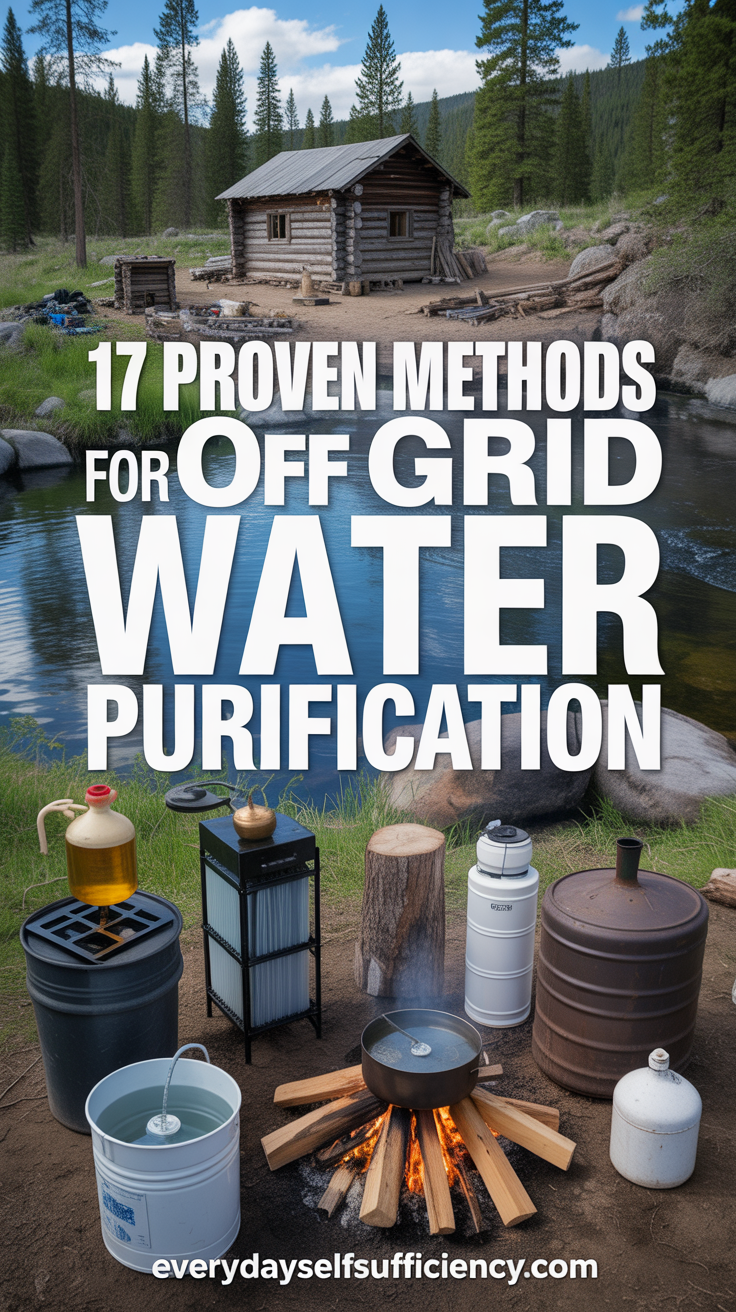
When infrastructure fails or you’re living beyond the grid, nothing matters more than clean, safe water. Water purification off grid is both a science and a system: you identify the hazards in your source, remove particulates, neutralize pathogens, and store water so it stays safe. In this guide, you’ll master 17 proven methods to stay safe and hydrated—covering boiling, filtration, chemical disinfection, UV treatment, distillation, and more—plus the gear, workflows, and redundancy plans that make water purification off grid reliable day after day.
After you understand the foundation of water purification off grid—sediment removal, pathogen kill steps, and safe storage—you can build a layered approach tailored to lakes, streams, rainwater, brackish sources, or even saltwater. Whether you’re prepping for emergencies or building a permanent off-grid system, the following methods, checklists, and step-by-step instructions will help you eliminate bacteria, viruses, and protozoa (like Giardia and Cryptosporidium), reduce chemicals and heavy metals, and keep turbidity low so treatments actually work. For a proven gravity solution that combines multi-stage filtration with everyday practicality, see the Water Freedom System.
You’ll also find planning templates, a compact toolkit list, and testing tips—because water purification off grid isn’t just about one method; it’s about verifying results and avoiding cross-contamination in the real world.
Table of Contents
Know Your Source and Risks Before You Treat
Effective water purification off grid starts with a quick risk assessment. Every source carries a different pathogen and contaminant profile:
- Surface water (streams, lakes, ponds): Often high turbidity with organic matter; likely protozoa (Giardia, Cryptosporidium) and bacteria (E. coli).
- Shallow wells and springs: Generally clearer; bacterial and viral risks remain; possible agricultural runoff.
- Rainwater catchment: Typically low in minerals and often clear, but can pick up roof contaminants, bird droppings, and biofilm from storage.
- Brackish or seawater: High salts; requires distillation or reverse osmosis for true water purification off grid.
- Floodwater: Treat as highly contaminated with chemicals, sewage, and pathogens; needs aggressive, layered purification.
Core goals of water purification off grid:
- Clarify the water (reduce turbidity) so disinfection can work.
- Neutralize or remove pathogens.
- Reduce chemicals, heavy metals, and off-flavors.
- Store and dispense safely to prevent recontamination.
Key terms to know:
- Turbidity: Cloudiness from suspended particles that shield microbes from disinfectants.
- Micron rating: Filter pore size; sub-micron ceramic and absolute 0.2–0.4 micron capture protozoa and many bacteria.
- Residual: A small amount of disinfectant (like chlorine) left in water to inhibit recontamination.
- Combined vs. residual method: Filtration plus disinfection provides broad-spectrum protection, crucial for water purification off grid.
Fast pre-treatment steps:
- Let muddy water settle, then decant the clearer top layer.
- Use a cloth, coffee filter, or dedicated pre-filter to remove sediments.
- If water is brown/green with visible particulates, consider flocculation (alum or crushed Moringa seeds) to clump particles before filtration.
Mid-content tip: For compact purification combining sediment, carbon, and pathogen reduction in one off-grid-ready unit, explore the New Water Offer: SmartWaterBox. It’s designed to streamline water purification off grid without grid power.
Testing and verification:
- Keep a basic water test kit or TDS meter to monitor changes over time.
- Use H2S bacterial test vials for a rough check of contamination risks.
- When in doubt, combine methods (e.g., filter plus boil or chlorinate).
Avoid cross-contamination:
- Dedicate one container for raw water and another for purified water.
- Sanitize hands, spigots, and lids with a bleach solution when handling clean water.
- Store purified water in food-grade, BPA-free containers and keep them sealed.
Anchor your plan with redundancy. Every off-grid water purification plan benefits from having at least three independent ways to make water safe: one heat-based, one filter-based, and one chemical or UV-based method. For broader resiliency planning, see the homestead and preparedness guides at Everyday Self-Sufficiency.
Methods 1–3 — Heat-Based Disinfection You Can Trust
Heat is a cornerstone of water purification off grid because it’s simple, visible, and reliable when done right.
Method 1: Full Boil (Rolling Boil)
- Bring clear water to a rolling boil for 1 minute (3 minutes above 2,000 meters/6,500 feet).
- A rolling boil inactivates bacteria, viruses, and protozoa.
- Pre-filter first if water is cloudy; boiling does not remove chemicals or heavy metals.
- Let cool in a covered pot, then pour into a sanitized container.
Method 2: Pasteurization with WAPI
- Water doesn’t need to boil to be safe; pasteurization occurs at 65–70°C (149–158°F) sustained long enough to kill pathogens.
- A Water Pasteurization Indicator (WAPI) uses melting wax to confirm safe temperature.
- Pasteurization reduces fuel consumption—key for water purification off grid where resources are scarce.
- Heat until the WAPI indicates; then cool covered to avoid airborne contamination.
Method 3: Solar Pasteurization (Solar Cooker/Oven)
- Use a solar oven or black-painted, lidded container in a reflective cooker to reach pasteurization temperatures.
- Add a WAPI to verify. This method uses no fuel and pairs well with sunny climates.
- For cloudy days, have a backup method ready.
Practical steps:
- Pre-treat: Decant and pre-filter to remove turbidity.
- Use covered containers to avoid recontamination while cooling.
- If flavor is flat after boiling, “polish” with activated carbon filtration.
Real-world workflow:
- Morning: Collect, settle, and pre-filter.
- Midday: Pasteurize or boil once, then store hot water in insulated containers.
- Evening: Use a secondary treatment (activated carbon) for taste, or chlorinate for residual protection.
After-first-paragraph placement already handled above; here’s a mid-section gear note: Pair heat methods with a gravity carbon stage to improve taste. A compact multi-stage unit like Water Freedom System gives you a repeatable daily routine for water purification off grid without electricity.
Safety and efficiency:
- Ventilate indoor cooking to avoid CO buildup.
- Track fuel: wood, propane, alcohol stoves, or solar cookers.
- Keep a dedicated “clean” ladle and funnel for purified water transfers.
Methods 4–6 — Filtration Fundamentals for Clarity and Pathogens
Filtration is the backbone of water purification off grid because it tackles turbidity and many pathogens before disinfection.
Method 4: Cloth, Coffee Filter, and DIY Prefilters
- A tight-weave cloth or coffee filter won’t remove microbes but reduces sediments that shield them.
- For DIY prefilters, layer gravel, sand, and charcoal in a bottle; change media frequently to avoid biofilm.
Method 5: Bio-Sand Filter (Household-Scale)
- A bio-sand filter uses sand layers and a “schmutzdecke” biofilm to remove turbidity, many bacteria, and protozoa.
- Build with a container, graded sands, and gravel; let it mature several weeks for full effect.
- Flow rate is slow; keep a lid to prevent contamination.
- Combine with chlorination or boiling for complete water purification off grid.
Method 6: Ceramic and Hollow-Fiber Gravity Filters
- Ceramic elements (0.2–0.5 microns) and hollow-fiber membranes physically remove protozoa and many bacteria. Some systems include carbon cores.
- Gravity operation is ideal off grid: no power, low maintenance.
- Clean the elements per manufacturer guidance; keep raw and purified chambers separate.
- Add a chemical residual or UV for viruses, which are smaller than many filter pore sizes.
Technique tips:
- Always pre-filter if water is cloudy; this prevents filter clogging and extends element life.
- Log your flow rates; a sudden drop can signal fouling.
- Store spare elements and gaskets—critical for long-term water purification off grid.
For a refined gravity approach with multi-stage media, consider the New Water Offer: SmartWaterBox, designed for repeated daily use and improved taste.
Methods 7–9 — Chemical Disinfection for Portable Reliability
Chemical disinfection provides portability and fast treatment—perfect for packs, vehicles, and emergency kits.
Method 7: Chlorine (Household Bleach or Calcium Hypochlorite)
- Unscented household bleach (5–9% sodium hypochlorite): Add 2 drops per liter of clear water, 4 drops if cloudy; wait 30 minutes. You should smell a slight chlorine odor. If not, repeat and wait another 15 minutes.
- Calcium hypochlorite (“pool shock,” 65–70%): Make a stock solution (mix 1 heaping teaspoon in 2 gallons of water), then use the stock to disinfect drinking water (about 1 part stock to 100 parts water; verify current guidelines).
- Pros: Kills bacteria and viruses; leaves a protective residual.
- Cons: Less effective against protozoan cysts; combine with filtration for robust water purification off grid.
Method 8: Iodine
- Tincture or tablets can disinfect bacteria and viruses; less effective for protozoa.
- Follow label doses; wait 30 minutes.
- Not recommended for long-term use by pregnant people or those with thyroid issues.
- Useful as a backup in cold environments where chlorine efficacy drops.
Method 9: Chlorine Dioxide Tablets
- Effective against bacteria, viruses, and protozoa with longer contact times (up to 4 hours for Cryptosporidium).
- Excellent pack-friendly option when you have time to wait.
Usage best practices:
- Start with clear water; turbidity reduces efficacy.
- Maintain contact time; keep water covered during treatment.
- Use a clean container with a lid and avoid touching inside surfaces.
Flavor fixes:
- After chemical treatment, run water through activated carbon to reduce taste and odor.
- Combine with gravity carbon units like Water Freedom System to “polish” water and increase daily drinkability.
Methods 10–12 — UV and Sunlight: Fast, Effective Disinfection
UV treatment neutralizes microbes without chemicals, making it a powerful tool for water purification off grid.
Method 10: SODIS (Solar Disinfection)
- Fill clear PET bottles with low-turbidity water, lay them horizontally on a reflective surface in full sun for 6 hours (or 2 days in overcast conditions).
- UV-A and heat work together to inactivate pathogens.
- Pros: Zero cost, excellent for sunny climates.
- Cons: Requires clear water and enough bottles; slower in clouds or at high latitudes.
Method 11: UV Wands and Portable Purifiers
- Handheld UV devices disrupt microbial DNA in minutes.
- Use with clear water; follow the swirl/immersion instructions for even exposure.
- Keep batteries charged via solar or crank for reliable water purification off grid.
Method 12: Off-Grid UV Chambers with Pre-Filtration
- Whole-house UV systems require clear, low-iron water and a power source.
- Off-grid power options: solar panels with battery storage or pedal power.
- Always pre-filter to manufacturer specs to ensure UV penetrance.
Mid-content gear pairing: A compact multi-stage system like the New Water Offer: SmartWaterBox can act as a pre-filter stage before a portable UV wand, creating a robust, two-step process for water purification off grid.
Operational tips:
- Keep quartz sleeves clean on UV chambers.
- Replace UV bulbs on schedule.
- Validate with periodic bacterial tests when possible.
Methods 13–15 — Distillation and Desalination for the Toughest Water
Distillation is your go-to when you need to remove salts, heavy metals, and virtually all pathogens—vital for seawater or contaminated sources in water purification off grid.
Method 13: Pot-and-Lid Distillation
- Boil water in a large pot; invert the lid so condensation drips into a clean bowl floating inside.
- For higher yield, run a tube from the pot lid through a cooling coil to a clean container.
- Pros: Removes salts, metals, and microbes.
- Cons: Energy-intensive; may need post-carbon to improve taste.
Method 14: Solar Still
- Dig a pit, place a catch container in the center, lay green vegetation around it (optional), cover with clear plastic weighted in the center so condensate drips into the container.
- Works anywhere with sun; slow but fuel-free.
- Useful for emergency water purification off grid when fuels are limited.
Method 15: Manual or Low-Power Reverse Osmosis (RO)
- RO removes salts and many contaminants; use brackish or seawater RO membranes depending on source.
- Off-grid options: manual hand-pump RO (maritime survival) or low-watt solar-powered RO with a pressure pump and storage tank.
- Pre-filter to protect the membrane; flush per specs; monitor TDS to track performance.
- Discard brine responsibly.
Taste polishing:
- Distilled or RO water can taste “flat.” Run through activated carbon or remineralize with a pinch of mineral salts for palatability.
If you expect to rely on seawater or brackish wells, plan an RO or distillation station as your primary method, with heat or chemical backup. For broader resilience planning and pantry strategies that complement water purification off grid, see The Lost SuperFoods.
Methods 16–17 — Activated Carbon and Combined Methods
Method 16: Activated Carbon (AC) Filtration
- AC improves taste and smell, reduces many organic chemicals, chlorine, and some heavy metals (depending on media).
- Use as a post-treatment after disinfection to “polish” water and improve compliance (people drink more when water tastes good).
- Replace cartridges or refresh DIY charcoal regularly to avoid saturation and bacterial growth.
- Combine with ceramic or hollow-fiber for comprehensive water purification off grid.
Method 17: The Combined Method (Layered Defense)
- For uncertain sources, stack steps: pre-filter → pathogen kill (boil/chlorine/UV) → AC polish → safe storage with residual chlorine.
- Example workflow:
- Settle and cloth-filter.
- Run through a gravity ceramic/fiber system.
- Dose with chlorine to achieve slight residual.
- Pass through activated carbon for taste.
- Store in a sanitized, sealed container with a spigot.
Layering maximizes safety and consistency in water purification off grid, especially when sources change. A gravity base like Water Freedom System or the New Water Offer: SmartWaterBox simplifies steps 2 and 4 in a home-friendly footprint.
Maintenance and monitoring:
- Keep a schedule for cartridge swaps and element scrubs.
- Track chlorine residual with test strips.
- Periodically test TDS and, when possible, do microbial tests to validate methods.
Rainwater Harvesting, Storage, and Sanitation That Keep Water Safe
A strong rainwater setup plus hygienic storage is the quiet powerhouse behind water purification off grid.
Rainwater harvesting basics:
- Roof materials: Metal roofs are ideal; avoid treated wood shingles or old tar if possible.
- First-flush diverter: Discard the initial roof wash-off from each rain to reduce contaminants.
- Pre-screen gutters and downspouts with mesh to block leaves and insects.
Storage:
- Use food-grade barrels, IBC totes, or cisterns with sealed lids and screened vents.
- Keep tanks shaded to reduce algae growth; paint translucent containers or store indoors.
- Sanitize new containers with a bleach solution (1 tablespoon unscented bleach per gallon) and rinse before use.
Treatment workflow for rainwater:
- Pre-filter via sediment screen → gravity filter → chemical or UV step.
- Maintain a small chlorine residual (0.2–0.5 mg/L) if storing for days, especially in warm climates.
- Polish with activated carbon before drinking.
Distribution and hygiene:
- Install spigots near the bottom of containers to reduce dipper use.
- Use dedicated “clean water” dispensers; avoid touching inside lids and spouts.
- Hand hygiene is part of water purification off grid: wash with treated water or use a safe sanitizer before handling containers.
Rotation and record-keeping:
- Label containers with fill dates.
- Rotate stored drinking water every 6–12 months, or maintain a chlorine residual and test routinely.
- Inspect seals, gaskets, and hoses quarterly.
For preppers and homesteaders, a sustainable pantry complements your water plan. Learn old-school storage strategies alongside water purification off grid with The Lost SuperFoods. For more homestead checklists, visit Everyday Self-Sufficiency.
Build Your Off-Grid Water System: Redundancy, Toolkits, and Daily Routines
Design your water purification off grid like a layered ecosystem.
Redundancy rule of three:
- Primary: Gravity filter + AC polish for taste and daily throughput.
- Secondary: Heat (boil or pasteurize) for guaranteed kill step.
- Tertiary: Chemical or UV for fast, portable treatment when you can’t boil.
Daily routine example:
- Morning: Collect water, settle, and pre-filter.
- Midday: Run a gravity batch while solar pasteurizes a backup batch.
- Evening: Chemical disinfect a smaller reserve for the next morning; polish with AC.
Toolkit for water purification off grid:
- Buckets, cloth prefilters, coffee filters.
- Gravity filter (ceramic/hollow fiber) with spare elements.
- Activated carbon cartridges/media.
- Chlorine (unscented bleach or calcium hypochlorite) and test strips.
- UV wand with rechargeable batteries and a solar panel.
- Heat source: rocket stove, propane, or solar cooker with WAPI.
- Distillation rig or manual RO if you expect brackish/saltwater.
- TDS meter and basic microbial test vials.
- Food-grade storage containers with spigots and labels.
Site layout to prevent cross-contamination:
- Raw water zone: collection buckets, prefilters.
- Treatment bench: filters, chemicals, UV.
- Clean zone: sealed storage and dispensing.
- Handwashing station between raw and clean zones.
If you want a pre-engineered, compact solution to anchor your system, both Water Freedom System and the New Water Offer: SmartWaterBox are practical centerpieces that reduce daily friction in water purification off grid.
Emergency protocols:
- Suspected sewage contamination: Layer filtration + high-dose chlorine + extended contact time; consider boil or UV after chemicals.
- Chemical spill nearby: Prefer sealed rainwater reserves or distillation/RO; do not rely on basic filters alone.
- Illness outbreak: Switch to boil as your default until you can test.
Health note: If someone gets GI symptoms despite treatment, escalate to boil/distill and seek medical guidance. A practical, no-nonsense reference like Home Doctor complements your water plan with at-home care guidance.
Conclusion
Clean water is the foundation of life off-grid, and redundancy is the rule. By combining clarification, pathogen kill steps, taste polishing, and safe storage, you make water purification off grid dependable—no matter the source or season. Use simple prefilters to protect your main filters, lean on heat or UV when contamination risks spike, keep a small chlorine residual in stored water, and verify with basic testing. Build your system around three independent methods, and you’ll stay safe, hydrated, and resilient in any scenario.
Ready to set up a reliable, daily-use core for water purification off grid? A gravity base unit like Water Freedom System or New Water Offer: SmartWaterBox is an easy win. For pantry skills that support your water plan, check out The Lost SuperFoods, and keep a trusted medical handbook like Home Doctor on your shelf.
FAQ
Q1: What are the 10 methods of purifying water?u003cbru003e
1)Boiling, 2) Pasteurization (WAPI), 3) Solar pasteurization, 4) Cloth/prefilter sediment removal, 5) Bio-sand filtration, 6) Ceramic/hollow-fiber gravity filtration, 7) Chlorine (bleach or calcium hypochlorite), 8) Iodine, 9) Chlorine dioxide tablets, 10) UV treatment (SODIS or UV wand). For tougher sources, add distillation, RO, and activated carbon polishing as needed.
Q2: What are the 7 steps of water purification?u003cbru003e
1)Source assessment and collection, 2) Settling/decanting, 3) Prefiltration (cloth/mesh), 4) Main filtration (bio-sand or ceramic/hollow fiber), 5) Disinfection (boil/chlorine/UV), 6) Taste/chemical reduction with activated carbon, 7) Safe storage with a lid/spigot and optional chlorine residual.
Q3: What is the safest method of water purification?u003cbru003e
A: Boiling is the most universally safe kill step for biological contaminants in water purification off grid. For chemical contaminants and salts, distillation or reverse osmosis is safest. The safest overall strategy is layered: filtration + boil/chemical/UV + activated carbon + safe storage, chosen based on the source.
Q4: How to 100% purify water?u003cbru003e
For biological risks: Filter (ceramic/hollow fiber) + boil or chlorine/UV.u003cbru003eFor chemical/metals/salt: Distillation or reverse osmosis, then activated carbon.u003cbru003eMaintain a chlorine residual in storage and avoid recontamination with sealed, sanitized containers. This layered approach is the gold standard for water purification off grid.
Ready to make water purification off grid simple and reliable? Start with a gravity core you’ll use every day: Water Freedom System or the New Water Offer: SmartWaterBox. Then round out your resilience with The Lost SuperFoods and a medical manual like Home Doctor. For more projects and checklists, explore Everyday Self-Sufficiency.