
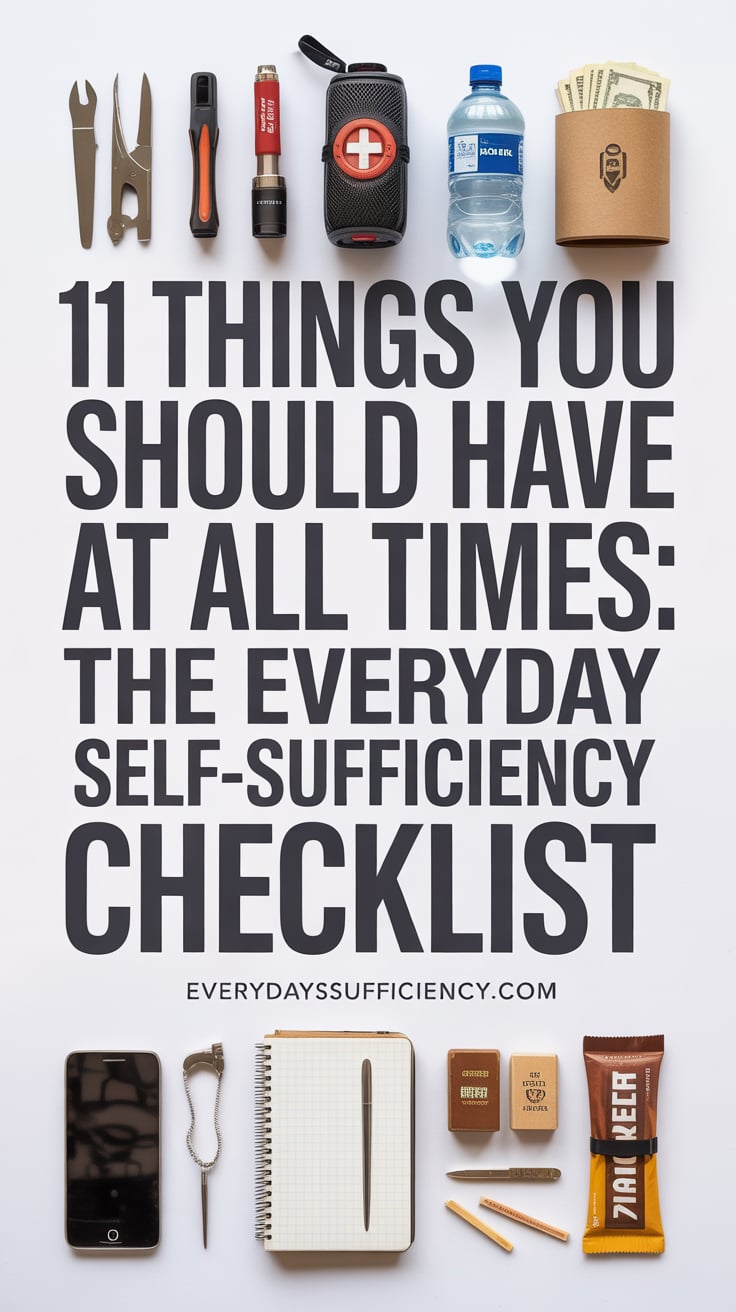
When life is smooth, it’s easy to forget how quickly small disruptions snowball. A dead phone, a lost wallet, a power outage, or a sudden detour can turn into real stress if you don’t have the right essentials on you. This is where the 11 Things You Should Have At All Times becomes more than a list—it’s an everyday carry strategy for peace of mind, safety, and self-reliance. Whether you’re commuting, traveling, hiking, or just running errands, these 11 Things You Should Have At All Times will cover hydration, first aid, power, light, shelter, hygiene, documentation, nutrition, and skills so you’re never caught off guard.
Check the best compact, off-grid water solution to pair with your EDC hydration plan: New Water Offer: SmartWaterBox
If you’re looking to rank your readiness, think of the 11 Things You Should Have At All Times like a layered toolkit. Start small with items that fit your pockets or a mini pouch, then scale to a daypack for commuting. The goal is to maintain self-sufficiency and continuity—hydration, health, communication, and comfort—no matter where you are. And yes, these essentials map to everyday carry (EDC) principles, emergency preparedness, and survival common sense while staying minimalist enough to carry daily.
- Quick overview of the 11 Things You Should Have At All Times:
- Water access + compact filter
- Pocket first aid + meds
- Cutting tool + multi-tool
- Light + fire
- Power bank + cables
- ID, emergency cash, and document backups
- Emergency shelter and warmth
- Communication backup
- Hygiene + PPE
- Compact calories
- Skills + mindset
Let’s walk through each item in depth, with practical loadouts, pro tips, and upgrade options so the 11 Things You Should Have At All Times truly work every day, not just “in case.”
Table of Contents
Clean Water Access and a Compact Filter
Of all the 11 Things You Should Have At All Times, water access is the most time sensitive. Dehydration hits fast—energy dips, headache, poor decision-making—all of which make routine problems feel bigger. So your water plan has two layers: carry and convert.
- Carry: A slim, reusable bottle (16–25 oz) or a collapsible soft flask packs easily and refills anywhere. Stainless steel is tough and can handle temperature extremes; BPA-free collapsibles weigh almost nothing.
- Convert: A compact filter or purifier lets you safely drink from fountains, office sinks, or questionable taps when traveling. Pocket-sized straw or squeeze filters are affordable and effective for daily preparedness.
Hydration tips to make the 11 Things You Should Have At All Times actually stick:
- Keep your bottle visible, not buried in a bag.
- Set a refill routine—arriving at work, after lunch, before your commute.
- For taste and odor, add a minimal activated-carbon element or purification tablets in your kit.
Scaling water for home and vehicle:
- Store a case of water in your trunk for unexpected delays.
- At home, maintain at least 1 gallon per person per day for 3–7 days.
If you’re building a comprehensive water plan beyond your pocket setup, see this guide on storage and purification fundamentals: water storage best practices and strategies
Water-friendly EDC choices for the 11 Things You Should Have At All Times:
- Collapsible 1L flask that tucks flat
- Ultralight straw filter with a protective cap
- A mini pouch holding purification tablets
- A small microfiber towel so your bag doesn’t get soggy after refilling
When you routinely bring your bottle, your hydration improves automatically. When you pair it with a small filter, your confidence skyrockets—you can handle park taps, gyms, airports, and trailheads. Among the 11 Things You Should Have At All Times, this one pays you back daily with better energy and fewer headaches.
Upgrade options if you want stronger off-grid capability:
- An in-home gravity-fed purification system is a game-changer during boil notices or power outages.
- A compact countertop unit that stores easily and purifies quickly adds resilience for families or roommates.
Water is the first of the 11 Things You Should Have At All Times because no other item stabilizes you as quickly. Make it effortless. Make it automatic. And make it safe.
Pocket First Aid and Personal Medications
Right after water, medical readiness is top-tier among the 11 Things You Should Have At All Times. Most real-world first aid isn’t dramatic—it’s cuts, blisters, headaches, allergies, or stomach upsets that derail your day. A pocket kit handles 90% of issues with minimal space and maximum usefulness.
Pocket first-aid EDC for the 11 Things You Should Have At All Times:
- Adhesive bandages (variety pack)
- Mini roll of medical tape
- Alcohol prep pads and antiseptic wipes
- Moleskin or hydrocolloid blister pads
- A pair of nitrile gloves (flat-packed)
- A few doses of OTC meds (pain relief, antihistamines, anti-diarrheals)
- Personal prescriptions (clearly labeled)
- Small packet of antibiotic ointment
Why this matters for the 11 Things You Should Have At All Times:
- Stops small injuries from becoming major distractions
- Lets you keep moving without detours to stores or clinics
- Supports companions and coworkers, not just yourself
Carry method:
- A slim zip pouch, tin, or wallet-style sleeve tucks into any bag.
- Replace what you use immediately and review expiration dates monthly.
Pro tips that elevate your kit:
- Add a couple of sterile gauze pads and a mini trauma pad; they weigh little but handle larger scrapes.
- Include a triangular bandage; it’s shockingly versatile for slings, wraps, and pressure.
- Keep a few oral rehydration salts packets—huge help on hot days or after stomach issues.
Skill matters as much as gear. Take one hour to review basic wound cleaning, bandaging, and recognizing when to seek care. For quick wins, bookmark a simple skills page and practice at home: basic first-aid skills and essentials
One of the smartest ways to strengthen the 11 Things You Should Have At All Times is to add authoritative at-home medical guidance so you can make better decisions when clinics are closed or lines are long. A trusted guide can help you manage non-urgent issues and know when to escalate, making your kit more effective in real life.
Pocket medical readiness is not about building a field hospital—it’s about smoothing out the bumps that interrupt everyday life. With this in place, two of your 11 Things You Should Have At All Times—water and first aid—are ready to work for you, every day, in every season.
A Cutting Tool and a Compact Multi-Tool
A reliable cutting tool plus a multi-tool is the action engine of the 11 Things You Should Have At All Times. From opening boxes and trimming loose threads to emergency seatbelt cutting or quick repairs, this pairing saves time and enables solutions.
Smart options for the 11 Things You Should Have At All Times:
- Folding knife with a 2.5–3” blade for daily utility, chosen with local laws in mind
- Or a compact utility knife with replaceable blades for workplaces that prefer non-locking tools
- Keychain multi-tool with screwdriver bits, bottle opener, small pry, and mini scissors
- Bonus: a dedicated seatbelt cutter/window breaker in the car for vehicle emergencies
How this helps:
- Faster, cleaner, safer than improvising with keys or pens
- Prevents tool abuse that leads to injury or breakage
- Supports repairs so you don’t discard gear prematurely
Carry technique for the 11 Things You Should Have At All Times:
- Clip the folding knife inside your pocket for quick access
- Keep the multi-tool in a belt pouch or front organizer panel in your daypack
- Maintain a tiny backup cutter on your keys if venues restrict larger tools
Maintenance:
- Touch up blade edges monthly with a pocket sharpener
- Wipe tools after exposure to moisture; a drop of oil prevents rust
- Practice one-handed opening and safe closing procedures
Legal awareness:
- Check local laws, workplace policies, and travel restrictions
- Have a “soft” kit for travel days—scissors in checked bags and a plastic-letter-opener-style cutter if needed
A knife and multi-tool unlock dozens of small wins per week, which is why they’re foundational to the 11 Things You Should Have At All Times. They reduce friction, speed up fixes, and extend the life of your stuff—core self-sufficiency in action.
Reliable Light and Simple Fire Starting
When the lights go out, everything slows down—unless you own the moment with light. Illumination is crucial among the 11 Things You Should Have At All Times because vision equals safety. Pair a pocket flashlight with a micro fire kit for layered capability.
EDC light setup for the 11 Things You Should Have At All Times:
- Compact LED flashlight (single AA/AAA or rechargeable 16340/18350)
- Modes: moonlight/low for map reading, medium for walking, high for searching
- Clip that reverses for pocket or hat brim use
- Red mode is a bonus for preserving night vision
Micro fire kit:
- Mini Bic lighter wrapped with a loop of duct tape
- Ferro rod striker as backup (sparks even when wet)
- Tinder tabs or cotton balls with petroleum jelly in a zip bag
How it pays off:
- Navigating dark stairwells and parking garages safely
- Signaling in emergencies with strobe or repeated flashes
- Starting a warming or cooking fire during outdoor detours or outages
Mid-content upgrade for grid-down resilience:
Add a structured skills guide that strengthens your urban readiness so your light-and-fire layer isn’t isolated knowledge. Consider complementing the 11 Things You Should Have At All Times with training that focuses on blackouts, civil disruptions, and movement in built environments: New Survival Offer: URBAN Survival Code
Light discipline and battery strategy:
- Standardize on a battery type to simplify spares
- Keep a small cable for rechargeable lights in your power kit
- Store lighters out of direct sun and heat
Your light-fire combo makes dawn, dusk, and night manageable while offering true emergency capability. In the framework of the 11 Things You Should Have At All Times, it’s a morale booster and a safety multiplier.
Power Bank, Cables, and a Small Radio (Plus Product Recommendations)
In a connected world, communications are lifelines. A compact power bank with the right charging cables ensures your phone, flashlight, and earbuds keep working. This is a mission-critical layer of the 11 Things You Should Have At All Times because a dead phone equals lost navigation, no ride sharing, and no quick calls.
Core power setup for the 11 Things You Should Have At All Times:
- 10,000–20,000 mAh power bank (PD-capable if possible)
- Short braided cables: USB-C, Lightning, and a USB-C-to-C
- Wall plug with dual-port and foldable prongs
- Slim solar panel only if you truly spend time outdoors; otherwise, it’s bulk for little daily gain
- Add a compact AM/FM/NOAA radio in your home/vehicle kit to stay informed during outages
Use and care:
- Top up your bank whenever you see it dip under 50%
- Keep one cable coiled around the bank with a tiny hook-and-loop strap
- Label cables so housemates don’t “borrow” them permanently
Power is the connector that keeps the other 11 Things You Should Have At All Times active—maps, medicine reminders, contacts, and notes.
Recommended gear and resources to deepen resilience:
- Off-grid water backup for apartment or home: New Water Offer: SmartWaterBox
- Family-ready gravity filtration for outages: Water Freedom System
- Build durable pantry strategies and no-cook meals: The Lost SuperFoods
- Practical home medical guidance for when clinics are far or closed: Home Doctor
- Urban tactics and safety skills for blackouts and disruptions: New Survival Offer: URBAN Survival Code
This product recommendation section aligns tightly with the 11 Things You Should Have At All Times by strengthening the bigger systems behind your EDC—water, power, food, and medical. Drop one or two into your plan; they’ll serve for years while your small daily kit handles the immediate stuff.
ID, Emergency Cash, and Document Backups
Documents and finances are the administrative backbone of the 11 Things You Should Have At All Times. When cards fail, networks glitch, or you lose a wallet, having secondary ways to identify yourself and pay is priceless.
What to carry:
- Primary photo ID and one backup ID if possible
- Two payment cards on different networks
- Emergency cash: a few small bills ($1s, $5s, $10s), hidden separately from your wallet
- A backup transit card or stored-value card for local transport
- Key contact list on paper: one pocket-sized card with essential numbers
Backups beyond your person:
- Encrypted digital copies of ID, insurance, and key documents stored in a secure cloud folder
- Paper copies in a sealed envelope in your home go-bag
- A spare house key cached with someone you trust
Why this belongs in the 11 Things You Should Have At All Times:
- Rapid proof-of-identity speeds up help and access
- Small bills handle cash-only moments and tipping
- Redundancy prevents one lost card from stranding you
Minimalist carry tactics:
- Use a slim wallet and a separate money clip for your emergency stash
- Keep a decoy stash of small bills in a quick-access pocket if you live in a busy city
- Split your cards between wallet and phone case to avoid total loss in one mishap
To round this out at home, consider a simple emergency bin that pairs documents with supplies so evacuations and late-night trips are easy, not chaotic: build a home emergency kit system
Inside the 11 Things You Should Have At All Times, this layer quietly solves problems before they start—travel snafus, payment failures, and proof-of-identity hurdles. It’s small, smart, and stress-proof.
Emergency Shelter and Warmth
You don’t always control temperature or weather. That’s why compact shelter is a sleeper hit among the 11 Things You Should Have At All Times. Even in cities, unexpected waits, transit delays, and unheated buildings happen. The right micro-gear keeps you warm, dry, and functional.
EDC shelter components:
- Ultralight emergency blanket or bivy (reflective)
- Packable rain shell or poncho
- Buff/neck gaiter and thin liner gloves
- Hand warmers in winter; a compact sun hat in summer
Use cases:
- Staying warm when rides are late or offices are cold
- Providing shade and cooling during heat waves
- Creating a dry spot to sit during outdoor delays
- Assisting someone else in distress without giving up your primary jacket
How to carry it without bulk:
- A reflective bivy packs to the size of a deck of cards
- A 2–3 oz nylon shell compresses small and lives in the bottom of your bag
- Keep seasonals rotated: swap hand warmers for sunscreen and lip balm as weather changes
Shelter joins the 11 Things You Should Have At All Times as a comfort and safety multiplier. Comfort keeps you thinking clearly; clear thinking prevents bad choices. It’s that simple.
Pro tip:
- Toss a few yards of duct tape and 10–20 feet of micro cord in your kit. Combined with a poncho, you can improvise a windbreak, secure a flap, or rig shade.
You’ll use this gear more often than you think. When others shiver, you’ll quietly solve the problem. That’s everyday self-sufficiency in a nutshell—and a major reason shelter belongs on the list of 11 Things You Should Have At All Times.
Hygiene and PPE
Hygiene and basic PPE are practical, not paranoid. They protect you from minor infections, seasonal bugs, and messy environments. That’s why this category deserves a slot in the 11 Things You Should Have At All Times.
Compact hygiene kit:
- Travel-size hand sanitizer
- A small pack of disinfecting wipes
- Folded tissues
- Lip balm and travel-size sunscreen
- Travel toothbrush and mini toothpaste (often overlooked but incredibly useful)
PPE basics:
- Two disposable masks or one reusable mask
- A small pair of nitrile gloves (doubles with first aid)
- Mini trash bags or dog-waste bags for containment
Real-world wins:
- Clean hands before eating on the go
- Wipe down questionable seating or tables
- Deal with spills without turning your backpack into a mess
- Mitigate exposure in crowded transit during cold/flu surges
Packing strategy for the 11 Things You Should Have At All Times:
- Use a flat zip pouch to prevent leaks from spreading
- Refill or swap items during your weekly reset
- Add a small bar of soap or solid soap sheets if you travel frequently
Hygiene intersects every other layer in the 11 Things You Should Have At All Times—first aid, food, and morale. Feeling clean and protected helps you keep moving, which is what daily preparedness is all about.
Compact Calories and Hydration Boosters
Food is the comfort gear of the 11 Things You Should Have At All Times. You’re not feeding a camping trip; you’re bridging a few missed meals, long meetings, or a transit stall. Aim for compact, durable calories that won’t melt, crumble, or spoil in your bag.
Smart food EDC:
- Two to three 200–300 calorie bars (mix protein and carbs)
- A small bag of nuts or trail mix
- Electrolyte tablets or packets for hot days and workouts
- If you prefer savory, mini jerky sticks or tuna packets
Criteria:
- Long shelf life at room temperature
- Easy to eat discreetly
- Won’t generate messy trash in your bag
- Meets your dietary needs and avoids allergens
Rotation habit:
- Eat what you carry; carry what you eat
- Replace monthly or at the start of each season
- Avoid chocolate-coated items if your climate runs hot
For home and vehicle backups, it’s smart to build a simple pantry that can feed you without power or cooking. If you want ideas beyond energy bars and want historical, shelf-stable strategies that really work, consider this resource that complements the 11 Things You Should Have At All Times: The Lost SuperFoods
Water pairs with food, which circles back to the first of your 11 Things You Should Have At All Times. Keep an electrolyte sachet or two with your bottle; when you’re tired or overheated, they’re a fast recovery tool.
Finally, stash a compact spork and a single wet wipe—two tiny items that make quick meals cleaner and easier anywhere.
Conclusion: Skills, Mindset, and Your Weekly 10-Minute Reset
Gear only works if you carry it and know it. The unsung hero of the 11 Things You Should Have At All Times is your skill set and mindset—awareness, basic first aid, navigation, and calm problem-solving. Build tiny habits around your kit and it will quietly make your days smoother.
Weekly 10-minute reset for the 11 Things You Should Have At All Times:
- Charge power bank and flashlight
- Refill water and check filter/tabs
- Replenish first aid items used
- Confirm cash and travel cards are present
- Swap seasonal shelter items
- Rotate snacks and electrolytes
- Quick wipe-down of your bag and pouches
Environment-aware tweaks:
- Commuters: Add transit card backups and a small umbrella
- Parents: Include kid-dose meds and an extra snack
- Pet owners: Include a foldable bowl and an extra waste bag
- Travelers: Use a “soft” tool kit compliant with security rules
Strong final to lock in your resilience:
- Build a real water backbone at home with the compact, practical New Water Offer: SmartWaterBox
- Add a family-scale gravity purifier for outages: Water Freedom System
- Strengthen pantry resilience the smart way: The Lost SuperFoods
- Put doctor-approved knowledge on your shelf: Home Doctor
- Level up your city-readiness: New Survival Offer: URBAN Survival Code
Practice once, carry always. The 11 Things You Should Have At All Times is not about fear—it’s about freedom. With water, first aid, tools, light, power, documents, shelter, hygiene, food, and skills, you’re equipped to turn disruptions back into ordinary days.
FAQ
u003cpu003eWhat are 10 things everyone needs?u003cbru003eu003c/pu003e
u003cpu003eEveryone needs the core of the 11 Things You Should Have At All Times: water access and a compact filter; a pocket first aid kit; a cutting tool and multi-tool; a flashlight and simple fire starter; a power bank with cables; ID and emergency cash; a packable rain shell or emergency blanket; a basic communication backup like a small radio at home; hygiene and PPE items; and compact calories like bars and electrolytes. These map to everyday carry, not just emergencies, and they form a practical baseline of self-sufficiency.u003c/pu003e
u003cpu003eWhat 10 things can I do now to have a better life?u003c/pu003e
Assemble the 11 Things You Should Have At All Times, starting with water and first aid. 2) Create a weekly 10-minute gear reset. 3) Standardize your charging cables and label them. 4) Take a basic first aid refresher. 5) Set calendar reminders to rotate snacks and meds. 6) Cache small bills in at least two places. 7) Keep a spare key and contact list off your phone. 8) Add a packable shell to your bag. 9) Practice using your flashlight, knife, and filter. 10) Build a simple home water and pantry plan so your EDC ties into a larger resilience system.
u003cpu003eWhat is the most important thing to do at all times?u003cbru003eu003c/pu003e
u003cpu003eStay hydrated and stay aware. Hydration stabilizes mood, energy, and decision-making, which is why water sits at the top of the 11 Things You Should Have At All Times. Awareness—of exits, weather, transit changes, and your surroundings—turns tools into results. Pair those with a charged phone and you’re solving problems before they grow.u003c/pu003e
u003cpu003eWhat are the essential items list?u003cbru003eu003c/pu003e
u003cpu003eThe essential items list here is the full set of the 11 Things You Should Have At All Times: 1) water bottle and compact filter, 2) pocket first aid and meds, 3) cutting tool and multi-tool, 4) flashlight and mini fire kit, 5) power bank with multi-cables, 6) ID, emergency cash, and document backups, 7) emergency blanket or packable shell, 8) backup communication like a small radio at home, 9) hygiene and PPE kit, 10) compact calories and electrolytes, and 11) skills and mindset with a weekly reset routine.u003c/pu003e