
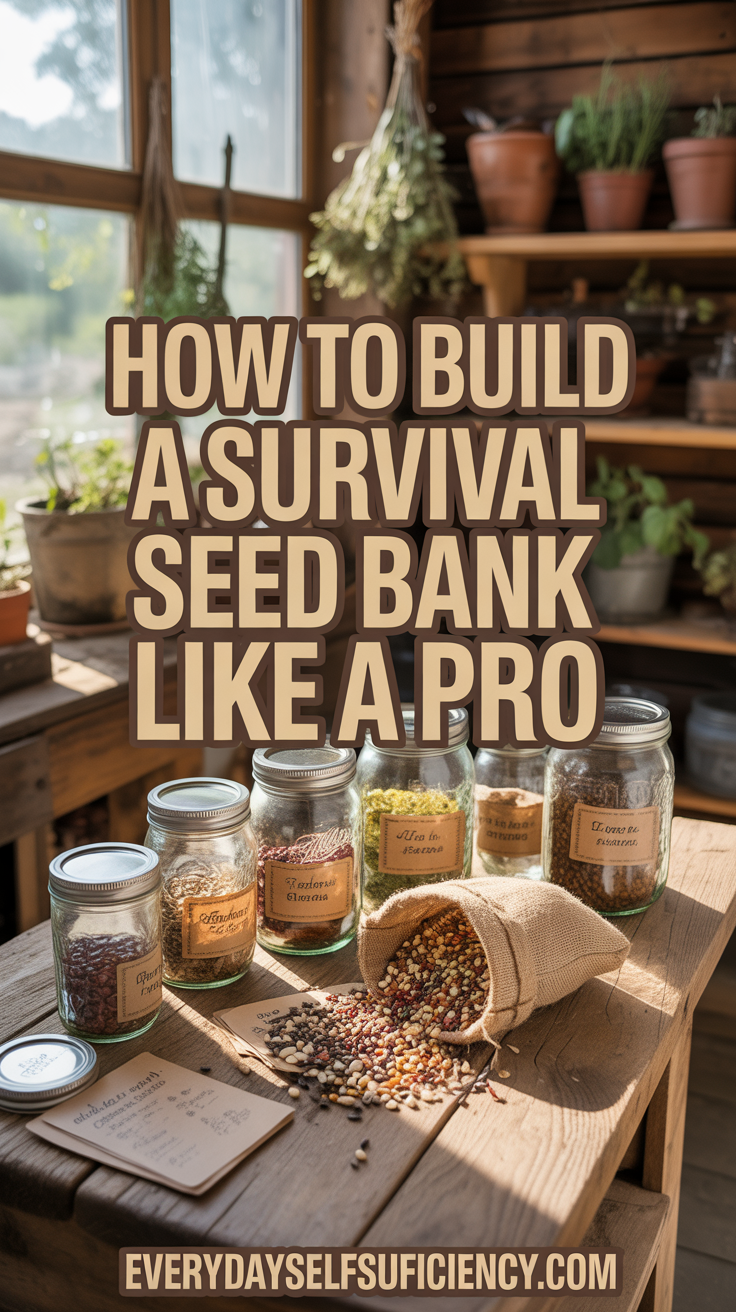
A resilient food system starts with seeds. If you want true self-reliance, learning how to build a survival seed bank is one of the smartest, highest-leverage prepper moves you can make. In this blueprint, you’ll learn exactly how to build a survival seed bank from scratch: what seeds to choose (and which to avoid), how to package them for decades-long viability, how to keep meticulous records, how to save seeds from your own garden, and how to protect and multiply your seed assets in any scenario.
The Lost SuperFoods is an excellent companion to this guide, offering historical, field-tested ways to turn your seed harvests into long-lasting, nutrient-dense food—perfect for anyone mapping out how to build a survival seed bank that feeds a family for years.
You’ll also get a seasonal action plan, a budget vs. premium build, and a product recommendations section to round out your preparedness system. By the end, you’ll not only understand how to build a survival seed bank—you’ll have a repeatable, documented process you can trust in an emergency.
Table of Contents
Survival Seed Bank Foundations: What It Is, Why It Matters, and Core Principles
Knowing how to build a survival seed bank means understanding what a seed bank truly is: a curated, long-term stash of open-pollinated, heirloom seeds that can be saved and replanted year after year to produce true-to-type crops. Unlike hybrid seeds, which often don’t breed true, heirloom and open-pollinated seeds preserve predictable traits, enabling you to produce reliable food from one generation of seed to the next—vital for long-term resilience.
Core principles when you’re mapping how to build a survival seed bank:
- Choose open-pollinated/heirloom seeds for self-sufficiency and seed saving.
- Prioritize calorie crops (potatoes, corn, beans, squash), staple greens (kale, collards), and nutrient-dense foods (tomatoes, peppers).
- Plan for your climate and USDA Hardiness Zone to ensure consistent yields.
- Protect seed viability by controlling temperature, moisture, and oxygen.
- Document everything: lot numbers, purchase dates, germination tests, and grow-out notes.
Your survival seed bank is not just a bucket of packets. If you want true mastery of how to build a survival seed bank, treat it like a living portfolio. You’ll rotate stock with grow-outs, expand varieties over time, and create redundancy (duplicates stored off-site). You’ll also align your seed bank with water, soil fertility, and food preservation plans so it’s not just possible to grow food—it’s inevitable.
Helpful internal resource navigation: Everyday Self-Sufficiency.
Choosing Seeds: Heirloom vs. Hybrid, Variety Criteria, and Must-Have Crops
To truly master how to build a survival seed bank, start with selection criteria. Every variety in your kit should earn its place with high yields, storability, disease resistance, and culinary versatility. The backbone is open-pollinated. Hybrids can be useful for short-term yields but they complicate seed saving; keep them separate and labeled if you include any.
Selection criteria to guide how to build a survival seed bank:
- Open-pollinated/heirloom, non-GMO.
- Short-to-medium maturity for your frost window.
- Disease resistance (especially against blights, mildews, rusts).
- Cultural adaptability: drought/heat tolerance or cold hardiness as needed.
- Storability: both for the seed and the harvested crop (winter squash, dry beans, dent/flint corn).
- Pollination category: selfers (beans, peas, tomatoes) vs. outcrossers (corn, squash), which determine isolation needs.
Must-have categories for how to build a survival seed bank:
- Calorie staples: dent/flint corn, dry beans, cowpeas, winter squash, potatoes (via tubers, but bank true seed if skilled), sunflowers.
- Everyday greens & brassicas: kale, collards, mustards, cabbage, broccoli (note: some brassicas are biennial seed producers).
- Root crops: beets, carrots, turnips, parsnips (biennial seeds, plan for overwintering).
- Alliums: onions, leeks (longer cycles, plan for bolting year).
- Nightshades: tomatoes (self-pollinating, easy to save), peppers (can cross, isolate or cage).
- Herbs & pollinator support: basil, dill, cilantro, calendula, echinacea; they help both flavor and ecosystem resilience.
Localize your list. The most important step in how to build a survival seed bank is choosing varieties that already prove themselves in your microclimate. Check local seed libraries or swaps for regionally adapted strains.
Pro tip: Include “bridge” crops for seed insurance—fast-maturing radishes, lettuces, and mustards that can produce seed relatively quickly, so you always have a fallback seed source while longer-season crops mature.
Sourcing Seeds: Where to Buy, How to Vet Suppliers, and Avoiding Pitfalls
Smart sourcing is central to how to build a survival seed bank that lasts. Buy from reputable seed houses with a focus on open-pollinated and heirloom stock, ideally those that publish germination rates and conduct region-specific trials. If possible, buy during off-peak times (late summer/fall) to avoid sell-outs.
Checklist for sourcing as you plan how to build a survival seed bank:
- Look for open-pollinated/heirloom labels, non-GMO commitments.
- Verify published germination rate and test dates on packets.
- Prefer untreated seed (unless you’re intentionally buying treated field seed for specific reasons).
- Purchase “bulk” packets for staples to reduce cost per seed and simplify long-term storage.
- Diversify suppliers to avoid single-point failure and genetic bottlenecks.
- Keep invoices and batch numbers—document everything.
Common pitfalls:
- Panic-buying random “survival seed cans” with poor variety relevance to your climate.
- Overemphasis on exotic crops with low calories or poor storage traits.
- Ignoring pollination biology (e.g., storing many Cucurbita pepo squash types together, which can cross if grown simultaneously, complicating future seed saving).
Sourcing tip: To master how to build a survival seed bank, add local landraces when you can—varieties that have adapted to your area’s stresses will outperform catalog darlings in tough years. Swap with local growers and keep meticulous notes on performance.
Storage Science: Temperature, Moisture, Oxygen, and Packaging That Preserves Viability
Seed longevity is governed by a simple rule: cool, dark, dry, and stable. The “Rule of Halves” says that for every 10°F drop in temperature (or every 1% drop in seed moisture), seed life roughly doubles. To truly nail how to build a survival seed bank, control all three: temperature, humidity, and oxygen.
Packaging hierarchy for how to build a survival seed bank:
- Primary: paper envelopes (for short-term organization and breathability during drying).
- Secondary: airtight mylar bags or glass jars with gasketed lids for long-term storage.
- Desiccants: silica gel packets to capture residual moisture; condition seeds to ~8% moisture before sealing.
- Oxygen absorbers: optional; useful to deter pests and slow oxidation for some species. Do not crush delicate seeds; avoid extreme vacuums.
Storage environment:
- Best: dedicated refrigerator (34–41°F) with stable humidity; or freezer at 0°F once seeds are dried and sealed correctly.
- Good: cool basement or interior closet away from heat swings and sunlight.
- Avoid: garages/attics with temperature extremes.
Labeling and dates are essential to how to build a survival seed bank. Include variety, lot, source, harvest/purchase date, and last germination test date. Keep a master index spreadsheet mirrored on paper.
Viability timeframes (very general):
- Long keepers: brassicas, tomatoes, cucurbits (4–8+ years with good storage).
- Moderate: beans/peas, carrots, beets/chard, lettuce (2–5+ years).
- Shorter: onions, parsnips, sweet corn (1–3 years; freeze for best longevity).
Add a low-tech redundancy: store duplicates off-site with a trusted friend or family member. If you’re serious about how to build a survival seed bank, create at least a 2-location scheme, ideally different climate risks (e.g., one on-site, one with a relative).
Organization, Cataloging, and Rotation: Turning a Pile of Packets into a Seed System
Disorganization kills viability and wastes seasons. The real secret to how to build a survival seed bank is systemization. Treat your seed bank like inventory: index it, rotate it, and test it on a schedule.
Core tools:
- Seed ledger (spreadsheet + printed binder): variety, species, supplier, lot, purchase/harvest date, germination % by year, storage location (bin, jar, bag ID), notes on performance.
- Color codes or bins by family: Solanaceae, Brassicaceae, Fabaceae, Cucurbitaceae, etc.
- Calendar prompts for germination tests 8–10 weeks before your sowing windows.
Rotation routine for how to build a survival seed bank:
- Every winter: conduct germination tests (10–50 seed samples on moist paper towels or in soil blocks). Record % germination in 3–10 days depending on crop.
- If germination falls below threshold (e.g., beans under 80%, carrots under 60%), plan a “seed increase” grow-out that season.
- Always back up: when you use a packet to plant, split and keep a sealed reserve portion in long-term storage.
Emergency “reconstitution” kit:
- If you need to restart after a failure, maintain a minimal, redundant set of fast, calorie-dense, easy-to-save varieties (e.g., Cherokee White Eagle corn, Provider bush beans, Waltham butternut, Lacinato kale, Black Krim tomatoes).
Organizing your process is what keeps how to build a survival seed bank actionable year after year. For more preparedness topics to integrate with your seed workflow, consult the site index.
Growing for Seed: Isolation, Population Size, and Clean Saving Techniques
Saving your own seed is the engine that powers how to build a survival seed bank that regenerates. Two knowledge pillars matter most: pollination biology and clean processing.
Pollination basics:
- Self-pollinators (easier): beans, peas, tomatoes (mostly selfers), lettuces. Minimal isolation needed; 10–20 feet often works.
- Insect/wind outcrossers (need more space): corn (isolate by distance/time), squash/pumpkins, cucumbers, brassicas, carrots, beets/chard, onions. Isolation distances range from hundreds of feet to half a mile+, or use time isolation (stagger bloom) and physical barriers (row covers, caging, hand pollination).
Population size:
- To prevent inbreeding depression and maintain vigor in outcrossers, grow adequate population sizes (e.g., corn 100+ plants for strong genetics; squash 6–12 plants; carrots/onions 20–50 plants where possible).
Clean saving methods:
- Dry seed processing: beans, peas, lettuce, brassicas—dry pods, thresh gently, screen or winnow.
- Wet seed fermentation: tomatoes and some cucurbits—ferment 2–3 days to remove gel and inhibit disease, then rinse and dry thoroughly.
- Drying targets: seeds should snap, not bend; reach low moisture before sealing.
- Label in the field: use weatherproof tags to avoid “mystery” jars.
Record varietal traits and select seed from the healthiest, earliest, and most productive plants. Selection is how to build a survival seed bank that gets better every year.
Water Planning for Seed Security: Irrigation, Drought-Proofing, and Storage
Seeds are only as useful as your water plan. Building resilient irrigation is part of how to build a survival seed bank that actually feeds you during disruptions. Pair rain capture with efficient delivery and drought-tolerant practices.
Key moves:
- Harvest rain: roof catchment into food-safe barrels; first-flush diverters reduce contaminants.
- Store smart: opaque containers, screened inlets, high/low spigots, mosquito-proofing.
- Deliver efficiently: drip lines or olla pots reduce evaporation and keep foliage dry (less disease).
- Mulch deeply (straw, leaves, wood chips) to conserve moisture and moderate soil temperature.
- Prioritize drought-tolerant varieties and root-deepening schedules (fewer, deeper waterings).
Mid-content resource: A compact on-site water backup greatly stabilizes your plan for how to build a survival seed bank. Consider SmartWaterBox for modular water storage and Water Freedom System to diversify household water resilience.
Seed storage humidity also matters. Use silica gel, airtight containers, and keep your seed bank away from irrigation areas to avoid accidental moisture spikes. Water helps plants—humidity kills viability. Make water abundant in the garden and scarce in the seed room.
Protection, Redundancy, and Risk Management: Make Your Seed Bank Hard to Lose
Redundancy is non-negotiable if you’re serious about how to build a survival seed bank. Fire, flood, pests, or a simple mistake can wipe out a single-location store.
Layered protection:
- Two to three geographic locations: one on-site, one with a trusted friend/relative, and (if possible) one in a safety deposit or secure cool locker.
- Pest-proof containers: gasketed steel tins inside totes; consider mylar inside jars for double barriers.
- Waterproofing: mylar, sealed pelican-style cases for off-site caches.
- Inventory sync: a monthly or quarterly check-in to align all duplicates and record changes in the ledger.
- Light discipline: store in total darkness; use opaque bins.
Power outage and temperature risk:
- Use phase-change packs or insulated coolers for short-term protection if freezers fail.
- Avoid frequent freezer door openings; temperature stability is crucial.
Operational security:
- Limit who knows the exact location of your seed bank. Your ability to grow food is a strategic asset. As you refine how to build a survival seed bank, pair discretion with documentation (keep copies of your index hidden and off-site).
Health and safety: A robust home medical guide complements food resilience. Home Doctor is a practical reference to keep alongside your survival library.
Budget Build vs. Premium Build: Bill of Materials, Costs, and Upgrades
You can start small and still do this right. Here’s how to build a survival seed bank on different budgets.
Budget build (starter):
- 12–18 essential heirloom varieties (bulk packets for beans, corn, squash, kale, tomatoes, peppers, lettuce, radish, beets).
- Paper coin envelopes + permanent markers.
- Quart mason jars with gasket lids or repurposed glass jars.
- Silica gel desiccant packs.
- Airtight tote for dark storage in a cool closet.
- Notebook or simple spreadsheet.
- Optional: second tote for off-site duplicate.
Cost: modest; you can assemble for the price of two grocery trips. This gets you practicing how to build a survival seed bank immediately.
Premium build (long-term):
- 30–50+ regionally adapted varieties with biodiversity for resilience.
- Mylar bags (5–7 mil) with oxygen absorbers; vacuum sealer with jar attachments.
- Dedicated dorm fridge or chest freezer for stable temps.
- Stainless seed screens, sieves, and winnowing tools.
- Label printer and weatherproof tags.
- Hygrometers and data loggers to track temp/humidity.
- Fire/waterproof case for off-site cache.
Cost: higher, but you gain decades of shelf life and professional organization.
Upgrade path:
- Start with the budget build while you learn how to build a survival seed bank through a full grow season.
- Add a fridge/freezer and better packaging once you confirm your variety list.
- Invest in field isolation tools (row covers, pollination cages) as you expand seed saving of outcrossers.
Recommended Tools and Guides to Pair With Your Seed Bank
A few well-chosen resources can dramatically accelerate your success as you learn how to build a survival seed bank and turn seeds into year-round food security.
Product recommendations (contextual and field-tested):
- The Lost SuperFoods: Historical preservation methods and emergency staples to transform your seed harvest into shelf-stable nutrition. The Lost SuperFoods
- SmartWaterBox: Modular, stackable water storage that’s easy to stage near your garden or pantry to drought-proof grow-outs. SmartWaterBox
- Aqua Tower: A robust water resilience solution to keep irrigation viable during disruptions, a practical partner to any seed plan. Water Freedom System
- URBAN Survival Code: For city dwellers building micro seed banks, balcony grows, and decentralized caches, this guide fills the urban gap. New Survival Offer: URBAN Survival Code
- Home Doctor: Medical how-to when clinics are far away; a smart companion to food self-reliance. Home Doctor
Use these to complement—not replace—your mastery of how to build a survival seed bank. Your core remains seed selection, storage discipline, and annual seed-saving practice.
12-Month Action Plan and Seasonal Calendar
Turn knowledge into a calendar you’ll actually follow. This is the operational backbone of how to build a survival seed bank that improves each year.
Winter (planning and testing):
- Audit your inventory; update the master index and cull expired or redundant packets.
- Conduct germination tests on sensitive crops (onions, parsnips, sweet corn) first; plan seed increases.
- Order replacements or new varieties you intend to trial. Begin stratification for perennials if needed.
- Package and relocate off-site duplicates.
Early spring (sowing and recordkeeping):
- Start transplants for tomatoes, peppers, brassicas according to your frost dates.
- Label flats meticulously; document sowing dates and expected maturity windows.
- Prep isolation strategies for outcrossers (staggered plantings, row covers).
Late spring to summer (grow-outs and selection):
- Select “mother” plants for seed, marking the healthiest and earliest. Remove off-types.
- Manage irrigation and mulch; prune and trellis to promote plant health.
- Bag blossoms for peppers or hand-pollinate squash if purity is critical.
Late summer to fall (harvest and processing):
- Harvest seed at correct maturity (dry pods for beans; fully ripe fruit for tomatoes/cucurbits).
- Process: dry or ferment, then dry thoroughly to storage moisture.
- Winnow and sieve; label and log germination assumptions for next year.
Fall to early winter (storage and review):
- Package seed into long-term containers with desiccant; seal and store in cool, dark, dry locations.
- Update the ledger’s “last tested” fields and schedule next tests.
- Conduct a lessons-learned review: what varieties excelled; what to expand or replace.
Repeat. Iteration is how to build a survival seed bank that evolves with your land and climate. For more preparedness categories to schedule alongside your seed tasks, see the site’s preparedness index.
Get Ready: Build and Deploy Your Seed Bank Now (CTA)
You’ve got the framework. The next step is action. Start with the essentials, document everything, and commit to one full season of seed saving. That’s how to build a survival seed bank that actually feeds you—year after year.
- Stabilize your water plan for consistent yields: SmartWaterBox and Water Freedom System
- Turn harvest into shelf-stable staples: The Lost SuperFoods
- Urban growers: structure a city-ready survival setup: URBAN Survival Code
Start today, and in one year you’ll have living proof that you know how to build a survival seed bank that works.
Conclusion: Your Seeds, Your Security, Your Seasonal Momentum
When you truly learn how to build a survival seed bank, you take control of your food system. This isn’t a one-time purchase—it’s a living cycle: select, store, sow, save, and scale. With clear criteria for varieties, disciplined storage protocols, rigorous organization, and seasonal action, you’ll turn packets into a resilient food engine.
Pair your seed bank with water security, simple preservation methods, and a few trusted guides. Protect it through redundancy and operational security. Record your lessons and refine yearly. That’s how to build a survival seed bank that stands up to supply shocks, weather swings, and the unexpected.
FAQ
u003cpu003eHow to create your own seed bank?u003cbru003eu003c/pu003e
u003cpu003eCreating your own seed bank is a practical, stepwise system. First, decide what to grow based on calories, climate fit, and seed-saving ease (beans, tomatoes, squash, kale). Buy open-pollinated, heirloom, non-GMO seed from reputable suppliers. Dry-condition seeds to ~8% moisture, then package in airtight jars or mylar with desiccant. Store cool, dark, and dry—ideally a fridge or freezer. Maintain a ledger with purchase/harvest dates, germination tests, and storage locations. Each year, grow out select varieties to refresh viability and save new seed, keeping isolation distances in mind. Duplicate and store a second set off-site. Systemization like this is exactly how to build a survival seed bank that endures.u003c/pu003e
u003cpu003eHow to prepare a seed bank?u003cbru003eu003c/pu003e
u003cpu003ePreparation focuses on stabilization and documentation. Sort your varieties by family and storage needs, label every container with variety, lot, and dates, and seal them with desiccant in airtight packaging. Test germination on older stock and schedule seasonal grow-outs for “seed increase.” Secure climate control (a dedicated refrigerator/freezer), add pest- and water-proof outer containers, and catalog everything digitally and on paper. Creating a duplicate cache for off-site storage is core to how to build a survival seed bank that’s resilient to single-point failures.u003c/pu003e
u003cpu003eHow many seeds are in 1 kg?u003cbru003eu003c/pu003e
u003cpu003eIt depends on species and seed size. Use Thousand Seed Weight (TSW): Seeds per kilogram ≈ 1,000,000 mg / TSW (mg). Typical ranges:u003c/pu003eu003cbru003eWheat: ~20–25 seeds/gram → ~20,000–25,000 seeds/kgu003cbru003eCorn (maize): ~3–4 seeds/gram → ~3,000–4,000 seeds/kgu003cbru003eDry beans: ~2–4 seeds/gram → ~2,000–4,000 seeds/kgu003cbru003eRice: ~30–40 seeds/gram → ~30,000–40,000 seeds/kgu003cbru003eTomato: ~250–350 seeds/gram → ~250,000–350,000 seeds/kgu003cbru003eLettuce: ~800–1,200 seeds/gram → ~800,000–1,200,000 seeds/kgu003cbru003eFor your exact lot, check packet data or weigh 1,000 seeds and scale. Knowing counts helps you budget grow-outs as you plan how to build a survival seed bank.
u003cpu003eWhich seed is best for survival?u003cbru003eu003c/pu003e
u003cpu003eThere isn’t a single “best” seed; build a balanced portfolio. For calories and storage, dent/flint corn, dry beans, and winter squash are staples. For nutrient density, add kale, collards, tomatoes, and peppers. Include fast producers (radish, lettuce) for quick harvests and seed “insurance.” Choose open-pollinated varieties proven in your climate and suited to your soil and water plan. Diversity plus regional adaptation is the safest path—exactly how to build a survival seed bank that can feed you reliably over many seasons.u003c/pu003e