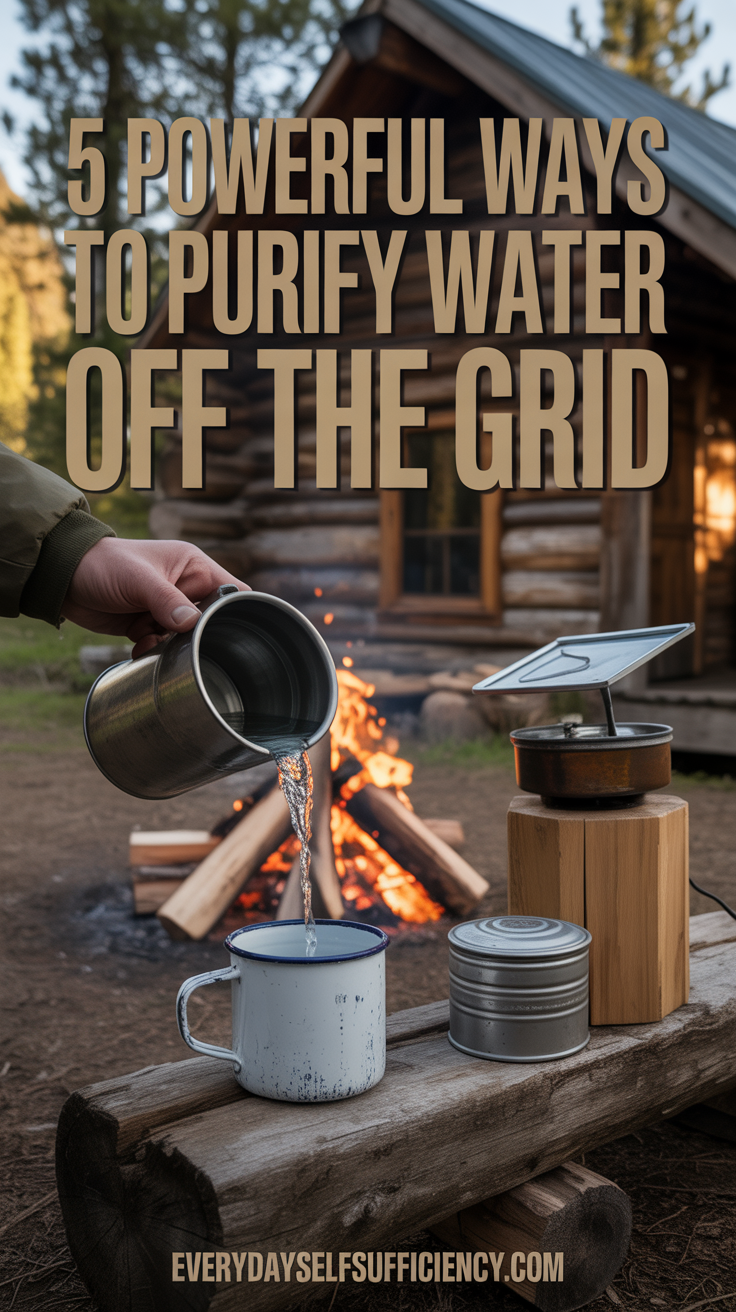
Clean drinking water is the backbone of self-reliance. When utilities fail, storms cut power, or you’re deep in the backcountry, knowing 5 ways to purify water off the grid (no power or plumbing needed) keeps you safe from bacteria, viruses, and parasites. In this complete field guide, you’ll learn how to choose water sources, pre-filter muddy water, and master five proven off-grid purification methods: boiling, gravity filtration, chemical disinfection, solar UV treatment, and distillation. You’ll also get step-by-step instructions, gear recommendations, and safety tips to prevent cross-contamination—so your water stays truly potable when you need it most.
Whether you’re homesteading, bugging in during a blackout, or hiking off-grid, this guide shows you exactly how to use 5 ways to purify water off the grid (no power or plumbing needed) safely and efficiently. We’ll compare effectiveness against pathogens, explain pore sizes and contact times, and share practical tricks like using a bandanna as a pre-filter or building a solar still from common cookware. If you want a printable reference and deeper off-grid skills, check our resource library at Everyday Self-Sufficiency.
Most water found in the wild—or even in urban systems during disasters—may contain pathogens such as E. coli, Giardia, and Cryptosporidium, along with chemical contaminants and sediment. The good news: with 5 ways to purify water off the grid (no power or plumbing needed), you can convert questionable water into safe drinking water using only heat, gravity, sunlight, or chemical reactions. The five methods featured here cover every scenario: quick field disinfection, high-volume homestead filtration, and long-haul purification when fuel is scarce.
What you’ll learn:
- How to assess and collect safer source water before treatment
- How to pre-filter and clarify turbid water
- The five best no-power purification methods and when to use each
- How to avoid post-treatment recontamination
- Storage, testing, and taste/odor improvement techniques
- Off-grid system setups that keep clean water flowing day after day
This isn’t theory. These are field-tested systems aligned with survival, emergency preparedness, homestead sustainability, and overland/travel realities. Let’s dive into the 5 ways to purify water off the grid (no power or plumbing needed)—and build your water security for the long run.
Table of Contents
Method #1 — Boiling (The Universal Baseline)
Boiling is the baseline of 5 ways to purify water off the grid (no power or plumbing needed). It’s reliable, simple, and requires only a container and heat source. Properly done, boiling inactivates bacteria, viruses, and protozoan cysts that cause waterborne disease.
How to boil correctly:
- Pre-filter first. If water is muddy or full of debris, pass it through a cloth, coffee filter, bandanna, or a folded t-shirt. Let suspended solids settle in a container and decant the clearer top water.
- Bring to a rolling boil. Don’t confuse tiny bubbles with a true rolling boil. You want large, consistent bubbles that can’t be stirred down.
- Maintain the boil. At sea level, boil for 1 minute; at altitudes above 6,500 feet (2,000 meters), boil for 3 minutes to account for the lower boiling point.
- Cool and store properly. Pour into a clean, covered container. Avoid dipping hands or dirty utensils in treated water.
Pros:
- Kills bacteria, viruses, protozoa (Giardia, Cryptosporidium)
- Works anywhere you can build a fire or use a stove
- No special chemicals or filters
Cons:
- Requires fuel and time
- Doesn’t remove chemicals, heavy metals, or sediment
- Can concentrate some contaminants if you boil off lots of water
Fuel ideas off-grid:
- Wood fired rocket stove, biomass, alcohol stove, or camp stove
- Solar cooker on clear sunny days
- Emergency gel fuel or Esbit tablets for short-term needs
Taste tips:
Boiled water can taste flat because dissolved oxygen drives off. To improve flavor, pour the cooled, boiled water back and forth between two clean containers to aerate. You can also add a pinch of salt per quart or pass it through activated carbon after boiling for taste and odor improvement.
Safety reminder:
Once boiled, don’t contaminate it again. Use a clean ladle or spigot, and keep storage containers sealed. This cross-contamination prevention applies to all 5 ways to purify water off the grid (no power or plumbing needed).
Method #2 — Gravity Filtration (Ceramic and Hollow Fiber)
Gravity filtration shines for daily use at a homestead or basecamp when you want continuous, no-power flow. It’s one of the most scalable of the 5 ways to purify water off the grid (no power or plumbing needed), letting gravity pull raw water through a filter element to remove pathogens and sediment.
Filter types:
- Ceramic filters: Typically 0.2–0.5 micron pores. Great at removing bacteria and protozoa; some are impregnated with silver to inhibit bacteria growth on the element. Cleanable by scrubbing.
- Hollow fiber membranes: Often 0.1–0.2 micron absolute. Excellent for protozoa and bacteria reduction with higher flow rates.
- Carbon stages: Activated carbon improves taste, odor, and reduces some chemicals (chlorine, volatile organic compounds). Pair with ceramic/hollow fiber for flavor and clarity.
Use case:
- Household/homestead daily drinking water
- Long-term emergency where you need liters per day reliably
- Any situation where you can collect water and let time/gravity do the work
How to set it up:
- Source water in a top “dirty” container (food-grade bucket with lid works).
- Install gravity cartridges or connect a gravity filter unit per instructions.
- Collect filtered water in a lower “clean” container with a dedicated spigot.
- Maintain. Wash hands before servicing, and scrub or backflush elements when flow slows.
Pathogen coverage:
Most gravity filters target bacteria and protozoa effectively. Many do not remove viruses unless they add a chemical or electro-adsorptive stage. If viruses are a risk (post-flood urban areas, certain tropical regions), pair your gravity system with a post-treatment step like chlorine dioxide.
Flow and capacity:
Expect 1–20 liters per hour depending on filter size, number of elements, and water turbidity. Pre-filtering heavily silty water with a cloth and allowing settling dramatically extends filter life.
Integration tip:
If your off-grid plan depends on gravity filtration as one of your 5 ways to purify water off the grid (no power or plumbing needed), stock extra elements and gaskets, plus a backup chemical method for viruses. Keep a spare activated carbon stage for taste and pesticide reduction.
Method #3 — Chemical Disinfection (Chlorine, Iodine, Chlorine Dioxide)
Chemical treatment is fast, lightweight, and ideal for mobile kits. It’s a key member of the 5 ways to purify water off the grid (no power or plumbing needed) because it works without heat, electricity, or bulky gear.
Common options:
- Household bleach (unscented 6–8.25% sodium hypochlorite): Add 2 drops per liter (8 drops per gallon) of clear water. Double the dose if water is cloudy. Stir, wait 30 minutes. You should smell a slight chlorine odor; if not, repeat the dose and wait another 15 minutes.
- Iodine: Tablets or tincture. Effective against bacteria and viruses, less so for Cryptosporidium. Follow product instructions for dosing and contact time. Not recommended for long-term daily use, pregnant people, or thyroid issues.
- Chlorine dioxide: Tablets or liquid kits. Very effective against bacteria, viruses, and more effective on Giardia/crypto than iodine. Contact times vary; cold/turbid water requires longer (often up to 4 hours for Cryptosporidium).
Best practices:
- Pre-filter turbid water to improve effectiveness.
- Obey contact times—temperature and turbidity matter.
- Keep chemicals fresh; liquids degrade faster than tablets.
- Neutralize taste if desired (some kits include a neutralizer).
Pros:
- Lightweight and portable
- Kills viruses as well as bacteria
- Minimal gear; great for bug-out bags, glove compartments, or travel kits
Cons:
- Taste and smell can be off-putting
- Not ideal for daily long-term use alone
- Does not remove particulates, heavy metals, or many chemicals
Stacking methods:
Combine chemical treatment with filtration for a multi-barrier approach. For example, run water through a 0.2 micron filter, then add chlorine dioxide tablets. This doubles down on pathogen removal and is particularly smart for uncertain sources. That layered strategy is central to making the 5 ways to purify water off the grid (no power or plumbing needed) more robust.
Method #4 — Solar UV Disinfection (SODIS) and Solar Still Basics
Sunlight is free—and ultraviolet radiation can disinfect water if applied correctly. SODIS (Solar Water Disinfection) is a low-tech member of the 5 ways to purify water off the grid (no power or plumbing needed), ideal in sunny climates where fuel is scarce.
SODIS method (clear PET bottles):
- Use clear PET plastic bottles (0.5–2 liters). Glass can work but warms slower.
- Pre-filter water until it’s visibly clear; SODIS is less effective on cloudy water.
- Fill bottles three-quarters, shake for 20 seconds to oxygenate, then top off and seal.
- Place in direct sun on a reflective surface like corrugated metal or aluminum foil.
- Exposure time: 6 hours in strong sun, or 2 consecutive days in overcast conditions.
- Drink directly from the bottle or pour into a clean container.
SODIS effectiveness:
- Inactivates many bacteria and viruses via UV-A and heat synergy.
- Less reliable for protozoan cysts compared to filtration or chlorine dioxide.
- Not suitable for highly turbid or colored water.
Solar still (distillation via evaporation):
A solar still can distill small amounts of very pure water, removing salts and many chemicals that boiling or basic filtration won’t. It’s slow, but it’s one of the most “set and forget” approaches among the 5 ways to purify water off the grid (no power or plumbing needed).
Basic tarp/plastic-sheet still:
- Dig a pit in a sunny area, place a container in the center, add moist material (damp soil, vegetation, brackish water).
- Cover pit with clear plastic, seal edges with soil.
- Place a small rock at the center to form an inverted cone so condensation drips into the container.
Cookware solar still:
- Put impure water in a dark pot, cover with a clean, inverted lid or wrap with plastic so condensation drips into a smaller cup placed inside.
Pros:
- Uses free solar energy
- Can reduce many chemicals and salts (distillation)
- Great for coastal/brackish and muddy sources if patient
Cons:
- Slow production (plan on cups, not gallons, per day)
- Requires good sunlight
- SODIS less effective against protozoan cysts without pre-treatment
SODIS pro tip:
Paint one side of the bottle black or lay the bottle on a black surface to increase heat gain, improving bacteria and virus inactivation.
Method #5 — Distillation (Fire-Powered and DIY Systems)
Distillation boils water and captures steam, leaving most contaminants behind. It’s the most thorough of the 5 ways to purify water off the grid (no power or plumbing needed) because it significantly reduces salts, heavy metals, and many chemicals as well as pathogens. It is also fuel-intensive and slower than boiling alone.
Simple stovetop distillation:
- Use a large pot with lid, a heat source, and a smaller cup or bowl.
- Place a trivet or ring in the pot, set the cup on top.
- Fill pot with salt/dirty water so it doesn’t flood the cup.
- Invert the lid so condensation drips into the cup.
- Heat to a gentle boil; collect distilled water from the cup.
Coil-and-condenser setup:
- Fit a lid with a steam outlet tube connected to copper or stainless coil.
- Run the coil through cool air or water to condense steam into a collection bottle.
What distillation removes:
- Pathogens: inactivated by heat
- Salts and many minerals
- Many heavy metals (lead, arsenic) and chemicals with higher boiling points
What it might not remove:
- Volatile organic compounds (VOCs) with lower boiling points than water can distill over; run distilled water through activated carbon to polish taste and reduce VOCs.
When to choose distillation:
- Brackish water, seawater, or questionable post-industrial sources
- Medical-grade water needs (wound cleaning, CPAP emergency use)
- Long-term base where quality trumps speed
Production and fuel:
- Expect limited throughput; plan batch cycles during cooking times to piggyback on fuel usage.
- Insulate pot sides and use wind screens to improve efficiency.
Mid-guide gear drop for sustained off-grid supply:
Choose Better Water Sources and Pre-Filter Like a Pro
No matter which of the 5 ways to purify water off the grid (no power or plumbing needed) you use, starting with cleaner source water makes everything better, safer, and faster.
Source selection hierarchy (best to worst):
- Rainwater from a first-flush system into covered barrels
- Clear, flowing upstream water away from livestock and campsites
- Springs and seepage filtered through sand/gravel
- Lakes/ponds away from shorelines and scum layers
- Urban runoff, floodwater, or agricultural ditches (last resort—assume chemical contamination)
Pre-filtering methods:
- Settling/decanting: Let a bucket sit for 30–60 minutes so sediment drops; pour off clear top.
- Cloth/coffee filter: Folded bandanna or towel removes large particles and algae.
- DIY bio-sand filter: Layer gravel, sand, and activated carbon in a bucket; excellent for turbidity reduction and taste, used before final disinfection.
- Flocculants: Alum or commercial tablets bind fine particles to settle faster. Use per instructions and follow with filtration/disinfection.
Taste and polish:
- Activated carbon (granular or block) removes chlorine taste, many odors, and reduces some pesticides and VOCs. Use it after disinfection to “polish” drinking water.
Avoid recontamination:
- Dedicate containers: “Dirty” source bucket vs. “Clean” treated jug with spigot.
- Don’t dip: Pour or use a spigot to dispense treated water.
- Sanitize storage vessels periodically with a weak bleach solution (1 tsp bleach per quart of water for sanitizing, then rinse).
Field cues:
- Look for water flowing over rocks and gravel—better oxygenation and clarity.
- Avoid sources immediately downstream of farms, mines, or industrial sites.
- If water has an oily sheen or chemical smell, lean toward distillation plus carbon polishing, or seek a better source.
For more off-grid sourcing ideas and build guides (like DIY first-flush diverters), see the homestead tips at Everyday Self-Sufficiency.
Recommended Off-Grid Water Gear (No-Power, High-Reliability)
You can accomplish all 5 ways to purify water off the grid (no power or plumbing needed) with improvised gear, but having dedicated equipment boosts safety, throughput, and convenience. Below are practical categories and what to look for. Links appear in the quote box to keep your reading flow clean.
What to include in your kit:
- Gravity filter system: Dual-chamber or bucket-based with ceramic/hollow fiber elements and an activated carbon stage for taste and chemical reduction. Stock spare elements and seals.
- Chemical backup: Chlorine dioxide tablets or a small dropper bottle with unscented bleach, labeled with clear dosing instructions.
- Heat options: Compact stove (alcohol/biomass) and nesting pot with tight-fitting lid for efficient boiling and simple distillation.
- Solar options: Clear PET bottles for SODIS and a reflective panel or foil for increased UV/heat exposure.
- Carbon polishing: Inline or countertop carbon block to improve taste/odors and reduce VOCs after disinfection.
- Storage: Opaque, food-grade containers with spigots, plus a dedicated ladle. Color-code for “raw” vs. “treated.”
- Testing: Simple test strips for chlorine residual and TDS meter to track distillation output or filter performance trending.
Redundancy plan:
- Primary: Gravity filter for daily volume.
- Secondary: Chemicals for virus coverage and mobility.
- Tertiary: Boiling or distillation for special cases (brackish, medical needs).
- Solar UV and SODIS: Passive backup when fuel is scarce.
Maintenance checklist:
- Backflush or scrub filter elements weekly (or when flow slows).
- Replace carbon stages on schedule or when taste returns.
- Rotate chemical tablets annually and relabel bleach with purchase dates.
- Scrub storage vessels and sanitize monthly.
Rainwater Harvesting and Off-Grid Systems That Scale
For long-term resilience, pair the 5 ways to purify water off the grid (no power or plumbing needed) with a collection system that delivers steady raw water. Rainwater is usually cleaner than surface water if you filter debris and divert the first dirty flush.
Build a simple system:
- Catchment: Clean roof (metal is best), leaf guards on gutters.
- First-flush diverter: A vertical standpipe with a ball or valve to capture the first few gallons of dirty runoff, automatically diverting it away.
- Filtration: Gutter screens, then a mesh sediment filter before the tank.
- Storage: Opaque, food-grade tanks or barrels with mosquito-proof screens.
- Distribution: Gravity feed to your purification station (gravity filter or carbon stage).
Purification stack:
- Pre-filter rainwater through a cloth if needed.
- Run through gravity filtration for daily drinking supply.
- Maintain a chlorine residual in storage for microbiological safety, or treat at point-of-use with chemicals or UV/boiling.
Seasonal management:
- Keep inlets screened to prevent mosquito larvae.
- Clean gutters and flush diverter regularly.
- Drain or insulate lines in freezing climates.
Well and spring integration:
- Spring boxes with gravel/sand pre-filtration reduce turbidity before your gravity system.
- Hand pumps and pitcher pumps add redundancy without electricity.
- If iron or sulfur is present, consider aeration and carbon polishing stages.
System throughput:
- A family typically needs 2–4 gallons per person per day for drinking and cooking.
- Size your gravity filter and storage to maintain at least a 72-hour buffer.
Multi-barrier advantage:
Stacking methods—pre-filtering, gravity filtration, and periodic chemical residual—gives you resilient coverage across microbes and taste/odor concerns. That layered approach is why 5 ways to purify water off the grid (no power or plumbing needed) is more than a list; it’s a blueprint for uninterrupted clean water.
For more blueprints and preparedness checklists, visit Everyday Self-Sufficiency.
Troubleshooting, Testing, and Myths Debunked
Even with 5 ways to purify water off the grid (no power or plumbing needed), mistakes happen. Here’s how to verify results and fix problems fast.
Common issues:
- “My water is clear but tastes bad.” Use activated carbon polishing after disinfection. Aerate by pouring between containers. Check for algae growth in storage; sanitize vessels.
- “My gravity filter slowed to a trickle.” Scrub ceramic elements or backflush hollow fiber. Pre-filter muddy water and allow settling. Replace clogged carbon blocks.
- “Chemical treatment leaves a taste.” Use correct dosing; a faint chlorine smell indicates proper residual. Add neutralizer tablets or polish through carbon.
- “SODIS didn’t work—it was cloudy.” SODIS needs clear water and direct sunlight for the required hours. Pre-filter, then extend exposure to two days in overcast weather.
- “Distillation is too slow.” Run small, constant batches and capture condensed water efficiently. Distill while cooking to share fuel use. Add a coil condenser to increase throughput.
Testing basics:
- Chlorine residual: Aim for ~0.2–0.5 mg/L free chlorine at point-of-use for stored water safety (if you maintain residuals).
- TDS meter: Distilled water should read very low TDS, indicating good separation.
- Turbidity: Visual clarity is a good sign; for precision, use simple turbidity tubes.
- If available, periodic lab testing confirms pathogen absence and checks for metals/chemicals.
Myths:
- “Crystal clear water is safe.” False. Many pathogens are invisible. Always treat.
- “Boiling concentrates heavy metals so it’s unsafe to boil.” Boiling does not add metals; it only reduces volume. If heavy metals are present, distillation plus carbon is a better choice, but boiling for pathogen safety is still necessary in the short term.
- “I can taste if water is contaminated.” You cannot taste bacteria/viruses. Use proven methods.
Packing a water plan:
- Everyday carry: Chlorine dioxide tablets, a collapsible bottle, and a mini hollow fiber filter.
- Vehicle kit: Robust gravity bag filter, stove, pot, and bleach dropper.
- Home base: Full gravity system with carbon polishing, rain catchment, and labeled storage.
Final pro tip:
Label every container “RAW” or “TREATED.” The number-one failure isn’t a method—it’s accidental recontamination after you’ve used one of the 5 ways to purify water off the grid (no power or plumbing needed).
Conclusion
Water is life, and redundancy is freedom. By mastering these 5 ways to purify water off the grid (no power or plumbing needed)—boiling, gravity filtration, chemical disinfection, solar UV, and distillation—you can turn nearly any source into safe, good-tasting drinking water. Start with better sources, pre-filter wisely, and stack methods for robust coverage. Build a small kit for mobility and a larger, no-power station for home. The payoff is peace of mind, day after day.
For off-grid build plans, checklists, and additional preparedness skills, explore the guides at Everyday Self-Sufficiency. Then equip your home with a dependable gravity setup and a compact emergency kit so clean water never becomes a question.
Secure Your Water Supply Now
FAQ
Q: What are the 5 methods of purifying water?
A: The 5 ways to purify water off the grid (no power or plumbing needed) are:
Boiling (1 minute rolling boil; 3 minutes at altitude),
Gravity filtration (ceramic or hollow fiber with optional carbon),
Chemical disinfection (bleach, iodine, or chlorine dioxide),
Solar UV/SODIS (clear bottles in full sun for 6 hours; longer if overcast), and
Distillation (boil-and-condense to remove pathogens, salts, and many chemicals).
Q: How do you purify water without electricity?
A: Use heat from biomass or camp stoves for boiling or distillation; let gravity drive a ceramic/hollow fiber filter; apply chemical disinfectants like chlorine dioxide or bleach; and harness sunlight with SODIS. These are all 5 ways to purify water off the grid (no power or plumbing needed) and require no electrical power.
Q: How do you purify water off the grid?
A: Start by choosing the cleanest source, pre-filtering out sediment, then apply one or more of the five no-power methods: boil for pathogen kill, run through a gravity system for daily use, add chemicals for virus control, use SODIS when fuel is limited, or distill when facing salts/metals. Store treated water in clean, labeled containers to avoid recontamination. For an integrated setup, combine rainwater harvesting with a gravity filter and a chemical backup as part of your 5 ways to purify water off the grid (no power or plumbing needed).
Q: Can a water purifier work without electricity?
A: Yes. Gravity-fed purifiers, ceramic and hollow fiber filters, and chemical disinfectants work without electricity. Boiling uses heat from stoves or fires, and SODIS uses sunlight. Many of the best off-grid systems are designed specifically to operate with zero power, making them ideal for the 5 ways to purify water off the grid (no power or plumbing needed).
Resource note: Keep practicing these methods and build redundancy into your plan. For printable checklists and more off-grid water tutorials, visit Everyday Self-Sufficiency.