
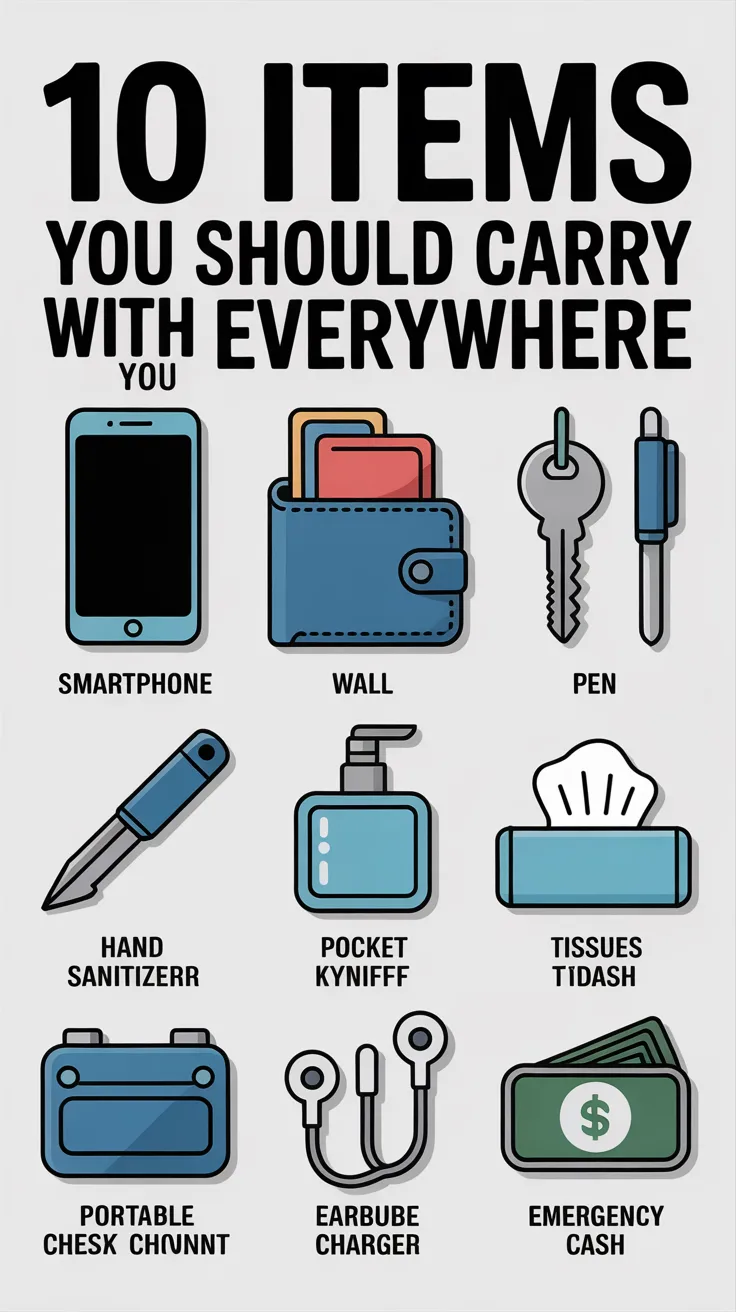
Most people don’t get caught off guard because they’re careless—they get caught off guard because everyday problems show up unannounced. A dead phone battery, a sudden downpour, a minor cut, a missed meal, a long commute home, or a delayed flight can turn a normal day into a stressful one fast. The good news is that a small, thoughtful “everyday carry” setup can prevent the majority of these hassles.
This guide covers 10 items you should carry with you everywhere, with practical options for work, travel, errands, and commuting. You’ll also learn how to build a lightweight kit that fits your lifestyle (not someone else’s fantasy “tactical” loadout), how to store items so they actually get used, and how to avoid the most common EDC mistakes.
Table of Contents
Everyday carry that actually gets used
Before we dive into the list, here’s the mindset that makes an EDC (everyday carry) kit effective:
- Solve likely problems, not rare disasters. You’re more likely to need a bandage than a fishing hook.
- Reduce friction. If it’s heavy, bulky, or complicated, you’ll stop carrying it.
- Build layers. Pocket basics + bag basics + car/desk backups.
- Rotate and refresh. Food, meds, and batteries don’t last forever.
“As many emergency-preparedness educators remind their students, ‘the best tool is the one you actually have on you when something goes wrong.’” That’s the spirit of this list.
If you’re building a deeper home readiness plan alongside your everyday kit, resources like Home Doctor can be useful as a general reference for practical, home-based medical preparedness (especially for people who want to understand what to do when professional help is delayed).
Wallet essentials and backup identification
The first “item” is your wallet setup—because it quietly determines how many emergencies remain small.
What to carry
- Primary ID (driver’s license/state ID)
- One or two payment methods (credit/debit + a backup option)
- Health insurance info (card or a secure photo)
- Emergency contact card (paper, not just in your phone)
- A small amount of cash (even $20–$60 helps)
Why this matters
Phones die. Payment systems go down. You might need to buy a train ticket with cash, prove identity, or give a bystander your emergency contact when you’re stressed.
Small upgrade that changes everything
Add a tiny paper card with:
- Name
- Emergency contact + number
- Allergies
- Medications (if critical)
- Blood type (optional, not always used clinically, but can help in chaos)
Store it behind your ID. You’ll forget it’s there—until you don’t.
Phone + reliable charging plan
Your phone is a map, flashlight, translator, payment tool, and emergency lifeline—until the battery hits 2%.
What to carry
- Phone (obviously)
- A short charging cable compatible with your phone
- A slim power bank (if you commute, travel, or work long shifts)
Why this matters
A dead phone can mean:
- No GPS
- No rideshare
- No communication
- No digital tickets
- No emergency calls if you can’t find a charger
Practical carry advice
- Keep a short cable in your bag permanently.
- If you use multiple devices, pick a cable that covers most of them.
- Charge your power bank on a schedule (e.g., every Sunday)
Problem-solution bridge: Struggling with water security during outages or long disruptions? Everyday charging is one layer, but water becomes the first real bottleneck in most emergencies. Tools like SmartWaterBox are often used as part of a broader “stored water + treatment” strategy so you’re not dependent on last-minute store runs.
Water and hydration support
Even mild dehydration affects mood, focus, and decision-making—exactly what you don’t want when something goes wrong.
What to carry
- A refillable water bottle (size depends on your routine)
- Optional: electrolyte packets (especially if you sweat a lot or do long walks)
Why this matters
This is one of the simplest forms of preparedness because it prevents everyday fatigue and reduces the chance a small issue becomes a bigger one.
Minimalist approach
If you hate carrying a bottle, create a rule:
- Always leave the house with a bottle, even if it’s small.
- Refill it whenever you pass a fountain or café.
When to go beyond daily hydration
For home and building-level water resilience, many people prefer a “store it and forget it (until needed)” approach. Aqua Tower is a relevant option to look into if you’re creating a more durable backup plan for household water storage and supply continuity.
“As one preparedness instructor notes, ‘Water is the first domino. If it falls, everything gets harder—cooking, hygiene, medical care, and morale.’”
A compact first-aid and blister kit
No need for a giant medical bag. You want a few high-value items that address the most common minor problems.
What to carry
- Adhesive bandages (a few sizes)
- Antiseptic wipes
- Gauze pad + tape (or a couple of larger bandages)
- Blister care (blister pads or moleskin)
- A pair of nitrile gloves (optional but smart)
- Any personal meds you might need (as appropriate)
Why this matters
Small cuts, scrapes, and blisters can ruin a workday or trip—and unclean wounds can become serious.
Carry tip
Use a small zip pouch and keep it in the same location. If you move it around, you’ll forget it when you need it.
💡 Recommended Solution: Home Doctor
Best for: building practical home-and-family medical readiness habits
Why it works:
- Helps you think through common scenarios and what to do
- Encourages preparation before stress and uncertainty hit
- Complements (not replaces) professional care and local emergency services
A flashlight you trust (not your phone light)
Phone flashlights are convenient—but they drain battery and can be awkward in real use.
What to carry
- A small dedicated flashlight (keychain or pocket size)
- Or a penlight if you prefer something slim
Why this matters
You’ll use it for:
- Walking through dark parking lots
- Checking under a car seat
- Finding a dropped item
- Power outages
- Navigating stairs safely
A good “rule”
If you routinely walk after dark (commute, dog, travel), a flashlight is not “extra.” It’s basic safety.
Simple operating habit
Every month:
- Turn it on for 10 seconds
- Check brightness
- Replace/charge if needed
A cutting tool and small utility edge
This is one of the most-used EDC items—opening packages, cutting tape, trimming loose threads, and handling basic tasks.
What to carry (choose based on legality and comfort)
- Small folding knife
- Keychain multitool blade
- Box cutter/utility knife (especially for work settings)
Why this matters
A safe, sharp edge saves time and prevents improvised (and risky) alternatives like tearing with teeth or grabbing random scissors.
Safety and legality note
Local laws and workplace policies vary widely. Choose the most appropriate tool for your environment, and prioritize safe handling.
A small multitool for fast fixes
A multitool expands what you can solve on the spot: a loose screw, a broken zipper pull, a bent key ring, a battery compartment, or a quick adjustment at work.
What to carry
- A compact multitool (pliers + screwdriver bits are the most useful)
- Or a minimalist keychain tool if you want ultralight
Why this matters
Most “emergencies” are small: a broken strap, a stuck latch, a loose bolt. A multitool turns those from “trip over” problems into quick fixes.
Comparison/alternative insight
While a full-size multitool is popular, a smaller tool often gets carried more consistently. For everyday life, the “best” multitool is the one you’ll still have on you in six months.
Fire and heat: lighter or ignition source
Even if you don’t smoke or camp, an ignition source is a classic “small item, big impact” tool.
What to carry
- A mini lighter
- Or a couple of strike-anywhere matches in a small waterproof sleeve (if appropriate)
Why this matters
Fire supports:
- Emergency warmth (within safety limits)
- Lighting a candle during outages
- Basic utility tasks
- Starting a stove or grill when power is out
Carry tip
Put ignition in a dedicated pocket or pouch so it doesn’t get lost at the bottom of a bag.
Food and energy backup (non-messy, stable)
Most people underestimate how quickly low blood sugar turns into bad decisions, irritability, and fatigue.
What to carry
- A protein bar or energy bar
- Nuts or trail mix pack
- Jerky
- Dried fruit
Why this matters
Unexpected delays happen:
- Late meetings
- Traffic
- Missed meals
- Travel disruptions
A small calorie buffer keeps you functional.
Problem-solution bridge: If you’re trying to build a deeper pantry strategy beyond “random cans,” resources like The Lost SuperFoods can help you think in terms of shelf-stable foods, variety, and practical storage ideas—useful for anyone who wants to be less reliant on constant grocery runs.
“As a nutrition-focused preparedness coach might put it: ‘A calm brain needs fuel. Food isn’t just comfort—it’s capability.’”
Communication + info backups (when your phone isn’t enough)
Modern life assumes constant connectivity. Preparedness means having alternatives when the assumption fails.
What to carry
- A small notebook + pen (yes, still useful)
- Important addresses/numbers written down (especially for kids or older relatives)
- Optional: a small local map if you travel frequently or work in coverage-poor areas
Why this matters
When you’re stressed, your memory gets worse. Writing things down prevents mistakes and helps you coordinate.
Simple use cases
- Leaving a note for a coworker during an outage
- Writing down license plate info after an incident
- Sharing directions when GPS fails
- Recording symptoms for a medical visit
Personal safety basics (tailored to your life)
Personal safety is contextual. The goal isn’t fear—it’s options and awareness.
What to consider carrying
- A whistle (lightweight and effective)
- A door wedge (useful for travel)
- A personal alarm (for quick attention in public spaces)
- Any lawful self-defense tool you’re trained and permitted to carry
Why this matters
Distance and attention are powerful safety tools. A whistle or alarm can create both quickly.
Training beats gear
If you carry anything for self-defense, practice using it safely and understand local laws. Your best everyday safety tools are awareness, boundaries, and a plan.
Contextual resource mention: If you’re broadening your readiness beyond EDC into urban disruption planning—routes, communication, and decision-making—**URBAN Survival Code** is a relevant educational-style resource some people use to think through city-specific risks and contingencies.
Tools & resources to strengthen your everyday carry mindset
Gear helps, but systems help more: water planning, home medical readiness, and food strategy.
- SmartWaterBox — useful for people who want a structured approach to water readiness at home
- Home Doctor — supports practical home medical preparedness thinking
- The Lost SuperFoods — helps with shelf-stable food planning ideas beyond basic snacks
While EDC covers what’s on you, these types of resources can support what’s around you—where you’ll spend most of your time.
Conclusion: build the “always with you” version of preparedness
The best everyday carry setup is invisible until it matters. If you take nothing else from this guide, remember: the 10 items you should carry with you everywhere should match your routine, your environment, and your actual needs.
Start small:
- Wallet essentials + emergency contact card
- Phone + charging plan
- Water
- Compact first-aid
Then add the rest one at a time. Over a week or two, you’ll feel the difference—less stress, more capability, and fewer “I wish I had…” moments.
Preparedness isn’t dramatic. It’s practical. And it starts with what you carry.
FAQ
What are the 10 items you should carry with you everywhere?
A practical list includes: wallet essentials, phone + charging plan, water, compact first-aid, flashlight, cutting tool, multitool, ignition source, small food backup, and communication/info backups (notebook + pen). Add personal safety items based on your environment.
How do I carry everyday items without feeling weighed down?
Use a layered approach: pocket essentials (wallet/phone/keys), a small pouch in your bag (first aid, cable, snacks), and backups at your desk or car. Focus on compact items you’ll realistically carry every day.
Is a first-aid kit really necessary for everyday carry?
Yes—because minor cuts, blisters, and scrapes are common. A small kit with bandages, antiseptic wipes, and blister care solves frequent problems and helps prevent complications.
What’s the best way to include water in everyday carry?
Carry a refillable bottle sized to your commute and refill it consistently. If carrying a bottle is inconvenient, pair smaller daily carry with a stronger home water plan so disruption doesn’t catch you off guard.
How often should I refresh or check my everyday carry kit?
Check monthly for battery levels, expired medications, and crushed/used items. Rotate snacks more frequently based on the product and your climate (heat in cars and bags can reduce shelf life).